Quick Answer
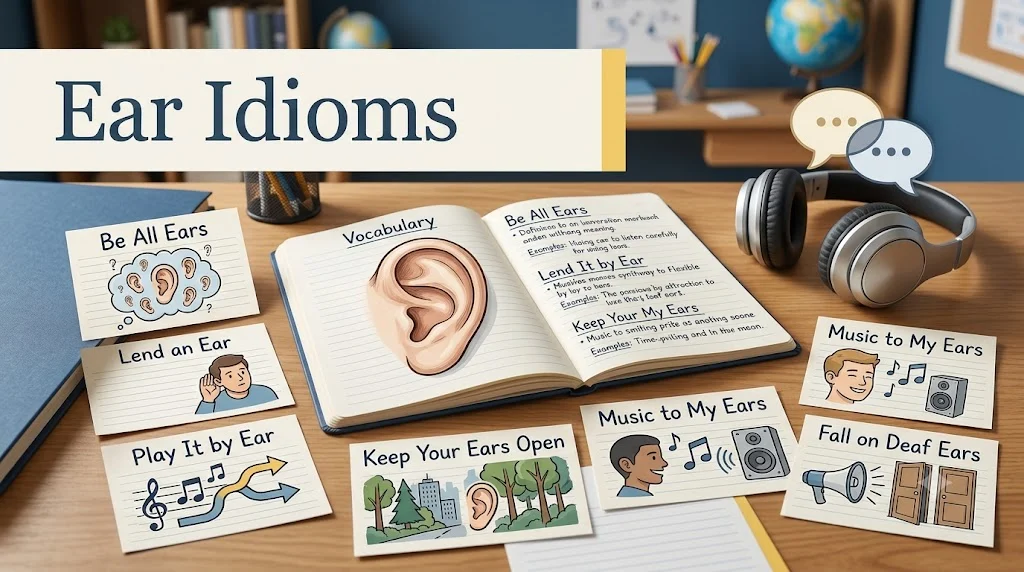
Ear idioms are colorful English expressions connected with listening, hearing, paying attention, secrets, gossip, music, warnings, and communication. Some of the most useful include lend an ear, keep an ear out, be all ears, turn a deaf ear, play it by ear, go in one ear and out the other, have an ear for something, prick up your ears, bend someone’s ear, wet behind the ears, walls have ears, keep your ears open, fall on deaf ears, music to my ears, and have someone’s ear.
We use our ears every day, but English uses the idea of the ear for much more than simply hearing sounds.
Someone can lend an ear when a friend needs to talk. You can keep an ear out for an important announcement. A surprising piece of information may make you prick up your ears, while unwanted advice might simply go in one ear and out the other.
These expressions are a great example of how idioms turn ordinary body parts into vivid communication tools. The ear becomes a symbol of attention, curiosity, secrecy, understanding, music, and even stubbornness.
For English learners, ear idioms are especially useful because many appear naturally in everyday speech.
Whether you’re studying English, writing an essay, creating a story, preparing a presentation, or simply trying to sound more natural in conversation, learning these expressions can give your vocabulary more flexibility.
The key is to learn each idiom in context not just memorize its definition.
Quick Summary of Ear Idioms
| Ear Idiom | Simple Meaning | Best Used For |
|---|---|---|
| Lend an ear | Listen carefully | Conversations and support |
| Be all ears | Be ready to listen | Casual conversation |
| Keep an ear out | Listen for something | Waiting for information |
| Keep your ears open | Stay alert and listen | Advice and warnings |
| Turn a deaf ear | Refuse to listen | Ignoring requests |
| Fall on deaf ears | Be ignored | Advice or warnings |
| Play it by ear | Decide as things happen | Flexible plans |
| Go in one ear and out the other | Be quickly forgotten | Advice and information |
| Have an ear for something | Have a natural ability to recognize sound | Music and languages |
| Prick up your ears | Become more attentive | Interesting information |
| Bend someone’s ear | Talk to someone for a long time | Complaints and conversation |
| Wet behind the ears | Inexperienced | Newcomers |
| Walls have ears | Conversations may be overheard | Warnings and secrecy |
| Music to my ears | Very pleasing news or sound | Good news |
| Have someone’s ear | Have their attention or influence | Professional settings |
| Ear to the ground | Stay alert to developments | News and trends |
| Out on your ear | Forced to leave | Informal situations |
| In one ear | Heard but not necessarily remembered | Casual conversation |
| Talk someone’s ear off | Talk for a very long time | Informal conversation |
| Have a word in someone’s ear | Give private advice | Quiet conversations |
| Put a bug in someone’s ear | Give an idea or suggestion | Informal advice |
| Make one’s ears burn | Make someone feel embarrassed or self-conscious | Social situations |
| Ring in one’s ears | Remain strongly remembered | Sounds or experiences |
| By word of mouth | Passed through spoken communication | Information sharing |
| Give someone an earful | Strongly criticize or complain | Informal conversation |
Lend an Ear
Meaning: To listen carefully or sympathetically to someone.
When someone needs to talk, you can lend an ear. The expression suggests giving someone your attention, especially when they need support.
Alternative Expression: Listen to someone
Formal Example:
“The counselor was willing to lend an ear to students who needed someone to talk to.”
Casual Example:
“Can you lend me an ear for a few minutes? I need to talk.”
Creative Example:
“When everyone else was too busy to listen, her grandmother quietly lent an ear.”
Usage Tip: This expression is often associated with empathy and patience. It works well when someone wants to share a concern or personal experience.
Be All Ears
Meaning: To be completely ready and willing to listen.
If someone says “I’m all ears,” they are telling you that they are paying attention and want to hear what you have to say.
Alternative Expression: I’m listening
Formal Example:
“Please share your suggestions; the committee is all ears.”
Casual Example:
“You said you have some exciting news? I’m all ears!”
Creative Example:
“The moment she mentioned a new opportunity, he was all ears.”
Usage Tip: This is a friendly and informal expression. It is extremely natural in everyday conversation.
Keep an Ear Out
Meaning: To listen carefully for a particular sound, person, announcement, or piece of information.
Keep an ear out suggests remaining alert without necessarily focusing exclusively on listening.
Alternative Expression: Listen out for
Formal Example:
“Please keep an ear out for any announcements regarding the schedule.”
Casual Example:
“Keep an ear out for the doorbell while I’m outside.”
Creative Example:
“She kept an ear out for the familiar sound of footsteps in the hallway.”
Usage Tip: This expression is useful when you are waiting for something specific to happen.
Keep Your Ears Open
Meaning: To remain alert and pay attention to information or opportunities.
The expression can suggest being observant, especially when you do not yet know exactly what you are going to hear.
Alternative Expression: Stay alert
Formal Example:
“Employees should keep their ears open for updates about the upcoming changes.”
Casual Example:
“Keep your ears open for any news about the concert.”
Creative Example:
“If you’re looking for an opportunity, keep your ears open; important ideas often arrive unexpectedly.”
Usage Tip: It can sound like advice or a warning, depending on context.
Turn a Deaf Ear
Meaning: To deliberately refuse to listen or pay attention.
This expression is often used when someone ignores a request, complaint, warning, or plea.
Alternative Expression: Ignore
Formal Example:
“The organization should not turn a deaf ear to concerns raised by its members.”
Casual Example:
“He turned a deaf ear to everyone’s advice.”
Creative Example:
“She asked for help repeatedly, but those in charge turned a deaf ear.”
Usage Tip: This expression usually carries a negative or critical tone.
Play It by Ear
Meaning: To deal with a situation as it develops instead of making a fixed plan in advance.
This is one of the most common ear idioms in everyday English.
Alternative Expression: Take things as they come
Formal Example:
“Because the circumstances remain uncertain, the team will play it by ear.”
Casual Example:
“We don’t have to plan everything. Let’s just play it by ear.”
Creative Example:
“They had no perfect plan for the weekend, so they decided to play it by ear.”
Usage Tip: This expression is informal and very common in spoken English.
Go in One Ear and Out the Other
Meaning: To be heard but immediately forgotten or ignored.
The image is simple: information enters one ear and immediately exits the other.
Alternative Expression: Forget immediately
Formal Example:
“Without practical application, important instructions may go in one ear and out the other.”
Casual Example:
“I told him three times, but it went in one ear and out the other.”
Creative Example:
“Her teacher’s advice went in one ear and out the other until experience taught her the same lesson.”
Usage Tip: This is informal and often slightly humorous or critical.
Have an Ear for Something
Meaning: To have a natural ability to recognize, understand, or reproduce sounds.
It is often used for music, accents, languages, rhythm, and pronunciation.
Alternative Expression: Have a natural talent for
Formal Example:
“She has an excellent ear for languages and can easily recognize subtle pronunciation differences.”
Casual Example:
“He really has an ear for music.”
Creative Example:
“With an ear for rhythm and a love of melody, she could turn ordinary sounds into something memorable.”
Usage Tip: This expression is particularly useful when talking about music and language learning.
Prick Up Your Ears
Meaning: To suddenly become more attentive because something sounds interesting, surprising, or important.
Alternative Expression: Pay close attention
Formal Example:
“Investors pricked up their ears when the company announced its new plans.”
Casual Example:
“I pricked up my ears when I heard my name.”
Creative Example:
“When the conversation shifted toward an unexpected opportunity, everyone pricked up their ears.”
Usage Tip: This expression adds a sense of sudden curiosity or attention.
Bend Someone’s Ear
Meaning: To talk to someone for a long time, often about a problem or personal concern.
The phrase can be friendly, but it can also imply that the speaker is talking at length.
Alternative Expression: Talk at length
Formal Example:
“The employee bent the manager’s ear about several concerns regarding the new schedule.”
Casual Example:
“Sorry to bend your ear, but I really need to complain about what happened.”
Creative Example:
“He sat beside his old friend and bent her ear about everything that had happened that week.”
Usage Tip: This is informal and works best in conversational English.
Wet Behind the Ears
Meaning: To be inexperienced or new to a situation.
This humorous idiom is often used to describe someone who lacks experience.
Alternative Expression: Inexperienced
Formal Example:
“Although the new employee was wet behind the ears, she learned quickly.”
Casual Example:
“I was pretty wet behind the ears when I started my first job.”
Creative Example:
“He may have been wet behind the ears, but his enthusiasm made up for his lack of experience.”
Usage Tip: It is informal and can sometimes sound teasing or patronizing, so use it carefully.
Walls Have Ears
Meaning: Other people may be listening to a private conversation.
This idiom serves as a warning to be careful about what you say.
Alternative Expression: Someone might be listening
Formal Example:
“The manager reminded the team that walls have ears when discussing confidential matters.”
Casual Example:
“Keep your voice down—walls have ears.”
Creative Example:
“She lowered her voice because she knew that walls had ears.”
Usage Tip: This expression is particularly useful in stories, mysteries, workplace conversations, and situations involving privacy.
Music to My Ears
Meaning: News or information that is extremely pleasing or welcome.
The expression compares good news to beautiful music.
Alternative Expression: Wonderful news
Formal Example:
“The announcement of additional funding was music to the research team’s ears.”
Casual Example:
“You finished your homework? That’s music to my ears!”
Creative Example:
“After weeks of uncertainty, the words she heard were music to her ears.”
Usage Tip: This is a positive and expressive phrase. It can be used seriously or humorously.
Have Someone’s Ear
Meaning: To have someone’s attention, trust, or influence.
If a person has the ear of an important individual, that individual is willing to listen to their opinions.
Alternative Expression: Have someone’s attention
Formal Example:
“The advisor has the director’s ear and often helps shape important decisions.”
Casual Example:
“If you have the manager’s ear, maybe you can suggest a better solution.”
Creative Example:
“Because she had the mayor’s ear, her concerns finally reached the people who could act on them.”
Usage Tip: This expression is particularly useful in professional, political, organizational, and leadership contexts.
Keep an Ear to the Ground
Meaning: To stay alert to new information, developments, opinions, or trends.
The image suggests listening closely to what is happening around you.
Alternative Expression: Stay informed
Formal Example:
“The company keeps an ear to the ground to understand changing customer preferences.”
Casual Example:
“I’ll keep an ear to the ground and let you know if I hear anything.”
Creative Example:
“Successful storytellers keep an ear to the ground, listening to the conversations that shape everyday life.”
Usage Tip: This is useful for business, journalism, community discussions, and situations where information may change quickly.
Out on Your Ear
Meaning: To be forced to leave a place, job, or situation.
This expression is informal and can sound humorous or dramatic.
Alternative Expression: Forced out
Formal Example:
“Employees who repeatedly violate the rules may find themselves out on their ear.”
Casual Example:
“If he keeps causing problems, he’ll be out on his ear.”
Creative Example:
“One more broken rule, and he knew he would be out on his ear.”
Usage Tip: Because of its informal and sometimes harsh tone, this expression should be used carefully.
Talk Someone’s Ear Off
Meaning: To talk to someone for a very long time.
It is often used humorously when someone talks continuously.
Alternative Expression: Talk nonstop
Formal Example:
“The speaker talked at length about the project’s history.”
Casual Example:
“My cousin talked my ear off about her new hobby.”
Creative Example:
“He could talk your ear off about old movies and never run out of stories.”
Usage Tip: This is strongly conversational and often playful rather than genuinely critical.
Have a Word in Someone’s Ear
Meaning: To speak privately to someone, often to give advice, a warning, or a suggestion.
Alternative Expression: Speak privately
Formal Example:
“The supervisor had a word in the employee’s ear about the importance of meeting deadlines.”
Casual Example:
“I need to have a word in his ear before he makes the same mistake again.”
Creative Example:
“Her mentor had a quiet word in her ear before the important meeting began.”
Usage Tip: The phrase often implies a private conversation with a specific purpose.
Put a Bug in Someone’s Ear
Meaning: To give someone an idea, suggestion, or thought that stays in their mind.
Alternative Expression: Plant an idea
Formal Example:
“The consultant put a bug in the director’s ear about expanding the program.”
Casual Example:
“I put a bug in his ear about taking a trip this summer.”
Creative Example:
“One casual suggestion put a bug in her ear, and she spent the next week thinking about it.”
Usage Tip: This is informal and often suggests that the idea may influence someone’s future decision.
Make Someone’s Ears Burn
Meaning: To make someone feel embarrassed, ashamed, or uncomfortable because people are talking about them.
Alternative Expression: Make someone feel embarrassed
Formal Example:
“The harsh criticism made the employee’s ears burn.”
Casual Example:
“I could feel my ears burning when they started talking about my mistake.”
Creative Example:
“The compliments made her smile, but the teasing afterward made her ears burn.”
Usage Tip: Context determines whether this expression refers to embarrassment, criticism, or the feeling of being talked about.
Ring in Your Ears
Meaning: For a sound, phrase, or experience to remain strongly in your memory.
The expression often suggests that something continues to be remembered vividly.
Alternative Expression: Stay in your memory
Formal Example:
“The warning continued to ring in his ears long after the meeting ended.”
Casual Example:
“Her advice is still ringing in my ears.”
Creative Example:
“Long after the concert ended, the final melody seemed to ring in her ears.”
Usage Tip: This expression can be literal or figurative, depending on the context.
By Word of Mouth
Meaning: Information that is passed from one person to another through spoken communication.
Although this expression includes mouth rather than ear, it belongs naturally with expressions about listening and communication.
Alternative Expression: Through personal recommendations
Formal Example:
“The small business grew primarily through word of mouth.”
Casual Example:
“I heard about the restaurant by word of mouth.”
Creative Example:
“The story traveled quietly from one neighbor to another by word of mouth.”
Usage Tip: This expression is especially common when discussing recommendations, rumors, local information, or communication without advertising.
Give Someone an Earful
Meaning: To speak angrily to someone or strongly criticize them.
An earful is a large amount of angry or critical speech directed at someone.
Alternative Expression: Give someone a strong reprimand
Formal Example:
“The employee received a serious reprimand after repeatedly ignoring the safety instructions.”
Casual Example:
“My mom gave me an earful when I forgot to call.”
Creative Example:
“When he finally arrived, his friends gave him an earful for disappearing without explanation.”
Usage Tip: This expression is informal and usually carries a strong emotional tone.
How to Use Ear Idioms Naturally
The easiest way to use ear idioms naturally is to connect them with the type of listening or communication they describe.
If you are waiting for specific information:
“Keep an ear out for an announcement.”
If someone refuses to listen:
“He’s turning a deaf ear to our concerns.”
The important thing is not to memorize these expressions as interchangeable synonyms. Each one describes a slightly different situation.
Common Mistakes with Ear Idioms
One common mistake is confusing turn a deaf ear with fall on deaf ears.
Turn a deaf ear means someone deliberately refuses to listen:
“She turned a deaf ear to the complaints.”
Another common mistake is using play it by ear to mean “listen carefully.” It does not mean that. It means decide what to do as the situation develops.
For example:
“We don’t know exactly when we’ll leave, so we’ll play it by ear.”
It has nothing to do with physically listening to something.
Ear Idioms vs Literal Expressions
Idioms can make communication much more vivid.
Compare:
Literal:
“I am ready to listen.”
Idiomatic:
“I’m all ears.”
The second sounds more enthusiastic and conversational.
Another example:
Literal:
“He ignored our advice.”
The idiomatic expression creates a stronger image of communication being completely ignored.
However, literal language is sometimes preferable. In instructions, scientific writing, technical documents, or situations requiring precision, direct wording can prevent confusion.
Idioms are most effective when they add meaning, personality, or emotional nuance.
Tips for Sounding More Fluent
Learn Ear Idioms by Theme
Group the expressions according to what they communicate.
Listening:
- Lend an ear
- Be all ears
- Keep an ear out
- Keep your ears open
Ignoring:
- Turn a deaf ear
- Fall on deaf ears
- Go in one ear and out the other
Attention and curiosity:
- Prick up your ears
- Keep an ear to the ground
- Have someone’s ear
Talking:
- Bend someone’s ear
- Talk someone’s ear off
- Give someone an earful
This makes the vocabulary easier to recall because every expression has a clear purpose.
Pay Attention to Formality
Some expressions are perfectly natural in conversation but may be inappropriate in formal writing.
For example:
“I’m all ears.”
is excellent in casual speech.
But in a formal report, you might write:
“The committee is prepared to consider the proposed recommendations.”
Similarly, talk someone’s ear off is playful and informal, while speak at length is more neutral.
Understanding register is an important part of using idioms correctly.
Use One Strong Idiom Instead of Several
Good writing does not require an idiom in every sentence.
Instead of writing:
“I was all ears, pricked up my ears, kept my ears open, and listened carefully.”
Choose the expression that communicates the exact idea:
“I was all ears when she explained the opportunity.”
That sounds cleaner and more natural.
Idioms for Listening and Paying Attention
If your main goal is describing attention, these expressions are particularly useful:
Be all ears | ready to listen.
Lend an ear | listen sympathetically.
Keep an ear out | listen for something specific.
Keep your ears open | remain alert.
Prick up your ears | suddenly become interested or attentive.
Keep an ear to the ground | stay informed about developments.
These expressions are similar, but the differences matter. A fluent speaker chooses between them based on the situation.
Ear Idioms for Ignoring Someone
English has several vivid expressions for situations where someone refuses to listen.
Turn a deaf ear suggests deliberate refusal.
Fall on deaf ears emphasizes that the message was ignored.
Go in one ear and out the other suggests that the information was heard but not remembered.
This means people did not take his warnings seriously.
But:
“Her instructions went in one ear and out the other.”
This suggests that someone heard the instructions but quickly forgot them.
Ear Idioms for Music and Sound
Ear-related expressions are also useful when talking about music and sound.
Have an ear for music describes natural musical ability.
Music to my ears describes something pleasant or welcome.
Ring in your ears describes a sound or phrase that remains vivid.
These expressions are especially useful for creative writing because they connect sound with emotion.
For example:
“The announcement that the project had been approved was music to the team’s ears.”
This is much more expressive than simply saying:
“The team was happy about the announcement.”
Ear Idioms for Conversations
Many ear idioms appear naturally in conversations because communication itself is often described through hearing.
You might say:
“I’m all ears. Tell me what happened.”
Or:
“Can I bend your ear for a minute?”
Or:
“Keep an ear out for my call.”
These expressions make everyday English sound more relaxed and natural.
How to Remember Ear Idioms Easily
Visual memory can make these expressions much easier to learn.
Imagine physically offering someone an ear to remember lend an ear.
Picture a person listening carefully with exaggerated attention for all ears.
Imagine information entering one ear and immediately leaving the other for go in one ear and out the other.
Picture someone suddenly becoming alert when they hear surprising news for prick up your ears.
Imagine a person standing quietly with an ear close to the ground for keep an ear to the ground.
The more ridiculous or vivid the mental image, the easier the expression can become to remember.
Using Ear Idioms in Essays and Creative Writing
Idioms can make writing more vivid, but they should match the style of the piece.
In an essay, you might write:
“The community’s concerns repeatedly fell on deaf ears, demonstrating a serious communication gap.”
This uses the idiom while keeping the sentence relatively formal.
In creative writing, you have more freedom:
“At the mention of the mysterious letter, everyone pricked up their ears.”
The idiom immediately shows the characters’ growing curiosity.
In dialogue, idioms can make characters sound more natural:
“I’m all ears,” she said. “Tell me everything.”
The expression works because real conversations often use idiomatic language.
FAQs
What does “I’m all ears” mean?
I’m all ears means that you are ready and willing to listen carefully. It is informal and common in everyday conversation.
What does “play it by ear” mean?
Play it by ear means to avoid making a fixed plan and instead decide what to do as circumstances develop.
What does “fall on deaf ears” mean?
It means that advice, warnings, requests, or complaints are ignored or not taken seriously.
What does “lend an ear” mean?
Lend an ear means to listen carefully or sympathetically, usually when someone wants to talk about a problem or concern.
What does “music to my ears” mean?
Music to my ears means that something you hear is extremely pleasing or welcome, especially good news.
Conclusion
Ear idioms show just how creative English can be. A simple body part becomes a powerful way to talk about attention, curiosity, communication, secrets, music, experience, and even stubbornness.
Expressions such as be all ears, lend an ear, keep an ear out, play it by ear, prick up your ears, fall on deaf ears, and music to my ears can make everyday English more expressive without making it complicated.
The best way to learn these ear idioms is to connect each expression with a realistic situation. Imagine a friend asking you to listen, a colleague ignoring advice, a musician recognizing a melody, or someone waiting for important news. Once the situation is familiar, the expression becomes much easier to remember.
You do not need to use idioms constantly to sound fluent. Choose the one that fits the moment, understand its tone, and let it do its job.
When used naturally, a well-chosen idiom can turn ordinary English into language that feels more vivid, conversational, and memorable.
Discover More Related Articles:
- Idioms for Marriage | Describe Love, Relationships & Commitment In 2026
- Idioms for Making Things Better | Improving Situations & Moving Forward In 2026