Quick Answer
An idiom is a phrase or group of words that has a special meaning different from the exact meaning of the individual words. For example, “It’s raining cats and dogs” does not mean animals are falling from the sky. It means it is raining very heavily.
Have you ever heard someone say, “That test was a piece of cake” and wondered why they were talking about dessert during school?
That is the fun of idioms!
Idioms are expressions that have a meaning different from the literal meaning of their words. They appear everywhere in children’s books, cartoons, classroom conversations, movies, stories, and even everyday chats with family and friends.
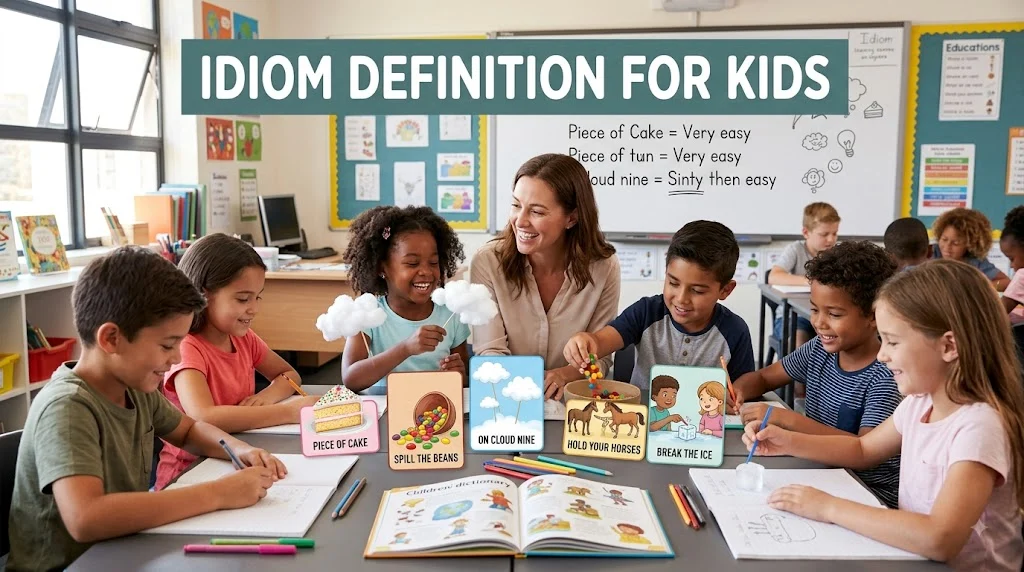
Learning idioms can make English easier to understand and much more interesting. Instead of saying “I am very happy,” someone might say, “I’m on cloud nine.” Instead of saying “Wait,” they might say, “Hold your horses!”
For kids learning English, idioms can seem confusing at first because the words do not always mean exactly what they appear to mean. Once you learn the hidden meaning, though, they become much easier and often quite funny.
This guide explains what idioms are, how they work, and how kids can recognize and use them naturally.
Quick Summary: Idiom Definition for Kids
| Idiom | Simple Meaning | Example |
|---|---|---|
| Break the ice | Make people feel comfortable | Mia told a joke to break the ice. |
| Piece of cake | Something very easy | The homework was a piece of cake. |
| Spill the beans | Tell a secret | Ben spilled the beans about the surprise. |
| Hit the books | Start studying | I need to hit the books tonight. |
| Under the weather | Feeling sick | Sam is under the weather today. |
| Let the cat out of the bag | Reveal a secret | Lily let the cat out of the bag. |
| Cool as a cucumber | Very calm | Dad stayed cool as a cucumber. |
| A busy bee | Someone who is very busy | My sister is a busy bee today. |
| Hold your horses | Wait or slow down | Hold your horses! We’re not ready yet. |
| Cost an arm and a leg | Very expensive | That toy costs an arm and a leg. |
| Once in a blue moon | Very rarely | We eat at that restaurant once in a blue moon. |
| When pigs fly | Something unlikely to happen | He’ll clean his room when pigs fly! |
| On cloud nine | Very happy | Sara was on cloud nine after winning. |
| Keep an eye on | Watch carefully | Please keep an eye on my backpack. |
| In hot water | In trouble | Jake was in hot water after breaking the window. |
What Is an Idiom?
An idiom is a common expression whose overall meaning is different from the literal meaning of its words.
Here is a simple example:
“Break the ice.”
If you hear this phrase for the first time, you might imagine someone breaking a frozen lake.
But “break the ice” usually means to help people feel more comfortable when they first meet or when a situation feels awkward.
For example:
Mia told a funny joke to break the ice at the new club.
Nobody actually broke any ice. The phrase has a special meaning.
That special meaning is what makes it an idiom.
Idiom Definition for Kids in Simple Words
If you need an easy definition for school, you can remember this:
An idiom is a phrase that means something different from what the words literally say.
For example:
“It’s raining cats and dogs.”
Literal meaning: Cats and dogs are falling from the sky.
Idiom meaning: It is raining very heavily.
Another example:
“I’m feeling under the weather.”
Literal meaning: Someone is physically underneath the weather.
Idiom meaning: Someone is feeling sick or unwell.
The important thing is to look for the intended meaning, not just the individual words.
Why Do We Use Idioms?
Idioms make language more interesting.
Imagine a story that always says:
Tom was very happy.
Then:
Tom was very happy again.
And:
Tom was very happy when he received the gift.
The sentences are understandable, but they are not very colorful.
Now imagine:
Tom was on cloud nine when he opened the gift.
That sentence creates a stronger picture.
Idioms can help speakers and writers:
- Make language more interesting
- Express feelings creatively
- Make stories more memorable
- Sound more natural in conversation
- Describe situations in a fun way
- Understand books, movies, and conversations more easily
For kids, idioms are also a great way to build vocabulary and discover how flexible language can be.
Break the Ice
Meaning:
To make people feel more comfortable when they first meet or when a situation feels awkward.
Kid-Friendly Example:
Liam told a funny joke to break the ice when he joined the new class.
Simple Idea:
You are not really breaking ice. You are helping people relax and start talking.
Piece of Cake
Meaning:
Something that is very easy.
Kid-Friendly Example:
The math question was a piece of cake for Emma.
Simple Idea:
The task was as easy as enjoying a piece of cake.
Spill the Beans
Meaning:
To accidentally or intentionally reveal a secret.
Kid-Friendly Example:
Noah spilled the beans about the surprise birthday party.
Simple Idea:
Nobody is actually spilling beans. The phrase means telling a secret.
Hit the Books
Meaning:
To start studying.
Kid-Friendly Example:
I have a test tomorrow, so I need to hit the books tonight.
Simple Idea:
You are not hitting books. You are getting serious about studying.
Under the Weather
Meaning:
To feel sick or unwell.
Kid-Friendly Example:
Ava stayed home because she was feeling under the weather.
Simple Idea:
The weather is not actually making someone sick. The expression means they do not feel well.
Let the Cat Out of the Bag
Meaning:
To reveal a secret.
Kid-Friendly Example:
Jack let the cat out of the bag and told his sister about the surprise.
Simple Idea:
There is no real cat involved. The phrase means to give away a secret.
Cool as a Cucumber
Meaning:
To remain very calm.
Kid-Friendly Example:
Even when everyone was nervous before the competition, Maya was cool as a cucumber.
Simple Idea:
The person is not actually a cucumber. The expression describes someone who stays calm.
A Busy Bee
Meaning:
A person who is very active or busy.
Kid-Friendly Example:
My mom has been a busy bee cleaning the house all morning.
Simple Idea:
The person is being compared to a busy little bee.
Hold Your Horses
Meaning:
Wait or slow down.
Kid-Friendly Example:
“Hold your horses! We need to put on our shoes first.”
Simple Idea:
Nobody needs to hold actual horses. It means wait a moment.
Cost an Arm and a Leg
Meaning:
Something is extremely expensive.
Kid-Friendly Example:
That giant video game machine costs an arm and a leg.
Simple Idea:
It does not mean you have to give away your body parts. It means something costs a lot of money.
Once in a Blue Moon
Meaning:
Something that happens very rarely.
Kid-Friendly Example:
We only visit that amusement park once in a blue moon.
Simple Idea:
It means something does not happen very often.
When Pigs Fly
Meaning:
Something is very unlikely to happen.
Kid-Friendly Example:
Ben said he would clean his room when pigs fly.
Simple Idea:
Pigs cannot normally fly, so this funny phrase means probably never or very unlikely.
On Cloud Nine
Meaning:
To be extremely happy.
Kid-Friendly Example:
Ella was on cloud nine after winning the school art competition.
Simple Idea:
The person is not actually sitting on a cloud. They are feeling very happy.
Keep an Eye On
Meaning:
To watch or look after something carefully.
Kid-Friendly Example:
Please keep an eye on my backpack while I get some water.
Simple Idea:
It means watch something carefully, not literally put an eye on it.
In Hot Water
Meaning:
To be in trouble.
Kid-Friendly Example:
Jake was in hot water after forgetting his homework again.
Simple Idea:
Nobody is actually sitting in hot water. The phrase means someone is facing trouble.
A Piece of the Pie
Meaning:
A share of something valuable, successful, or beneficial.
Kid-Friendly Example:
Everyone wanted a piece of the pie after the team won the prize.
Simple Idea:
The “pie” represents something that people want to share.
The Ball Is in Your Court
Meaning:
It is now your turn to make a decision or take action.
Kid-Friendly Example:
I gave you the information, so now the ball is in your court.
Simple Idea:
It comes from sports. The other person now has the responsibility to respond.
A Drop in the Bucket
Meaning:
A very small amount compared with what is needed.
Kid-Friendly Example:
One bottle of water is just a drop in the bucket for the whole team.
Simple Idea:
Imagine dropping one tiny drop into a huge bucket. It would make very little difference.
Go the Extra Mile
Meaning:
To make an extra effort to help or achieve something.
Kid-Friendly Example:
Our teacher went the extra mile to help us understand the difficult lesson.
Simple Idea:
It means doing more than what is normally expected.
Practice Makes Perfect
Meaning:
The more you practice something, the better you can become at it.
Kid-Friendly Example:
Keep practicing your piano song. Practice makes perfect!
Simple Idea:
Skills improve when you practice regularly.
A Fish Out of Water
Meaning:
To feel uncomfortable or unfamiliar in a new situation.
Kid-Friendly Example:
I felt like a fish out of water on my first day at the new school.
Simple Idea:
A fish belongs in water, so being outside it represents feeling like you do not belong somewhere.
Bite the Bullet
Meaning:
To face something difficult or unpleasant with courage.
Kid-Friendly Example:
I didn’t want to clean my messy room, but I decided to bite the bullet and get started.
Simple Idea:
It means face a difficult task instead of avoiding it.
A Storm in a Teacup
Meaning:
A big argument or worry about something that is actually quite small.
Kid-Friendly Example:
Their argument over who got the blue pencil was just a storm in a teacup.
Simple Idea:
The problem seems much bigger than it really is.
See Eye to Eye
Meaning:
To agree with someone.
Kid-Friendly Example:
My brother and I don’t always see eye to eye about which movie to watch.
Simple Idea:
If two people “see eye to eye,” they have the same opinion.
How Can Kids Recognize an Idiom?
One helpful trick is to ask:
“Does this sentence make sense if I take the words literally?”
For example:
“I have butterflies in my stomach.”
If you imagine actual butterflies flying around inside someone’s stomach, the sentence sounds strange.
That is a clue that the phrase may be an idiom.
The real meaning is that the person feels nervous or excited.
Another clue is when the literal meaning seems impossible or unusual.
For example:
“It’s raining cats and dogs.”
Cats and dogs do not normally fall from the sky. So the sentence is probably using figurative language.
Literal Meaning vs Idiom Meaning
Understanding the difference between literal and figurative meanings is one of the most important steps in learning idioms.
| Phrase | Literal Meaning | Idiom Meaning |
|---|---|---|
| Break the ice | Break frozen water | Make people comfortable |
| Spill the beans | Drop beans | Reveal a secret |
| Hit the books | Hit books | Study |
| Under the weather | Be beneath weather | Feel sick |
| On cloud nine | Sit on a cloud | Feel very happy |
| Hold your horses | Hold horses | Wait |
| Piece of cake | A piece of dessert | Something easy |
This comparison can make idioms much easier for children to understand.
How to Teach Idioms to Kids
The best way to teach idioms is to make them visual and memorable.
Instead of giving children a long list of definitions, start with a funny picture.
For “spill the beans,” imagine someone accidentally tipping a bowl of beans onto the floor while revealing a secret.
For “on cloud nine,” imagine someone happily sitting on a fluffy cloud.
Funny mental pictures help children remember meanings much longer.
Stories, cartoons, classroom games, matching activities, and short conversations can also make idioms easier to learn.
How Kids Can Use Idioms in Writing
Idioms can make children’s stories more colorful, but they should be used naturally.
Instead of writing:
Sarah was very happy when she won the race.
A child might write:
Sarah was on cloud nine when she won the race.
Or instead of:
Everyone became comfortable after the teacher told a joke.
A child could write:
The teacher told a joke to break the ice.
The idiom adds personality without making the sentence difficult to understand.
Common Mistakes Kids Make With Idioms
Taking idioms literally
A child may think “break a leg” means someone should actually break a leg. In many contexts, however, the phrase is used to wish someone good luck.
Using an idiom without understanding it
It is better to know exactly what an expression means before using it in a story or conversation.
Using too many idioms
A paragraph filled with idioms can become confusing. One or two well-chosen expressions can be more effective.
Forgetting the situation
Some idioms are casual, while others are more appropriate for formal writing. Kids should learn that context matters.
Changing the words too much
Idioms are usually fixed expressions. Changing their wording can make them sound unnatural or change their meaning.
Fun Ways to Practice Idioms
Learning idioms does not have to feel like memorizing a dictionary.
Try these activities:
Idiom Drawing:
Choose an idiom and draw its literal meaning. Then write its real meaning underneath.
Idiom Matching:
Match phrases such as “piece of cake” with meanings such as “very easy.”
Idiom Detective:
Look for idioms while reading a children’s book and explain what each one means.
These activities help children understand that idioms are part of real communication rather than just vocabulary words to memorize.
Why Learning Idioms Helps Kids
Idioms help children understand language beyond individual words.
When children recognize common expressions, they can understand conversations more easily and enjoy stories without stopping every few sentences to wonder what a phrase means.
Idioms also encourage children to think creatively. They learn that language can describe emotions and situations in imaginative ways.
For students learning English as an additional language, this is especially helpful. Knowing common idioms can make everyday conversations, books, videos, and classroom discussions easier to follow.
Most importantly, idioms show kids that language can be playful. A phrase like “when pigs fly” is not just vocabulary it is a tiny piece of humor built into everyday speech.
FAQs
What is an idiom in simple words for kids?
An idiom is a phrase that has a special meaning different from the literal meaning of its words. For example, “piece of cake” means something is very easy.
What is an easy example of an idiom?
“It’s raining cats and dogs” is a popular example. It means that it is raining very heavily, not that cats and dogs are falling from the sky.
Why do people use idioms?
People use idioms to make communication more interesting, colorful, expressive, and sometimes humorous.
How can kids learn idioms easily?
Kids can learn idioms through stories, pictures, games, conversations, cartoons, and examples. Connecting each idiom with a memorable image can make it easier to remember.
Are idioms important for kids to learn?
Yes. Learning common idioms can help children understand conversations, books, movies, classroom activities, and everyday English more easily.
Conclusion
An idiom may look like an ordinary group of words, but it often carries a much bigger meaning. For kids, understanding this hidden meaning is an exciting step toward becoming stronger readers, writers, speakers, and listeners.
Expressions such as “piece of cake,” “break the ice,” “spill the beans,” “on cloud nine,” and “hold your horses” show how creative English can be.
The easiest way to learn idioms is not to memorize huge lists. Start with a few familiar expressions, learn what they mean, notice them in real conversations and stories, and then try using them yourself.
Once kids understand that idioms are not meant to be taken literally, these colorful expressions become much less confusing and a lot more fun.
Learning idioms is really about learning how people use language creatively. And once that skill starts to develop, ordinary sentences can become much more expressive, memorable, and fun to read.
Discover More Related Articles: