Quick Answer
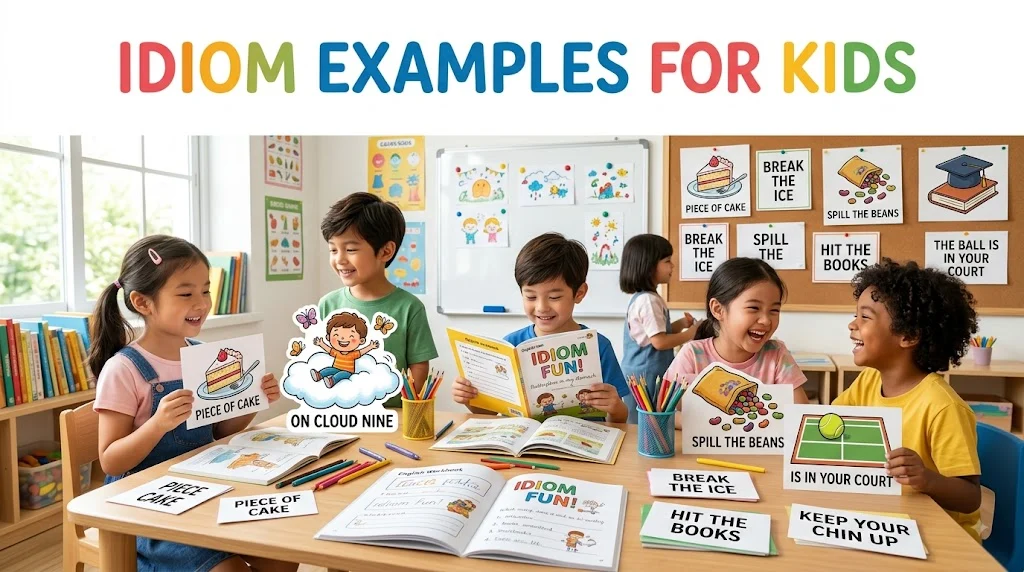
Idiom examples for kids are simple expressions whose meaning is different from the literal meaning of the individual words. For example, “spill the beans” does not mean dropping beans on the floor it means to tell a secret. Similarly, “piece of cake” means something is very easy, while “break the ice” means to help people feel more comfortable when they first meet.
Have you ever heard someone say, “That test was a piece of cake,” and wondered why they were suddenly talking about dessert?
That is the fun of idioms!
An idiom is an expression that has a special meaning that is different from the literal meaning of its words. Children hear idioms in conversations, books, cartoons, movies, classrooms, and even at home. Learning what these expressions mean can make English much easier to understand.
Imagine a teacher saying, “Keep an eye on your homework.” The teacher is not asking students to place an actual eye on their notebooks. The expression means to watch or pay attention to something.
For kids, idioms are especially useful because they turn vocabulary learning into something visual and memorable. A child can imagine a cat having nine lives, a piece of cake being easy, or someone breaking the ice.
Below are 25 fun idiom examples for kids, explained in simple language with examples that children can understand and use.
Quick Summary of Idiom Examples for Kids
| Idiom | Meaning | Example |
|---|---|---|
| Piece of cake | Very easy | The test was a piece of cake. |
| Break the ice | Feel comfortable | The game helped break the ice. |
| Spill the beans | Tell a secret | Who spilled the beans? |
| Hit the books | Start studying | I need to hit the books. |
| Under the weather | Feeling unwell | I am under the weather. |
Piece of Cake
Meaning: Something that is very easy to do.
This is one of the easiest idioms for children to learn because kids can easily picture a delicious piece of cake.
When Kids Use It:
Children can use this expression when talking about homework, games, puzzles, chores, sports, or anything that feels easy.
Alternative Expression: Easy as pie
Formal Example:
“The science activity was simple enough that the students thought it was a piece of cake.”
Casual Example:
“That math question was a piece of cake!”
Creative Example:
“After practicing the puzzle all week, solving it was a piece of cake.”
Kid-Friendly Tip: Remember: the idiom is about something being easy, not about eating cake.
Break the Ice
Meaning: To make people feel more comfortable when they first meet or when a situation feels awkward.
When Kids Use It:
This idiom is useful at school, camps, parties, clubs, or anywhere children meet new people.
Alternative Expression: Start a friendly conversation
Formal Example:
“The teacher played a fun game to break the ice on the first day of school.”
Casual Example:
“We played a guessing game to break the ice.”
Creative Example:
“A silly joke helped break the ice, and soon everyone was laughing together.”
Kid-Friendly Tip: No real ice needs to be broken! Think of it as breaking the awkward feeling between people.
Spill the Beans
Meaning: To reveal a secret or give away information that was supposed to stay secret.
When Kids Use It:
Kids may hear this expression when friends are planning a surprise party, gift, game, or special event.
Alternative Expression: Tell the secret
Formal Example:
“The students were asked not to spill the beans about the surprise.”
Casual Example:
“Come on, spill the beans! What happened?”
Creative Example:
“Ben tried to keep the surprise secret, but his excited smile almost spilled the beans.”
Kid-Friendly Tip: Imagine someone accidentally spilling a bowl of beans. Once they are on the floor, it is hard to hide them—just like a secret that has been told.
Hit the Books
Meaning: To start studying seriously.
When Kids Use It:
This is a common expression for students preparing for tests, exams, or homework.
Alternative Expression: Study hard
Formal Example:
“The students needed to hit the books before their final examination.”
Casual Example:
“I have a test tomorrow, so I need to hit the books.”
Creative Example:
“After dinner, Maya hit the books and worked through her science notes.”
Kid-Friendly Tip: You are not hitting books! You are simply getting ready to study.
Under the Weather
Meaning: To feel sick or unwell.
When Kids Use It:
Children can use this expression when they are not feeling their best and need rest.
Alternative Expression: Feeling sick
Formal Example:
“Daniel stayed home from school because he was under the weather.”
Casual Example:
“I can’t play today. I’m feeling a little under the weather.”
Creative Example:
“Sam was under the weather, so his family made him a cozy place to rest.”
Kid-Friendly Tip: Picture a gray cloud hanging over someone. That image can help you remember that the person is not feeling well.
Once in a Blue Moon
Meaning: Something that happens very rarely.
When Kids Use It:
This expression is useful when describing something that almost never happens.
Alternative Expression: Very rarely
Formal Example:
“The class goes on an outdoor adventure only once in a blue moon.”
Casual Example:
“We eat ice cream for breakfast once in a blue moon.”
Creative Example:
“Once in a blue moon, Dad lets us stay up late to watch a movie.”
Kid-Friendly Tip: Imagine seeing a strange blue moon in the sky. It is unusual, just like something that happens very rarely.
Cost an Arm and a Leg
Meaning: To be very expensive.
When Kids Use It:
Children may hear adults use this expression when talking about expensive toys, games, vacations, or other things.
Alternative Expression: Very expensive
Formal Example:
“The new equipment cost an arm and a leg.”
Casual Example:
“That video game costs an arm and a leg!”
Creative Example:
“The giant remote-control car looked amazing, but it cost an arm and a leg.”
Kid-Friendly Tip: Nobody is actually losing an arm or leg. It simply means something costs a lot of money.
Raining Cats and Dogs
Meaning: Raining very heavily.
When Kids Use It:
This is a fun expression children often encounter in stories and conversations about weather.
Alternative Expression: Pouring with rain
Formal Example:
“The outdoor sports event was canceled because it was raining heavily.”
Casual Example:
“Grab your umbrella! It’s raining cats and dogs!”
Creative Example:
“It was raining cats and dogs, so the children turned their living room into an indoor playground.”
Kid-Friendly Tip: Look outside during heavy rain and imagine cats and dogs falling from the sky. It is silly, but that is what makes the idiom memorable!
Let the Cat Out of the Bag
Meaning: To accidentally reveal a secret.
When Kids Use It:
This idiom is useful when someone accidentally tells information that was supposed to remain hidden.
Alternative Expression: Give away the secret
Formal Example:
“Liam let the cat out of the bag when he mentioned the surprise party.”
Casual Example:
“Oops! I let the cat out of the bag.”
Creative Example:
“Ella tried to stay quiet, but one excited sentence let the cat out of the bag.”
Kid-Friendly Tip: There is no real cat. The “cat” represents a secret that has escaped.
On Cloud Nine
Meaning: Extremely happy.
When Kids Use It:
Children can use this idiom after winning a competition, receiving good news, celebrating a birthday, or enjoying a special achievement.
Alternative Expression: Very happy
Formal Example:
“The students were on cloud nine after receiving their awards.”
Casual Example:
“I was on cloud nine when I found out I won!”
Creative Example:
“After scoring the winning goal, Leo was on cloud nine all afternoon.”
Kid-Friendly Tip: Imagine being so happy that you are floating high above the clouds.
Hold Your Horses
Meaning: Wait or slow down.
When Kids Use It:
This playful expression can be used when someone is moving too quickly or becoming too excited.
Alternative Expression: Wait a minute
Formal Example:
“The teacher told the excited students to hold their horses while she explained the rules.”
Casual Example:
“Hold your horses! We haven’t opened the presents yet.”
Creative Example:
“‘Hold your horses!’ shouted Mia as her brother raced toward the door.”
Kid-Friendly Tip: Imagine someone trying to stop a team of running horses. It means slow down and wait.
Keep an Eye On
Meaning: To watch or look after something carefully.
When Kids Use It:
This expression is helpful when asking someone to watch a pet, backpack, toy, younger sibling, or classroom item.
Alternative Expression: Watch
Formal Example:
“The teacher asked the students to keep an eye on their belongings.”
Casual Example:
“Can you keep an eye on my backpack?”
Creative Example:
“Dad asked me to keep an eye on the cookies while he answered the phone.”
Kid-Friendly Tip: You do not need to put your eye anywhere! It simply means watch carefully.
In Hot Water
Meaning: To be in trouble.
When Kids Use It:
Children may hear this expression after someone breaks a rule, forgets an important responsibility, or causes a problem.
Alternative Expression: In trouble
Formal Example:
“The student was in hot water after repeatedly ignoring the classroom rules.”
Casual Example:
“I think I’m in hot water for forgetting my homework.”
Creative Example:
“Jake knew he was in hot water when he realized he had accidentally deleted the class project.”
Kid-Friendly Tip: Imagine standing in very hot water. It would be uncomfortable—just like being in trouble!
A Piece of the Pie
Meaning: A share or portion of something.
When Kids Use It:
This expression can be used when talking about sharing prizes, responsibilities, opportunities, or rewards.
Alternative Expression: A share
Formal Example:
“Each team member received a piece of the pie after the project was completed.”
Casual Example:
“Everyone wants a piece of the pie!”
Creative Example:
“After the big project succeeded, every student felt proud to have a piece of the pie.”
Kid-Friendly Tip: Think about cutting a real pie into slices. Each person gets a share.
Butterflies in My Stomach
Meaning: A nervous or excited feeling in your stomach.
When Kids Use It:
This is perfect for situations such as giving a presentation, performing on stage, taking a test, or joining a new group.
Alternative Expression: Feel nervous
Formal Example:
“The student had butterflies in her stomach before presenting her project.”
Casual Example:
“I have butterflies in my stomach before the school play.”
Creative Example:
“Just before the curtain opened, Noah felt butterflies in his stomach.”
Kid-Friendly Tip: Nobody actually has butterflies inside their stomach. The phrase describes that fluttery feeling caused by nervousness or excitement.
Go the Extra Mile
Meaning: To make more effort than expected.
When Kids Use It:
Children can use this expression when someone works especially hard to help another person or complete a task.
Alternative Expression: Try extra hard
Formal Example:
“The student went the extra mile to help organize the school fundraiser.”
Casual Example:
“She went the extra mile to help me finish my project.”
Creative Example:
“Instead of simply sharing his notes, Ben went the extra mile and explained the difficult questions.”
Kid-Friendly Tip: Imagine someone walking one extra mile after already finishing a long journey. It represents extra effort.
Practice Makes Perfect
Meaning: Practicing something repeatedly helps you improve.
When Kids Use It:
This is especially useful for sports, music, spelling, handwriting, mathematics, reading, and other skills.
Alternative Expression: Keep practicing
Formal Example:
“The teacher reminded the class that practice makes perfect.”
Casual Example:
“My first drawing looked funny, but practice makes perfect!”
Creative Example:
“Every time Emma practiced the piano, she made fewer mistakes. Practice makes perfect.”
Kid-Friendly Tip: You do not need to become perfect immediately. The important idea is that practice helps you get better.
The Ball Is in Your Court
Meaning: It is now your turn to make a decision or take action.
When Kids Use It:
This idiom can be useful when friends are deciding what to do next or when a person needs to make a choice.
Alternative Expression: It’s your turn
Formal Example:
“The teacher gave the students several options and explained that the ball was in their court.”
Casual Example:
“I’ve given you the choices, so the ball is in your court.”
Creative Example:
“After hearing everyone’s ideas, the final decision was in Maya’s hands—the ball was in her court.”
Kid-Friendly Tip: Think about a tennis game. When the ball comes to your side, it is your turn to respond.
Barking Up the Wrong Tree
Meaning: Looking in the wrong place or blaming the wrong person.
When Kids Use It:
This expression is useful in mystery stories, games, classroom discussions, and situations involving a misunderstanding.
Alternative Expression: Looking in the wrong place
Formal Example:
“The detective realized he was barking up the wrong tree after discovering new evidence.”
Casual Example:
“If you’re looking for your pencil here, you’re barking up the wrong tree.”
Creative Example:
“Sam blamed the dog for the missing sandwich, but he was barking up the wrong tree—the sandwich was in his backpack.”
Kid-Friendly Tip: Imagine a dog barking loudly at a tree where the squirrel is not even hiding. That is barking up the wrong tree.
Keep Your Chin Up
Meaning: Stay positive and do not give up when something is difficult.
When Kids Use It:
This expression is helpful when encouraging a friend after a disappointing test, lost game, mistake, or other setback.
Alternative Expression: Stay positive
Formal Example:
“The coach encouraged the team to keep their chins up after the disappointing result.”
Casual Example:
“Keep your chin up! You can try again tomorrow.”
Creative Example:
“Although she did not win the contest, her teacher told her to keep her chin up and continue practicing.”
Kid-Friendly Tip: Picture someone literally lifting their chin and standing confidently. It represents staying hopeful.
A Breath of Fresh Air
Meaning: Something new, refreshing, pleasant, or different from what came before.
When Kids Use It:
Children can use this expression when a new teacher, game, activity, idea, or change makes things feel exciting.
Alternative Expression: Something refreshing and new
Formal Example:
“The new activity was a breath of fresh air for the students.”
Casual Example:
“This new game is a breath of fresh air!”
Creative Example:
“After weeks of the same routine, the outdoor art class was a breath of fresh air.”
Kid-Friendly Tip: Imagine opening a window and taking a deep breath of cool, clean air. The idiom means something feels fresh and enjoyable.
See Eye to Eye
Meaning: To agree with someone.
When Kids Use It:
This idiom is useful when talking about friends, classmates, siblings, teammates, or family members who agree about an idea.
Alternative Expression: Agree
Formal Example:
“The two students saw eye to eye about how to organize the project.”
Casual Example:
“My sister and I don’t always see eye to eye.”
Creative Example:
“They had different favorite colors, but they saw eye to eye about how much fun the game was.”
Kid-Friendly Tip: Imagine two people looking directly in the same direction. They agree about something.
A Storm in a Teacup
Meaning: A lot of anger, excitement, or worry about a small problem.
When Kids Use It:
This expression can help children understand that some disagreements seem much bigger than they really are.
Alternative Expression: A fuss over something small
Formal Example:
“The disagreement turned out to be nothing more than a storm in a teacup.”
Casual Example:
“Don’t worry about their argument. It’s just a storm in a teacup.”
Creative Example:
“The two friends argued over which game to play, but their huge disagreement was really just a storm in a teacup.”
Kid-Friendly Tip: Imagine trying to fit a huge storm inside a tiny teacup. It sounds dramatic, but the problem is actually small.
Zip Your Lips
Meaning: Be quiet or keep a secret.
When Kids Use It:
This playful expression is common among children, friends, and families.
Alternative Expression: Keep it a secret
Formal Example:
“The teacher asked the students to keep the surprise a secret.”
Casual Example:
“Zip your lips! It’s supposed to be a surprise.”
Creative Example:
“‘Zip your lips,’ whispered Ava with a smile, ‘or you’ll ruin the surprise.’”
Kid-Friendly Tip: Imagine a zipper closing across your mouth. It simply means do not tell.
Have a Sweet Tooth
Meaning: To really enjoy sweet foods.
When Kids Use It:
This is an easy and fun idiom for conversations about desserts, candy, cakes, and other sweet treats.
Alternative Expression: Love sweets
Formal Example:
“Children with a sweet tooth may especially enjoy the dessert table.”
Casual Example:
“My brother definitely has a sweet tooth.”
Creative Example:
“Lena had such a sweet tooth that the sight of a cupcake could make her smile instantly.”
Kid-Friendly Tip: You do not actually have a sweet tooth. The expression means you really like sweet foods.
How to Teach Idioms to Kids
Children usually remember language better when they can connect it to a picture, story, game, or real situation.
Instead of simply telling a child:
“Piece of cake means easy.”
Create a tiny story:
“Ali finished his puzzle in five minutes. He smiled and said, ‘That was a piece of cake!’”
Now the child can connect the idiom with an actual situation.
Visual learning is especially helpful. Draw a piece of cake beside the word easy. Draw a tennis court beside the ball is in your court.
The sillier the mental picture, the easier the expression can be to remember.
Common Mistakes Kids Make with Idioms
One common mistake is taking an idiom literally.
If a child hears:
“It’s raining cats and dogs.”
They might imagine animals falling from the sky.
That is actually a useful first reaction because it creates curiosity. Explain that idioms often have a figurative meaning, which is the meaning people really intend.
Another common mistake is using an idiom in the wrong situation.
For example, under the weather means feeling unwell. It would not normally be used simply because someone is standing outside in the rain.
Incorrect idea:
“I am under the weather because it is raining.”
Correct idea:
“I stayed home because I was under the weather.”
Learning the situation behind an idiom is just as important as learning its definition.
Literal Meaning vs Idiomatic Meaning
Understanding the difference between literal and figurative language is one of the most important parts of learning idioms.
Consider:
“Hit the books.”
Literal meaning: Physically hit books.
Idiomatic meaning: Start studying.
Or:
“Break the ice.”
Literal meaning: Crack frozen water.
Idiomatic meaning: Make people feel comfortable.
Or:
“On cloud nine.”
Literal meaning: Sitting on a cloud.
Idiomatic meaning: Feeling extremely happy.
This difference is what makes idioms interesting. They encourage children to think beyond the individual words and understand the meaning of the whole expression.
How Idioms Help Kids Learn English
Idioms can strengthen several language skills at once.
They help children:
- Build vocabulary
- Understand figurative language
- Improve reading comprehension
- Become more comfortable with everyday English
- Make writing more interesting
- Understand conversations more easily
- Recognize expressions in stories and books
- Develop creative thinking
A child who understands “keep your chin up” is more likely to understand it when it appears in a story, even if the author does not explain it.
That is one of the biggest benefits of learning idioms: children begin recognizing language patterns naturally.
Fun Ways to Practice Idioms
Draw the Idiom
Ask children to draw the literal meaning of an idiom.
For raining cats and dogs, they might draw cats and dogs falling from the sky.
Then ask them to write the real meaning:
“It is raining very heavily.”
The contrast between the funny drawing and the real meaning helps make the idiom memorable.
Act It Out
Children can act out expressions such as:
- Hold your horses
- Hit the books
- Keep your chin up
- Break the ice
- Zip your lips
The goal is not to act out the literal meaning perfectly. It is to help children remember the expression and discuss what it really means.
Make an Idiom Matching Game
Create two sets of cards.
One set contains idioms:
Piece of cake
Spill the beans
On cloud nine
Hit the books
The second set contains meanings:
Very happy
Very easy
Tell a secret
Start studying
Children match each idiom with its meaning.
Use Idioms in Short Stories
Give a child three idioms and ask them to create a short story using all three.
For example:
On cloud nine
Hit the books
Piece of cake
A child might write:
“Mia was on cloud nine because she had finished her project. She hit the books for her next test, but the homework was a piece of cake.”
This combines vocabulary practice with creative writing.
Tips for Parents and Teachers
The most effective approach is to introduce idioms gradually.
Choose three to five expressions at a time rather than presenting a huge list all at once. Repeat them naturally during the week.
For example, if children are learning piece of cake, use it during an easy classroom activity:
“This exercise was a piece of cake!”
Later, ask:
“What does ‘piece of cake’ mean?”
Repetition in different situations helps children understand that idioms are flexible expressions rather than phrases they need to memorize word for word.
It is also helpful to explain when an idiom is casual. Children should learn that zip your lips is playful and informal, while a school essay might simply say keep the information confidential or do not reveal the secret.
Idioms Kids Can Use in Writing
Idioms can make children’s stories and paragraphs more interesting when used carefully.
Instead of:
“Sam was very happy.”
A story could say:
“Sam was on cloud nine after winning the race.”
Instead of:
“The test was very easy.”
A child could write:
“The test was a piece of cake.”
Instead of:
“Mia was nervous before the performance.”
A child could write:
“Mia had butterflies in her stomach before the performance.”
The idiom gives the reader a clearer picture of the character’s feelings.
However, children do not need to put an idiom into every sentence. One well-chosen expression can make a paragraph stronger than several forced ones.
FAQs
What is an idiom for something that is very easy?
Piece of cake means something is very easy. For example: “The homework was a piece of cake.”
What idiom means to tell a secret?
Spill the beans means to reveal a secret. Let the cat out of the bag has a similar meaning.
What does “on cloud nine” mean for kids?
On cloud nine means feeling extremely happy. A child might say, “I was on cloud nine after winning the spelling contest.”
What is a good idiom for feeling nervous?
Butterflies in my stomach describes the nervous or excited feeling someone may have before a test, performance, game, or important event.
Why should kids learn idioms?
Idioms help children understand everyday English, improve reading comprehension, expand vocabulary, and make their speaking and writing more expressive and interesting.
Conclusion
Idioms may seem strange at first because their words often tell a completely different story from their real meaning. A piece of cake is not necessarily dessert, hitting the books does not mean damaging schoolbooks, and breaking the ice does not require a frozen lake.
That is exactly what makes idioms so enjoyable for kids.
When children learn expressions such as spill the beans, break the ice, hit the books, keep your chin up, on cloud nine, and practice makes perfect, they are learning more than vocabulary. They are learning how English communicates ideas through humor, imagination, pictures, and shared expressions.
The best way to learn is through stories, games, drawings, conversations, and repeated practice. Encourage kids to use one new idiom at a time and explain what it means in their own words.
With a little practice, these colorful expressions can become a natural and enjoyable part of everyday English.
Discover More Related Articles:
- Idioms for Mean | Expressions for Unkind, Cruel & Nasty Behavior In 2026
- Ear Idioms | Interesting Meanings Behind Common Phrases In 2026