Quick Answer
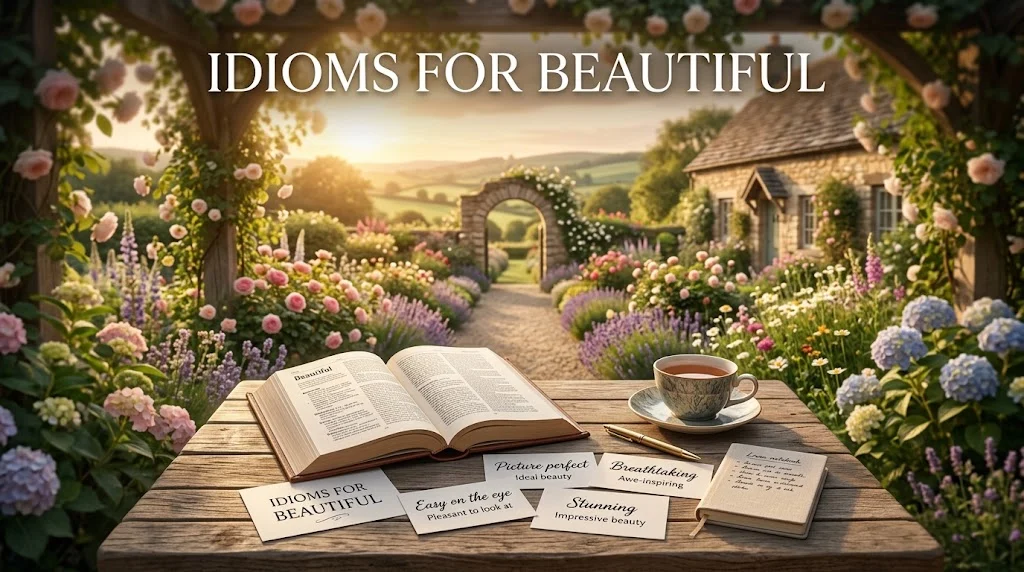
Idioms for beautiful are figurative expressions used to describe beauty, charm, elegance, attractiveness, or something especially pleasing. Instead of repeatedly saying “beautiful,” you can use expressions such as “a sight for sore eyes,” “easy on the eyes,” “a feast for the eyes,” “beauty is in the eye of the beholder,” “take your breath away,” and “a thing of beauty.”
Imagine describing a mountain view simply as “very beautiful.” The sentence communicates the basic idea, but it does not give the reader much to picture.
Now consider: “The view took my breath away.”
Suddenly, the beauty feels more emotional and immediate.
Idioms allow us to communicate more than appearance. They can suggest admiration, surprise, elegance, warmth, charm, excitement, or emotional impact. This makes them particularly valuable for students, writers, bloggers, storytellers, and English learners.
They also help avoid repetitive writing. If every paragraph describes something as “beautiful,” the language can quickly feel flat. A carefully chosen expression adds variety without making the writing unnecessarily complicated.
The important thing is context. Not every beautiful expression works in every situation. Some are formal, some playful, some poetic, and some are strongly conversational.
Quick Summary Table
| Idiom | Simple Meaning | Common Use |
|---|---|---|
| A sight for sore eyes | Something wonderful or welcome to see | People, places, reunions |
| Easy on the eyes | Pleasant or attractive to look at | People, design, places |
| A feast for the eyes | Extremely beautiful or visually impressive | Art, scenery, events |
| Beauty is in the eye of the beholder | Beauty is subjective | Opinions, art, appearance |
| Take your breath away | Be extremely beautiful or impressive | Scenery, performances |
| A thing of beauty | Something exceptionally beautiful | Art, objects, experiences |
| Drop-dead gorgeous | Extremely attractive | Informal descriptions |
| Pretty as a picture | Very attractive or picturesque | People, places |
| A picture of beauty | An excellent example of beauty | People, scenes |
| Beauty personified | The perfect embodiment of beauty | Formal/literary writing |
| A feast for the senses | Pleasing in many sensory ways | Food, nature, experiences |
| Turn heads | Attract attention because of appearance | People, fashion |
| Look like a million dollars | Look exceptionally good | People, outfits |
| Dressed to the nines | Dressed very stylishly | Events, celebrations |
| In full bloom | At the most beautiful stage | Flowers, nature |
| Blooming with beauty | Full of beauty and vitality | Nature, people |
| A breath of fresh air | Refreshingly pleasant or different | People, ideas, places |
| A ray of sunshine | Cheerful and delightful | People, personalities |
| Beauty beyond words | So beautiful it is difficult to describe | Scenery, art, experiences |
| A work of art | Extremely well-designed or beautiful | Objects, people, creations |
| Eye candy | Someone or something visually attractive | Informal conversation |
| A visual treat | Something especially pleasing to see | Design, scenery, events |
| Like a dream | Extremely beautiful or wonderful | Places, experiences |
| As pretty as a picture | Very attractive or picturesque | People, scenery |
| Beauty that stops you in your tracks | Remarkably beautiful or impressive | Nature, moments, places |
A Sight for Sore Eyes
Meaning: Something or someone that is especially pleasant or welcome to see.
When People Use It: This expression is often used when seeing someone or something brings relief, happiness, or pleasure, especially after not seeing it for a while.
Alternative Expression: A welcome sight.
Examples in Communication:
Formal Example:
“After months of restoration, the historic building was a sight for sore eyes.”
Casual Example:
“You’re finally home! You’re a sight for sore eyes.”
Creative Example:
“After hours beneath the gray sky, the garden was a sight for sore eyes.”
This idiom is about more than physical beauty. It often carries an emotional feeling of welcome or relief.
Easy on the Eyes
Meaning: Pleasant, attractive, or comfortable to look at.
When People Use It: It can describe people, clothing, websites, interiors, artwork, landscapes, or designs.
Alternative Expression: Easy to look at.
Examples in Communication:
Formal Example:
“The redesigned website is clean, balanced, and easy on the eyes.”
Casual Example:
“That new design is really easy on the eyes.”
Creative Example:
“The quiet blue room was easy on the eyes after a long day in the city.”
This expression is especially useful when discussing visual design because it does not necessarily mean something is spectacular; it simply means it looks pleasing.
A Feast for the Eyes
Meaning: Something extremely beautiful, colorful, or visually impressive.
When People Use It: This expression works particularly well for festivals, gardens, artwork, fashion, architecture, food displays, and natural scenery.
Alternative Expression: A visual delight.
Examples in Communication:
Formal Example:
“The exhibition is a feast for the eyes, combining traditional patterns with modern design.”
Casual Example:
“The flower market was a feast for the eyes.”
Creative Example:
“Every corner of the old city was a feast for the eyes.”
The metaphor compares visual beauty with a satisfying meal, suggesting that there is so much to enjoy that the eyes feel “fed.”
Beauty Is in the Eye of the Beholder
Meaning: Different people have different ideas about what is beautiful.
When People Use It: This expression is useful when discussing subjective opinions about art, fashion, architecture, appearance, or design.
Alternative Expression: Beauty is subjective.
Examples in Communication:
Formal Example:
“Although the artwork divided public opinion, beauty is ultimately in the eye of the beholder.”
Casual Example:
“Some people love that style, while others don’t. Beauty is in the eye of the beholder.”
Creative Example:
“The painting was strange to some and magical to others—proof that beauty is in the eye of the beholder.”
This is one of the most valuable expressions for essays because it introduces the idea that beauty cannot always be measured objectively.
Take Your Breath Away
Meaning: To be extremely beautiful, impressive, or emotionally powerful.
When People Use It: It is commonly used for breathtaking landscapes, performances, architecture, achievements, or unforgettable moments.
Alternative Expression: Leave someone speechless.
Examples in Communication:
Formal Example:
“The mountain landscape takes visitors’ breath away throughout the year.”
Casual Example:
“That view took my breath away.”
Creative Example:
“When the clouds parted, the valley below took her breath away.”
Although this expression can refer to beauty, it can also describe something astonishing or emotionally powerful.
A Thing of Beauty
Meaning: Something that is genuinely beautiful or pleasing.
When People Use It: This phrase is useful in descriptive, literary, artistic, and reflective writing.
Alternative Expression: A beautiful creation.
Examples in Communication:
Formal Example:
“The restored sculpture is a thing of beauty and historical significance.”
Casual Example:
“That old car is a thing of beauty.”
Creative Example:
“The handmade violin was a thing of beauty long before anyone heard its first note.”
This expression has a slightly poetic quality, making it particularly effective in creative writing.
Drop-Dead Gorgeous
Meaning: Extremely attractive or strikingly beautiful.
When People Use It: This is strongly informal and is generally used in casual conversation, entertainment writing, or social contexts.
Alternative Expression: Absolutely stunning.
Examples in Communication:
Formal Example:
“The venue was exceptionally elegant and visually striking.”
Casual Example:
“That dress is drop-dead gorgeous.”
Creative Example:
“The old theater looked drop-dead gorgeous beneath the evening lights.”
Because it is highly informal, avoid using it in academic or professional writing unless you are intentionally creating a conversational voice.
Pretty as a Picture
Meaning: Very attractive, charming, or picturesque.
When People Use It: It can describe people, landscapes, homes, villages, gardens, or scenes that look almost like an idealized picture.
Alternative Expression: Picture-perfect.
Examples in Communication:
Formal Example:
“The coastal village was pretty as a picture.”
Casual Example:
“Your garden is pretty as a picture.”
Creative Example:
“The little cottage stood beside the lake, pretty as a picture.”
This is especially useful for descriptive writing because it creates an immediate visual image.
Beauty Personified
Meaning: A person or thing that represents beauty in an especially strong or complete way.
When People Use It: This expression is more formal and literary. It works well in creative writing, speeches, reviews, and polished descriptions.
Alternative Expression: The embodiment of beauty.
Examples in Communication:
Formal Example:
“The historic cathedral stands as beauty personified, blending craftsmanship with centuries of history.”
Casual Example:
“She walked into the room looking like beauty personified.”
Creative Example:
“Among the wildflowers, the scene seemed like beauty personified.”
This phrase sounds elevated, so it should be used intentionally rather than in everyday conversation.
Turn Heads
Meaning: To attract attention because of appearance, style, or something remarkable.
When People Use It: This expression is commonly used for fashion, impressive appearances, unusual designs, and striking people or objects.
Alternative Expression: Attract attention.
Examples in Communication:
Formal Example:
“The building’s unusual architecture is designed to turn heads.”
Casual Example:
“That outfit is definitely going to turn heads.”
Creative Example:
“The bright red bicycle turned heads wherever it went.”
It does not always mean “beautiful.” Something unusual or dramatic can also turn heads.
Look Like a Million Dollars
Meaning: To look exceptionally attractive, elegant, or well dressed.
When People Use It: This informal expression is commonly used when complimenting someone’s appearance, particularly before an important event.
Alternative Expression: Look fantastic.
Examples in Communication:
Formal Example:
“The performer appeared exceptionally polished for the evening event.”
Casual Example:
“You look like a million dollars tonight!”
Creative Example:
“After weeks of preparation, she stepped onto the stage looking like a million dollars.”
This phrase is upbeat and complimentary, making it suitable for friendly conversations.
Dressed to the Nines
Meaning: Dressed very elegantly or stylishly.
When People Use It: People use this idiom for weddings, parties, celebrations, formal dinners, and other occasions where someone is dressed especially well.
Alternative Expression: Dressed to impress.
Examples in Communication:
Formal Example:
“Guests arrived dressed to the nines for the annual gala.”
Casual Example:
“Everyone was dressed to the nines at the wedding.”
Creative Example:
“Under the golden lights, the guests were dressed to the nines.”
This idiom focuses specifically on clothing and presentation rather than beauty in general.
In Full Bloom
Meaning: At the stage when something is flowering or at its most developed and beautiful.
When People Use It: Most literally, it describes flowers, but writers can also use it metaphorically for people, creativity, culture, or life.
Alternative Expression: At its peak.
Examples in Communication:
Formal Example:
“The botanical garden is particularly impressive when the roses are in full bloom.”
Casual Example:
“The garden looks amazing when everything is in full bloom.”
Creative Example:
“In spring, the quiet village came alive, its gardens bursting into full bloom.”
This is an excellent phrase for nature writing and poetic descriptions.
A Breath of Fresh Air
Meaning: Someone or something refreshing, pleasant, or pleasantly different.
When People Use It: This idiom is often used for people with refreshing personalities, new ideas, changes, experiences, or places.
Alternative Expression: Refreshing change.
Examples in Communication:
Formal Example:
“The new approach has been a breath of fresh air for the organization.”
Casual Example:
“She’s such a breath of fresh air.”
Creative Example:
“After years of routine, the little seaside town felt like a breath of fresh air.”
This expression is not specifically about physical beauty, but it is excellent when the “beauty” comes from someone’s personality or atmosphere.
A Ray of Sunshine
Meaning: A cheerful, warm, and delightful person or thing.
When People Use It: This phrase often describes someone whose presence makes others feel happier.
Alternative Expression: A bright spot.
Examples in Communication:
Formal Example:
“Her positive attitude has been a ray of sunshine during a challenging period.”
Casual Example:
“You’re a ray of sunshine today!”
Creative Example:
“In a room full of tired faces, her laughter was a ray of sunshine.”
This idiom describes inner charm rather than physical appearance.
Beauty Beyond Words
Meaning: Something so beautiful that ordinary language seems insufficient to describe it.
When People Use It: It works well for extraordinary scenery, emotional moments, art, music, and memorable experiences.
Alternative Expression: Impossible to describe.
Examples in Communication:
Formal Example:
“The natural landscape displayed a beauty beyond words.”
Casual Example:
“The view was honestly beauty beyond words.”
Creative Example:
“The first snowfall transformed the village into something of beauty beyond words.”
This expression has a poetic quality and is particularly useful in travel and creative writing.
A Work of Art
Meaning: Something made or presented with exceptional beauty, skill, or creativity.
When People Use It: It can describe paintings and sculptures, but people also use it for architecture, clothing, food presentation, writing, furniture, and other impressive creations.
Alternative Expression: Masterpiece.
Examples in Communication:
Formal Example:
“The building is a remarkable work of art that combines function with visual elegance.”
Casual Example:
“That cake is a work of art!”
Creative Example:
“Every stitch was carefully placed until the dress became a wearable work of art.”
This expression is particularly useful when beauty comes from craftsmanship.
Eye Candy
Meaning: Someone or something that is visually attractive or entertaining to look at.
When People Use It: This is informal and often appears in casual conversation, entertainment discussions, advertising, and social media.
Alternative Expression: Visually appealing.
Examples in Communication:
Formal Example:
“The campaign combines functional design with strong visual appeal.”
Casual Example:
“The new interface is pure eye candy.”
Creative Example:
“The colorful storefront was eye candy for everyone walking down the street.”
Use this expression carefully in formal contexts because it is casual and can sometimes objectify people.
A Visual Treat
Meaning: Something especially enjoyable or impressive to look at.
When People Use It: This expression is useful for films, photography, architecture, fashion, nature, food presentation, and art.
Alternative Expression: Visual delight.
Examples in Communication:
Formal Example:
“The exhibition is a visual treat for visitors interested in contemporary design.”
Casual Example:
“That movie was a visual treat.”
Creative Example:
“The lantern festival turned the dark streets into a visual treat.”
It is a versatile expression that works particularly well in reviews and blog writing.
Like a Dream
Meaning: Extremely beautiful, wonderful, or unreal in an appealing way.
When People Use It: People commonly use this expression for scenery, weddings, vacations, rooms, events, and memorable experiences.
Alternative Expression: Dreamlike.
Examples in Communication:
Formal Example:
“The resort’s gardens created an atmosphere that felt almost like a dream.”
Casual Example:
“Your vacation photos look like a dream!”
Creative Example:
“The lake shimmered beneath the moon, quiet and still, like a dream.”
This expression is simple but emotionally effective.
As Pretty as a Picture
Meaning: Very attractive, charming, or picturesque.
When People Use It: It is especially useful for people, places, houses, gardens, and scenes that look unusually perfect or charming.
Alternative Expression: Picture-perfect.
Examples in Communication:
Formal Example:
“The countryside was as pretty as a picture in early spring.”
Casual Example:
“Your little café is as pretty as a picture.”
Creative Example:
“Framed by lavender fields, the cottage was as pretty as a picture.”
This expression is similar to “pretty as a picture” and is especially natural in descriptive writing.
Beauty That Stops You in Your Tracks
Meaning: Beauty or visual impact so strong that it makes you pause and pay attention.
When People Use It: This is a more creative expression rather than a fixed traditional idiom. It works especially well in blogs, travel writing, storytelling, and social media captions.
Alternative Expression: Absolutely breathtaking.
Examples in Communication:
Formal Example:
“The coastline offers dramatic views that can stop visitors in their tracks.”
Casual Example:
“That sunset was the kind of beauty that stops you in your tracks.”
Creative Example:
“She turned the corner and found a field of wildflowers, a scene beautiful enough to stop her in her tracks.”
It is excellent when you want to describe beauty as an experience rather than simply an appearance.
How to Use Idioms for Beautiful Naturally
The most effective way to use beauty idioms is to match the expression to what kind of beauty you are describing.
If something is visually pleasing, try “easy on the eyes.”
If a scene is spectacular, “a feast for the eyes” or “take your breath away” may be stronger.
And if you’re describing someone’s personality rather than appearance, “a ray of sunshine” or “a breath of fresh air” may communicate the idea much better.
The goal is not to make every sentence sound poetic. One well-chosen idiom can be more effective than several decorative phrases.
Common Mistakes with Beauty Idioms
A frequent mistake is treating every beauty idiom as interchangeable.
For example, “dressed to the nines” describes stylish clothing. It does not simply mean someone is physically beautiful.
Likewise, “a sight for sore eyes” often suggests that seeing someone is especially welcome or comforting, rather than merely attractive.
Another mistake is using highly informal expressions in formal writing. “Drop-dead gorgeous” and “eye candy” can work in casual content, but they may sound inappropriate in an academic essay or professional report.
Writers should also avoid overusing idioms. If every sentence contains a figurative expression, the writing can become exaggerated and difficult to read.
Good writing gives figurative language room to breathe.
Idioms vs. Simple Words for Beautiful
There is nothing wrong with saying beautiful, lovely, attractive, stunning, or elegant.
In fact, simple words are sometimes the best choice.
Idioms become useful when you want to communicate an additional idea.
Beautiful:
“The garden was beautiful.”
A feast for the eyes:
“The garden was a feast for the eyes, filled with bright flowers and winding paths.”
The second sentence does more than label the garden as beautiful. It suggests abundance and visual pleasure.
That is the real value of idiomatic language: it adds meaning, tone, and imagery.
How to Make Your Writing More Expressive
If you are writing a blog post, essay, story, caption, or description, try replacing repeated uses of “beautiful” with more specific language.
Instead of:
“The beach was beautiful.”
Try:
“The beach was a feast for the eyes.”
Instead of:
“The view was very beautiful.”
Try:
“The view took my breath away.”
Instead of:
“She looked beautiful at the celebration.”
Try:
“She looked like a million dollars.”
Instead of:
“The garden was beautiful in spring.”
Try:
“The garden was in full bloom.”
The important difference is specificity. You are not simply searching for a synonym for “beautiful.” You are choosing an expression that tells the reader why something feels beautiful.
How to Remember Idioms for Beautiful
Group them by the type of beauty they describe.
For visual beauty, remember:
- Easy on the eyes
- A feast for the eyes
- A visual treat
- Pretty as a picture
- Like a dream
For stylish appearance, remember:
- Look like a million dollars
- Dressed to the nines
- Turn heads
- Drop-dead gorgeous
This approach makes the expressions easier to recall because each one is connected to a specific idea.
Tips for English Learners
If English is not your first language, avoid trying to use every idiom immediately.
Start by recognizing them when you hear or read them. Once an expression feels familiar, practice using it in your own sentence.
A useful three-step method is:
Notice it.
Find the idiom in a conversation, article, movie, or book.
Understand it.
Learn both its figurative meaning and its emotional tone.
Use it.
Create a sentence connected to your own experience.
For example:
“The sunset took my breath away.”
Once you have used the phrase several times in meaningful contexts, it becomes much easier to remember.
FAQs
What are the best idioms for beautiful?
Some of the most useful include “a feast for the eyes,” “take your breath away,” “easy on the eyes,” “pretty as a picture,” “a thing of beauty,” and “beauty is in the eye of the beholder.” The best choice depends on the type of beauty you want to describe.
What idiom means very beautiful?
Expressions such as “take your breath away,” “drop-dead gorgeous,” “beauty personified,” and “a feast for the eyes” can communicate an exceptionally high level of beauty or visual appeal.
What is a poetic way to say beautiful?
Poetic expressions include “beauty beyond words,” “a thing of beauty,” “take your breath away,” “like a dream,” and “beauty personified.” These are particularly effective in creative and descriptive writing.
What idiom means beauty is subjective?
The well-known expression “beauty is in the eye of the beholder” means that different people can have different opinions about what is beautiful.
How can I avoid repeating the word beautiful in writing?
Instead of automatically replacing “beautiful” with another adjective, identify the specific quality you want to communicate. Use “a feast for the eyes” for visual richness, “dressed to the nines” for elegant clothing, “take your breath away” for emotional impact, or “in full bloom” for flowers and nature.
Conclusion
Beauty is not always about appearance. Sometimes it is the feeling a place creates, the elegance of a design, the warmth of a person’s personality, or the unforgettable impact of a single moment.
That is why idioms for beautiful can make English so expressive. They allow you to move beyond a simple adjective and communicate the particular kind of beauty you have in mind.
Whether you are writing an essay, creating a blog post, learning conversational English, or simply looking for better ways to describe the world around you, expressions such as “a feast for the eyes,” “take your breath away,” “a thing of beauty,” and “beauty is in the eye of the beholder” give your language more color and personality.
Use them thoughtfully rather than excessively. The strongest expression is the one that feels natural in its context and when the right words finally fit, even an ordinary description can become something beautiful.
Discover More Related Articles:
- Idioms for Rare | Unique Expressions for Things That Are Hard to Find In 2026
- Idioms for Scary | Expressions for Fear, Fright & Chilling Moments In 2026