Quick Answer
Idioms for being nervous are figurative expressions that describe feelings of worry, fear, uncertainty, tension, or uneasiness. Common examples include “have butterflies in your stomach,” “get cold feet,” “on edge,” “a bundle of nerves,” “shake in your boots,” and “bite your nails.” These expressions are useful in conversations, storytelling, essays, creative writing, and everyday English.
Imagine someone says, “I was nervous before my presentation.”
That sentence is perfectly correct, but it doesn’t tell us much about the feeling.
Now compare it with:
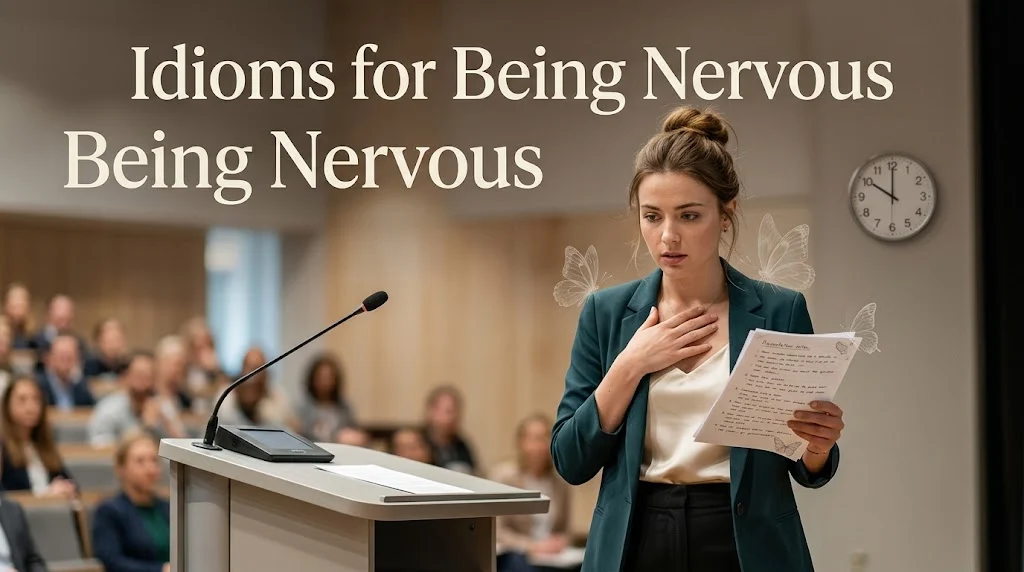
“I had butterflies in my stomach before my presentation.”
The second sentence gives the reader an immediate emotional image.
Idioms allow speakers and writers to describe different shades of nervousness. Someone can be mildly uneasy, extremely frightened, hesitant about a decision, or overwhelmed by pressure. Each expression gives that emotion a slightly different shape.
This makes nervousness idioms especially useful for students, English learners, bloggers, storytellers, writers, and anyone who wants to communicate emotions naturally.
The important thing is to understand the context. Some expressions describe fear, while others describe excitement mixed with nervousness. Others suggest hesitation rather than anxiety itself.
Quick Summary Table
| Idiom | Simple Meaning | Common Use |
|---|---|---|
| Have butterflies in your stomach | Feel nervous or excited | Tests, dates, performances |
| Get cold feet | Become nervous and hesitate | Important decisions |
| Be on edge | Feel tense or uneasy | Stressful situations |
| A bundle of nerves | Be extremely nervous | Events, interviews |
| Shake in your boots | Be very frightened | Fearful situations |
| Bite your nails | Worry nervously | Waiting, uncertainty |
| Have jitters | Feel nervous or restless | Performances, events |
| Lose your nerve | Suddenly lose courage | Challenges, decisions |
| Keep your cool | Stay calm under pressure | Work, exams, conflicts |
| Jump out of your skin | Be extremely startled | Sudden surprises |
| Have one’s heart in one’s mouth | Feel very anxious | Suspense, danger |
| Quake in your boots | Feel extremely afraid | Informal storytelling |
| Break into a cold sweat | Suddenly become very nervous | Fear, pressure |
| Sweat bullets | Be extremely anxious | Waiting, stressful moments |
| Hair stand on end | Feel frightened or alarmed | Scary situations |
| Tongue-tied | Unable to speak easily | Social situations |
| At one’s wits’ end | Feel overwhelmed and unsure | Difficult situations |
| Lose sleep over something | Worry excessively | Problems, decisions |
| Have a sinking feeling | Suddenly feel that something is wrong | Bad news, uncertainty |
| Walk on eggshells | Act very cautiously | Tense relationships |
| Under pressure | Feel stressed by demands | School, work, deadlines |
| Feel the pressure | Become anxious because of expectations | Competition, performance |
| In a panic | Feel sudden intense worry | Emergencies, mistakes |
| Fear the worst | Expect a negative outcome | Uncertainty |
| Dread the thought of | Feel strong anxiety about something | Difficult events |
Have Butterflies in Your Stomach
Meaning: To feel nervous or excited, especially before an important event.
When People Use It: This is one of the most common expressions for nervous anticipation. It is often used before exams, performances, competitions, presentations, interviews, or exciting social occasions.
Alternative Expression: Have the jitters.
Examples in Communication:
Formal Example:
“Many students experience butterflies in their stomachs before delivering an important presentation.”
Casual Example:
“I had butterflies in my stomach before the interview.”
Creative Example:
“Minutes before the curtain rose, butterflies fluttered wildly in her stomach.”
This expression can describe both nervousness and excitement, which makes it more positive than many fear-related idioms.
Get Cold Feet
Meaning: To become nervous or afraid and lose confidence about doing something you had planned.
When People Use It: People use this expression when someone begins to hesitate before an important action or decision.
Alternative Expression: Lose your nerve.
Examples in Communication:
Formal Example:
“Several participants became hesitant and got cold feet before the final stage of the competition.”
Casual Example:
“I was going to speak up, but I got cold feet.”
Creative Example:
“She stood at the doorway, ready to leave, but suddenly got cold feet.”
The expression usually suggests hesitation caused by nervousness or fear, rather than ordinary stress.
Be On Edge
Meaning: To feel nervous, tense, worried, or unable to relax.
When People Use It: This idiom works well when someone has been worried for a while or expects something unpleasant to happen.
Alternative Expression: Feel tense.
Examples in Communication:
Formal Example:
“The uncertainty surrounding the announcement left employees on edge.”
Casual Example:
“Everyone’s been on edge waiting for the results.”
Creative Example:
“The quiet house felt strangely tense, leaving everyone on edge.”
This expression is useful in both conversation and writing.
A Bundle of Nerves
Meaning: A person who is extremely nervous.
When People Use It: It is often used before an important event, particularly when someone’s nervousness is obvious.
Alternative Expression: Extremely nervous.
Examples in Communication:
Formal Example:
“Despite appearing confident, the candidate was a bundle of nerves before the interview.”
Casual Example:
“I was a complete bundle of nerves before my speech.”
Creative Example:
“Behind the confident smile was a bundle of nerves counting every passing second.”
This phrase is descriptive and conversational rather than highly formal.
Shake in Your Boots
Meaning: To be extremely frightened or nervous.
When People Use It: This colorful expression is usually informal and often used humorously or dramatically.
Alternative Expression: Be scared stiff.
Examples in Communication:
Formal Example:
“The unexpected announcement caused considerable concern among the participants.”
Casual Example:
“That horror movie had me shaking in my boots.”
Creative Example:
“The thunder was so loud that even the bravest travelers were shaking in their boots.”
It is best suited to casual conversation and creative storytelling.
Bite Your Nails
Meaning: To worry or feel nervous while waiting for something to happen.
When People Use It: This is commonly used when someone is waiting for results, news, a decision, or an uncertain outcome.
Alternative Expression: Fret over something.
Examples in Communication:
Formal Example:
“Applicants spent the weekend anxiously awaiting the final decision.”
Casual Example:
“I’ve been biting my nails waiting for their answer.”
Creative Example:
“She sat by the phone, biting her nails as the hours crawled by.”
The expression often emphasizes waiting-related anxiety.
Have the Jitters
Meaning: To feel nervous, restless, or unable to relax.
When People Use It: This expression is common before performances, competitions, interviews, tests, and other stressful occasions.
Alternative Expression: Feel nervous.
Examples in Communication:
Formal Example:
“First-time performers often experience the jitters before appearing on stage.”
Casual Example:
“I’ve got the jitters about tomorrow’s exam.”
Creative Example:
“His hands were restless; the jitters had arrived long before the audience.”
It is informal but widely understandable.
Lose Your Nerve
Meaning: To suddenly lose courage or confidence.
When People Use It: This expression fits situations where someone intended to do something difficult but became too nervous or afraid.
Alternative Expression: Back out.
Examples in Communication:
Formal Example:
“The speaker nearly lost her nerve before addressing the large audience.”
Casual Example:
“I wanted to ask the question, but I lost my nerve.”
Creative Example:
“He reached for the microphone, then lost his nerve for just a moment.”
This idiom focuses more on courage than general nervousness.
Keep Your Cool
Meaning: To remain calm and composed in a stressful or difficult situation.
When People Use It: This is technically an expression about managing nervousness rather than feeling it, but it is extremely useful when discussing nervous situations.
Alternative Expression: Stay calm.
Examples in Communication:
Formal Example:
“Effective leaders must keep their cool when unexpected problems arise.”
Casual Example:
“Just keep your cool and answer the questions.”
Creative Example:
“Her heart was racing, but she kept her cool and stepped forward.”
This is an excellent expression for advice and motivational writing.
Jump Out of Your Skin
Meaning: To be extremely startled or suddenly frightened.
When People Use It: It is generally used when something unexpected causes a strong reaction.
Alternative Expression: Be startled.
Examples in Communication:
Formal Example:
“The unexpected noise startled everyone in the room.”
Casual Example:
“You nearly made me jump out of my skin!”
Creative Example:
“The sudden knock made her jump out of her skin.”
It is usually informal and highly expressive.
Have Your Heart in Your Mouth
Meaning: To feel extremely nervous, frightened, or anxious during a tense moment.
When People Use It: This expression is useful when something important or frightening is happening and you are waiting to see what happens next.
Alternative Expression: Feel terrified.
Examples in Communication:
Formal Example:
“Observers watched the final moments with their hearts in their mouths.”
Casual Example:
“My heart was in my mouth when I saw the car approaching.”
Creative Example:
“With her heart in her mouth, she waited for the door to open.”
This is particularly effective in storytelling because it creates an immediate emotional image.
Quake in Your Boots
Meaning: To feel extremely afraid or nervous.
When People Use It: This is an informal and dramatic expression, often used humorously.
Alternative Expression: Shake with fear.
Examples in Communication:
Formal Example:
“The intimidating atmosphere made several participants visibly nervous.”
Casual Example:
“You’d quake in your boots if you saw that storm!”
Creative Example:
“The villagers claimed that anyone entering the old castle would quake in their boots.”
It works especially well in fictional and playful writing.
Break Into a Cold Sweat
Meaning: To suddenly become extremely nervous, frightened, or anxious.
When People Use It: This expression often describes a strong physical reaction to fear or pressure.
Alternative Expression: Become extremely anxious.
Examples in Communication:
Formal Example:
“The unexpected question caused the candidate to break into a cold sweat.”
Casual Example:
“I broke into a cold sweat when I realized I’d forgotten the deadline.”
Creative Example:
“The moment she heard the news, a cold sweat swept over her.”
This expression is stronger than simply saying “feel nervous.”
Sweat Bullets
Meaning: To be extremely nervous, worried, or anxious.
When People Use It: This is informal and often used when someone is under intense pressure.
Alternative Expression: Be extremely anxious.
Examples in Communication:
Formal Example:
“The team was under considerable pressure while waiting for the final results.”
Casual Example:
“I was sweating bullets before they called my name.”
Creative Example:
“Behind the calm expression, he was sweating bullets.”
It is vivid and conversational, so avoid it in highly formal academic writing.
Your Hair Stands on End
Meaning: To suddenly feel frightened or alarmed.
When People Use It: This expression is often associated with creepy, frightening, or mysterious situations.
Alternative Expression: Feel a chill.
Examples in Communication:
Formal Example:
“The unusual sound created a strong sense of unease among the visitors.”
Casual Example:
“That story made my hair stand on end.”
Creative Example:
“Every whisper in the abandoned hallway made her hair stand on end.”
It is particularly effective in suspenseful storytelling.
Tongue-Tied
Meaning: Unable to speak easily because of nervousness, embarrassment, surprise, or emotion.
When People Use It: This expression is common when someone suddenly cannot find the right words.
Alternative Expression: Lost for words.
Examples in Communication:
Formal Example:
“The unexpected question left the presenter temporarily tongue-tied.”
Casual Example:
“I got so nervous that I became completely tongue-tied.”
Creative Example:
“All the clever words she had prepared vanished, leaving her tongue-tied.”
This is a very useful expression for describing social nervousness.
At Your Wits’ End
Meaning: So worried, frustrated, or overwhelmed that you do not know what to do next.
When People Use It: This expression is useful for difficult situations that have continued for a long time.
Alternative Expression: Completely overwhelmed.
Examples in Communication:
Formal Example:
“After repeated attempts to resolve the issue, the team was at its wits’ end.”
Casual Example:
“I’ve tried everything. I’m at my wits’ end.”
Creative Example:
“After hours of searching, she was at her wits’ end.”
This phrase is broader than nervousness and can include frustration or helplessness.
Lose Sleep Over Something
Meaning: To worry so much about something that it affects your ability to relax or sleep.
When People Use It: This is common when discussing exams, decisions, mistakes, relationships, deadlines, or uncertain outcomes.
Alternative Expression: Worry constantly about something.
Examples in Communication:
Formal Example:
“Students should avoid losing sleep over minor mistakes that can be corrected.”
Casual Example:
“Don’t lose sleep over one bad grade.”
Creative Example:
“She had spent nights losing sleep over a decision that still had no clear answer.”
This expression is often used when offering reassurance.
Have a Sinking Feeling
Meaning: To suddenly feel that something bad or disappointing may happen.
When People Use It: This idiom is especially useful when a person senses that something is wrong before knowing exactly what it is.
Alternative Expression: Have a bad feeling.
Examples in Communication:
Formal Example:
“The manager had a sinking feeling that the figures had been reported incorrectly.”
Casual Example:
“I had a sinking feeling when I saw the empty parking space.”
Creative Example:
“The unanswered message gave her a sinking feeling she could not explain.”
It expresses intuition mixed with worry.
Walk on Eggshells
Meaning: To behave very carefully because you do not want to upset someone or create a problem.
When People Use It: This expression is often used for tense relationships, sensitive conversations, or unpredictable situations.
Alternative Expression: Tread carefully.
Examples in Communication:
Formal Example:
“Employees felt they had to walk on eggshells when discussing the sensitive issue.”
Casual Example:
“I feel like I’m walking on eggshells around him today.”
Creative Example:
“Every conversation became a careful dance, as though they were walking on eggshells.”
This idiom describes social tension more than ordinary nervousness.
Under Pressure
Meaning: Experiencing stress because of demands, expectations, deadlines, or difficult circumstances.
When People Use It: This expression is extremely common in school, work, sports, competitions, and everyday conversations.
Alternative Expression: Under stress.
Examples in Communication:
Formal Example:
“Employees often make difficult decisions when working under pressure.”
Casual Example:
“I don’t think clearly when I’m under pressure.”
Creative Example:
“Under pressure, every second seemed louder than the last.”
It is not exclusively an idiom, but it is an important figurative expression for discussing nervousness.
Feel the Pressure
Meaning: To become aware of stress or expectations and feel affected by them.
When People Use It: This phrase works particularly well when someone is approaching an important deadline, performance, competition, or decision.
Alternative Expression: Feel stressed.
Examples in Communication:
Formal Example:
“As the deadline approached, the team began to feel the pressure.”
Casual Example:
“I’m really feeling the pressure before tomorrow’s test.”
Creative Example:
“As the final hour approached, she could feel the pressure building.”
It is natural in both spoken and written English.
In a Panic
Meaning: In a state of sudden and intense fear, worry, or confusion.
When People Use It: This phrase is used when someone reacts strongly to an unexpected or stressful event.
Alternative Expression: In a state of alarm.
Examples in Communication:
Formal Example:
“People should avoid making major decisions while in a panic.”
Casual Example:
“I was in a panic when I couldn’t find my phone.”
Creative Example:
“For a moment, she was in a panic, searching every corner of the room.”
This is stronger than simply being nervous.
Fear the Worst
Meaning: To expect that the most negative possible outcome may happen.
When People Use It: This expression is useful when someone is waiting for uncertain news or interpreting a worrying situation.
Alternative Expression: Expect the worst.
Examples in Communication:
Formal Example:
“Without further information, the family feared the worst.”
Casual Example:
“I haven’t heard back, so I’m starting to fear the worst.”
Creative Example:
“Every passing hour made him fear the worst.”
It is useful in both emotional storytelling and everyday conversation.
Dread the Thought of
Meaning: To feel strong worry, fear, or reluctance about something that may happen.
When People Use It: This expression is useful when nervousness develops before an unpleasant event.
Alternative Expression: Be anxious about.
Examples in Communication:
Formal Example:
“Many students dread the thought of speaking before a large audience.”
Casual Example:
“I dread the thought of having that conversation.”
Creative Example:
“She dreaded the thought of opening the letter, even though she knew she had to.”
This expression emphasizes anticipation rather than a sudden nervous reaction.
How to Use Idioms for Being Nervous Naturally
The first step is to identify what kind of nervousness you are trying to describe.
If you are excited and nervous before an event, “have butterflies in your stomach” is a natural choice.
If you are thinking about backing out, “get cold feet” is better.
If you have been tense for hours, “be on edge” may fit.
If you are under intense pressure, “sweat bullets” or “break into a cold sweat” can communicate stronger anxiety.
This distinction makes your English more precise.
It is also helpful to consider the audience. A phrase like “sweat bullets” works naturally in a casual conversation, while “under pressure” is more suitable for professional writing.
Common Mistakes with Nervousness Idioms
One common mistake is treating every nervousness idiom as interchangeable.
For example, “get cold feet” does not simply mean “feel nervous.” It usually involves hesitation about doing something.
Likewise, “have butterflies in your stomach” can suggest excitement as well as anxiety.
Another mistake is using too many idioms in a single sentence. Figurative language works best when it has room to breathe.
Instead of writing:
“I had butterflies, was on edge, was sweating bullets, and was biting my nails.”
Choose the expression that best captures the feeling:
“I was on edge while waiting for the results.”
Clear writing usually beats crowded writing.
Idioms vs. Literal Expressions
Understanding the difference between literal and figurative language is essential for English learners.
Literal:
“My hands were shaking because I was cold.”
Figurative:
“My hands were shaking because I was nervous.”
Idiomatic:
“I had butterflies in my stomach before the interview.”
The butterflies in the final sentence are not real. The phrase communicates nervous anticipation through an image.
Idioms often make emotional writing more memorable because they turn an abstract feeling into something readers can imagine.
How to Sound More Fluent When Talking About Nervousness
Instead of always using “I am nervous,” learn to describe the specific experience.
You might say:
- “I have butterflies in my stomach.”
- “I’m feeling a little on edge.”
- “I got the jitters before the presentation.”
- “I almost lost my nerve.”
- “I’m under a lot of pressure.”
- “I was completely tongue-tied.”
- “I had a sinking feeling.”
These expressions give your English more variety without making it unnecessarily complicated.
The goal is not to sound impressive. The goal is to sound natural and precise.
How to Remember Nervousness Idioms Easily
Group them according to the type of feeling they describe.
Mild nervousness or anticipation:
- Have butterflies in your stomach
- Have the jitters
- Feel the pressure
Strong fear:
- Shake in your boots
- Quake in your boots
- Break into a cold sweat
- Sweat bullets
Hesitation:
- Get cold feet
- Lose your nerve
Tension and worry:
- Be on edge
- Bite your nails
- Have a sinking feeling
- Lose sleep over something
Difficulty speaking:
- Be tongue-tied
- Be lost for words
Learning them in groups makes the vocabulary easier to recall because each expression becomes connected to a particular emotional situation.
Nervousness Idioms in Everyday Conversations
Everyday conversations naturally contain many of these expressions.
Before an exam, a student might say:
“I have the jitters about tomorrow.”
Before a presentation:
“I had butterflies in my stomach.”
While waiting for important news:
“I’ve been biting my nails all morning.”
During an uncomfortable conversation:
“I feel like I’m walking on eggshells.”
After successfully handling a difficult situation:
“I managed to keep my cool.”
These examples show why idioms are so useful: they let people communicate emotional experiences quickly without lengthy explanations.
Nervousness Idioms in Creative Writing
Writers can use idioms to reveal emotion without repeatedly telling readers that a character is nervous.
Instead of:
“She was nervous.”
Try:
“She stood outside the room with butterflies in her stomach.”
Or:
“He reached for the microphone but suddenly lost his nerve.”
Or:
“The unanswered phone call left her with a sinking feeling.”
These expressions create images that allow readers to experience the emotion rather than simply being told about it.
For fiction, personal essays, blog storytelling, and social media captions, this can make the writing feel much more alive.
When Not to Use Nervousness Idioms
Idioms are useful, but they are not appropriate everywhere.
In scientific, technical, or highly formal writing, direct language may be clearer.
Instead of:
“The participants were sweating bullets.”
a formal report might say:
“The participants reported high levels of stress.”
Likewise, if your audience is still learning English, too many unfamiliar idioms may create confusion.
Good communication depends on clarity, audience, and purpose. Use an idiom when it adds meaning, personality, or emotional precision—not simply because it sounds interesting.
FAQs
What is the most common idiom for being nervous?
“Have butterflies in your stomach” is one of the most familiar idioms for nervousness. It usually describes nervous excitement before an important or anticipated event.
What idiom means extremely nervous?
Expressions such as “a bundle of nerves,” “sweat bullets,” and “break into a cold sweat” can describe intense nervousness. The best choice depends on the situation and tone.
What does “get cold feet” mean?
“Get cold feet” means becoming nervous or afraid and hesitating before doing something you had planned to do. It often involves losing confidence at the last moment.
What idiom means to stay calm when nervous?
“Keep your cool” means to remain calm and composed during a stressful or difficult situation. It is often used as advice.
What is a good idiom for nervousness before an exam or presentation?
“Have butterflies in your stomach,” “have the jitters,” and “feel the pressure” are natural choices. For stronger anxiety, “be on edge” can also work.
Conclusion
Nervousness is a complicated emotion, and English has plenty of expressive ways to describe it. Idioms for being nervous can help you communicate whether someone is excited, worried, frightened, hesitant, tense, or overwhelmed.
Expressions such as “have butterflies in your stomach,” “get cold feet,” “be on edge,” “lose your nerve,” and “keep your cool” are especially useful because they appear naturally in conversations, stories, articles, and everyday situations.
The best way to learn them is to connect each idiom with a real situation. Imagine the nervous student before an exam, the speaker waiting backstage, or the person nervously checking for an important message. Once you associate the expression with the emotion, it becomes much easier to remember.
Use idioms thoughtfully, match them to your audience, and let them add personality rather than clutter. With regular practice, your English can become more expressive, natural, and emotionally precise.