Quick Answer
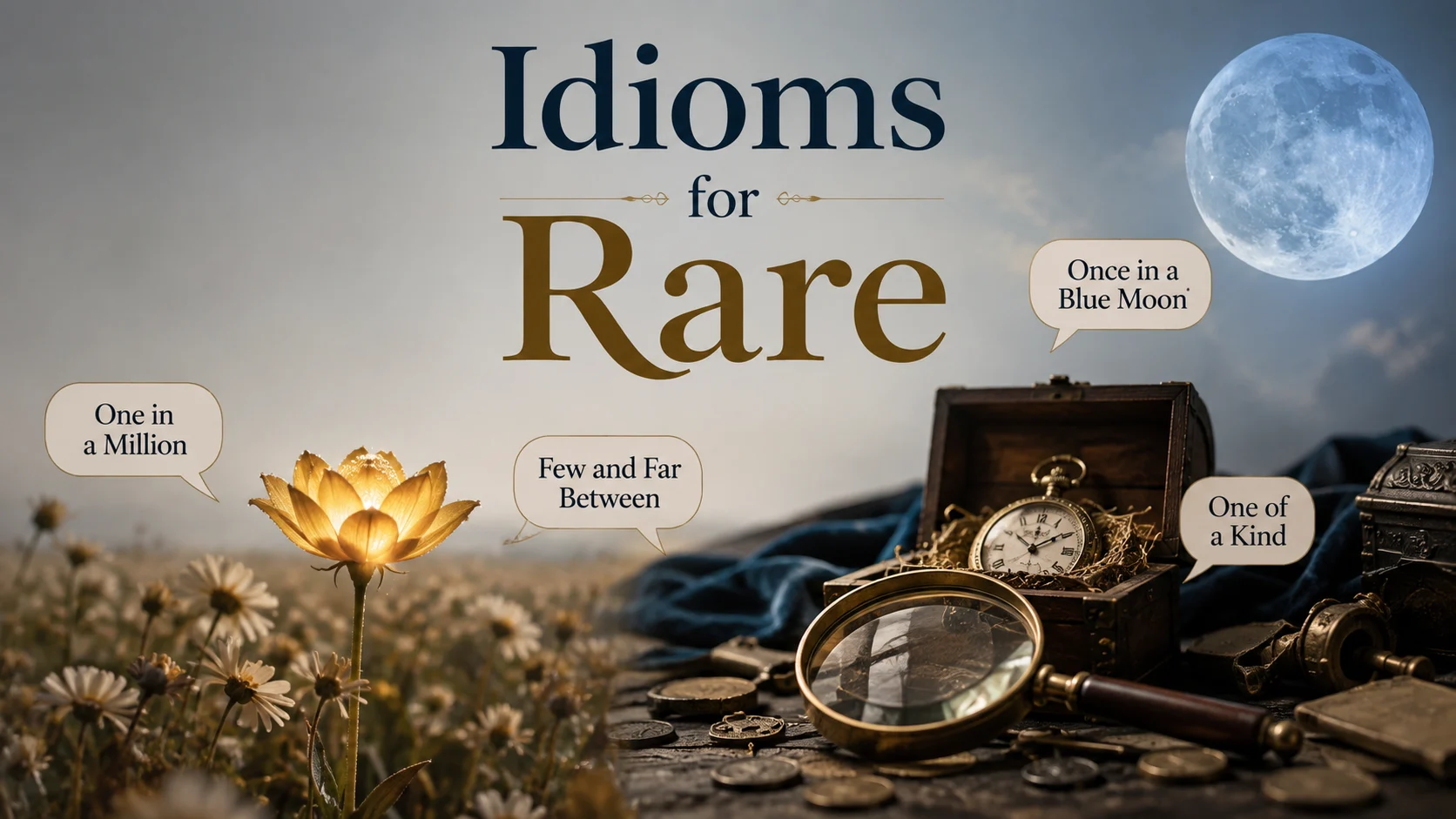
Idioms for rare are expressions used to describe something uncommon, unusual, exceptional, scarce, or difficult to find. Useful phrases include “once in a blue moon,” “few and far between,” “a needle in a haystack,” “one in a million,” “a rare bird,” and “like finding a needle in a haystack.”
Some things are easy to find. Others seem to disappear the moment you start looking for them.
Maybe you are searching for a quiet place in a crowded city, an unusually talented person, a vintage object, a genuine opportunity, or simply a moment when everything goes perfectly. Calling it “rare” is accurate, but sometimes the word does not quite capture the feeling.
That is where idioms for rare become useful.
English has many colorful expressions for describing things that are unusual, scarce, exceptional, or surprisingly difficult to find. Some are casual and humorous, while others work beautifully in essays, storytelling, and descriptive writing.
For language learners, these expressions also reveal something important about English: rarity is not always about numbers. Something can be rare because it happens infrequently, because it is difficult to locate, because it is exceptionally valuable, or because it is almost unique.
Learning these distinctions will help you choose expressions more naturally and make your communication more vivid without relying on the word “rare” repeatedly.
Quick Summary of Idioms for Rare
| Idiom or Expression | Meaning | Tone | Best Used For |
|---|---|---|---|
| Once in a blue moon | Very rarely | Casual | Infrequent events |
| Few and far between | Very uncommon | Neutral | Opportunities, events |
| A needle in a haystack | Extremely difficult to find | Figurative | Searching |
| One in a million | Extremely special or unusual | Positive | People, opportunities |
| A rare bird | An unusual or exceptional person | Literary | People |
| Like finding a needle in a haystack | Extremely hard to locate | Figurative | Searching |
| Few and far between | Scattered and uncommon | Neutral | Things or events |
| Once in a lifetime | Extremely uncommon | Positive | Experiences |
| A diamond in the rough | Rare potential hidden in something ordinary | Positive | People, talent |
| A cut above the rest | Unusually good | Positive | Quality |
| In a class of its own | Uniquely excellent | Positive | People, things |
| One of a kind | Completely unique | Positive | Objects, people |
| Few and exceptional | Uncommon and outstanding | Neutral/Formal | Qualities |
| Rarity value | Worth because something is uncommon | Neutral | Collectibles |
| Hard to come by | Difficult to find or obtain | Neutral | Resources, opportunities |
| Scarce as hen’s teeth | Extremely rare | Humorous | Things that barely exist |
| As rare as hen’s teeth | Extremely uncommon | Humorous | Rare objects |
| Thin on the ground | Available in very small numbers | Informal | People, resources |
| In short supply | Not available in sufficient quantity | Neutral | Goods, resources |
| Like gold dust | Extremely valuable and difficult to find | Figurative | People, opportunities |
| Few in number | Existing in small numbers | Formal | Groups, objects |
| Not a dime a dozen | Not common or ordinary | Informal | Valuable things |
| Worth its weight in gold | Extremely valuable | Positive | People, skills |
| A unicorn | An exceptionally rare or unusual thing | Modern/Informal | Ideas, people, opportunities |
Once in a Blue Moon
Meaning:
Something that happens very rarely.
When People Use It:
This is one of the most familiar idioms for rarity. It is informal and works naturally in everyday conversation.
Alternative Expression:
Very rarely.
Examples in Communication
Formal Example:
The organization holds such celebrations only once in a blue moon.
Casual Example:
I eat dessert like that once in a blue moon.
Creative Example:
Once in a blue moon, the entire town seemed to fall silent beneath the stars.
Few and Far Between
Meaning:
Very uncommon or occurring only occasionally.
When People Use It:
This expression is useful when something exists in small numbers or opportunities do not happen often.
Alternative Expression:
Few and scattered.
Examples in Communication
Formal Example:
Employment opportunities in this specialized field remain few and far between.
Casual Example:
Good parking spaces around here are few and far between.
Creative Example:
Moments of complete peace were few and far between during that busy summer.
A Needle in a Haystack
Meaning:
Something extremely difficult to find among many other things.
When People Use It:
This is especially useful when rarity is connected with searching.
Alternative Expression:
Extremely difficult to find.
Examples in Communication
Formal Example:
Finding the original document among thousands of files was like searching for a needle in a haystack.
Casual Example:
Trying to find that one photo on my phone is like looking for a needle in a haystack.
Creative Example:
The tiny clue was a needle in a haystack of forgotten memories.
One in a Million
Meaning:
Extremely unusual, special, or exceptional.
When People Use It:
This phrase is often complimentary. It can describe people, opportunities, experiences, or objects.
Alternative Expression:
Extraordinary.
Examples in Communication
Formal Example:
Her combination of creativity and leadership makes her a one-in-a-million candidate.
Casual Example:
You’re one in a million!
Creative Example:
Every so often, life gives you a one-in-a-million moment you never forget.
A Rare Bird
Meaning:
An unusual or uncommon person, especially someone with distinctive qualities.
When People Use It:
This expression has a literary or slightly old-fashioned flavor. It can be affectionate, admiring, or humorous depending on context.
Alternative Expression:
An unusual character.
Examples in Communication
Formal Example:
A scientist who combines technical expertise with exceptional storytelling skills is a rare bird.
Casual Example:
He’s a rare bird—you don’t meet people like him every day.
Creative Example:
She was a rare bird, equally comfortable discussing poetry and repairing old machines.
Once in a Lifetime
Meaning:
An experience or opportunity that is extremely unlikely to happen again.
When People Use It:
This expression is common when talking about extraordinary experiences or opportunities.
Alternative Expression:
A once-in-a-lifetime opportunity.
Examples in Communication
Formal Example:
The expedition offered researchers a once-in-a-lifetime opportunity.
Casual Example:
That trip was a once-in-a-lifetime experience.
Creative Example:
The sunrise painted the mountains in colors that seemed like a once-in-a-lifetime gift.
A Diamond in the Rough
Meaning:
Someone or something with exceptional qualities that are hidden beneath an ordinary or imperfect exterior.
When People Use It:
This idiom is especially useful when discussing talent or potential.
Alternative Expression:
Hidden gem.
Examples in Communication
Formal Example:
The young artist may be a diamond in the rough with considerable potential.
Casual Example:
That little bookstore is a diamond in the rough.
Creative Example:
Behind the peeling paint stood a diamond in the rough, waiting for someone to recognize its charm.
One of a Kind
Meaning:
Completely unique or unlike anything else.
When People Use It:
This is common in everyday English and works for people, objects, experiences, and ideas.
Alternative Expression:
Unique.
Examples in Communication
Formal Example:
The museum contains a one-of-a-kind collection of historical artifacts.
Casual Example:
Her sense of humor is one of a kind.
Creative Example:
The handmade necklace was one of a kind, with no two stones arranged in the same way.
In a Class of Its Own
Meaning:
So unusual or excellent that it cannot easily be compared with others.
When People Use It:
This expression focuses more on exceptional quality than simple rarity.
Alternative Expression:
Incomparable.
Examples in Communication
Formal Example:
The institution’s research program is in a class of its own.
Casual Example:
That little restaurant is in a class of its own.
Creative Example:
Her ability to turn ordinary stories into unforgettable moments was in a class of its own.
Hard to Come By
Meaning:
Difficult to find, obtain, or experience.
When People Use It:
This is extremely useful in everyday English and can apply to physical things, opportunities, resources, and qualities.
Alternative Expression:
Difficult to find.
Examples in Communication
Formal Example:
Affordable housing in the area is becoming increasingly hard to come by.
Casual Example:
Good advice is hard to come by sometimes.
Creative Example:
In the noisy city, moments of genuine solitude were hard to come by.
Like Gold Dust
Meaning:
Extremely valuable because it is scarce or difficult to obtain.
When People Use It:
This expression is especially useful when rarity and value are connected.
Alternative Expression:
Highly sought after.
Examples in Communication
Formal Example:
Experienced specialists are like gold dust in this rapidly developing industry.
Casual Example:
Free seats at that concert are like gold dust.
Creative Example:
In a world overflowing with noise, moments of honest connection can feel like gold dust.
Scarce as Hen’s Teeth
Meaning:
Extremely rare or almost nonexistent.
When People Use It:
This humorous idiom is informal and works best in conversational or playful writing.
Alternative Expression:
Extremely scarce.
Examples in Communication
Formal Example:
In this region, suitable plots of land are scarce as hen’s teeth.
Casual Example:
Affordable tickets are as scarce as hen’s teeth.
Creative Example:
On that remote island, fresh supplies were as scarce as hen’s teeth.
Thin on the Ground
Meaning:
Present in very small numbers.
When People Use It:
This informal expression is useful for describing people, resources, opportunities, or supplies.
Alternative Expression:
In short supply.
Examples in Communication
Formal Example:
Qualified candidates are currently thin on the ground.
Casual Example:
Good apartments are pretty thin on the ground around here.
Creative Example:
During the long winter, signs of spring were thin on the ground.
In Short Supply
Meaning:
Available in smaller quantities than needed.
When People Use It:
This is more neutral and practical than many idioms on the list. It is useful in formal and everyday contexts.
Alternative Expression:
Scarce.
Examples in Communication
Formal Example:
Clean drinking water was in short supply following the disruption.
Casual Example:
Time is always in short supply during exam week.
Creative Example:
On the isolated island, fresh fruit was constantly in short supply.
Not a Dime a Dozen
Meaning:
Not common, ordinary, or easy to find.
When People Use It:
This informal expression emphasizes that something has unusual value because it is not common.
Alternative Expression:
Not commonplace.
Examples in Communication
Formal Example:
Employees with both technical expertise and strong communication skills are not a dime a dozen.
Casual Example:
A friend like her isn’t a dime a dozen.
Creative Example:
A quiet afternoon without interruptions wasn’t a dime a dozen in their busy household.
Worth Its Weight in Gold
Meaning:
Extremely valuable or useful.
When People Use It:
Although this expression does not literally mean rare, it often describes people, skills, or resources whose scarcity contributes to their value.
Alternative Expression:
Invaluable.
Examples in Communication
Formal Example:
Experienced mentors are worth their weight in gold to young professionals.
Casual Example:
A reliable friend is worth their weight in gold.
Creative Example:
In a difficult season, her simple words of encouragement proved worth their weight in gold.
A Unicorn
Meaning:
A person, thing, or opportunity that is exceptionally rare or difficult to find.
When People Use It:
This is a modern informal expression. It is especially common in business, technology, social media, and casual conversation.
Alternative Expression:
Extremely rare find.
Examples in Communication
Formal Example:
A candidate with all of these specialized skills would be something of a unicorn.
Casual Example:
An affordable apartment with that view is basically a unicorn.
Creative Example:
A perfect day with no deadlines, no traffic, and no interruptions felt like a unicorn.
A Rare Find
Meaning:
Something unusual and valuable that is not easy to find.
When People Use It:
This expression is common in shopping, collecting, travel, writing, and everyday descriptions.
Alternative Expression:
Hidden gem.
Examples in Communication
Formal Example:
The archive contains several rare finds from the early twentieth century.
Casual Example:
That old record was a rare find.
Creative Example:
The tiny café tucked behind the market was a rare find.
A Hidden Gem
Meaning:
Something excellent that is not widely known or easily discovered.
When People Use It:
This phrase is popular for restaurants, books, travel destinations, businesses, talents, and creative works.
Alternative Expression:
Undiscovered treasure.
Examples in Communication
Formal Example:
The library is a hidden gem for researchers interested in local history.
Casual Example:
We found a hidden gem of a restaurant downtown.
Creative Example:
Beyond the crowded trail was a hidden gem—a quiet lake surrounded by pine trees.
Few in Number
Meaning:
Existing in a small quantity or group.
When People Use It:
This is straightforward and relatively formal. It works well in reports, essays, and factual descriptions.
Alternative Expression:
Limited in number.
Examples in Communication
Formal Example:
Historical records from this period are few in number.
Casual Example:
The good options are few in number.
Creative Example:
The surviving photographs were few in number but rich with forgotten stories.
A Cut Above the Rest
Meaning:
Noticeably better or more impressive than others.
When People Use It:
This expression focuses on exceptional quality rather than literal rarity, but it is useful when describing something unusually outstanding.
Alternative Expression:
Exceptional.
Examples in Communication
Formal Example:
The candidate’s research skills placed her a cut above the rest.
Casual Example:
That little shop is a cut above the rest.
Creative Example:
His storytelling was a cut above the rest, turning simple memories into vivid adventures.
Rarity Value
Meaning:
The additional value something has because it is uncommon or difficult to find.
When People Use It:
This phrase is especially useful when discussing collectibles, antiques, historical objects, or unusual items.
Alternative Expression:
Value because of scarcity.
Examples in Communication
Formal Example:
The artifact’s rarity value significantly increases its historical importance.
Casual Example:
That old edition has serious rarity value among collectors.
Creative Example:
Its faded cover was imperfect, but its rarity value made it precious.
How to Use Idioms for Rare Naturally
The first question to ask is why something is rare.
Is it rare because it happens infrequently?
Use “once in a blue moon” or “once in a lifetime.”
Is it difficult to locate?
Use “a needle in a haystack,” “hard to come by,” or “a rare find.”
Is it valuable because it is uncommon?
Try “like gold dust,” “worth its weight in gold,” or “rarity value.”
Is someone exceptionally unusual?
“A rare bird” can work beautifully.
Is something completely unique?
“One of a kind” is usually the most natural choice.
Matching the idiom to the specific kind of rarity is more important than simply memorizing a long list.
Idioms for Rare People
When describing an unusual person, be thoughtful about the emotional tone.
“A rare bird” suggests someone distinctive or unusual.
“One in a million” is usually warm and complimentary.
“A unicorn” suggests someone or something extremely difficult to find, often with a modern or playful tone.
“A diamond in the rough” emphasizes hidden potential.
For example:
A teacher who can make every student feel heard is one in a million.
This sounds more personal and expressive than:
A teacher who can make every student feel heard is rare.
The idiom adds appreciation rather than simply describing frequency.
Idioms for Rare Opportunities
Rare opportunities are often described with expressions such as:
- Once in a lifetime
- Few and far between
- Hard to come by
- Like gold dust
- One in a million
For professional writing, “a once-in-a-lifetime opportunity” can be effective when the situation genuinely deserves that level of emphasis.
Avoid using it for ordinary events. If every small opportunity is described as “once in a lifetime,” the expression quickly loses its impact.
Idioms for Rare Things
When describing rare objects, consider what makes them unusual.
A collectible may be a rare find.
A unique handmade object may be one of a kind.
An unusual historical object may have rarity value.
Something difficult to obtain may be hard to come by.
A valuable scarce resource may be like gold dust.
This vocabulary gives writers more precision and prevents repetitive descriptions.
Idioms for Rare in Creative Writing
Rare things often create a feeling of mystery.
Instead of repeatedly writing:
The flower was rare.
You could write:
The flower was a rare find, growing quietly where few people ever ventured.
Or:
Such flowers were few and far between in that region.
The difference is subtle but important. The second versions give the reader a setting and a feeling, not just a fact.
Idioms work particularly well when describing unusual discoveries, extraordinary people, unexpected opportunities, and memorable experiences.
Idioms for Rare in Essays and Academic Writing
Formal writing requires a little more care.
Expressions such as “few and far between,” “in short supply,” “few in number,” and “hard to come by” can sometimes fit naturally.
However, highly informal expressions such as “scarce as hen’s teeth” or “a unicorn” may be unsuitable for a formal academic assignment.
Always consider your audience.
For example:
Reliable historical records from this period are few and far between.
This can work in an essay.
But:
Reliable historical records are as scarce as hen’s teeth.
This sounds humorous and may not suit an academic discussion.
The strongest writing is not necessarily the most colorful writing. It is the writing that uses the right level of color for its purpose.
Common Mistakes When Using Idioms for Rare
Using “rare” and “unique” as if they mean exactly the same thing:
Rare means uncommon. Unique means one of a kind. Something can be rare without being unique.
Using “once in a blue moon” for something that happens regularly:
The phrase suggests very infrequent events.
Using “one in a million” negatively:
It is normally positive or admiring.
Forcing an idiom into every sentence:
Idioms should enhance communication, not overwhelm it.
Ignoring context:
“A needle in a haystack” describes difficulty finding something, not simply its rarity.
Idioms vs Literal Expressions for Rare
There is a major difference between saying:
This opportunity is rare.
and:
Opportunities like this are few and far between.
The first is direct and factual. The second gives the reader a stronger sense that such opportunities appear only occasionally.
Similarly:
This person is unusual.
is different from:
She’s a rare bird.
The second expression suggests that the person has distinctive qualities that make them memorable.
Literal language is often best when precision matters most. Idioms are especially useful when you want to add tone, imagery, or personality.
How to Sound More Fluent Using Idioms for Rare
Do not memorize idioms as isolated vocabulary items.
Instead, learn them in meaning groups.
For frequency:
- Once in a blue moon
- Few and far between
- Once in a lifetime
For difficult searches:
- A needle in a haystack
- Hard to come by
- A rare find
This makes it easier to retrieve the right expression during real conversations and writing.
How to Remember Idioms for Rare
Create a mental image for each expression.
Picture an enormous haystack hiding one tiny needle.
Imagine a blue moon appearing in the night sky only rarely.
Picture someone discovering a sparkling diamond hidden inside an ordinary rock.
Imagine a unicorn standing in an otherwise ordinary crowd.
The more vivid the image, the easier the phrase becomes to remember.
You can also write one personal sentence for every idiom you learn. Personal examples tend to stick in memory much better than dictionary definitions.
FAQs
What is a common idiom meaning very rare?
“Once in a blue moon” is one of the most common idioms meaning something happens very rarely.
What idiom means something is difficult to find?
“A needle in a haystack” is a common expression for something extremely difficult to find. “Hard to come by” is another natural choice.
What is an idiom for a rare and special person?
“One in a million” is a warm expression for someone who is exceptionally special. “A rare bird” can describe someone who is unusual or distinctive.
What does “few and far between” mean?
“Few and far between” means something is uncommon or occurs only occasionally. It can describe opportunities, events, resources, or people.
What is a good idiom for something unique?
“One of a kind” is one of the clearest expressions for something completely unique. “In a class of its own” can also describe something exceptionally different or impressive.
Conclusion
The word rare is useful, but English gives us many more expressive ways to describe things that are uncommon, scarce, exceptional, or difficult to find. Expressions such as “once in a blue moon,” “few and far between,” “a needle in a haystack,” “one in a million,” and “one of a kind” each describe a slightly different kind of rarity.
That difference is worth learning.
When you understand whether something is rare because it happens infrequently, is difficult to find, has unusual value, or is completely unique, you can choose an idiom that communicates the idea more precisely.
Use these expressions naturally in conversations, essays, stories, blog posts, and everyday writing. You do not need to use every idiom you know. A single well-chosen phrase can make an ordinary sentence feel more vivid and memorable.
The real skill is not knowing the most idioms—it is knowing which rare expression fits the moment best.
Discover More Related Articles: