Quick Answer
Idioms for scary are colorful expressions that help describe fear, danger, nervousness, shocking experiences, frightening people, or unsettling situations. Instead of repeatedly saying “I was scared,” you can use expressions such as “scared stiff,” “scared out of your wits,” “give someone the creeps,” “send shivers down your spine,” or “hair-raising.”
Fear has many faces.
Sometimes it arrives suddenly a strange sound in the dark, an unexpected movement behind you, or a moment when you realize something is not quite right. Other times, fear builds slowly. You become uneasy, your imagination starts working overtime, and suddenly you are on edge without knowing exactly why.
English has a surprisingly rich collection of expressions for these moments. Instead of simply saying “That was scary,” speakers can describe fear with much more personality: something can send shivers down your spine, make your blood run cold, or leave you shaking like a leaf.
That is what makes idioms for scary so useful for language learners, students, storytellers, bloggers, and everyday speakers. These expressions add emotion and help distinguish between being mildly nervous, suddenly startled, deeply frightened, or simply uncomfortable.
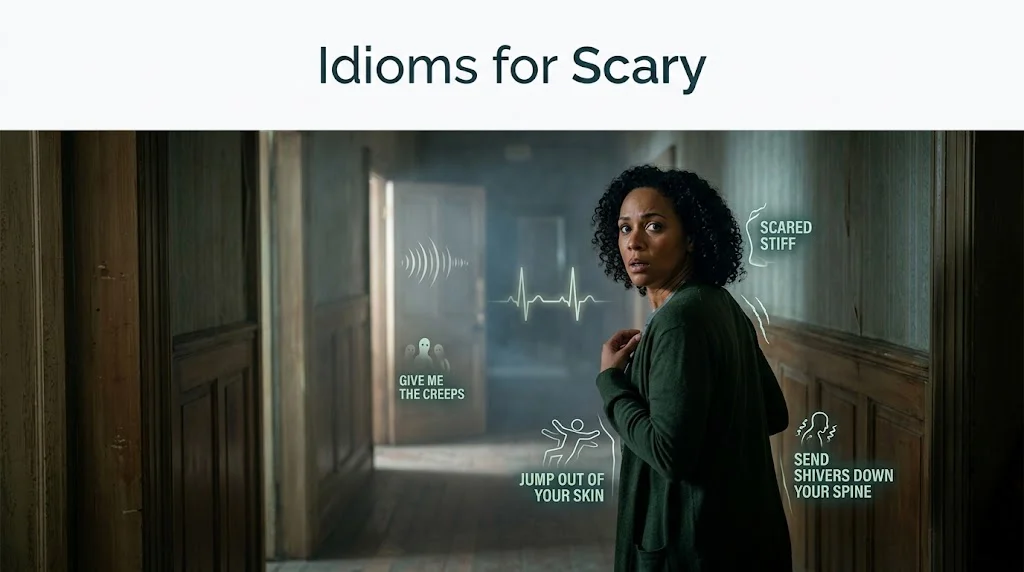
The key is understanding the difference between them. A spooky old house might give you the creeps, while a sudden loud noise might make you jump out of your skin. Once you understand those shades of meaning, your English becomes much more vivid and natural.
Quick Summary of Idioms for Scary
| Idiom or Expression | Meaning | Tone | Best Used For |
|---|---|---|---|
| Scared stiff | Extremely frightened | Informal | Sudden fear |
| Scared out of your wits | Very frightened | Informal | Intense fear |
| Scared to death | Extremely scared | Informal | Strong reactions |
| Give someone the creeps | Make someone uncomfortable or frightened | Informal | Eerie feelings |
| Send shivers down your spine | Cause a strong feeling of fear or excitement | Vivid | Stories, experiences |
Scared Stiff
Meaning:
Extremely frightened and almost unable to move or react.
When People Use It:
This informal idiom is useful for describing intense fear, especially after something sudden or frightening.
Alternative Expression:
Frozen with fear.
Examples in Communication
Formal Example:
The unexpected incident left several visitors scared stiff.
Casual Example:
That movie scared me stiff!
Creative Example:
She stood scared stiff as the footsteps approached the door.
Scared Out of Your Wits
Meaning:
Extremely frightened.
When People Use It:
This informal expression emphasizes that someone has been frightened so badly that they temporarily lose their usual composure.
Alternative Expression:
Scared senseless.
Examples in Communication
Formal Example:
The sudden alarm left the passengers scared out of their wits.
Casual Example:
You scared me out of my wits!
Creative Example:
The mysterious noise scared him out of his wits in the middle of the night.
Scared to Death
Meaning:
Extremely frightened.
When People Use It:
This is a common informal exaggeration. It does not normally mean someone is literally going to die.
Alternative Expression:
Terrified.
Examples in Communication
Formal Example:
The hikers were scared to death when the storm suddenly intensified.
Casual Example:
I was scared to death when I heard that crash.
Creative Example:
For one silent moment, she was scared to death by the shadow moving across the wall.
Give Someone the Creeps
Meaning:
To make someone feel uncomfortable, uneasy, or slightly frightened.
When People Use It:
This expression is especially useful for eerie people, places, situations, or things that feel strangely unsettling.
Alternative Expression:
Make someone uneasy.
Examples in Communication
Formal Example:
The abandoned building gave visitors the creeps.
Casual Example:
That old doll gives me the creeps.
Creative Example:
The empty hallway gave her the creeps, although she could not explain why.
Send Shivers Down Your Spine
Meaning:
To cause a sudden, powerful feeling of fear, excitement, or emotion.
When People Use It:
This vivid expression works especially well in storytelling and descriptive writing.
Alternative Expression:
Send chills through you.
Examples in Communication
Formal Example:
The haunting account sent shivers down the audience’s spines.
Casual Example:
That story sent shivers down my spine.
Creative Example:
A distant whisper sent shivers down his spine.
Make Your Blood Run Cold
Meaning:
To frighten or shock someone deeply.
When People Use It:
This dramatic expression is useful when something is deeply disturbing or frightening.
Alternative Expression:
Chill someone to the bone.
Examples in Communication
Formal Example:
The discovery made the investigators’ blood run cold.
Casual Example:
That sound made my blood run cold.
Creative Example:
The message on the door was enough to make her blood run cold.
Hair-Raising
Meaning:
Extremely frightening, thrilling, or exciting.
When People Use It:
This adjective is useful for describing experiences rather than simply labeling someone as scared.
Alternative Expression:
Terrifying.
Examples in Communication
Formal Example:
The documentary included several hair-raising accounts of survival.
Casual Example:
That was a hair-raising ride!
Creative Example:
The narrow mountain road turned into a hair-raising journey through the storm.
Have Your Heart in Your Mouth
Meaning:
To feel extremely nervous, anxious, or frightened about what is happening.
When People Use It:
This expression is especially common during suspenseful moments when you are waiting to see what happens next.
Alternative Expression:
Be on tenterhooks.
Examples in Communication
Formal Example:
The spectators had their hearts in their mouths as the final seconds passed.
Casual Example:
My heart was in my mouth when she nearly slipped.
Creative Example:
He watched the door open with his heart in his mouth.
Jump Out of Your Skin
Meaning:
To be extremely startled or frightened by something unexpected.
When People Use It:
This is common in casual conversation and is especially suitable for sudden scares.
Alternative Expression:
Jump a mile.
Examples in Communication
Formal Example:
The sudden noise caused several guests to jump out of their skins.
Casual Example:
You made me jump out of my skin!
Creative Example:
The unexpected knock made her jump out of her skin.
Scare the Life Out of Someone
Meaning:
To frighten someone very badly.
When People Use It:
This informal idiom is often used after a sudden surprise.
Alternative Expression:
Scare someone half to death.
Examples in Communication
Formal Example:
The unexpected announcement scared the life out of the audience.
Casual Example:
You scared the life out of me!
Creative Example:
The sudden movement in the bushes scared the life out of him.
Scare Someone Witless
Meaning:
To frighten someone severely.
When People Use It:
This informal expression emphasizes an unusually strong reaction to fear.
Alternative Expression:
Scare someone senseless.
Examples in Communication
Formal Example:
The unexpected event scared the children witless.
Casual Example:
That movie scared me witless.
Creative Example:
The strange figure standing at the end of the road scared her witless.
Shake Like a Leaf
Meaning:
To tremble noticeably because of fear, nervousness, or cold.
When People Use It:
This vivid idiom focuses on the physical reaction to fear.
Alternative Expression:
Tremble with fear.
Examples in Communication
Formal Example:
The witness was shaking like a leaf while describing the incident.
Casual Example:
I was shaking like a leaf before going on stage.
Creative Example:
He stood beneath the porch light, shaking like a leaf in the cold night air.
Quaking in Your Boots
Meaning:
To be very frightened or nervous.
When People Use It:
This is informal and often humorous. It can make fear sound slightly playful rather than deeply serious.
Alternative Expression:
Terrified.
Examples in Communication
Formal Example:
The inexperienced players were quaking in their boots before the difficult match.
Casual Example:
He’s quaking in his boots about the exam.
Creative Example:
The brave-looking explorer was secretly quaking in his boots.
On Edge
Meaning:
Nervous, tense, or uneasy.
When People Use It:
Unlike some stronger idioms, “on edge” often describes an ongoing state of nervousness rather than sudden terror.
Alternative Expression:
Uneasy.
Examples in Communication
Formal Example:
The uncertain situation left residents on edge.
Casual Example:
I’ve been on edge all day.
Creative Example:
Every creak in the old house kept them on edge.
Have Butterflies in Your Stomach
Meaning:
To feel nervous or excited, especially before an important event.
When People Use It:
This expression is usually about anticipation rather than genuine danger or terror.
Alternative Expression:
Feel nervous.
Examples in Communication
Formal Example:
The students had butterflies in their stomachs before presenting their projects.
Casual Example:
I always get butterflies in my stomach before a big event.
Creative Example:
She felt butterflies in her stomach as the curtain slowly rose.
Feel a Chill Run Down Your Spine
Meaning:
To suddenly experience an eerie, frightening, or unsettling feeling.
When People Use It:
This expression works particularly well in suspenseful descriptions.
Alternative Expression:
Feel a shiver.
Examples in Communication
Formal Example:
The strange discovery sent a chill down the researcher’s spine.
Casual Example:
I felt a chill run down my spine when I heard that noise.
Creative Example:
A cold whisper drifted through the room, and a chill ran down his spine.
A Close Shave
Meaning:
A situation in which someone narrowly avoids danger or trouble.
When People Use It:
This idiom is often used after a frightening or risky experience that ends safely.
Alternative Expression:
Narrow escape.
Examples in Communication
Formal Example:
The rescue operation followed what could have been a serious close shave.
Casual Example:
That was a close shave!
Creative Example:
Missing the falling branch by inches was a close shave he would never forget.
A Narrow Escape
Meaning:
A situation where someone barely avoids danger or an unpleasant outcome.
When People Use It:
This expression is neutral and can work in both formal and informal contexts.
Alternative Expression:
Close call.
Examples in Communication
Formal Example:
The travelers experienced a narrow escape during the unexpected storm.
Casual Example:
That was a really narrow escape.
Creative Example:
The locked gate turned out to be their last-minute escape from the approaching danger.
In Fear of Your Life
Meaning:
Extremely afraid that you may be seriously harmed.
When People Use It:
This is a serious expression and should not normally be used casually for minor scares.
Alternative Expression:
Terrified for your safety.
Examples in Communication
Formal Example:
The residents reported living in fear of their lives during the dangerous period.
Casual Example:
He ran because he was in fear of his life.
Creative Example:
For the first time, she realized she was genuinely in fear of her life.
Run for Your Life
Meaning:
To run away as quickly as possible because of immediate danger.
When People Use It:
This dramatic expression is common in stories, movies, and descriptions of urgent situations.
Alternative Expression:
Flee for safety.
Examples in Communication
Formal Example:
The hikers were instructed to run for their lives when the warning was issued.
Casual Example:
Run for your life!
Creative Example:
When the alarm sounded, everyone ran for their lives toward the exit.
Walking on Eggshells
Meaning:
To behave extremely carefully because you are worried about upsetting someone or causing trouble.
When People Use It:
This is usually figurative. It describes emotional tension rather than physical fear.
Alternative Expression:
Tread carefully.
Examples in Communication
Formal Example:
Employees felt as though they were walking on eggshells around the unpredictable supervisor.
Casual Example:
I feel like I’m walking on eggshells around him.
Creative Example:
Every conversation became a careful dance, as though they were walking on eggshells.
The Hairs on the Back of Your Neck Stand Up
Meaning:
To suddenly feel frightened, suspicious, or uneasy.
When People Use It:
This vivid expression is excellent for suspenseful storytelling when something feels wrong before you know exactly what it is.
Alternative Expression:
Get a creepy feeling.
Examples in Communication
Formal Example:
The unfamiliar surroundings made the hairs on her neck stand up.
Casual Example:
Something about that place made the hairs on the back of my neck stand up.
Creative Example:
The forest was silent, and the hairs on the back of his neck stood up.
Frighten the Life Out of Someone
Meaning:
To frighten someone extremely badly.
When People Use It:
This informal expression is similar to “scare the life out of someone” and is often used after a sudden surprise.
Alternative Expression:
Give someone a terrible fright.
Examples in Communication
Formal Example:
The unexpected incident frightened the life out of several visitors.
Casual Example:
You frightened the life out of me!
Creative Example:
The sudden figure in the doorway frightened the life out of her.
A Nightmare
Meaning:
A terrible, stressful, or frightening experience.
When People Use It:
This word is often used figuratively for difficult real-life situations, not only for frightening dreams.
Alternative Expression:
A terrible experience.
Examples in Communication
Formal Example:
The delayed journey became a logistical nightmare for the travelers.
Casual Example:
Getting home last night was a nightmare.
Creative Example:
The peaceful trip slowly turned into a nightmare of confusion and uncertainty.
A Fate Worse Than Death
Meaning:
Something imagined or described as being extremely unpleasant or undesirable.
When People Use It:
This dramatic expression is often humorous or exaggerated rather than literal.
Alternative Expression:
An unbearable situation.
Examples in Communication
Formal Example:
The character regarded public humiliation as a fate worse than death.
Casual Example:
Being stuck in that boring meeting felt like a fate worse than death.
Creative Example:
To the young adventurer, returning home without finishing the journey seemed like a fate worse than death.
How to Choose the Right Idiom for Scary Situations
Not every frightening situation deserves the same expression.
If something gives you a strange, uncomfortable feeling, “give me the creeps” is a natural choice.
If something happens suddenly, you might “jump out of your skin.”
If fear becomes physically overwhelming, you could be “shaking like a leaf” or “scared stiff.”
For suspense, “have your heart in your mouth” works particularly well.
For a deeply disturbing experience, “make your blood run cold” is much stronger.
This difference matters because good idiomatic English is not simply about knowing vocabulary. It is about choosing language that matches the intensity and emotional character of the situation.
Idioms for Scary People
English has several ways to describe a person who creates an uneasy feeling, but context matters.
Someone might give you the creeps because they behave strangely.
A frightening character in a story might send shivers down your spine.
A threatening situation may leave you on edge.
Avoid automatically calling someone “scary” when what you really mean is that they are unusual, intimidating, unpredictable, or unsettling. More precise language makes both conversation and writing stronger.
For example:
That man is scary.
is vague.
But:
Something about his silence gave me the creeps.
creates a much clearer emotional impression.
Idioms for Scary Stories
Idioms are especially effective in horror, mystery, suspense, and adventure writing because they help build atmosphere.
Instead of repeatedly writing:
She was scared.
You might write:
A chill ran down her spine.
Or:
The sound made her blood run cold.
Or:
She stood scared stiff beside the doorway.
These alternatives allow the reader to experience the character’s fear rather than simply being told that the character is frightened.
For writers, that distinction is powerful: showing the emotional reaction often creates a stronger scene than naming the emotion repeatedly.
Idioms for Scary Experiences
Different experiences call for different expressions.
A frightening roller coaster might be hair-raising.
A dangerous journey might end in a narrow escape.
A tense conversation might leave everyone on edge.
A sudden surprise could make you jump out of your skin.
A mysterious location might give you the creeps.
Thinking about the source of fear first makes choosing an idiom much easier.
Ask yourself:
Was the fear sudden?
Use “jump out of your skin.”
Was it eerie?
Use “give you the creeps.”
Was it intense?
Use “scared stiff” or “scared out of your wits.”
Was it suspenseful?
Use “have your heart in your mouth.”
Was there real danger?
Consider “a narrow escape” or “run for your life.”
Idioms for Scary in Creative Writing
Creative writing benefits from precise emotional language, but idioms should never become decoration for decoration’s sake.
Compare:
The house was scary. The hallway was scary. The sounds were scary.
with:
The hallway was silent, but every few seconds a faint sound seemed to travel through the walls. A chill ran down her spine.
The second version creates a feeling instead of repeatedly labeling the environment as scary.
One strong idiom can do more work than several ordinary adjectives.
The best expressions also match the genre. A playful mystery might use “quaking in your boots,” while a darker suspense scene might benefit from “make your blood run cold.”
Idioms for Scary in Essays and School Writing
Idioms can make essays more engaging, but context is important.
Formal assignments usually benefit from precise language rather than highly casual expressions.
For example, instead of:
Everyone was scared out of their wits.
you might write:
The unexpected event caused widespread fear among the residents.
However, if you are writing a narrative essay or personal story, an idiom can make your experience sound much more natural:
I had my heart in my mouth as I waited for the results.
The key is to match the expression to the assignment’s tone.
Common Mistakes When Using Idioms for Scary
Using every scary idiom as a synonym for “afraid”
The expressions have different meanings. “On edge” suggests nervousness, while “scared stiff” suggests much stronger fear.
Using dramatic idioms for tiny situations
Saying you were “in fear of your life” because you saw a harmless spider may sound exaggerated unless you are deliberately being humorous.
Forgetting the emotional tone
“Quaking in your boots” can sound playful, while “make your blood run cold” sounds much more serious.
Mixing idioms together
Avoid combining phrases such as “scared stiff” and “shaking like a leaf” into an unnecessarily crowded sentence.
Using informal expressions in formal contexts
“Scared the life out of me” is natural conversation, but a formal report may require more neutral wording.
Idioms vs Literal Expressions for Fear
There is a big difference between saying:
I was very afraid.
and:
I was shaking like a leaf.
The first statement directly names the emotion. The second describes a physical reaction, allowing the reader to picture the experience.
Similarly:
The place was frightening.
is straightforward.
But:
The place gave me the creeps.
suggests something more specific—an uncomfortable, eerie feeling that may be difficult to explain.
Idioms make language more expressive because they connect an emotional experience with an image.
How to Sound More Fluent When Using Scary Idioms
The easiest way to sound natural is to learn idioms as complete phrases, not isolated vocabulary.
Instead of memorizing only:
“Scared stiff = very frightened.”
Practice:
“I was scared stiff when I heard the noise.”
Then change the context:
“The children were scared stiff during the storm.”
“He looked scared stiff when the lights suddenly went out.”
This teaches you how the expression behaves in real sentences.
It is also useful to pay attention to register. Everyday conversations often favor “scared to death,” “give me the creeps,” and “jump out of my skin,” while formal writing may prefer more measured expressions.
How to Remember Idioms for Scary
Create a mental picture for each expression.
Imagine someone literally jumping out of their skin after hearing a sudden noise.
Picture a nervous person shaking like a leaf.
Imagine a mysterious hallway that gives you the creeps.
Picture a suspenseful moment where your heart is in your mouth.
These exaggerated images make idioms easier to remember because they connect language with emotion and visual memory.
Another effective strategy is to group idioms by intensity:
Mild uneasiness:
On edge, give someone the creeps.
Nervous anticipation:
Have butterflies in your stomach, have your heart in your mouth.
Sudden fright:
Jump out of your skin, scare the life out of someone.
Extreme fear:
Scared stiff, scared out of your wits, scared to death.
Danger:
Run for your life, a narrow escape, in fear of your life.
Why Idioms Make Fear More Expressive
Fear is not one single emotion.
You can be nervous before an exam, uneasy in a strange place, startled by a sudden noise, terrified during danger, or thrilled by a frightening story.
Idioms help separate these experiences.
That is why idioms for scary are so valuable for writers and language learners. They provide emotional precision. Instead of saying “scared” again and again, you can communicate the exact character of the fear.
A good idiom also creates an image in the reader’s mind. “A chill ran down her spine” feels different from “she was afraid.”
The language becomes more memorable because the emotion becomes more visible.
FAQs
What is a good idiom for being very scared?
“Scared stiff,” “scared out of your wits,” and “scared to death” are common informal expressions for being extremely frightened.
What is an idiom for something that feels creepy?
“Give someone the creeps” is a natural expression for something that makes a person feel uneasy, uncomfortable, or slightly frightened.
What idiom describes sudden fear?
“Jump out of your skin” is commonly used when someone is suddenly startled or frightened.
What is an idiom for feeling nervous or uneasy?
“On edge” is one of the most useful expressions for describing a continuing feeling of nervousness, tension, or uneasiness.
What is a good idiom for a frightening experience?
“Hair-raising,” “send shivers down your spine,” and “make your blood run cold” are vivid choices, depending on how intense or dramatic the experience is.
Conclusion
Fear can be quiet, sudden, playful, overwhelming, or deeply unsettling. That variety is exactly why idioms for scary can make English so much more expressive.
Expressions such as “scared stiff,” “give someone the creeps,” “jump out of your skin,” “send shivers down your spine,” “on edge,” and “make your blood run cold” each describe a different shade of fear. Learning those differences allows you to communicate with greater accuracy rather than relying on the same word again and again.
For students, idioms can make narrative writing more vivid. For language learners, they provide natural conversational vocabulary. For bloggers and storytellers, they can turn a simple description into an emotional scene.
The goal is not to use an idiom every time you talk about fear. Instead, listen to how expressions work in context and choose the one that genuinely fits the moment. When the phrase matches the feeling, your English becomes more vivid, natural, and memorable.
Discover More Related Articles:
- Idioms for Children | Fun & Easy Expressions Kids Can Learn In 2026
- Idioms for Running | Expressions to Make Your English More Fluent In 2026