Quick Answer
Idioms for children are fun expressions whose meanings are different from the exact words used. They help kids understand everyday English, improve vocabulary, become better readers, and express ideas in a more colorful way.
For example, “break the ice” does not mean actually breaking ice. It means helping people feel more comfortable when they first meet. Similarly, “piece of cake” means something is very easy.
The best idioms for children are simple, memorable, and connected to situations they already understand—school, friends, family, games, feelings, success, and everyday conversations.
Learning idioms through short examples and funny mental pictures makes them much easier to remember. Whether a child is working on an English assignment, reading a story, or simply trying to speak more naturally, these expressions can make language more interesting and expressive.
Quick Summary of Idioms for Children
| Idiom | Simple Meaning | Best For |
|---|---|---|
| Piece of cake | Very easy | Schoolwork |
| Break the ice | Make people comfortable | Meeting friends |
| Hit the books | Start studying | School |
| Spill the beans | Reveal a secret | Conversations |
| Once in a blue moon | Very rarely | Time |
Children naturally love language that feels like a little puzzle. An expression such as “raining cats and dogs” can make them wonder why anyone would talk about animals when the sky is full of rain. That moment of curiosity is exactly what makes idioms so memorable.
Idioms are common in conversations, children’s books, classroom discussions, cartoons, stories, and everyday English. Understanding them helps children move beyond the literal meaning of words and recognize what speakers actually intend to say.
For parents, teachers, and language learners, idioms can also be a wonderful way to build vocabulary without making learning feel like a list of difficult definitions.
The trick is to teach idioms through context. A child is more likely to remember “hit the books” after imagining a student opening a huge pile of textbooks than after memorizing a dictionary definition.
The expressions below are simple, useful, and connected to situations children encounter in real life.
Piece of Cake
Meaning:
Something that is very easy to do.
When People Use It:
This is useful when talking about an easy homework task, game, puzzle, or activity.
Alternative Expression:
Easy as pie.
Examples in Communication
Formal Example:
The reading exercise was a piece of cake for the students.
Casual Example:
That math problem was a piece of cake!
Creative Example:
After practicing all week, the spelling test felt like a piece of cake.
Break the Ice
Meaning:
To make people feel more comfortable when they meet for the first time.
When People Use It:
Children may hear this at school, clubs, parties, or new activities where people do not know one another.
Alternative Expression:
Start a friendly conversation.
Examples in Communication
Formal Example:
The teacher played a quick game to break the ice on the first day of school.
Casual Example:
I told a joke to break the ice.
Creative Example:
One silly question was enough to break the ice between the two new classmates.
Hit the Books
Meaning:
To start studying seriously.
When People Use It:
This informal expression is especially common when students are preparing for tests or completing schoolwork.
Alternative Expression:
Start studying.
Examples in Communication
Formal Example:
The students decided to hit the books before the upcoming examination.
Casual Example:
I have to hit the books tonight.
Creative Example:
With the science test approaching, Maya knew it was time to hit the books.
Spill the Beans
Meaning:
To accidentally or intentionally reveal a secret.
When People Use It:
This playful idiom is often used when someone tells information that was supposed to remain secret.
Alternative Expression:
Let the secret out.
Examples in Communication
Formal Example:
The children were asked not to spill the beans about the surprise celebration.
Casual Example:
Come on, spill the beans! What’s the surprise?
Creative Example:
Tom tried to keep quiet, but one excited smile almost spilled the beans.
Once in a Blue Moon
Meaning:
Something that happens very rarely.
When People Use It:
This expression is useful for talking about unusual events or things that do not happen often.
Alternative Expression:
Very rarely.
Examples in Communication
Formal Example:
We visit that part of town once in a blue moon.
Casual Example:
I eat candy once in a blue moon.
Creative Example:
Once in a blue moon, Grandma would let us stay up past bedtime.
Under the Weather
Meaning:
Feeling sick or unwell.
When People Use It:
This common expression is useful in everyday conversations about health without describing a specific illness.
Alternative Expression:
Feeling unwell.
Examples in Communication
Formal Example:
Several students were under the weather and stayed home from school.
Casual Example:
I’m feeling a little under the weather today.
Creative Example:
Even the usually energetic puppy seemed under the weather.
A Blessing in Disguise
Meaning:
Something that initially seems bad but eventually turns out to be helpful or fortunate.
When People Use It:
This idiom is especially useful for teaching children about finding positive outcomes in difficult situations.
Alternative Expression:
Something good came from it.
Examples in Communication
Formal Example:
Missing the bus turned out to be a blessing in disguise because the next bus arrived quickly.
Casual Example:
Losing that game was a blessing in disguise because we learned what to practice.
Creative Example:
The rainy day was a blessing in disguise; everyone ended up playing board games together.
Cost an Arm and a Leg
Meaning:
To be extremely expensive.
When People Use It:
This informal expression is often used when talking about something that costs much more than expected.
Alternative Expression:
Cost a fortune.
Examples in Communication
Formal Example:
The family decided not to buy the toy because it cost an arm and a leg.
Casual Example:
That new game costs an arm and a leg!
Creative Example:
The enormous chocolate cake looked amazing, but it seemed to cost an arm and a leg.
Hold Your Horses
Meaning:
Wait or slow down.
When People Use It:
This playful expression is useful when someone is becoming too excited or rushing ahead.
Alternative Expression:
Wait a minute.
Examples in Communication
Formal Example:
The teacher asked the students to hold their horses while she explained the next step.
Casual Example:
Hold your horses! We aren’t leaving yet.
Creative Example:
“Hold your horses!” shouted Ben as his friends raced toward the playground.
Let the Cat Out of the Bag
Meaning:
To reveal a secret.
When People Use It:
It has a similar meaning to “spill the beans” and works well in playful conversations.
Alternative Expression:
Reveal the secret.
Examples in Communication
Formal Example:
The children tried not to let the cat out of the bag before the surprise party.
Casual Example:
Who let the cat out of the bag?
Creative Example:
One tiny hint let the cat out of the bag before the big celebration.
Raining Cats and Dogs
Meaning:
Raining very heavily.
When People Use It:
This colorful idiom is common in children’s stories and informal conversation.
Alternative Expression:
Pouring with rain.
Examples in Communication
Formal Example:
The outdoor activity was canceled because it was raining cats and dogs.
Casual Example:
Take an umbrella—it’s raining cats and dogs!
Creative Example:
It was raining cats and dogs, so the children turned the living room into a pretend camping site.
When Pigs Fly
Meaning:
Something is very unlikely or probably will never happen.
When People Use It:
This humorous idiom is often used when joking about an impossible or highly unlikely event.
Alternative Expression:
Not likely.
Examples in Communication
Formal Example:
He said he would finish all his homework before breakfast—but only when pigs fly.
Casual Example:
Will you clean your room today? “When pigs fly!”
Creative Example:
Lena promised to give up her favorite game when pigs fly.
On Cloud Nine
Meaning:
Extremely happy.
When People Use It:
This is a cheerful expression for describing excitement after good news, success, celebrations, or special moments.
Alternative Expression:
Overjoyed.
Examples in Communication
Formal Example:
The students were on cloud nine after hearing the good news.
Casual Example:
I’m on cloud nine!
Creative Example:
After seeing her name on the winners’ list, she was on cloud nine.
In Hot Water
Meaning:
To be in trouble.
When People Use It:
Children may hear this expression when someone has broken a rule or made a mistake.
Alternative Expression:
In trouble.
Examples in Communication
Formal Example:
The student knew he was in hot water after forgetting the important assignment.
Casual Example:
I’m in hot water for losing Dad’s book.
Creative Example:
By the time the teacher arrived, the mischievous puppy had already put everyone in hot water.
Keep an Eye On
Meaning:
To watch or look after something carefully.
When People Use It:
This is a very useful everyday expression for school, family, travel, and safety situations.
Alternative Expression:
Watch carefully.
Examples in Communication
Formal Example:
Please keep an eye on the younger children while they play.
Casual Example:
Can you keep an eye on my bag?
Creative Example:
Mom asked Sara to keep an eye on the cookies cooling by the window.
Get Cold Feet
Meaning:
To become nervous or uncertain before doing something.
When People Use It:
This is useful when someone becomes nervous before performing, competing, speaking, or trying something new.
Alternative Expression:
Become nervous.
Examples in Communication
Formal Example:
The student almost got cold feet before giving her presentation.
Casual Example:
I wanted to go on the stage, but I got cold feet.
Creative Example:
Just before the race began, Sam got cold feet—but his friends encouraged him.
The Ball Is in Your Court
Meaning:
It is now your responsibility or turn to decide what happens next.
When People Use It:
Children can learn this through games and teamwork. It is also useful when discussing decisions.
Alternative Expression:
It is your turn.
Examples in Communication
Formal Example:
We have shared our suggestions, so the ball is now in your court.
Casual Example:
I gave you the idea. The ball is in your court now.
Creative Example:
The invitation was on the table, and the ball was in Mia’s court.
Go the Extra Mile
Meaning:
To make more effort than is normally expected.
When People Use It:
This is excellent for teaching children about kindness, responsibility, teamwork, and effort.
Alternative Expression:
Make extra effort.
Examples in Communication
Formal Example:
The student went the extra mile to help her classmates understand the lesson.
Casual Example:
Thanks for going the extra mile to help me!
Creative Example:
He went the extra mile by decorating the classroom before everyone arrived.
Barking Up the Wrong Tree
Meaning:
Looking in the wrong place or blaming the wrong person.
When People Use It:
This playful expression is particularly memorable for children because it uses the image of a dog searching the wrong tree.
Alternative Expression:
Looking in the wrong place.
Examples in Communication
Formal Example:
If you think I lost the book, you are barking up the wrong tree.
Casual Example:
You’re barking up the wrong tree—I wasn’t even there!
Creative Example:
The detective searched the blue box, but he was barking up the wrong tree.
See Eye to Eye
Meaning:
To agree with someone.
When People Use It:
This expression is useful for talking about friendship, teamwork, family discussions, and different opinions.
Alternative Expression:
Agree.
Examples in Communication
Formal Example:
The two students did not always see eye to eye, but they respected each other’s ideas.
Casual Example:
We don’t always see eye to eye.
Creative Example:
Although the brothers argued about many things, they saw eye to eye about helping their friend.
Give It a Shot
Meaning:
To try something.
When People Use It:
This informal expression encourages someone to attempt something even if they are unsure of success.
Alternative Expression:
Give it a try.
Examples in Communication
Formal Example:
The teacher encouraged every student to give the challenging activity a shot.
Casual Example:
I’ve never tried skating, but I’ll give it a shot.
Creative Example:
Maya was nervous about the new game, but she decided to give it a shot.
Pull Yourself Together
Meaning:
To calm down and regain control of your emotions.
When People Use It:
This phrase can be useful, but adults and teachers should use it gently. Someone who is upset may need patience and support rather than criticism.
Alternative Expression:
Calm yourself.
Examples in Communication
Formal Example:
After taking a few deep breaths, the student pulled herself together and continued the presentation.
Casual Example:
Take a breath and pull yourself together.
Creative Example:
He wiped away his tears, took a breath, and pulled himself together before returning to the game.
Practice Makes Perfect
Meaning:
Regular practice helps you improve your skills.
When People Use It:
This is especially useful for children learning music, sports, spelling, mathematics, reading, or another new skill.
Alternative Expression:
Practice helps you improve.
Examples in Communication
Formal Example:
The teacher reminded the class that practice makes perfect.
Casual Example:
Keep practicing—practice makes perfect!
Creative Example:
The first drawing looked difficult, but after weeks of practice, the pictures became much better.
Actions Speak Louder Than Words
Meaning:
What someone does is often more meaningful than what they say.
When People Use It:
This is a valuable expression for teaching children about honesty, responsibility, kindness, and keeping promises.
Alternative Expression:
What you do matters more than what you say.
Examples in Communication
Formal Example:
The volunteer showed that actions speak louder than words by helping the community every weekend.
Casual Example:
He says he’ll help, but actions speak louder than words.
Creative Example:
She never promised to be a good friend; she simply showed it. Actions speak louder than words.
Head Over Heels
Meaning:
Extremely excited, enthusiastic, or deeply interested in something or someone.
When People Use It:
For children, this expression is often best used for enthusiasm about hobbies, activities, books, sports, or exciting experiences.
Alternative Expression:
Extremely excited.
Examples in Communication
Formal Example:
The young reader was head over heels for the new adventure series.
Casual Example:
I’m head over heels for this new game!
Creative Example:
After discovering the magical garden, the children were head over heels with excitement.
How to Use Idioms Naturally With Children
The easiest way to teach an idiom is to connect it to a situation a child already understands.
Instead of simply saying:
“Piece of cake means easy.”
Try:
“If your homework is really easy, you can say, ‘This homework is a piece of cake!’”
That small example turns a definition into something usable.
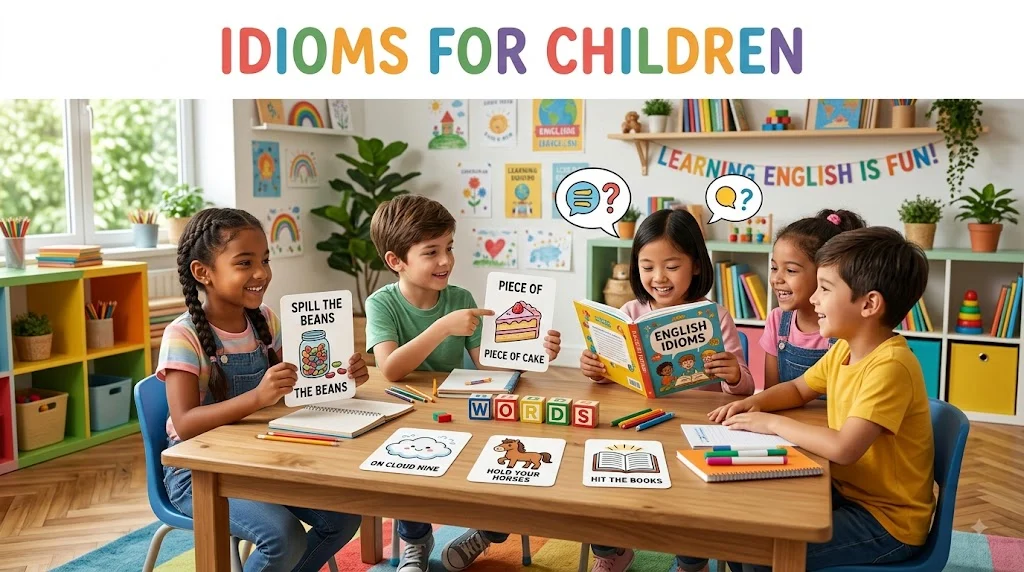
Pictures, stories, classroom games, role-playing, and short conversations can make idioms even easier to remember. Children often understand figurative expressions faster when they can visualize the funny or unusual image behind them.
It is also helpful to introduce only a few expressions at a time. Learning five idioms well is more useful than memorizing twenty-five definitions and forgetting them the next day.
Common Mistakes Children Make With Idioms
Taking Idioms Literally
A child who hears “raining cats and dogs” for the first time may imagine animals falling from the sky. Explain the figurative meaning while also enjoying the funny literal image.
Using an Idiom in Every Sentence
Idioms should add color to language, not replace ordinary communication. Children should learn when a simple phrase is clearer.
Choosing the Wrong Context
“Give someone an earful” suggests a long angry complaint. It would not be appropriate for describing a friendly conversation.
Forgetting the Meaning
Encourage children to learn idioms through complete sentences rather than isolated vocabulary cards.
Using Very Informal Expressions in School Writing
Some idioms are perfect for conversations but may not fit a formal assignment. Teaching children about tone helps them become stronger writers.
Idioms vs Literal Expressions for Kids
An idiom has a figurative meaning, while a literal expression means exactly what the words say.
For example:
Literal:
“The cake is easy to make.”
Idiomatic:
“The cake recipe is a piece of cake.”
The second sentence does not mean the cake itself is literally a piece of cake. It means the task is easy.
This difference can seem confusing at first, but it is also one of the most enjoyable parts of learning English. Idioms encourage children to think about language from more than one angle.
How Idioms Help Children Improve English
Idioms can help children:
- Understand conversations more easily
- Improve reading comprehension
- Build vocabulary
- Make stories more interesting
- Recognize figurative language
- Express emotions more naturally
- Understand books, movies, and conversations
- Become more confident English speakers
- Add variety to school writing
- Appreciate humor and wordplay
The goal is not to make every sentence sound fancy. The goal is to help children recognize the expressions they are likely to encounter and use appropriate ones when the situation calls for them.
Fun Ways to Teach Idioms to Children
Use Drawing Activities
Ask children to draw the literal version of an idiom. A picture of cats and dogs falling from the sky can create a memorable connection with “raining cats and dogs.”
Create Mini Stories
Give children three idioms and ask them to build a short story around them. This encourages both comprehension and creativity.
Play a Guessing Game
Read the meaning without saying the idiom. Let children guess which expression matches it.
Act Them Out
Expressions such as “hold your horses,” “hit the books,” and “give it a shot” are perfect for simple classroom role-play.
Use Everyday Situations
When a child finishes a difficult puzzle, you might say, “That was a piece of cake!” Context helps the expression stick.
Why Children Remember Funny Idioms
Idioms often contain unusual mental images. A person cannot literally hold horses when someone says “hold your horses,” and pigs are unlikely to fly when someone says “when pigs fly.”
That unusual imagery gives the brain something memorable to hold onto.
Children can use this to their advantage. Whenever they learn a new idiom, they can imagine the literal picture first and then connect it with the real meaning.
For example:
Hold your horses → Imagine horses → Think “wait.”
Hit the books → Imagine hitting a stack of books → Think “study.”
On cloud nine → Imagine floating on a cloud → Think “very happy.”
This simple technique can turn vocabulary practice into a creative activity.
FAQs
What is an idiom for kids?
An idiom is an expression whose intended meaning is different from the literal meaning of its words. For example, “piece of cake” means something is easy.
What are some easy idioms for children?
“Piece of cake,” “break the ice,” “hit the books,” “spill the beans,” “speak of the devil,” “hold your horses,” and “give it a shot” are easy expressions for children to learn through examples.
Why should children learn idioms?
Idioms help children understand everyday English, improve reading comprehension, expand vocabulary, and make their speaking and writing more expressive.
How can children remember idioms easily?
Pictures, stories, role-play, games, and personal example sentences can make idioms much easier to remember than memorizing definitions alone.
What is the best idiom for something easy?
“Piece of cake” is one of the most familiar idioms for something that is very easy.
Conclusion
Learning idioms for children can turn ordinary vocabulary practice into something much more imaginative. Expressions such as “piece of cake,” “break the ice,” “hit the books,” “spill the beans,” and “on cloud nine” give children new ways to understand conversations and express their own thoughts.
The most effective approach is to teach idioms through context rather than asking children to memorize long definitions. A funny picture, a short story, or a familiar school situation can make an unfamiliar expression suddenly click.
Children also do not need to use every idiom they learn. Recognizing an expression when they hear or read it is already an important language skill.
With regular exposure and plenty of opportunities to experiment, idioms can become a natural part of a child’s English vocabulary. More importantly, they can show young learners that language is not only about rules it can also be playful, imaginative, surprising, and fun.
Discover More Related Articles: