Quick Answer
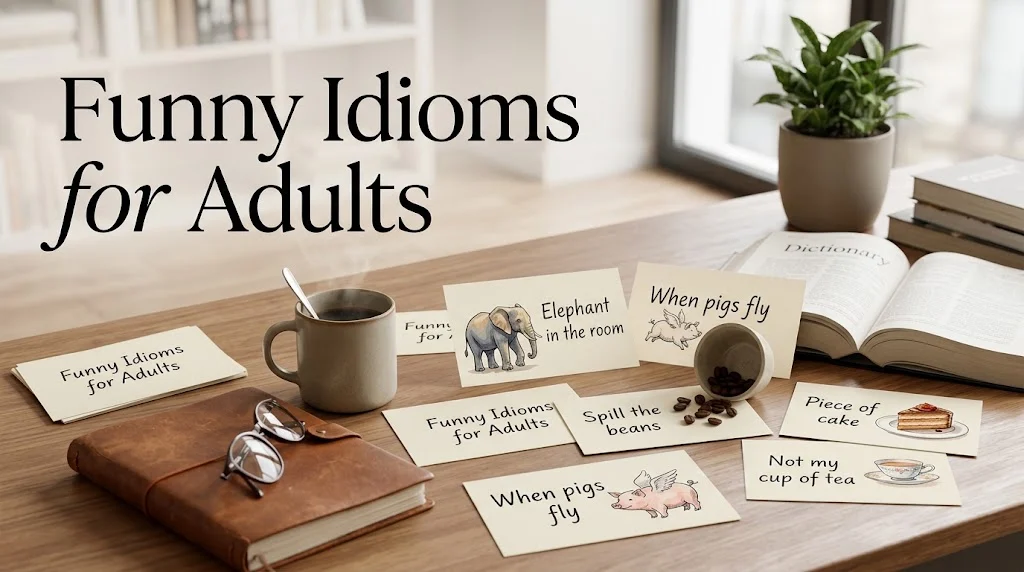
Funny idioms for adults are playful expressions that communicate everyday situations with humor, exaggeration, and personality. Popular examples include “bite the bullet,” “spill the beans,” “let the cat out of the bag,” “piece of cake,” “break a leg,” “cost an arm and a leg,” “under the weather,” “the elephant in the room,” and “when pigs fly.”
Adult life gives us plenty of situations that are easier to laugh about than explain.
A meeting lasts longer than expected. Someone accidentally reveals a surprise. A friend spends too much money on something unnecessary. A tiny problem becomes a dramatic household emergency.
Instead of explaining every detail, English speakers often reach for an idiom.
Saying “That meeting was a storm in a teacup” is much more colorful than simply saying, “People made too much fuss about a small issue.”
Funny idioms work because they create an unexpected mental picture. Pigs flying, cats escaping bags, people eating cake, and elephants standing unnoticed in rooms are obviously not literal descriptions. That contrast is what makes the language memorable.
For adults learning English, these expressions are especially useful because they appear frequently in conversations, television, podcasts, books, workplace discussions, social media, and informal writing.
The secret is knowing when to use them. An idiom can make a casual conversation lively, but the same expression might feel too informal in a serious business report.
Quick Summary Table
| Funny Idiom | Simple Meaning | Best Used For |
|---|---|---|
| Bite the bullet | Face something difficult | Difficult tasks |
| Spill the beans | Reveal a secret | Secrets, gossip |
| Let the cat out of the bag | Reveal a secret accidentally | Surprises |
| Piece of cake | Very easy | Easy tasks |
| Break a leg | Good luck | Performances, events |
| Cost an arm and a leg | Very expensive | Shopping, expenses |
| Under the weather | Feeling unwell | Everyday conversation |
| The elephant in the room | An obvious issue nobody discusses | Awkward situations |
| When pigs fly | Something extremely unlikely | Jokes, disbelief |
| Hit the nail on the head | Be exactly right | Opinions, observations |
| Barking up the wrong tree | Pursuing the wrong idea | Mistakes, misunderstandings |
| Once in a blue moon | Very rarely | Habits, events |
| Pull someone’s leg | Joke with someone | Friendly teasing |
| A fish out of water | Feel uncomfortable in a situation | New experiences |
| Go bananas | Become very excited or upset | Emotional reactions |
| Couch potato | Someone very inactive | Leisure, humor |
| Spill the tea | Share gossip or interesting news | Casual conversation |
| Not my cup of tea | Not something I like | Preferences |
| Beat around the bush | Avoid the main point | Difficult conversations |
| Have bigger fish to fry | Have more important things to do | Priorities |
| A storm in a teacup | A lot of fuss over something minor | Small problems |
| Add fuel to the fire | Make a situation worse | Arguments, conflict |
| Off one’s rocker | Acting strangely | Playful descriptions |
| The last straw | Final problem that causes frustration | Annoyance |
| Jump on the bandwagon | Follow a popular trend | Trends, social behavior |
Bite the Bullet
Meaning: To face something difficult or unpleasant with courage and get it done.
When People Use It: This expression is useful when someone has been avoiding a difficult task and finally decides to deal with it.
Alternative Expression: Face the music.
Examples in Communication:
Formal Example:
“The management team decided to bite the bullet and address the underlying issue.”
Casual Example:
“I’ve been avoiding my taxes, but I guess I need to bite the bullet.”
Creative Example:
“She stared at the mountain of paperwork, sighed dramatically, and decided to bite the bullet.”
The expression has a humorous quality because its literal image sounds rather extreme.
Spill the Beans
Meaning: To reveal secret or private information.
When People Use It: People commonly use this phrase when someone accidentally or intentionally reveals a surprise, plan, or piece of gossip.
Alternative Expression: Let the secret out.
Examples in Communication:
Formal Example:
“The spokesperson refused to spill the beans before the official announcement.”
Casual Example:
“Come on, spill the beans! What happened?”
Creative Example:
“One innocent question was enough to make him spill the beans about the surprise party.”
This idiom is highly conversational and works particularly well among friends.
Let the Cat Out of the Bag
Meaning: To accidentally reveal a secret.
When People Use It: This is especially common when someone ruins a surprise without meaning to.
Alternative Expression: Give the game away.
Examples in Communication:
Formal Example:
“The announcement was intended to remain confidential, but an employee accidentally let the cat out of the bag.”
Casual Example:
“I wasn’t supposed to tell you, but I let the cat out of the bag.”
Creative Example:
“Her excited smile let the cat out of the bag before the birthday card even arrived.”
The funny mental picture makes this expression easy to remember.
Piece of Cake
Meaning: Something that is very easy to do.
When People Use It: Use this phrase when a task requires little effort or seems surprisingly simple.
Alternative Expression: Easy as pie.
Examples in Communication:
Formal Example:
“Once the process was explained, the task proved to be a piece of cake.”
Casual Example:
“Don’t worry about the presentation. It’ll be a piece of cake.”
Creative Example:
“The supposedly terrifying puzzle turned out to be a piece of cake.”
This is one of the safest and most familiar humorous idioms for everyday English.
Break a Leg
Meaning: Good luck, especially before a performance or important event.
When People Use It: It is traditionally associated with actors and performers, although people sometimes use it playfully before exams, presentations, competitions, or other important moments.
Alternative Expression: Good luck.
Examples in Communication:
Formal Example:
“The director wished the performers well before the opening night.”
Casual Example:
“You’re going on stage in five minutes? Break a leg!”
Creative Example:
“She took one deep breath, smiled at her friends, and heard the familiar words: “Break a leg!””
The expression sounds strange if taken literally, which is part of its charm.
Cost an Arm and a Leg
Meaning: To be extremely expensive.
When People Use It: This idiom is common when talking about expensive products, services, vacations, repairs, or purchases.
Alternative Expression: Cost a fortune.
Examples in Communication:
Formal Example:
“The renovation cost an arm and a leg, although the final result was impressive.”
Casual Example:
“That phone looks great, but it costs an arm and a leg.”
Creative Example:
“The tiny cup of coffee was delicious, but at that price, it practically cost an arm and a leg.”
It is informal and often humorous rather than genuinely dramatic.
Under the Weather
Meaning: Feeling slightly ill or unwell.
When People Use It: This is a gentle way to say that you are not feeling well without describing a specific illness.
Alternative Expression: Feel off.
Examples in Communication:
Formal Example:
“Several employees were absent after feeling under the weather.”
Casual Example:
“I’m feeling a little under the weather today.”
Creative Example:
“Even the brightest morning couldn’t cheer him up; he was still under the weather.”
It is common in everyday speech and sounds softer than simply saying, “I’m sick.”
The Elephant in the Room
Meaning: An obvious or important problem that everyone knows about but nobody wants to discuss.
When People Use It: This is excellent for awkward meetings, family conversations, social situations, and serious discussions.
Alternative Expression: The obvious issue.
Examples in Communication:
Formal Example:
“The discussion addressed several minor concerns but avoided the elephant in the room.”
Casual Example:
“Okay, can we talk about the elephant in the room?”
Creative Example:
“Everyone admired the new office furniture while carefully ignoring the elephant in the room.”
The humor comes from imagining an enormous elephant somehow being ignored by everyone.
When Pigs Fly
Meaning: Something is extremely unlikely or probably will never happen.
When People Use It: This playful phrase is useful when responding humorously to an unrealistic suggestion or prediction.
Alternative Expression: Not in a million years.
Examples in Communication:
Formal Example:
“Such a dramatic change seems unlikely in the foreseeable future.”
Casual Example:
“You’ll clean your room without being asked? When pigs fly!”
Creative Example:
“He promised to stop procrastinating forever. Sure—when pigs fly.”
It is informal and deliberately exaggerated.
Hit the Nail on the Head
Meaning: To describe something exactly correctly or identify the main point.
When People Use It: Use it when someone makes an accurate observation or explains the real cause of a problem.
Alternative Expression: Get it exactly right.
Examples in Communication:
Formal Example:
“The researcher hit the nail on the head when she identified poor communication as the central issue.”
Casual Example:
“You hit the nail on the head. That’s exactly what I’ve been thinking.”
Creative Example:
“His one sentence hit the nail on the head and suddenly the whole mystery made sense.”
It is useful in both casual and professional communication.
Barking Up the Wrong Tree
Meaning: To pursue the wrong idea or blame the wrong person.
When People Use It: This phrase works when someone has misunderstood a situation or is searching in the wrong direction.
Alternative Expression: Looking in the wrong place.
Examples in Communication:
Formal Example:
“The investigation may be barking up the wrong tree by focusing on unrelated factors.”
Casual Example:
“If you think I ate the last cookie, you’re barking up the wrong tree.”
Creative Example:
“The detective had spent three hours barking up the wrong tree—and the real clue was sitting on his desk.”
It is especially fun in humorous storytelling.
Once in a Blue Moon
Meaning: Something that happens very rarely.
When People Use It: Use it for occasional habits, unusual events, or things that almost never happen.
Alternative Expression: Hardly ever.
Examples in Communication:
Formal Example:
“Such opportunities occur only once in a blue moon.”
Casual Example:
“I eat dessert once in a blue moon.”
Creative Example:
“Once in a blue moon, the entire family managed to sit down for dinner at the same time.”
The phrase adds personality to an otherwise ordinary statement.
Pull Someone’s Leg
Meaning: To joke with someone or tease them by pretending something is true.
When People Use It: This expression is common among friends and family members.
Alternative Expression: Tease someone.
Examples in Communication:
Formal Example:
“The comment was not intended as a factual statement; he was merely pulling his colleague’s leg.”
Casual Example:
“Relax, I’m just pulling your leg!”
Creative Example:
“She stared at him suspiciously until he laughed and admitted he was pulling her leg.”
Tone matters here. The expression works best when everyone understands that the comment is playful.
A Fish Out of Water
Meaning: A person who feels uncomfortable, unfamiliar, or out of place in a particular situation.
When People Use It: This is useful when someone enters a completely unfamiliar environment.
Alternative Expression: Out of one’s element.
Examples in Communication:
Formal Example:
“Without prior experience, the new employee initially felt like a fish out of water.”
Casual Example:
“I felt like a fish out of water at that fancy event.”
Creative Example:
“Surrounded by experts discussing complicated theories, he felt like a fish out of water.”
It is especially effective for describing social awkwardness without sounding harsh.
Couch Potato
Meaning: A person who spends a lot of time sitting around watching television or relaxing instead of being active.
When People Use It: Usually used humorously or self-deprecatingly.
Alternative Expression: Stay glued to the couch.
Examples in Communication:
Formal Example:
“Excessive sedentary behavior can contribute to an unhealthy lifestyle.”
Casual Example:
“I’ve been a total couch potato all weekend.”
Creative Example:
“By Sunday afternoon, the couch had officially claimed him as its newest potato.”
It is generally lighthearted when used about oneself or among friends.
Spill the Tea
Meaning: To share gossip, interesting information, or the latest news.
When People Use It: This is informal and especially common in casual online communication and conversations.
Alternative Expression: Tell me the gossip.
Examples in Communication:
Formal Example:
“During the informal discussion, colleagues exchanged the latest news.”
Casual Example:
“Okay, spill the tea. What happened?”
Creative Example:
“She arrived with a dramatic expression and immediately announced that she had tea to spill.”
Because this expression is strongly casual, it is better suited to social conversations, blogs, captions, and informal writing than formal essays.
Not My Cup of Tea
Meaning: Something that you do not particularly like or enjoy.
When People Use It: This phrase is useful when expressing a preference politely.
Alternative Expression: Not really my thing.
Examples in Communication:
Formal Example:
“Although the genre has a dedicated audience, it is not particularly my cup of tea.”
Casual Example:
“Horror movies aren’t really my cup of tea.”
Creative Example:
“Camping beneath the stars sounded romantic, but sleeping beside mosquitoes was definitely not her cup of tea.”
It is often softer than simply saying, “I don’t like it.”
Beat Around the Bush
Meaning: To avoid saying what you really mean or delay getting to the main point.
When People Use It: This idiom is common when someone is giving an unnecessarily indirect explanation.
Alternative Expression: Get to the point.
Examples in Communication:
Formal Example:
“The report should address the issue directly rather than beat around the bush.”
Casual Example:
“Stop beating around the bush and tell me what happened.”
Creative Example:
“He spent ten minutes discussing the weather before finally getting to the reason for the visit.”
This is useful when discussing communication itself.
Have Bigger Fish to Fry
Meaning: To have more important matters to deal with.
When People Use It: This phrase is often used casually when someone does not want to spend time on a minor issue.
Alternative Expression: Have more important things to do.
Examples in Communication:
Formal Example:
“The committee has bigger issues to address before considering the minor complaint.”
Casual Example:
“I’ve got bigger fish to fry today.”
Creative Example:
“With a deadline approaching, she had bigger fish to fry than arguing over a missing pen.”
The strange image of someone frying fish makes the expression memorable.
A Storm in a Teacup
Meaning: A lot of excitement, anger, or concern about something that is actually minor.
When People Use It: This expression works well when people dramatically overreact to a small problem.
Alternative Expression: Make a mountain out of a molehill.
Examples in Communication:
Formal Example:
“The disagreement ultimately proved to be a storm in a teacup.”
Casual Example:
“Everyone was arguing over the seating plan. It was just a storm in a teacup.”
Creative Example:
“The missing cookie created a storm in a teacup before everyone realized there was another packet in the cupboard.”
It is excellent for describing unnecessary drama.
Add Fuel to the Fire
Meaning: To make an already difficult or tense situation worse.
When People Use It: This idiom is often used during arguments, disagreements, conflicts, or stressful situations.
Alternative Expression: Make matters worse.
Examples in Communication:
Formal Example:
“Public criticism could add fuel to the fire during an already sensitive negotiation.”
Casual Example:
“Don’t mention his mistake right now. You’ll just add fuel to the fire.”
Creative Example:
“The argument was already burning, and his sarcastic comment added fuel to the fire.”
The image is dramatic, which gives the phrase emotional strength.
Off One’s Rocker
Meaning: Acting strangely, irrationally, or foolishly.
When People Use It: This is an informal and humorous way to describe unusual behavior.
Alternative Expression: Out of one’s mind.
Examples in Communication:
Formal Example:
“The statement appeared highly irrational to those present.”
Casual Example:
“You’d have to be off your rocker to pay that much for a sandwich.”
Creative Example:
“Anyone who thought wearing a winter coat in July was a good idea had clearly gone off their rocker.”
Use it carefully because describing another person this way can sound insulting.
The Last Straw
Meaning: The final problem or annoyance that makes someone lose patience after several previous problems.
When People Use It: This is common when a person has tolerated several difficulties and one more issue finally becomes too much.
Alternative Expression: The final straw.
Examples in Communication:
Formal Example:
“The repeated delays became the last straw for several customers.”
Casual Example:
“The broken coffee machine was the last straw.”
Creative Example:
“First came the traffic, then the rain, then the missing keys. The spilled coffee was the last straw.”
This idiom is especially effective when telling a story because it naturally creates buildup.
Jump on the Bandwagon
Meaning: To join a popular trend or support something because many other people are doing it.
When People Use It: This phrase is useful when discussing trends, social media, fashion, opinions, businesses, or popular movements.
Alternative Expression: Follow the crowd.
Examples in Communication:
Formal Example:
“Several companies jumped on the bandwagon after the trend demonstrated strong consumer interest.”
Casual Example:
“Everyone started using that app, so I jumped on the bandwagon too.”
Creative Example:
“He had ignored the trend for months, then suddenly jumped on the bandwagon when everyone else did.”
It can be neutral or slightly critical depending on context.
How to Use Funny Idioms Naturally
The best funny idioms do not feel like jokes pasted into a sentence. They feel like a natural part of the conversation.
Imagine a friend telling you:
“I have been trying to organize my desk for three hours, and I’m about to lose my mind.”
You could respond:
“Sounds like you’re making a mountain out of a molehill.”
Or if the situation really is difficult:
“Maybe it’s time to bite the bullet.”
The expression works because it matches the emotional situation.
When speaking English, listen for the moments when an idiom naturally fits rather than trying to force one into every conversation.
A good rule is simple:
Use an idiom because it improves the sentence, not because you learned it yesterday.
Funny Idioms for Workplace Conversations
Workplaces are full of situations where a little figurative language can make communication more relaxed.
For example:
“Let’s not beat around the bush.”
“We need to hit the nail on the head.”
“We’re running against the clock.”
“Let’s not add fuel to the fire.”
“We’ll deal with that in the long run.”
These expressions can make everyday workplace communication sound more natural, but professional judgment matters.
An idiom such as “spill the tea” may be perfectly appropriate among close colleagues during a casual conversation but could sound too informal in a formal report.
Knowing the difference between conversational English and professional English is part of using idioms well.
Funny Idioms for Everyday Conversations
Everyday conversations are where humorous idioms really shine.
You might say:
“I’ve been a couch potato all weekend.”
“Don’t worry, I’m just pulling your leg.”
“That restaurant costs an arm and a leg.”
“Cleaning the kitchen is not my cup of tea.”
These phrases add personality without requiring elaborate jokes.
They also help language learners understand how native and fluent speakers make ordinary conversations more expressive.
Funny Idioms for Social Media Captions
Idioms can also work beautifully in captions because they are short, recognizable, and visually interesting.
Some playful caption ideas include:
“Living life one piece of cake at a time.”
“Officially a couch potato today.”
“When pigs fly, I’ll become a morning person.”
“Just here to spill the tea.”
“Running on coffee and good intentions.”
“Not my cup of tea, but I’ll try it once.”
For social media, conversational expressions generally perform better stylistically than formal idioms because they feel spontaneous and relatable.
How to Remember Funny Idioms
Funny images are often easier for the brain to remember than abstract definitions.
Imagine an actual elephant sitting in a meeting room.
That image immediately connects with “the elephant in the room.”
Picture a pig flying through the sky.
Now you have “when pigs fly.”
Imagine someone literally trying to bite a bullet.
That’s “bite the bullet.”
This technique works because idioms often have memorable literal images even though their actual meanings are figurative.
You can also create a personal sentence for every idiom you learn. The more closely the sentence connects to your own experiences, the easier the expression is likely to become.
Common Mistakes When Using Funny Idioms
One common mistake is using an idiom in a situation where its tone does not fit.
For example, “spill the tea” is playful and casual. It would usually sound inappropriate in a formal academic essay.
Another mistake is changing an established idiom.
The natural expression is:
“Cost an arm and a leg.”
Not:
“Cost a hand and a leg.”
You should also avoid using too many idioms together. A sentence filled with five different expressions can become confusing rather than funny.
Finally, remember that some idioms can sound insulting depending on how they are used. Calling someone “off their rocker” may be funny among close friends but could easily offend someone in a more formal relationship.
How Funny Idioms Make English More Fluent
Fluency is not only about knowing more words. It is also about knowing which expressions naturally belong together.
Compare:
“I think the problem is obvious, but nobody wants to discuss it.”
with:
“There’s an elephant in the room.”
The second expression communicates the same basic idea in a much more compact and familiar way.
Idioms help you recognize these patterns. They make your speech more flexible and give you alternatives to plain, repetitive vocabulary.
For English learners, learning idioms is also a useful way to understand cultural humor. The literal images may seem strange, but that strangeness is often what makes the expressions memorable.
Idioms vs. Literal Expressions
Understanding the difference between literal and figurative language is essential.
If someone says:
“The cake is on the table.”
That is literal.
If someone says:
“The exam was a piece of cake.”
The cake is no longer literal. The speaker means the exam was easy.
Likewise:
“There is an elephant in the room.”
could literally describe an animal in a room, but as an idiom it refers to an obvious issue people are avoiding.
Context usually tells you which meaning is intended.
When Should Adults Avoid Funny Idioms?
Funny idioms are not appropriate for every situation.
In a formal business report, legal document, academic paper, or serious professional announcement, direct language is often safer.
For example, instead of writing:
a professional report might say:
“The project experienced significant disruption.”
Similarly, “spill the tea” might be perfect for a friendly social post but unsuitable for a formal workplace email.
The goal is not to make every sentence entertaining. The goal is to make communication effective.
FAQs
What are some funny idioms adults can use in conversation?
Popular choices include “spill the beans,” “pull someone’s leg,” “when pigs fly,” “piece of cake,” “the elephant in the room,” and “cost an arm and a leg.”
What is the funniest English idiom?
There is no single funniest idiom because humor depends on the speaker and situation. Expressions such as “when pigs fly,” “a storm in a teacup,” and “the elephant in the room” are especially memorable because their literal images are amusing.
Can funny idioms be used in professional conversations?
Yes, but choose carefully. Expressions such as “hit the nail on the head,” “bite the bullet,” “in the long run,” and “the last straw” can work in many professional conversations.
Why do English speakers use idioms?
Idioms make communication shorter, more expressive, and more memorable. They can communicate an entire idea or emotion through a familiar phrase instead of a long explanation.
How can I learn funny idioms quickly?
Learn idioms in small groups based on meaning, create your own examples, and notice them in real conversations, books, films, podcasts, and articles.
Conclusion
Funny idioms for adults bring a little personality into everyday English. They turn ordinary situations into memorable images: elephants become impossible problems, pigs take flight, difficult tasks require biting bullets, and minor arguments become storms in teacups.
More importantly, these expressions teach you how English works beyond individual vocabulary words. They show how culture, humor, exaggeration, and shared experiences shape everyday communication.
Start with a handful of expressions that genuinely fit your life. Try “piece of cake” when something is easy, “run out of steam” when your energy disappears, “spill the beans” when someone reveals a secret, or “bite the bullet” when you finally tackle something you’ve been avoiding.
Use idioms naturally, pay attention to tone, and let context guide you. Once you stop treating idioms like vocabulary homework and start noticing how real people use them, your English can become more expressive, confident, and most importantly a lot more fun.
Discover More Related Articles:
- Idioms for Rare | Unique Expressions for Things That Are Hard to Find In 2026
- Idioms for Scary | Expressions for Fear, Fright & Chilling Moments In 2026