
Quick Answer
Idioms for anger are figurative expressions people use to describe frustration, irritation, rage, or emotional tension in a more vivid and natural way.
Phrases like “blow a fuse,” “see red,” and “hit the roof” help conversations sound more expressive, emotional, and realistic in both speaking and writing.
Anger is one of the most powerful emotions people experience, and language often reflects that intensity in creative ways. Instead of repeatedly saying someone was “angry” or “mad,” English speakers use vivid idioms that instantly paint a stronger emotional picture. A phrase like “hit the roof” feels far more alive than simply saying someone became upset.
Idioms for anger appear everywhere in movies, conversations, novels, classrooms, workplaces, and online discussions. They help speakers communicate frustration, irritation, disappointment, or explosive rage more naturally and emotionally. For English learners, understanding these expressions can dramatically improve listening skills and conversational fluency.
Writers also use anger idioms to add tension, realism, and emotional depth to storytelling. A carefully chosen expression can reveal a character’s mood instantly without lengthy explanations.
In this guide, you’ll explore some of the most useful idioms for anger, understand when people actually use them, and learn how to include them naturally in everyday communication and writing.
Quick Summary Table
| Idiom | Simple Meaning | Common Usage |
|---|---|---|
| Blow a fuse | Become suddenly angry | Heated situations |
| See red | Become extremely angry | Strong emotional reactions |
| Hit the roof | React angrily | Shocking news |
| Lose your cool | Stop controlling emotions | Arguments |
| Fly off the handle | Overreact angrily | Sudden frustration |
| Bite someone’s head off | Speak angrily | Stressful moments |
| Boiling with anger | Feeling intense anger | Emotional tension |
| Foam at the mouth | Be furiously angry | Extreme reactions |
| Get worked up | Become emotionally upset | Minor conflicts |
| Burn with rage | Feel deep anger | Dramatic situations |
Blow a Fuse
Meaning
To suddenly become extremely angry.
When People Use It
Used when someone reacts emotionally and loses patience quickly.
Alternative Expression
Lose your temper
Examples in Communication
Formal Example
The manager nearly blew a fuse after discovering the costly mistake.
Casual Example
Dad blew a fuse when he saw the broken window.
Creative Example
The moment the computer crashed again, he blew a fuse and slammed his notebook shut.
Usage Insight
This idiom is informal and commonly used in everyday speech.
See Red
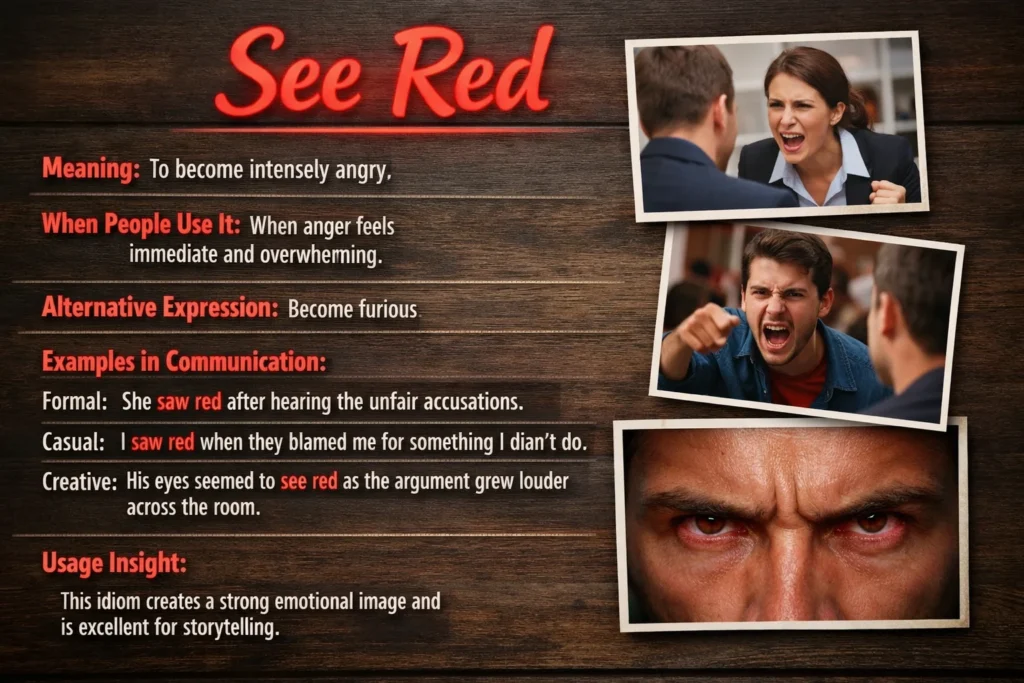
Meaning
To become intensely angry.
When People Use It
Used when anger feels immediate and overwhelming.
Alternative Expression
Become furious
Examples in Communication
Formal Example
She saw red after hearing the unfair accusations.
Casual Example
I saw red when they blamed me for something I didn’t do.
Creative Example
His eyes seemed to see red as the argument grew louder across the room.
Usage Insight
This idiom creates a strong emotional image and is excellent for storytelling.
Hit the Roof
Meaning
To react with explosive anger.
When People Use It
Common after hearing shocking or upsetting news.
Alternative Expression
Go ballistic
Examples in Communication
Formal Example
The client hit the roof when the project deadline was missed.
Casual Example
Mom hit the roof when she saw the mess in the kitchen.
Creative Example
The coach hit the roof after the team ignored the game plan entirely.
Lose Your Cool
Meaning
To stop controlling your emotions and become angry.
When People Use It
Used when someone normally calm becomes upset.
Alternative Expression
Lose composure
Examples in Communication
Formal Example
Even under pressure, she rarely loses her cool.
Casual Example
I almost lost my cool during the traffic jam.
Creative Example
He tried to stay calm, but the endless interruptions slowly made him lose his cool.
Fly Off the Handle

Meaning
To suddenly react angrily without warning.
When People Use It
Used when someone overreacts emotionally.
Alternative Expression
Snap angrily
Examples in Communication
Formal Example
The supervisor flew off the handle during the heated discussion.
Casual Example
Don’t fly off the handle over a small mistake.
Creative Example
Like a storm breaking without warning, she flew off the handle after hours of frustration.
Bite Someone’s Head Off
Meaning
To speak to someone in an unnecessarily angry way.
When People Use It
Used when stress causes rude or harsh communication.
Alternative Expression
Snap at someone
Examples in Communication
Formal Example
He apologized for biting his colleague’s head off earlier.
Casual Example
Why are you biting my head off? I just asked a question.
Creative Example
Exhausted and frustrated, she bit everyone’s head off before realizing how harsh she sounded.
Boiling with Anger
Meaning
Feeling extremely angry internally.
When People Use It
Used when someone is trying to control intense anger.
Alternative Expression
Fuming with anger
Examples in Communication
Formal Example
He sat silently, boiling with anger after the meeting.
Casual Example
I was boiling with anger the whole drive home.
Creative Example
Behind the quiet expression, he was boiling with anger like water trapped beneath a lid.
Foam at the Mouth
Meaning
To be furiously angry or outraged.
When People Use It
Often used humorously or dramatically.
Alternative Expression
Furious beyond control
Examples in Communication
Formal Example
The critics were practically foaming at the mouth over the controversial decision.
Casual Example
My brother was foaming at the mouth after losing the game.
Creative Example
The crowd foamed at the mouth as tensions exploded in the stadium.
Get Worked Up
Meaning
To become emotionally upset or angry.
When People Use It
Used for situations involving stress or emotional agitation.
Alternative Expression
Get upset
Examples in Communication
Formal Example
There’s no reason to get worked up over minor delays.
Casual Example
He always gets worked up before exams.
Creative Example
She got worked up watching the unfair argument unfold online.
Burn with Rage
Meaning
To feel deep and powerful anger.
When People Use It
Used in dramatic or emotional situations.
Alternative Expression
Consumed by anger
Examples in Communication
Formal Example
He burned with rage after learning the truth.
Casual Example
I was burning with rage all afternoon.
Creative Example
The betrayal made her burn with rage long after the room fell silent.
Steam Coming Out of Someone’s Ears
Meaning
To look extremely angry.
When People Use It
Often used humorously to exaggerate anger.
Alternative Expression
Visibly furious
Examples in Communication
Formal Example
The director looked like steam was coming out of his ears during the discussion.
Casual Example
You should’ve seen him — steam was practically coming out of his ears.
Creative Example
He stormed across the hallway with steam coming out of his ears after the argument.
Make Someone’s Blood Boil
Meaning
To make someone feel intense anger.
When People Use It
Used when describing irritating situations or behavior.
Alternative Expression
Drive someone furious
Examples in Communication
Formal Example
The unfair treatment made her blood boil.
Casual Example
People cutting in line really make my blood boil.
Creative Example
The smug smile on his face made her blood boil instantly.
Hot Under the Collar
Meaning
Feeling annoyed or angry.
When People Use It
Used for irritation that is noticeable but controlled.
Alternative Expression
Slightly irritated
Examples in Communication
Formal Example
The journalist became hot under the collar during the tense interview.
Casual Example
He gets hot under the collar whenever politics comes up.
Creative Example
You could tell she was hot under the collar even though she kept smiling politely.
See Smoke Coming Out of Someone’s Ears
Meaning
To appear visibly furious.
When People Use It
Usually used humorously or dramatically.
Alternative Expression
Look enraged
Examples in Communication
Formal Example
The teacher looked ready to explode, with smoke practically coming out of his ears.
Casual Example
Mom had smoke coming out of her ears after the prank.
Creative Example
After hearing the accusation, he stood frozen with smoke coming out of his ears.
Practical Ways to Use Idioms Naturally
Match the Intensity Correctly
Not every anger idiom expresses the same level of emotion.
- “Hot under the collar” suggests mild irritation.
- “See red” expresses intense rage.
- “Get worked up” feels more emotional than aggressive.
Choosing the right emotional level makes your English sound more natural.
Avoid Overusing Dramatic Idioms
In professional communication, dramatic expressions like “foaming at the mouth” may sound exaggerated. Use them carefully depending on the audience and situation.
Learn Through Real Conversations
Movies, TV shows, podcasts, and novels are excellent places to hear anger idioms used naturally. Notice the tone and context carefully.
Use Idioms in Dialogue Practice
Writing short conversations helps idioms feel more natural.
Example:
- “He totally blew a fuse when the internet stopped working.”
- “Don’t get worked up over one comment.”
Common Mistakes with Anger Idioms
Using the Wrong Emotional Strength
Saying someone “saw red” over a tiny inconvenience may sound exaggerated.
Mixing Idioms Incorrectly
Incorrect:
“She hit her fuse.”
Correct:
“She blew a fuse.”
Using Informal Idioms in Serious Professional Writing
Expressions like “bite someone’s head off” are better suited for conversations and storytelling than formal reports.
Translating Literally
Idioms are figurative. “Steam coming out of someone’s ears” does not describe actual steam. It simply exaggerates visible anger.
How to Remember Anger Idioms More Easily
Visualize the Emotion
Imagine someone literally exploding, boiling, or seeing red. Strong imagery helps memory.
Group Idioms by Intensity
Learn mild, moderate, and extreme anger idioms separately.
Practice in Everyday Scenarios
Think about common frustrating situations and match them with idioms naturally.
Read Dialogue-Rich Stories
Fiction and conversational writing expose you to emotional language in realistic settings.
Cross with Someone
Meaning
To become annoyed or angry with someone.
When People Use It
Usually used in everyday conversations when someone feels upset by another person’s actions.
Alternative Expression
Upset with someone
Examples in Communication
Formal Example
She was clearly cross with the team for ignoring the instructions.
Casual Example
Why are you so cross with me today?
Creative Example
He stayed quiet through dinner, still cross with his brother after the argument earlier.
Usage Insight
This idiom sounds softer and more polite than stronger anger expressions.
Throw a Tantrum
Meaning
To react with uncontrolled anger or frustration.
When People Use It
Often used for children, but adults can also “throw a tantrum” humorously.
Alternative Expression
Have an outburst
Examples in Communication
Formal Example
The customer threw a tantrum over the delayed order.
Casual Example
He threw a tantrum because the Wi-Fi stopped working.
Creative Example
Like a child denied candy, he threw a tantrum when things didn’t go his way.
Rub Someone the Wrong Way
Meaning
To irritate or annoy someone.
When People Use It
Used when a person’s behavior creates discomfort or frustration.
Alternative Expression
Get on someone’s nerves
Examples in Communication
Formal Example
His dismissive attitude rubbed the staff the wrong way.
Casual Example
Something about that guy rubs me the wrong way.
Creative Example
Her fake smile rubbed him the wrong way from the very first meeting.
Get on Someone’s Nerves
Meaning
To repeatedly annoy or irritate someone.
When People Use It
Commonly used for habits or behaviors that become frustrating over time.
Alternative Expression
Drive someone crazy
Examples in Communication
Formal Example
The constant interruptions got on everyone’s nerves during the conference.
Casual Example
That loud chewing really gets on my nerves.
Creative Example
The dripping faucet slowly got on her nerves through the silent night.
Blow Your Top
Meaning
To suddenly become extremely angry.
When People Use It
Used when someone reacts explosively.
Alternative Expression
Explode with anger
Examples in Communication
Formal Example
The coach blew his top after the careless mistake.
Casual Example
Dad’s going to blow his top when he finds out.
Creative Example
The moment the truth came out, she blew her top in front of everyone.
Drive Someone Up the Wall
Meaning
To annoy someone intensely.
When People Use It
Often used for repeated irritating behavior.
Alternative Expression
Drive someone crazy
Examples in Communication
Formal Example
The endless delays drove the manager up the wall.
Casual Example
My little brother drives me up the wall sometimes.
Creative Example
The nonstop buzzing sound drove her up the wall during the long evening.
Lose Your Temper
Meaning
To become unable to control anger.
When People Use It
Used in both formal and informal communication.
Alternative Expression
Get angry
Examples in Communication
Formal Example
He rarely loses his temper in stressful situations.
Casual Example
I lost my temper during the argument yesterday.
Creative Example
The pressure kept building until he finally lost his temper like a storm breaking loose.
Have a Short Fuse
Meaning
To become angry very quickly.
When People Use It
Used for people who are easily irritated.
Alternative Expression
Easily angered
Examples in Communication
Formal Example
The supervisor was known for having a short fuse under pressure.
Casual Example
Don’t tease him too much — he has a short fuse.
Creative Example
Years of stress had left him with a fuse so short that even tiny problems sparked anger.
Be Fed Up
Meaning
To feel frustrated and tired of something.
When People Use It
Used when annoyance has built up over time.
Alternative Expression
Sick and tired of something
Examples in Communication
Formal Example
Employees were fed up with the constant schedule changes.
Casual Example
I’m fed up with all this drama.
Creative Example
By midnight, she was completely fed up with the endless noise outside her apartment.
Have Steam Coming Out of Your Ears
Meaning
To look visibly furious.
When People Use It
Used humorously to exaggerate anger.
Alternative Expression
Look extremely angry
Examples in Communication
Formal Example
He looked like he had steam coming out of his ears during the debate.
Casual Example
You should’ve seen her — steam was coming out of her ears.
Creative Example
After the embarrassing mistake, the boss stormed through the office with steam coming out of his ears.
Tips for Sounding More Natural with Anger Idioms
Pay Attention to Tone
Some anger idioms sound playful while others sound aggressive. Understanding emotional tone helps avoid awkward usage.
Listen to Native Speakers
TV dramas, interviews, and podcasts are full of natural emotional expressions. Observing real conversations helps idioms feel less memorized.
Use Idioms Sparingly
Strong emotional idioms become more effective when used naturally instead of forcing them into every sentence.
Match the Context
Expressions like “blow your top” work well in storytelling and casual speech, but may sound too dramatic in professional emails.
Idioms vs Literal Anger Expressions
Literal expressions directly describe emotion:
- “She was angry.”
- “He became frustrated.”
Idioms create imagery and emotion:
- “She saw red.”
- “He blew a fuse.”
That imagery makes language more memorable, emotional, and engaging for readers and listeners.
FAQs
What are idioms for anger?
Idioms for anger are figurative expressions used to describe frustration, irritation, or rage in a more vivid and emotional way.
What is the most common anger idiom?
“Blow a fuse” and “see red” are two of the most commonly used idioms for anger.
Are anger idioms formal or informal?
Most anger idioms are informal and commonly used in conversations, storytelling, and casual writing.
Why should I learn anger idioms?
They help improve fluency, emotional expression, and natural communication in English.
How can I practice using anger idioms naturally?
Try using them in conversations, journaling, storytelling, or while watching English movies and shows.
Conclusion
Idioms for anger bring emotional realism and personality into communication. Instead of repeating simple words like “angry” or “upset,” these expressions allow speakers and writers to describe frustration, irritation, and rage in far more vivid ways.
They also make conversations sound more natural and emotionally expressive. Whether you’re improving spoken English, writing stories, preparing essays, or simply expanding your vocabulary, understanding anger idioms can greatly improve fluency and communication skills.
The key is to focus on context. Notice how people naturally use these phrases in conversations, movies, books, and online discussions. Over time, you’ll begin recognizing which idioms fit playful annoyance, controlled frustration, or explosive anger.
Used thoughtfully, these expressions can transform ordinary sentences into language that feels alive, relatable, and memorable.