
Quick Answer
Idioms for sadness are expressive phrases people use to describe emotional pain, disappointment, loneliness, heartbreak, or grief in a more vivid and natural way.
Expressions like “feeling blue,” “down in the dumps,” and “cry your heart out” help conversations and writing sound more emotional, relatable, and human.
Sadness is one of the most universal human emotions, yet people rarely describe it in simple words alone. Instead of always saying “I’m sad,” English speakers often use emotional idioms that paint a clearer picture of how they feel. These expressions add depth, emotion, and realism to conversations, storytelling, and everyday communication.
Think about the difference between saying someone was upset and saying they were “down in the dumps.” One sounds basic. The other instantly creates mood and personality. That’s why idioms for sadness appear so often in books, films, songs, blogs, and real-life conversations.
For English learners and writers, understanding these phrases can make communication feel more natural and emotionally expressive. They help you connect with readers, describe feelings more accurately, and understand native speakers more easily.
In this guide, you’ll discover useful idioms for sadness, learn what they really mean, and explore practical ways to use them naturally in writing and speech without sounding forced or unnatural.
Quick Summary Table
| Idiom | Simple Meaning | Common Usage |
|---|---|---|
| Feeling blue | Feeling sad | Everyday emotions |
| Down in the dumps | Depressed or gloomy | Bad days |
| Cry your heart out | Cry intensely | Emotional situations |
| Lump in your throat | Feeling emotional | Difficult moments |
| Heavy heart | Deep sadness | Emotional reflection |
| Heartbroken | Extremely sad | Loss or disappointment |
| In low spirits | Feeling unhappy | Temporary sadness |
| Tearjerker | Something emotionally sad | Movies or stories |
| World came crashing down | Sudden emotional shock | Bad news |
| Under a cloud | Feeling troubled | Stress or sadness |
Idioms for Sadness
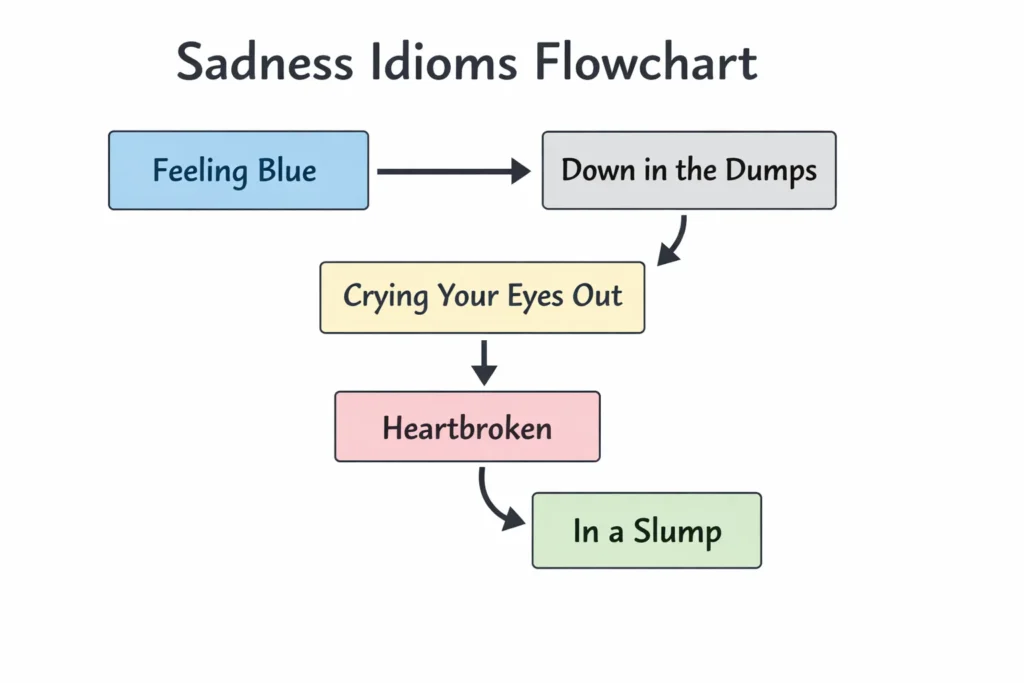
Feeling Blue
Meaning
Feeling sad, low, or emotionally down.
When People Use It
Used for everyday sadness or emotional disappointment.
Alternative Expression
In low spirits
Examples in Communication
Formal Example
She had been feeling blue since moving away from her hometown.
Casual Example
I don’t know why, but I’ve been feeling blue all week.
Creative Example
The quiet rain outside matched the feeling blue mood hanging over the apartment.
Usage Insight
This is one of the most common and natural sadness idioms in English.
Down in the Dumps
Meaning
Feeling very gloomy or depressed.
When People Use It
Usually used when someone seems emotionally drained or discouraged.
Alternative Expression
Feeling miserable
Examples in Communication
Formal Example
He seemed down in the dumps after hearing the disappointing results.
Casual Example
Why are you so down in the dumps today?
Creative Example
She sat by the window down in the dumps, watching the empty streetlights flicker in silence.
Usage Insight
This idiom has a conversational tone and works well in informal communication.
Cry Your Heart Out
Meaning
To cry intensely because of deep sadness.
When People Use It
Used during heartbreak, emotional pain, or overwhelming disappointment.
Alternative Expression
Sob uncontrollably
Examples in Communication
Formal Example
After the farewell ceremony, many students cried their hearts out.
Casual Example
I just needed to cry my heart out for a while.
Creative Example
Alone in the dark room, she cried her heart out until sunrise softened the silence.
Lump in Your Throat
Meaning
A strong emotional feeling that makes it difficult to speak.
When People Use It
Often used during emotional speeches, reunions, or sad memories.
Alternative Expression
Choked up
Examples in Communication
Formal Example
He felt a lump in his throat while giving the retirement speech.
Casual Example
That movie gave me a lump in my throat.
Creative Example
As the old song played again, a lump in her throat stopped every word she wanted to say.
Heavy Heart
Meaning
Feeling deeply sad or emotionally burdened.
When People Use It
Used in emotional or serious situations involving grief or regret.
Alternative Expression
Deep sorrow
Examples in Communication
Formal Example
She left the city with a heavy heart after saying goodbye to her family.
Casual Example
I watched the ending with a heavy heart.
Creative Example
With a heavy heart, he folded the last letter and placed it quietly in the drawer.
Usage Insight
This idiom sounds emotional and slightly poetic, making it common in storytelling.
Heartbroken
Meaning
Extremely sad because of loss, disappointment, or emotional pain.
When People Use It
Often used after breakups, failures, or personal loss.
Alternative Expression
Devastated
Examples in Communication
Formal Example
The community was heartbroken after the tragic event.
Casual Example
She was completely heartbroken after the breakup.
Creative Example
The empty chair at dinner made him feel heartbroken all over again.
In Low Spirits
Meaning
Feeling unhappy or discouraged.
When People Use It
Used for temporary emotional sadness.
Alternative Expression
Feeling down
Examples in Communication
Formal Example
Employees appeared to be in low spirits after the announcement.
Casual Example
I’ve been in low spirits lately.
Creative Example
The once lively café suddenly felt quiet and in low spirits during the stormy evening.
Tearjerker
Meaning
A story, movie, or event that makes people cry.
When People Use It
Common when discussing emotional entertainment.
Alternative Expression
Emotional story
Examples in Communication
Formal Example
The film became known as a classic tearjerker.
Casual Example
That drama was such a tearjerker.
Creative Example
The final scene turned the simple story into an unforgettable tearjerker.
World Came Crashing Down
Meaning
Feeling emotionally shattered after shocking news.
When People Use It
Used for deeply painful or unexpected situations.
Alternative Expression
Emotionally devastated
Examples in Communication
Formal Example
When the company closed, it felt like his world came crashing down.
Casual Example
My world came crashing down after hearing the news.
Creative Example
In a single phone call, her world came crashing down around her.
Under a Cloud
Meaning
Feeling troubled, ashamed, or emotionally burdened.
When People Use It
Used during stressful or emotionally difficult periods.
Alternative Expression
Emotionally troubled
Examples in Communication
Formal Example
He remained under a cloud after the public criticism.
Casual Example
She’s been under a cloud lately.
Creative Example
The entire office seemed under a cloud after the unexpected announcement.
Broken-Hearted
Meaning
Deeply hurt emotionally.
When People Use It
Common after personal loss or emotional disappointment.
Alternative Expression
Emotionally crushed
Examples in Communication
Formal Example
Fans were broken-hearted after the team’s final defeat.
Casual Example
He looked completely broken-hearted.
Creative Example
The broken-hearted musician played softly while the rain tapped against the windows.
Feeling Down
Meaning
Feeling unhappy or emotionally low.
When People Use It
Used in everyday conversation for mild sadness.
Alternative Expression
Feeling blue
Examples in Communication
Formal Example
Students may feel down during stressful exam periods.
Casual Example
I’ve been feeling down recently.
Creative Example
Even the bright sunlight couldn’t lift the feeling down mood hanging over him.
A Face Like Thunder
Meaning
Looking visibly angry, upset, or unhappy.
When People Use It
Used when someone’s sadness or frustration is obvious.
Alternative Expression
Looking miserable
Examples in Communication
Formal Example
He entered the room with a face like thunder after the meeting.
Casual Example
Why do you have a face like thunder today?
Creative Example
She stood at the doorway with a face like thunder while the party laughter faded around her.
Cry Over Spilled Milk
Meaning
To stay upset about something that already happened and cannot be changed.
When People Use It
Used to encourage emotional acceptance.
Alternative Expression
Let it go
Examples in Communication
Formal Example
There is no benefit in crying over spilled milk after the decision has been finalized.
Casual Example
Don’t cry over spilled milk — mistakes happen.
Creative Example
He kept crying over spilled milk while life quietly moved forward without him.
Practical Ways to Use Idioms Naturally
Pay Attention to Emotional Tone
Sadness idioms can sound soft, dramatic, poetic, or conversational depending on the situation. “Feeling blue” sounds casual, while “heavy heart” feels more emotional and reflective.
Use Idioms Sparingly
Emotional idioms become more powerful when used naturally. Too many sadness expressions in one paragraph can feel exaggerated.
Learn Through Stories
Books, songs, and films are excellent places to discover how sadness idioms work in real emotional situations.
Match the Context Carefully
Some idioms fit personal conversations better than formal writing. For example, “down in the dumps” sounds casual, while “with a heavy heart” works well in emotional speeches or storytelling.
Common Mistakes with Sadness Idioms
Taking Idioms Literally
Idioms are figurative expressions. “Feeling blue” has nothing to do with the color blue literally.
Using Emotional Idioms Randomly
Strong idioms like “world came crashing down” should only be used for genuinely emotional situations.
Mixing Similar Expressions Incorrectly
Incorrect:
“She was on low spirits.”
Correct:
“She was in low spirits.”
Overusing Dramatic Idioms
Using overly emotional expressions in small situations can sound unnatural or exaggerated.
How to Remember Sadness Idioms Easily
Connect Them to Real Emotions
Associating idioms with personal memories or scenes from movies helps you remember them naturally.
Practice Through Journaling
Writing emotional diary entries or fictional scenes is a powerful way to build comfort with idioms.
Learn in Context
Memorizing isolated phrases is harder than learning them inside stories or conversations.
Repeat Them Naturally
Using one or two idioms regularly in conversation improves long-term recall more effectively than memorizing long lists.
Tears Welled Up
Meaning
Eyes filling with tears because of strong emotions.
When People Use It
Often used during emotional conversations, touching memories, or painful moments.
Alternative Expression
Eyes filled with tears
Examples in Communication
Formal Example
Tears welled up in her eyes during the farewell speech.
Casual Example
I could feel tears welling up while watching that scene.
Creative Example
As the old photograph slipped from the book, tears welled up before she could stop them.
Crying a River
Meaning
Crying excessively or dramatically.
When People Use It
Usually used informally when someone is very emotional.
Alternative Expression
Sobbing endlessly
Examples in Communication
Formal Example
The character spent the entire novel crying a river over lost opportunities.
Casual Example
She was crying a river after the argument.
Creative Example
Rain hammered the rooftop while he sat alone crying a river into the midnight silence.
Usage Insight
This idiom can sound slightly dramatic or humorous depending on tone.
Wear a Long Face
Meaning
To look visibly sad or disappointed.
When People Use It
Used when someone’s unhappiness is obvious from their expression.
Alternative Expression
Look gloomy
Examples in Communication
Formal Example
He wore a long face after hearing the final decision.
Casual Example
Why are you wearing such a long face today?
Creative Example
The cheerful room suddenly dimmed when she walked in wearing a long face.
Fall to Pieces
Meaning
To become emotionally overwhelmed.
When People Use It
Used during intense grief, stress, or heartbreak.
Alternative Expression
Break down emotionally
Examples in Communication
Formal Example
She nearly fell to pieces after the sudden loss.
Casual Example
I completely fell to pieces during the movie ending.
Creative Example
The strong smile disappeared, and he quietly fell to pieces beneath the evening lights.
Feeling Empty Inside
Meaning
Experiencing emotional numbness or sadness.
When People Use It
Often used after loss, loneliness, or disappointment.
Alternative Expression
Emotionally drained
Examples in Communication
Formal Example
After retirement, he admitted to feeling empty inside for several months.
Casual Example
I just feel empty inside lately.
Creative Example
The crowded streets meant nothing to her while she walked through the city feeling empty inside.
Downhearted
Meaning
Feeling discouraged or unhappy.
When People Use It
Used when someone loses motivation because of disappointment.
Alternative Expression
Disheartened
Examples in Communication
Formal Example
Many players felt downhearted after the narrow defeat.
Casual Example
Don’t be too downhearted about the results.
Creative Example
The young artist grew downhearted after another unanswered submission email.
Like Rain on Your Parade
Meaning
Something ruining a happy moment.
When People Use It
Used when bad news interrupts excitement or joy.
Alternative Expression
Spoil the mood
Examples in Communication
Formal Example
The sudden cancellation rained on everyone’s parade.
Casual Example
I hate to rain on your parade, but the event got postponed.
Creative Example
The cloudy announcement rained on their parade just as laughter filled the room.
Hit Rock Bottom
Meaning
To reach the lowest emotional point.
When People Use It
Used during severe sadness, stress, or personal struggles.
Alternative Expression
Reach the lowest point
Examples in Communication
Formal Example
He admitted he had hit rock bottom before seeking support.
Casual Example
I felt like I hit rock bottom last year.
Creative Example
Among the silent apartment walls, she realized she had finally hit rock bottom emotionally.
Usage Insight
This idiom carries strong emotional weight and should be used thoughtfully.
Practical Tips for Writing Emotional Idioms Naturally

Use Emotional Context
Sadness idioms work best when supported by atmosphere, actions, or emotional detail.
Instead of:
- “He was sad.”
Try:
- “He sat quietly by the window with a heavy heart.”
This creates stronger emotional imagery for readers.
Avoid Overdramatizing Small Situations
Not every disappointment needs intense idioms like “heartbroken” or “world came crashing down.” Matching emotional intensity matters.
Blend Idioms with Natural Dialogue
Idioms sound more realistic when they appear inside conversations.
Example:
- “You’ve looked down in the dumps ever since yesterday.”
Read Emotional Writing Closely
Poetry, novels, films, and songs often use figurative language beautifully. Paying attention to those patterns improves your own writing naturally.
Bonus Everyday Sadness Expressions
| Expression | Meaning |
|---|---|
| Feeling low | Mild sadness |
| Choked up | Too emotional to speak |
| In tears | Crying |
| Gloomy mood | Feeling emotionally dark |
| Heart sank | Sudden disappointment |
| Feeling miserable | Very unhappy |
| Lost for words | Emotionally speechless |
| Emotional wreck | Extremely upset |
FAQs
What are idioms for sadness?
Idioms for sadness are figurative expressions used to describe emotional pain, disappointment, loneliness, or grief in a vivid and natural way.
Why do people use sadness idioms?
They make communication more emotional, expressive, and relatable compared to plain literal language.
What is the most common idiom for sadness?
“Feeling blue” is one of the most commonly used idioms for sadness in everyday English.
Can sadness idioms be used in formal writing?
Some can. Idioms like “with a heavy heart” work well in speeches and emotional writing, while casual idioms are better for conversation.
How can I learn idioms faster?
Reading stories, watching movies, journaling, and practicing idioms in real sentences can help you remember them naturally.
Conclusion
Idioms for sadness help language feel more emotional, expressive, and human. Instead of relying on plain descriptions, these phrases allow speakers and writers to communicate feelings with depth and personality. Whether you’re writing stories, improving spoken English, understanding movies, or building stronger communication skills, sadness idioms add realism and emotional nuance to language.
The key is using them naturally. Listen to how people use these expressions in conversations, films, songs, and books. Over time, you’ll begin recognizing which idioms suit different moods and situations best.
Language becomes far more memorable when emotion is involved. A thoughtful idiom can turn a simple sentence into something readers genuinely feel and that’s what makes figurative language so powerful.
Discover More Related Articles:
- Idioms About Songs | Musical Expressions That Add Rhythm to Your English In 2026
- Idioms About Age | Timeless Expressions That Add Wisdom to Your English In 2026