
Quick Answer
Idioms for hope are expressive phrases people use to describe optimism, belief in better outcomes, emotional strength, and positive expectations about the future.
Expressions like “light at the end of the tunnel” and “keep the faith” help conversations feel more emotional, encouraging, and human.
Hope has a quiet power. It keeps people moving forward during uncertain moments, difficult seasons, and personal struggles. In everyday English, people often use idioms to express that feeling because ordinary words sometimes fail to capture the emotional weight of optimism and perseverance.
Instead of saying “things might improve,” someone may say there’s “light at the end of the tunnel.” Rather than simply telling a friend to stay positive, they might encourage them to “keep the faith.” These expressions feel warmer, more human, and emotionally memorable.
Idioms for hope appear everywhere conversations with friends, motivational speeches, novels, movies, workplace discussions, and social media captions. They help people communicate encouragement naturally without sounding overly formal or repetitive.
For language learners and writers, understanding these idioms can dramatically improve emotional expression in English. They add depth to storytelling, make dialogue feel realistic, and help communication sound more fluent and relatable.
In this guide, you’ll discover some of the most meaningful idioms for hope, learn when people actually use them, and understand how to include them naturally in writing and conversation.
Quick Summary Table
| Idiom | Simple Meaning | Common Usage |
|---|---|---|
| Light at the end of the tunnel | Signs of improvement ahead | Difficult situations |
| Keep the faith | Stay hopeful and confident | Encouragement |
| Hold out hope | Continue believing | Challenging moments |
| Every cloud has a silver lining | Good can come from hardship | Comforting others |
| Tomorrow is another day | New opportunities will come | Recovering from setbacks |
| Dare to dream | Believe in possibilities | Motivation |
| A ray of hope | A small sign of positivity | Tough circumstances |
| Stay afloat | Continue surviving difficulties | Emotional resilience |
| Looking up | Things are improving | Positive progress |
| Never say die | Refuse to give up | Determination |
Light at the End of the Tunnel
Meaning
A sign that a difficult situation is improving or nearing its end.
When People Use It
People use this idiom during challenging times when positive change finally seems possible.
Alternative Expression
A ray of hope
Examples in Communication
Formal Example
The recent economic improvements are a light at the end of the tunnel for many businesses.
Casual Example
After months of stress, getting that job interview felt like a light at the end of the tunnel.
Creative Example
The hospital room suddenly felt warmer, as if a light at the end of the tunnel had quietly appeared.
Usage Insight
This is one of the most emotional and widely recognized idioms connected to hope and perseverance.
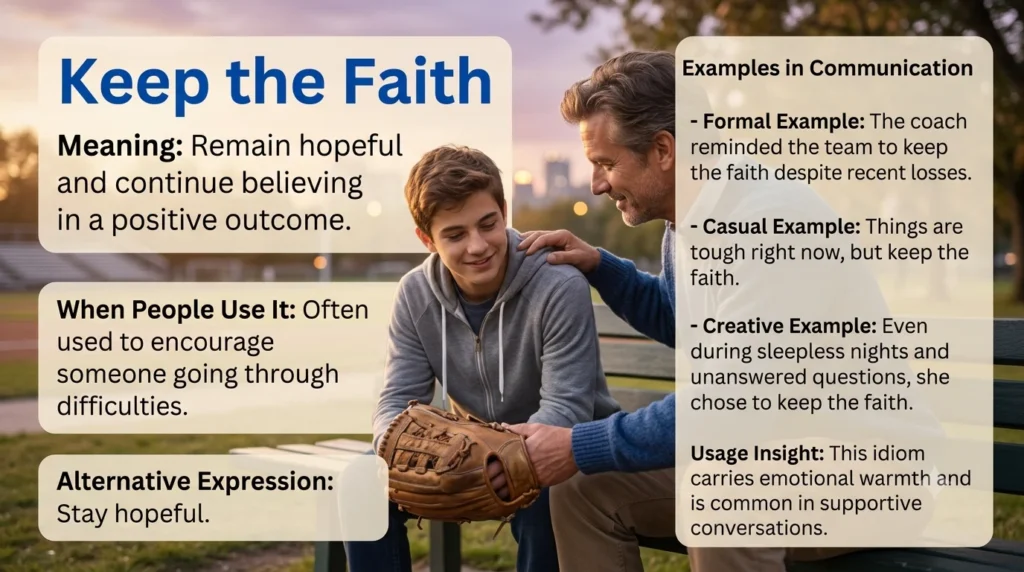
Keep the Faith
Meaning
Remain hopeful and continue believing in a positive outcome.
When People Use It
Often used to encourage someone going through difficulties.
Alternative Expression
Stay hopeful
Examples in Communication
Formal Example
The coach reminded the team to keep the faith despite recent losses.
Casual Example
Things are tough right now, but keep the faith.
Creative Example
Even during sleepless nights and unanswered questions, she chose to keep the faith.
Usage Insight
This idiom carries emotional warmth and is common in supportive conversations.
Hold Out Hope
Meaning
To continue believing something good may still happen.
When People Use It
Used when success or improvement still seems uncertain.
Alternative Expression
Cling to hope
Examples in Communication
Formal Example
Scientists continue to hold out hope for a breakthrough treatment.
Casual Example
I’m still holding out hope that we’ll make the trip happen.
Creative Example
He held out hope like a tiny candle against the stormy night.
Every Cloud Has a Silver Lining

Meaning
Even difficult situations usually contain something positive.
When People Use It
People use this phrase to comfort or encourage others after disappointment.
Alternative Expression
Something good comes from hardship
Examples in Communication
Formal Example
Although the project failed, every cloud has a silver lining because valuable lessons were learned.
Casual Example
Missing the train wasn’t great, but every cloud has a silver lining — we found that amazing café.
Creative Example
She searched the rainy afternoon for the silver lining hidden behind every cloud.
Usage Insight
This idiom is especially useful in motivational writing and personal conversations.
Tomorrow Is Another Day
Meaning
A bad day does not mean the future will stay bad.
When People Use It
Used after setbacks, failures, or emotional disappointment.
Alternative Expression
There’s always a new beginning
Examples in Communication
Formal Example
Despite the challenges faced today, tomorrow is another day filled with opportunity.
Casual Example
Don’t worry too much about the argument. Tomorrow is another day.
Creative Example
She closed the curtains, whispered that tomorrow is another day, and finally let herself rest.
Dare to Dream
Meaning
To believe in ambitious possibilities and future success.
When People Use It
Common in motivational discussions and inspirational writing.
Alternative Expression
Dream big
Examples in Communication
Formal Example
The speaker encouraged students to dare to dream beyond limitations.
Casual Example
You’ll never know what’s possible unless you dare to dream.
Creative Example
He dared to dream even when the world kept telling him to stay realistic.
A Ray of Hope
Meaning
A small but meaningful sign of encouragement.
When People Use It
Often used during emotionally difficult situations.
Alternative Expression
A glimmer of hope
Examples in Communication
Formal Example
The successful test results provided a ray of hope for the research team.
Casual Example
Your message was honestly a ray of hope today.
Creative Example
The child’s laughter became a quiet ray of hope in the silent house.
Stay Afloat
Meaning
To continue surviving during difficult times.
When People Use It
Used financially, emotionally, or mentally.
Alternative Expression
Keep going
Examples in Communication
Formal Example
Small businesses struggled to stay afloat during the economic downturn.
Casual Example
I’m just trying to stay afloat this week.
Creative Example
Through long nights and endless worries, they somehow managed to stay afloat together.
Things Are Looking Up
Meaning
Situations are improving gradually.
When People Use It
Used when positive progress begins appearing.
Alternative Expression
Getting better
Examples in Communication
Formal Example
Sales have increased steadily, and things are looking up for the company.
Casual Example
I finally got some good news — things are looking up.
Creative Example
The gray skies slowly cleared, and suddenly life started looking up again.
Never Say Die
Meaning
Never give up hope or determination.
When People Use It
Often used during difficult or competitive situations.
Alternative Expression
Never give up
Examples in Communication
Formal Example
Her never-say-die attitude inspired the entire organization.
Casual Example
I know it’s hard, but never say die.
Creative Example
With scraped hands and tired eyes, he carried a quiet never-say-die spirit into the final round.
Keep Your Chin Up
Meaning
Stay positive during difficult situations.
When People Use It
Common in supportive and friendly conversations.
Alternative Expression
Stay strong
Examples in Communication
Formal Example
The manager encouraged the employees to keep their chins up during the transition.
Casual Example
Keep your chin up — better days are coming.
Creative Example
She walked through the storm with her chin up and hope tucked quietly inside her heart.
Build Castles in the Air
Meaning
To dream hopefully about future possibilities.
When People Use It
Used for imaginative or ambitious hopes.
Alternative Expression
Dream beyond limits
Examples in Communication
Formal Example
Entrepreneurs are often willing to build castles in the air before success becomes reality.
Casual Example
We spent the evening building castles in the air about future travel plans.
Creative Example
They built castles in the air beneath the stars, believing life still held surprises.
A New Lease on Life
Meaning
A renewed sense of hope, energy, or opportunity.
When People Use It
Often used after recovery or major positive change.
Alternative Expression
Fresh start
Examples in Communication
Formal Example
The successful surgery gave him a new lease on life.
Casual Example
This new job feels like a new lease on life for me.
Creative Example
The little bookstore gave the lonely street a new lease on life.
Hang in There
Meaning
Continue enduring despite hardship.
When People Use It
Frequently used to comfort friends or coworkers.
Alternative Expression
Stay strong
Examples in Communication
Formal Example
The counselor advised students to hang in there during exam season.
Casual Example
I know things are stressful right now, but hang in there.
Creative Example
Like a tree surviving winter winds, she kept hanging in there.
Practical Ways to Use Hope Idioms Naturally
Use Them During Emotional Conversations
Hope idioms work best in moments involving encouragement, resilience, motivation, or emotional recovery.
Match the Tone Carefully
Some idioms sound poetic, while others are conversational.
- “A ray of hope” feels emotional and reflective.
- “Hang in there” sounds casual and supportive.
- “Never say die” feels strong and determined.
Understanding tone makes communication sound more authentic.
Don’t Force Idioms into Every Sentence
A few meaningful idioms can strengthen communication. Overusing them may sound unnatural or dramatic.
Practice Through Real Situations
Write short journal entries, social captions, or fictional dialogues using hope idioms naturally.
Example:
- “I’m finally seeing light at the end of the tunnel.”
- “She told me to keep the faith during difficult times.”
Common Mistakes with Hope Idioms
Using Idioms Literally
Idioms are figurative expressions. “Light at the end of the tunnel” does not refer to an actual tunnel.
Mixing Emotional Tones
Avoid playful idioms during deeply serious conversations unless appropriate.
Overcomplicating Writing
Simple idioms often sound more natural than trying to use several complex phrases together.
Ignoring Context
“Build castles in the air” can sometimes imply unrealistic dreaming, so context matters.
How to Remember Hope Idioms Easily
Connect Them to Personal Experiences
Relating idioms to real memories helps them feel meaningful instead of memorized.
Learn Through Stories
Books, films, and speeches often use hope-related idioms naturally and emotionally.
Visualize the Expressions
Imagining a “silver lining” or “light at the end of the tunnel” helps memory retention.
Use One Idiom Daily
Small consistent practice improves fluency faster than memorizing long lists.
More Idioms for Hope and Optimism
Against All Odds
Meaning
Succeeding despite extremely difficult circumstances.
When People Use It
Used when someone achieves something people thought was impossible.
Alternative Expression
Beat the odds
Examples in Communication
Formal Example
Against all odds, the small startup became an international success.
Casual Example
She made it through everything against all odds.
Creative Example
Against all odds, the tiny flower pushed through the cracked sidewalk toward the sunlight.
Usage Insight
This idiom carries a strong emotional tone and works beautifully in storytelling and motivational writing.
Keep Your Head Above Water
Meaning
To survive financially, emotionally, or mentally during difficult times.
When People Use It
Common during stressful periods when someone is barely managing.
Alternative Expression
Stay afloat
Examples in Communication
Formal Example
Many families struggled to keep their heads above water during the recession.
Casual Example
I’m just trying to keep my head above water this month.
Creative Example
Through deadlines, worries, and sleepless nights, she fought to keep her head above water.
The Sky’s the Limit
Meaning
There are no limits to success or possibility.
When People Use It
Used to encourage ambition and optimism.
Alternative Expression
Anything is possible
Examples in Communication
Formal Example
With dedication and innovation, the sky’s the limit for young entrepreneurs.
Casual Example
You’re talented — honestly, the sky’s the limit for you.
Creative Example
Standing beneath the stars, they believed the sky itself was no longer the limit.
Turn the Corner
Meaning
To begin improving after a difficult period.
When People Use It
Often used for health, business, or emotional recovery.
Alternative Expression
Start recovering
Examples in Communication
Formal Example
The company finally turned the corner after months of financial struggle.
Casual Example
I think I’ve finally turned the corner emotionally.
Creative Example
Winter slowly faded, and the town quietly turned the corner toward spring.
Keep Hope Alive
Meaning
Continue believing in a positive outcome despite difficulties.
When People Use It
Used during emotional or uncertain situations.
Alternative Expression
Stay hopeful
Examples in Communication
Formal Example
Community leaders encouraged citizens to keep hope alive during challenging times.
Casual Example
Even when things feel impossible, keep hope alive.
Creative Example
They lit candles by the window each evening to keep hope alive through the long winter.
Reach for the Stars
Meaning
Aim for ambitious goals and dreams.
When People Use It
Used to inspire confidence and aspiration.
Alternative Expression
Aim high
Examples in Communication
Formal Example
Teachers should encourage students to reach for the stars.
Casual Example
Don’t settle too quickly — reach for the stars.
Creative Example
She carried her sketchbook everywhere, quietly reaching for the stars one drawing at a time.
Weather the Storm
Meaning
To survive a difficult situation with patience and strength.
When People Use It
Often used during emotional hardship, business problems, or personal struggles.
Alternative Expression
Get through hard times
Examples in Communication
Formal Example
The organization managed to weather the storm through careful planning.
Casual Example
We’ll weather the storm together somehow.
Creative Example
Like old sailors facing wild waves, they weathered the storm side by side.
Practical Tip for Writers and Students
Hope idioms are especially effective in:
- Motivational essays
- Personal storytelling
- Emotional dialogue
- Graduation speeches
- Social media captions
- Reflective journal writing
For example, instead of writing:
“She felt hopeful about the future.”
You could write:
“She finally saw light at the end of the tunnel.”
That small change instantly creates stronger emotional imagery and makes the sentence more memorable.
Mini Practice Exercise
Try completing these naturally:
- After months of stress, I finally saw __________.
- Even during hard times, she told herself to __________.
- Against all __________, the team won the championship.
- Don’t give up yet — tomorrow is __________.
Suggested Answers
- light at the end of the tunnel
- keep the faith
- odds
- another day
Bonus Everyday Expressions Related to Hope
| Expression | Meaning |
|---|---|
| Fingers crossed | Hoping for good luck |
| Looking on the bright side | Focusing on positives |
| Faith can move mountains | Strong belief creates strength |
| Better days are ahead | Future improvement is coming |
| Dream come true | A hoped-for wish happened |
These expressions are slightly more conversational than traditional idioms, but native speakers use them constantly in daily English.
FAQs
What are idioms for hope?
Idioms for hope are figurative expressions that describe optimism, encouragement, belief in the future, or emotional resilience.
Why are hope idioms useful in communication?
They make conversations and writing feel more emotional, relatable, and naturally expressive.
Can hope idioms be used in formal writing?
Yes, many can work well in essays, speeches, storytelling, and motivational writing when used carefully.
What is the most common idiom for hope?
“Light at the end of the tunnel” is one of the most widely used idioms connected to hope and recovery.
How can I learn idioms more naturally?
Read stories, watch conversations in movies or interviews, and practice using one idiom in daily communication.
Conclusion
Idioms for hope do more than decorate language. They help people express resilience, optimism, emotional strength, and belief in better days ahead. These phrases make communication feel warmer, more relatable, and far more human than plain literal wording.
Whether you’re improving spoken English, writing emotional stories, preparing essays, or simply trying to communicate with more depth, hope idioms can transform the way your words connect with others.
The key is natural usage. Listen to how people use these expressions in real conversations, then gradually make them part of your own voice. Over time, they’ll stop feeling like vocabulary exercises and start becoming genuine tools for emotional expression.
Sometimes a simple phrase like “keep the faith” can carry more comfort and encouragement than an entire paragraph.
Discover More Related Articles:
- Idioms About Songs | Musical Expressions That Add Rhythm to Your English In 2026
- Idioms About Age | Timeless Expressions That Add Wisdom to Your English In 2026