
Quick Answer
Idioms for crying are figurative expressions that describe sadness, emotional pain, disappointment, or intense feelings in a colorful and memorable way. Common examples include cry one’s eyes out, break down in tears, sob one’s heart out, and shed tears. These expressions make conversations, essays, and creative writing sound more natural and expressive.
Everyone cries at some point. Sometimes tears come quietly, and sometimes emotions overflow unexpectedly. Because crying is such a universal human experience, English has developed many colorful expressions to describe different kinds of tears and emotions.
Learning idioms for crying can make your speech sound more natural and your writing more vivid. Whether you’re writing a story, preparing an essay, chatting with friends, or simply expanding your vocabulary, these expressions help convey feelings in ways that ordinary words often cannot.
You’ll hear many of these phrases in movies, novels, conversations, and even workplace discussions when people describe emotional moments. Understanding when and how to use them can greatly improve your fluency and help you express emotions with confidence.
Let’s explore some of the most useful and widely understood idioms for crying.
Quick Summary
| Idiom | Meaning | Common Tone |
|---|---|---|
| Cry One’s Eyes Out | Cry intensely | Emotional |
| Break Down in Tears | Suddenly start crying | Sadness |
| Shed Tears | Cry quietly | Gentle emotion |
| Sob One’s Heart Out | Cry deeply and emotionally | Heartbroken |
| Burst Into Tears | Start crying unexpectedly | Surprise or sadness |
| Have a Good Cry | Release emotions by crying | Comforting |
| Cry Over Spilled Milk | Be upset about something already done | Regret |
| Weep Bitter Tears | Feel deep sorrow | Serious sadness |
| Waterworks | Excessive crying | Informal |
| Choke Back Tears | Try not to cry | Emotional restraint |
Cry One’s Eyes Out
Meaning
To cry very heavily for a long time.
When People Use It
After heartbreak, disappointment, or emotional loss.
Alternative Expression
Sob one’s heart out.
Examples in Communication
Formal Example
She cried her eyes out after hearing the unfortunate news.
Casual Example
I cried my eyes out watching that movie.
Creative Example
When the final chapter ended, Emma cried her eyes out and hugged the book to her chest.
Break Down in Tears
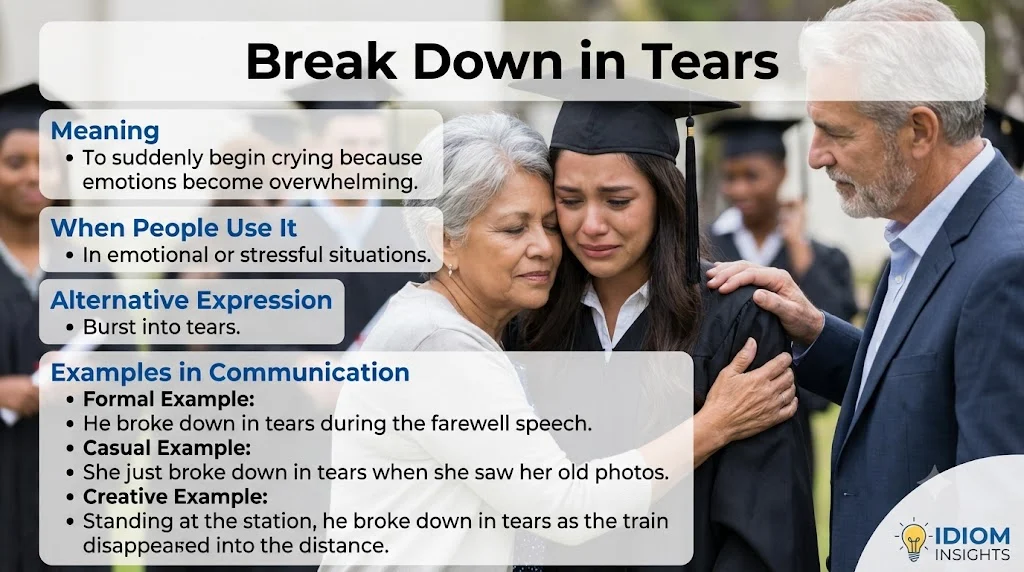
Meaning
To suddenly begin crying because emotions become overwhelming.
When People Use It
In emotional or stressful situations.
Alternative Expression
Burst into tears.
Examples in Communication
Formal Example
He broke down in tears during the farewell speech.
Casual Example
She just broke down in tears when she saw her old photos.
Creative Example
Standing at the station, he broke down in tears as the train disappeared into the distance.
Burst Into Tears
Meaning
To start crying unexpectedly.
When People Use It
When emotions suddenly take over.
Alternative Expression
Break down in tears.
Examples in Communication
Formal Example
The child burst into tears after receiving the upsetting news.
Casual Example
I burst into tears when I heard the song again.
Creative Example
The forgotten letter made her burst into tears after years of silence.
Shed Tears
Meaning
To cry or express sadness.
When People Use It
In both formal and literary contexts.
Alternative Expression
Weep.
Examples in Communication
Formal Example
Many people shed tears during the memorial service.
Casual Example
I actually shed a few tears during the ending.
Creative Example
As autumn leaves fell, she quietly shed tears by the window.
Usage Tip: This idiom sounds more polished and works well in essays and storytelling.
Sob One’s Heart Out
Meaning
To cry intensely and emotionally.
When People Use It
During heartbreak or painful experiences.
Alternative Expression
Cry one’s eyes out.
Examples in Communication
Formal Example
She sobbed her heart out after losing her beloved pet.
Casual Example
He sobbed his heart out all night.
Creative Example
Wrapped in a blanket, she sobbed her heart out beneath the stars.
Choke Back Tears
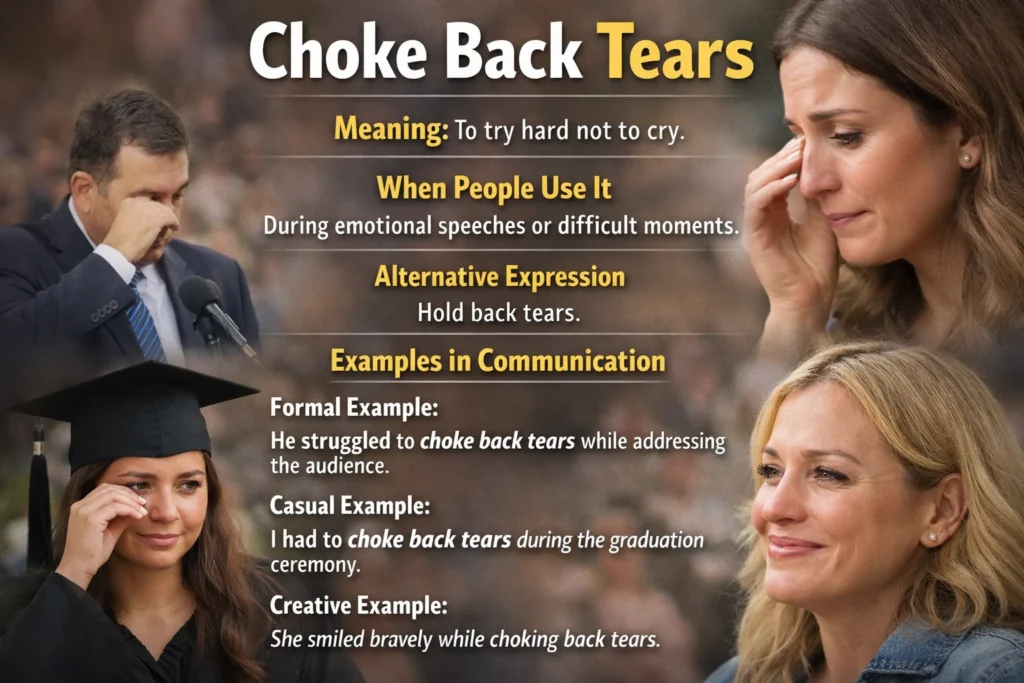
Meaning
To try hard not to cry.
When People Use It
During emotional speeches or difficult moments.
Alternative Expression
Hold back tears.
Examples in Communication
Formal Example
He struggled to choke back tears while addressing the audience.
Casual Example
I had to choke back tears during the graduation ceremony.
Creative Example
She smiled bravely while choking back tears.
Hold Back Tears
Meaning
To prevent yourself from crying.
When People Use It
When trying to remain composed.
Alternative Expression
Choke back tears.
Examples in Communication
Formal Example
She held back tears while thanking her colleagues.
Casual Example
I was trying so hard to hold back tears.
Creative Example
Behind the cheerful smile, he held back tears.
Have a Good Cry
Meaning
To cry in order to release emotions.
When People Use It
After stress or emotional pain.
Alternative Expression
Let it all out.
Examples in Communication
Formal Example
Sometimes having a good cry can provide emotional relief.
Casual Example
I just needed a good cry.
Creative Example
She sat by the ocean and finally had a good cry.
Cry Over Spilled Milk
Meaning
To be upset about something that cannot be changed.
When People Use It
When discussing regrets.
Alternative Expression
What’s done is done.
Examples in Communication
Formal Example
There is little value in crying over spilled milk.
Casual Example
Stop crying over spilled milk and move on.
Creative Example
He learned that life is too short for crying over spilled milk.
Usage Tip: This expression is usually metaphorical and doesn’t involve actual tears.
Weep Bitter Tears
Meaning
To feel deep sorrow.
When People Use It
In serious or literary situations.
Alternative Expression
Mourn deeply.
Examples in Communication
Formal Example
Families wept bitter tears during the tragedy.
Casual Example
She wept bitter tears after the breakup.
Creative Example
The lonely violin echoed while she wept bitter tears.
In Floods of Tears
Meaning
Crying excessively.
When People Use It
To emphasize strong sadness.
Alternative Expression
Inconsolable.
Examples in Communication
Formal Example
She arrived at the hospital in floods of tears.
Casual Example
He came home in floods of tears.
Creative Example
The goodbye left her in floods of tears.
Reduce Someone to Tears
Meaning
To make someone cry.
When People Use It
When emotions or words affect someone deeply.
Alternative Expression
Move someone emotionally.
Examples in Communication
Formal Example
The heartfelt tribute reduced many guests to tears.
Casual Example
That song always reduces me to tears.
Creative Example
His final message reduced her to tears.
Fight Back Tears
Meaning
To resist crying.
When People Use It
In emotional moments.
Alternative Expression
Hold back tears.
Examples in Communication
Formal Example
She fought back tears during the ceremony.
Casual Example
I was fighting back tears the whole time.
Creative Example
He fought back tears while waving goodbye.
Cry a River
Meaning
To cry excessively or complain too much.
When People Use It
Mostly informal and sometimes sarcastic.
Alternative Expression
Make a big fuss.
Examples in Communication
Formal Example
The phrase is rarely used in formal writing.
Casual Example
Oh, cry me a river!
Creative Example
He could cry a river over every little inconvenience.
Waterworks
Meaning
Heavy crying.
When People Use It
In informal conversations.
Alternative Expression
Burst into tears.
Examples in Communication
Formal Example
This idiom is generally avoided in professional writing.
Casual Example
That reunion started the waterworks.
Creative Example
One memory was enough to turn on the waterworks.
Eyes Well Up
Meaning
Eyes begin filling with tears.
When People Use It
During touching moments.
Alternative Expression
Become teary-eyed.
Examples in Communication
Formal Example
His eyes welled up with emotion.
Casual Example
My eyes welled up watching that video.
Creative Example
As the choir sang, her eyes welled up.
Be in Tears
Meaning
To be crying or extremely upset.
When People Use It
Everyday conversations.
Alternative Expression
Be heartbroken.
Examples in Communication
Formal Example
She was in tears after the announcement.
Casual Example
He was in tears laughing at the joke.
Creative Example
By sunset, she was in tears remembering the past.
Tear Up
Meaning
To become emotional and nearly cry.
When People Use It
During touching events.
Alternative Expression
Get emotional.
Examples in Communication
Formal Example
Many audience members teared up during the speech.
Casual Example
That video made me tear up.
Creative Example
He teared up when he saw his childhood home again.
Tears Flow Like a River
Meaning
To cry continuously and heavily for a long time.
When People Use It
In deeply emotional or tragic situations.
Alternative Expression
In floods of tears
Examples
- Formal: After the disaster, tears flowed like a river in the affected community.
- Casual: She was sitting there with tears flowing like a river.
- Creative: The goodbye was silent, but her tears flowed like a river under the night sky.
Tear-Stained Face
Meaning
A face marked by visible crying.
When People Use It
To describe someone after emotional distress.
Alternative Expression
Wet with tears
Examples
- Formal: The child had a tear-stained face after the incident.
- Casual: He showed up with a tear-stained face.
- Creative: Her tear-stained face told a story words could not hold.
Cry Softly
Meaning
To cry quietly without loud sobbing.
When People Use It
In private sadness or controlled emotion.
Alternative Expression
Whimper quietly
Examples
- Formal: She cried softly during the ceremony.
- Casual: I just cried softly in my room.
- Creative: The room stayed silent while she cried softly into the pillow.
Tears Roll Down One’s Cheeks
Meaning
Tears falling visibly from the eyes.
When People Use It
To show visible emotional response.
Alternative Expression
Tears stream down
Examples
- Formal: Tears rolled down her cheeks during the speech.
- Casual: I saw tears rolling down his cheeks.
- Creative: As the music played, tears rolled down her cheeks without warning.
Be Reduced to a Tearful Silence
Meaning
To become too emotional to speak.
When People Use It
In intense emotional moments.
Alternative Expression
Speechless in tears
Examples
- Formal: The audience was reduced to tearful silence.
- Casual: We were all just silent and emotional.
- Creative: The truth left the room in a tearful silence.
Let the Tears Flow
Meaning
To allow oneself to cry freely.
When People Use It
When someone finally releases emotions.
Alternative Expression
Have a good cry
Examples
- Formal: It is healthy to let the tears flow in difficult times.
- Casual: I just let the tears flow last night.
- Creative: She closed her eyes and finally let the tears flow like rain.
Tear Apart Emotionally
Meaning
To deeply affect someone emotionally, often causing crying.
When People Use It
In heartbreaking experiences.
Alternative Expression
Break someone emotionally
Examples
- Formal: The news tore him apart emotionally.
- Casual: That movie totally tore me apart.
- Creative: The letter tore her apart long after it was read.
Cry Silently to Oneself
Meaning
To cry privately without showing others.
When People Use It
In hidden emotional struggles.
Alternative Expression
Cry in silence
Examples
- Formal: He often cried silently to himself.
- Casual: I just cry silently when I’m stressed.
- Creative: Behind the closed door, she cried silently to herself.
Practical Usage Guidance
How to Use Idioms Naturally
The best way to use idioms for crying is to match them with the emotional intensity of the situation. For example, shed tears sounds gentle and formal, while cry one’s eyes out expresses stronger feelings.
In stories and blogs, these idioms add emotional depth. In daily conversation, they make speech sound more fluent and natural.
Common Mistakes With Idioms
Many learners use idioms literally. Remember that phrases like cry over spilled milk do not describe actual crying. Instead, they refer to worrying about something that has already happened.
Another common mistake is using very informal expressions in academic writing. For essays and professional communication, expressions like shed tears or hold back tears usually sound more appropriate.
Idioms vs Literal Expressions
Literal language:
“She cried loudly after hearing the news.”
Idiomatic language:
“She broke down in tears after hearing the news.”
Idioms often paint a stronger emotional picture and make writing more memorable.
Tips for Sounding More Fluent
- Learn idioms through stories and movies.
- Notice how native speakers use emotional expressions.
- Practice using one or two idioms in conversations.
- Match the idiom with the tone of the situation.
- Keep a vocabulary notebook with examples.
How to Remember Idioms Easily
Connecting idioms to personal experiences makes them easier to remember. If a movie once made you cry, you might remember the phrase cry one’s eyes out more naturally.
Reading novels and listening to conversations can also help these expressions become part of your active vocabulary.
FAQs
What are idioms for crying?
They are figurative expressions used to describe sadness, emotional reactions, or intense feelings in colorful and natural ways.
Which idiom means crying heavily?
“Cry one’s eyes out” and “sob one’s heart out” are commonly used to describe intense crying.
Can these idioms be used in essays?
Yes. Formal expressions such as “shed tears” and “hold back tears” work well in essays and stories.
What does “cry over spilled milk” mean?
It means being upset about something that cannot be changed rather than actual crying.
How can I learn idioms more effectively?
Reading books, watching movies, and practicing expressions in daily conversations are some of the best ways to remember idioms naturally.
Conclusion
Emotions are a big part of human communication, and idioms for crying allow us to express those feelings with greater depth and personality. Instead of simply saying someone was sad, expressions like break down in tears, choke back tears, or cry one’s eyes out paint a much clearer picture.
These idioms appear everywhere from novels and movies to everyday conversations and social media posts. Learning them not only expands your vocabulary but also helps you sound more fluent and expressive.
Don’t try to memorize every expression at once. Choose a few favorites, notice them in real-life situations, and practice using them naturally. Over time, these colorful phrases will become a comfortable and valuable part of your English communication skills.
Discover More Related Articles:
- Idioms About Teeth | Bite Into English Like a Pro In 2026
- Idioms for Heart | That Reveal Human Feelings In 2026