
Quick Answer
Looking for useful idioms for memory? English is full of expressions that describe remembering, forgetting, and recalling information. Idioms such as ring a bell, slip one’s mind, jog someone’s memory, and etched in one’s memory help speakers and writers express thoughts more naturally.
Everyone has experienced moments when a name suddenly comes back to mind, an old photograph triggers childhood memories, or an important task completely slips away. We talk about memory more often than we realize, and English offers plenty of colorful expressions to describe these experiences.
Learning idioms for memory is useful because they appear naturally in everyday conversations, novels, movies, blogs, and even workplace discussions. Instead of simply saying “I remembered,” native speakers often use expressions like “it rang a bell” or “it came back to me.”
As someone who enjoys observing how language works in real life, I’ve noticed that these expressions make conversations feel warmer and more vivid. They also help writers create scenes and emotions that readers instantly understand.
Whether you’re preparing for school assignments, improving spoken English, or adding life to your writing, these idioms can help you communicate with greater confidence and creativity.
Quick Summary Table
| Idiom | Meaning | Common Use |
|---|---|---|
| Ring a Bell | Sounds familiar | Remembering something vaguely |
| Jog Someone’s Memory | Help someone remember | Conversations and reminders |
| Slip One’s Mind | Forget something unintentionally | Everyday situations |
| Come Back to Someone | Suddenly remember | Recalling forgotten details |
| Etched in One’s Memory | Impossible to forget | Emotional memories |
| Refresh Someone’s Memory | Remind someone | Formal and informal speech |
| Have a Memory Like an Elephant | Excellent memory | Compliments |
| Commit to Memory | Memorize something | Study and learning |
| Bear in Mind | Remember and consider | Writing and discussions |
| Cast One’s Mind Back | Think about the past | Storytelling |
Idioms for Memory
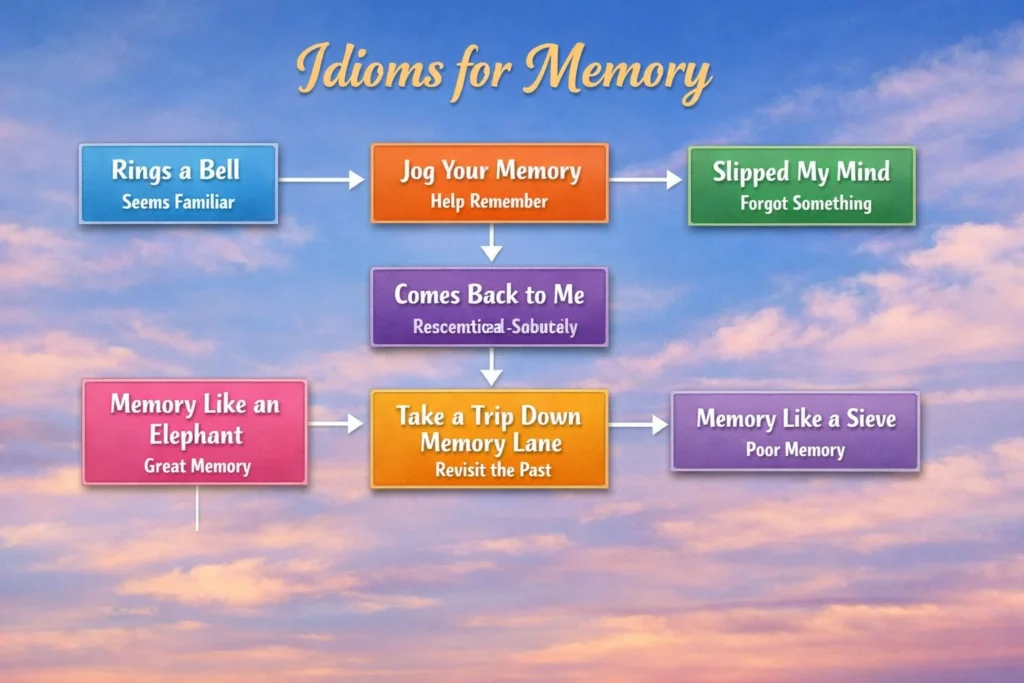
Ring a Bell
Meaning
To seem familiar even if you cannot completely remember.
When People Use It
People use this expression when they recognize a name, place, or idea but cannot immediately recall all the details.
Alternative Expression
Sound familiar.
Examples in Communication
Formal Example
The author’s name rings a bell, although I cannot recall which books she wrote.
Casual Example
That restaurant name rings a bell. I think we’ve eaten there before.
Creative Example
The melody rang a bell and carried him back to summers long forgotten.
Jog Someone’s Memory
Meaning
To help someone remember something they have forgotten.
When People Use It
Common in conversations, meetings, and storytelling.
Alternative Expression
Refresh someone’s memory.
Examples in Communication
Formal Example
The photographs helped jog the witness’s memory.
Casual Example
Can you show me the picture? It might jog my memory.
Creative Example
The scent of old books jogged her memory and reopened a chapter of childhood.
Slip One’s Mind
Meaning
To forget something unintentionally.
When People Use It
Usually used when apologizing for forgetting.
Alternative Expression
Forget about something.
Examples in Communication
Formal Example
I apologize for the delay; the appointment completely slipped my mind.
Casual Example
Sorry, your birthday slipped my mind.
Creative Example
Among the noise of daily life, the promise quietly slipped his mind.
Come Back to Someone
Meaning
To suddenly remember something after forgetting it.
When People Use It
Used when memories return unexpectedly.
Alternative Expression
Remember eventually.
Examples in Communication
Formal Example
The details came back to me after reviewing the report.
Casual Example
Wait a minute, it’s coming back to me now!
Creative Example
Like waves returning to shore, the memories slowly came back to her.
Etched in One’s Memory
Meaning
Remembered very clearly for a long time.
When People Use It
Often used for emotional, joyful, or life-changing experiences.
Alternative Expression
Burned into one’s memory.
Examples in Communication
Formal Example
The historic event remains etched in the nation’s memory.
Casual Example
That vacation is etched in my memory forever.
Creative Example
The laughter of that evening stayed etched in his memory like a beautiful painting.
Refresh Someone’s Memory
Meaning
To remind someone of something forgotten.
When People Use It
Common in both professional and personal communication.
Alternative Expression
Jog someone’s memory.
Examples in Communication
Formal Example
Allow me to refresh your memory regarding the original agreement.
Casual Example
Can you refresh my memory? I forgot his name.
Creative Example
The faded letter refreshed memories hidden beneath the years.
Have a Memory Like an Elephant
Meaning
To possess an exceptionally good memory.
When People Use It
Usually as a compliment.
Alternative Expression
Never forget anything.
Examples in Communication
Formal Example
She has a memory like an elephant and remembers every detail.
Casual Example
Dad remembers everything. He has a memory like an elephant.
Creative Example
He carried memories like treasures, with a memory like an elephant guiding him through the years.
Commit to Memory
Meaning
To memorize something carefully.
When People Use It
Common in education and studying.
Alternative Expression
Learn by heart.
Examples in Communication
Formal Example
Students are encouraged to commit important formulas to memory.
Casual Example
I committed her phone number to memory.
Creative Example
He committed every line to memory before stepping onto the stage.
Bear in Mind
Meaning
To remember or consider something important.
When People Use It
Very common in essays, business communication, and discussions.
Alternative Expression
Keep in mind.
Examples in Communication
Formal Example
Please bear in mind that deadlines may change.
Casual Example
Bear that in mind when you’re shopping.
Creative Example
She carried her grandmother’s advice in mind wherever life took her.
Cast One’s Mind Back
Meaning
To think about something that happened in the past.
When People Use It
Often found in storytelling and reflective writing.
Alternative Expression
Think back.
Examples in Communication
Formal Example
If we cast our minds back, we can understand how the project began.
Casual Example
Cast your mind back to high school days.
Creative Example
He cast his mind back and found pieces of happiness hidden in old memories.
Keep in Mind
Meaning
To remember something important or not forget a particular fact.
When People Use It
This expression appears frequently in conversations, presentations, and everyday advice.
Alternative Expression
Bear in mind.
Examples in Communication
Formal Example
Please keep in mind that weather conditions may affect the schedule.
Casual Example
Keep in mind that the store closes early today.
Creative Example
She kept her father’s words in mind like a compass guiding her journey.
Learn by Heart
Meaning
To memorize something completely.
When People Use It
Common in school, language learning, and performances.
Alternative Expression
Commit to memory.
Examples in Communication
Formal Example
Students were asked to learn the poem by heart.
Casual Example
I know the lyrics by heart.
Creative Example
He had learned every line by heart long before the curtains rose.
Bring to Mind
Meaning
To cause someone to remember something.
When People Use It
Useful in writing and thoughtful conversations.
Alternative Expression
Remind someone.
Examples in Communication
Formal Example
The painting brings to mind the beauty of the countryside.
Casual Example
That song brings back memories.
Creative Example
The smell of rain brought to mind evenings spent on the porch.
Bring Back Memories
Meaning
To make someone remember experiences from the past.
When People Use It
Often used when old photos, songs, or places trigger nostalgia.
Alternative Expression
Take someone down memory lane.
Examples in Communication
Formal Example
The documentary brought back memories of my childhood.
Casual Example
Wow, this picture brings back memories.
Creative Example
The old train station brought back memories wrapped in laughter and sunshine.
Take a Trip Down Memory Lane
Meaning
To spend time thinking fondly about the past.
When People Use It
Popular in storytelling and social conversations.
Alternative Expression
Reminisce.
Examples in Communication
Formal Example
The reunion provided an opportunity to take a trip down memory lane.
Casual Example
We looked through old albums and took a trip down memory lane.
Creative Example
They wandered through forgotten photographs and traveled down memory lane together.
Burned Into One’s Memory
Meaning
Remembered very vividly, often because the experience was emotional.
When People Use It
Used for unforgettable events.
Alternative Expression
Etched in one’s memory.
Examples in Communication
Formal Example
The scene remains burned into my memory.
Casual Example
I’ll never forget that day. It’s burned into my memory.
Creative Example
The sunset over the ocean was burned into her memory forever.
Memory Like a Sieve
Meaning
To have a poor memory and forget things easily.
When People Use It
Usually said humorously.
Alternative Expression
Forgetful.
Examples in Communication
Formal Example
He joked that he had a memory like a sieve.
Casual Example
I have a memory like a sieve these days.
Creative Example
Birthdays and appointments slipped away through his memory like grains of sand.
On the Tip of One’s Tongue
Meaning
Almost able to remember something but not quite.
When People Use It
Common when trying to recall names or words.
Alternative Expression
Almost remember.
Examples in Communication
Formal Example
The answer was on the tip of her tongue.
Casual Example
His name is on the tip of my tongue.
Creative Example
The forgotten melody hovered on the tip of her tongue like a distant echo.
Rekindle Old Memories
Meaning
To revive memories that had faded over time.
When People Use It
Used in emotional and nostalgic contexts.
Alternative Expression
Bring back memories.
Examples in Communication
Formal Example
The photographs rekindled old memories.
Casual Example
Meeting my classmates rekindled old memories.
Creative Example
A single letter rekindled memories hidden beneath the years.
A Walk Down Memory Lane
Meaning
An activity that involves remembering happy moments from the past.
When People Use It
Often used when discussing old stories and photographs.
Alternative Expression
Trip down memory lane.
Examples in Communication
Formal Example
The anniversary celebration became a walk down memory lane.
Casual Example
Watching old videos was a walk down memory lane.
Creative Example
The dusty attic turned into a walk down memory lane filled with forgotten treasures.
Practical Usage Guidance
Idioms for memory are especially useful because they add emotion and personality to communication. Instead of repeatedly saying “remember” or “forget,” these expressions create richer and more natural language.
In professional writing, phrases like bear in mind and keep in mind sound polished and appropriate.
In casual conversations, expressions such as ring a bell and slip my mind feel friendly and natural.
Writers and storytellers often prefer phrases like etched in my memory or trip down memory lane because they create vivid imagery and emotional depth.
How to Use Idioms Naturally
Try introducing one or two idioms into everyday conversations instead of forcing several into the same sentence.
Pay attention to how native speakers use these expressions in books, podcasts, and movies.
Practice writing short stories or journal entries using idioms to make them feel more natural.
Common Mistakes with Idioms
Avoid changing the wording of established idioms. For example, people say ring a bell, not sound a bell.
Do not use too many idioms in formal essays. A few well-chosen expressions are usually more effective.
Remember that some idioms are informal and fit conversations better than academic writing.
Idioms vs Literal Expressions
Literal expressions are direct.
- I remembered his name.
Idiomatic expressions are more colorful.
- His name suddenly came back to me.
Literal language focuses on facts, while idioms often add emotion, imagery, and personality.
Tips for Sounding More Fluent
- Learn idioms in context instead of memorizing isolated lists.
- Read novels and blogs to see how expressions are used naturally.
- Practice speaking aloud.
- Use idioms that match the tone of the conversation.
- Focus on quality rather than quantity.
How to Remember Idioms Easily
Associate idioms with real-life situations.
Create your own examples rather than copying dictionary sentences.
Review expressions regularly and use them in conversations whenever possible.
Stories and emotions make idioms easier to remember, which is why phrases like trip down memory lane often stay with learners for years.
FAQs
What are idioms for memory?
Idioms for memory are expressions used to describe remembering, forgetting, or recalling information in a figurative and natural way.
Which idiom means remembering something vaguely?
The idiom ring a bell is commonly used when something sounds familiar but cannot be remembered completely.
What idiom describes forgetting something accidentally?
Slip one’s mind is one of the most common expressions for accidental forgetfulness.
Are memory idioms suitable for formal writing?
Some are. Expressions such as bear in mind and keep in mind work well in professional and academic contexts.
How can I learn idioms more effectively?
Practice them in conversations, connect them with personal experiences, and read authentic English content regularly.
Conclusion
Memory shapes our stories, relationships, and experiences, which is why English has developed so many expressive ways to talk about remembering and forgetting. Learning these idioms for memory can make your writing more vivid, your conversations more natural, and your understanding of English much deeper.
Rather than memorizing long lists, try using these expressions in everyday situations. Over time, phrases like ring a bell, jog someone’s memory, and trip down memory lane will become part of your natural vocabulary.
Language is full of memorable expressions, and the more you explore them, the more confidently you can communicate. Keep practicing, stay curious, and enjoy the journey of making English both meaningful and memorable.
Discover More Related Articles:
- Idioms About Teeth | Bite Into English Like a Pro In 2026
- Idioms for Heart | That Reveal Human Feelings In 2026