
People often use idioms for laughing to describe different kinds of amusement, joy, or uncontrollable laughter. Common expressions include laugh your head off, crack up, split your sides, roar with laughter, in stitches, and fall about laughing. These idioms make conversations, stories, essays, and creative writing more vivid and expressive.
Laughter is one of those universal experiences that connects people instantly. Whether you’re sharing jokes with friends, reading a humorous story, or watching a funny video, laughter naturally brings warmth and energy into conversations.
That’s why English speakers often rely on colorful expressions rather than repeatedly saying “laugh a lot.” Idioms for laughing add personality and emotion to language. They help writers paint vivid scenes and allow speakers to express different shades of amusement, from a quiet chuckle to uncontrollable laughter.
In everyday conversations, blog writing, storytelling, and even essays, these expressions can make your language sound more natural and engaging. Learning them isn’t just about expanding vocabulary. It’s about understanding how native speakers communicate emotions and humor in real-life situations.
If you’ve ever wanted to sound more fluent or make your writing feel more lively, these idioms for laughing are worth adding to your vocabulary.
Quick Summary Table
| Idiom | Meaning | Tone |
|---|---|---|
| Laugh Your Head Off | Laugh very hard | Informal |
| Crack Up | Burst into laughter | Informal |
| In Stitches | Unable to stop laughing | Informal |
| Roar with Laughter | Laugh loudly | Neutral |
| Split Your Sides | Laugh intensely | Informal |
| Fall About Laughing | Laugh uncontrollably | Informal |
| Have a Good Laugh | Enjoy something funny | Neutral |
| Burst Out Laughing | Suddenly start laughing | Neutral |
| Die Laughing | Find something extremely funny | Informal |
| Giggle Like a Schoolgirl | Laugh in a silly way | Informal |
| Belly Laugh | Deep and hearty laughter | Neutral |
| Snicker Behind Someone’s Back | Laugh secretly | Negative |
| Laugh in Someone’s Face | Show disrespect through laughter | Negative |
| Be Tickled Pink | Feel amused and delighted | Positive |
| Get a Kick Out of Something | Find something amusing | Informal |
| Chuckle to Yourself | Laugh quietly | Neutral |
| Laugh All the Way to the Bank | Profit while others criticize | Informal |
| Raise a Smile | Cause mild amusement | Formal |
| Have Everyone in Fits of Laughter | Make people laugh uncontrollably | Neutral |
| Howl with Laughter | Laugh very loudly | Informal |
Laugh Your Head Off
Meaning
To laugh extremely hard.
When People Use It
When something is hilariously funny.
Alternative Expression
Crack up.
Examples in Communication
Formal Example:
The audience laughed their heads off during the comedian’s performance.
Casual Example:
We laughed our heads off watching that video.
Creative Example:
By the end of the movie, everyone was laughing their heads off and wiping away tears.
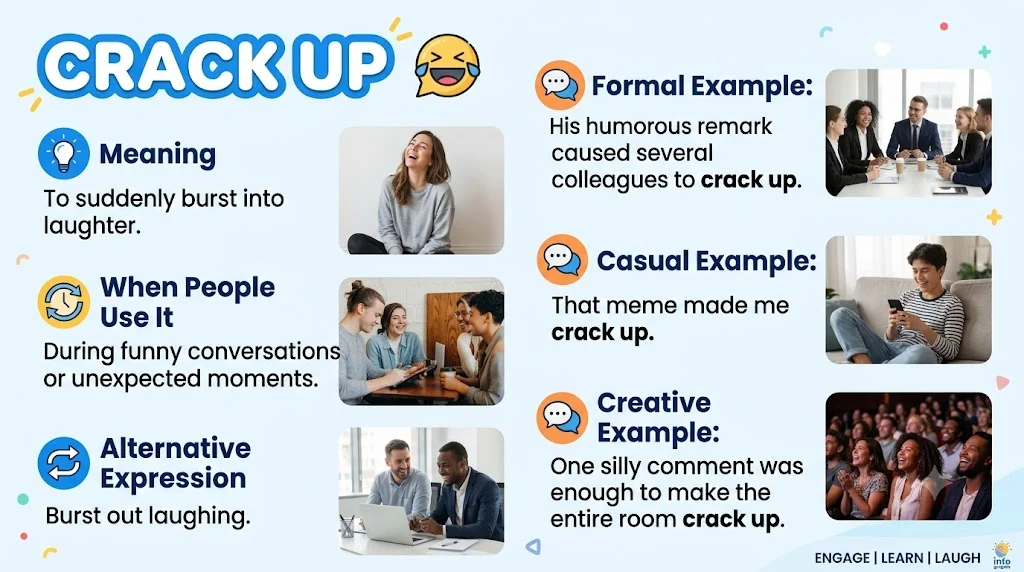
Crack Up
Meaning
To suddenly burst into laughter.
When People Use It
During funny conversations or unexpected moments.
Alternative Expression
Burst out laughing.
Formal Example:
His humorous remark caused several colleagues to crack up.
Casual Example:
That meme made me crack up.
Creative Example:
One silly comment was enough to make the entire room crack up.
In Stitches
Meaning
Unable to stop laughing.
When People Use It
When something is incredibly funny.
Alternative Expression
Split your sides.
Formal Example:
Her speech had the audience in stitches.
Casual Example:
That prank video had me in stitches.
Creative Example:
Grandpa’s stories always leave us in stitches around the dinner table.
Roar with Laughter
Meaning
To laugh loudly and heartily.
When People Use It
During entertaining events or funny stories.
Alternative Expression
Howl with laughter.
Formal Example:
The crowd roared with laughter throughout the performance.
Casual Example:
Everyone roared with laughter when he slipped on the ice.
Creative Example:
The theater echoed as hundreds of people roared with laughter.
Split Your Sides
Meaning
To laugh so hard that your stomach hurts.
When People Use It
When describing intense amusement.
Alternative Expression
In stitches.
Formal Example:
His witty anecdotes nearly had the guests splitting their sides.
Casual Example:
That comedian made us split our sides.
Creative Example:
The children split their sides listening to Uncle Sam’s silly impressions.
Fall About Laughing

Meaning
To laugh uncontrollably.
Alternative Expression
Crack up.
Formal Example:
The students fell about laughing after the teacher’s joke.
Casual Example:
We were falling about laughing all evening.
Creative Example:
The campfire stories had everyone falling about laughing beneath the stars.
Have a Good Laugh
Meaning
To enjoy a funny moment.
Alternative Expression
Share a laugh.
Formal Example:
The team had a good laugh during the celebration.
Casual Example:
Let’s just have a good laugh about it.
Creative Example:
Old photographs always give the family a chance to have a good laugh.
Burst Out Laughing
Meaning
To start laughing suddenly.
Alternative Expression
Crack up.
Formal Example:
Several attendees burst out laughing at the unexpected comment.
Casual Example:
I burst out laughing when I saw the cat wearing sunglasses.
Creative Example:
The room went silent before everyone burst out laughing at the punchline.
Die Laughing
Meaning
To find something extremely funny.
Alternative Expression
Laugh your head off.
Formal Example:
The humorous article had readers practically dying laughing.
Casual Example:
You’re going to die laughing when you hear this story.
Creative Example:
Her reaction was so priceless that we nearly died laughing.
Belly Laugh
Meaning
A deep, genuine laugh.
Alternative Expression
Roar with laughter.
Formal Example:
The performance inspired several hearty belly laughs.
Casual Example:
I needed a good belly laugh today.
Creative Example:
His contagious laugh sparked belly laughs across the room.
Howl with Laughter
Meaning
To laugh very loudly.
Alternative Expression
Roar with laughter.
Formal Example:
The audience howled with laughter during the comedy show.
Casual Example:
We were howling with laughter all night.
Creative Example:
Their jokes made the entire cabin howl with laughter.
Be Tickled Pink
Meaning
To feel delighted and amused.
Alternative Expression
Be pleased.
Formal Example:
She was tickled pink by the children’s funny performance.
Casual Example:
Mom was tickled pink by the surprise.
Creative Example:
Grandma was tickled pink when the twins performed their silly dance.
Get a Kick Out of Something
Meaning
To find something amusing or enjoyable.
Alternative Expression
Enjoy greatly.
Formal Example:
Many readers get a kick out of humorous novels.
Casual Example:
I get a kick out of dad jokes.
Creative Example:
He gets a kick out of making everyone smile.
Chuckle to Yourself
Meaning
To laugh quietly.
Alternative Expression
Giggle softly.
Formal Example:
She chuckled to herself while reading the article.
Casual Example:
I couldn’t help chuckling to myself.
Creative Example:
He chuckled to himself remembering childhood adventures.
Raise a Smile
Meaning
To cause mild amusement.
Alternative Expression
Bring a smile.
Formal Example:
The story raised a smile among the audience.
Casual Example:
That picture raised a smile.
Creative Example:
Even on difficult days, her jokes raised a smile.
Have Everyone in Fits of Laughter
Meaning
To make people laugh uncontrollably.
Alternative Expression
In stitches.
Formal Example:
The speaker had everyone in fits of laughter.
Casual Example:
That joke had us all in fits of laughter.
Creative Example:
His impressions had the whole neighborhood in fits of laughter.
Laugh in Someone’s Face
Meaning
To laugh disrespectfully at someone.
Alternative Expression
Mock someone.
Usage Note
This idiom carries a negative tone and should be used carefully.
Snicker Behind Someone’s Back
Meaning
To laugh secretly at someone.
Usage Note
Often used to describe rude behavior.
Laugh All the Way to the Bank
Meaning
To profit or succeed despite criticism.
Alternative Expression
Have the last laugh.
Have the Last Laugh
Meaning
To ultimately succeed after others doubted you.
Alternative Expression
Laugh all the way to the bank.
Giggle Like a Schoolgirl
Meaning
To laugh in a lighthearted, silly manner.
Alternative Expression
Chuckle.
Have the Last Laugh
Meaning
To eventually succeed or prove others wrong after being doubted or criticized.
When People Use It
When someone triumphs after facing ridicule or skepticism.
Alternative Expression
Laugh all the way to the bank.
Examples in Communication
Formal Example:
Despite early criticism, the company had the last laugh when its product became successful.
Casual Example:
Everyone doubted him, but he had the last laugh in the end.
Creative Example:
Years later, she smiled quietly, knowing she had the last laugh.
Laugh All the Way to the Bank
Meaning
To make money or achieve success while others criticize or underestimate you.
When People Use It
When someone benefits greatly despite negative opinions.
Alternative Expression
Have the last laugh.
Examples in Communication
Formal Example:
The author laughed all the way to the bank after her novel became a bestseller.
Casual Example:
People mocked his idea, but now he’s laughing all the way to the bank.
Creative Example:
While critics complained, she was laughing all the way to the bank with record sales.
Giggle Like a Schoolgirl
Meaning
To laugh in an excited, playful, or slightly silly manner.
When People Use It
During happy or amusing moments.
Alternative Expression
Chuckle softly.
Examples in Communication
Formal Example:
The old friends giggled like schoolgirls as they remembered their childhood adventures.
Casual Example:
They were giggling like schoolgirls over old photos.
Creative Example:
The sisters sat on the porch, giggling like schoolgirls under the evening sky.
Be in Fits of Laughter
Meaning
To laugh so much that it becomes difficult to stop.
When People Use It
When something is unbelievably funny.
Alternative Expression
In stitches.
Examples in Communication
Formal Example:
The speaker’s humorous anecdotes left the audience in fits of laughter.
Casual Example:
That video had me in fits of laughter.
Creative Example:
The family spent the evening in fits of laughter over Grandpa’s stories.
Roll in the Aisles
Meaning
To laugh uncontrollably, especially at a performance or show.
When People Use It
When describing something hilariously entertaining.
Alternative Expression
Roar with laughter.
Examples in Communication
Formal Example:
The comedy play had the audience rolling in the aisles.
Casual Example:
That comedian had everyone rolling in the aisles.
Creative Example:
By the final act, people were practically rolling in the aisles with laughter.
Practical Usage Guidance
How to Use Idioms Naturally
Idioms work best when they match the mood of the conversation. Expressions like “laugh your head off” and “crack up” sound natural among friends and in casual writing. Meanwhile, phrases such as “raise a smile” fit better in essays, reviews, or professional communication.
Instead of overusing one phrase, vary your expressions. This makes your speech and writing more interesting and authentic.
Common Mistakes with Idioms
Many learners try to interpret idioms literally. For example, nobody actually loses their head when they “laugh their head off.” The phrase simply means laughing very hard.
Another mistake is using informal idioms in highly formal situations. Knowing the tone behind an expression is just as important as understanding its meaning.
Idioms vs Literal Expressions
Compare these sentences:
- Literal: Everyone laughed loudly.
- Idiomatic: Everyone roared with laughter.
The second sentence creates a stronger image and adds more personality to the writing.
Tips for Sounding More Fluent
- Learn idioms through stories and conversations.
- Pay attention to movies and TV shows.
- Practice using one or two new expressions each week.
- Match idioms with the emotional tone of the situation.
- Avoid forcing idioms into every sentence.
How to Remember Idioms Easily
Think of the picture each expression creates. Visualizing a crowd “in stitches” or someone having a hearty “belly laugh” makes these phrases easier to remember.
Keeping a personal notebook of favorite idioms and writing your own examples can also help them become part of your everyday vocabulary.
FAQs
What are the most common idioms for laughing?
Some of the most common expressions are laugh your head off, crack up, roar with laughter, and in stitches.
Are laughing idioms formal or informal?
Most are informal, though expressions like raise a smile can sound more polished and suitable for formal writing.
Can idioms improve creative writing?
Yes. Idioms add emotion, imagery, and personality, making stories and essays more engaging.
Should I use idioms in professional communication?
Moderately. Choose neutral expressions and avoid overly casual phrases in formal settings.
How can I remember idioms more easily?
Reading, watching conversations in context, and creating your own example sentences are effective ways to remember them.
Conclusion
Learning idioms for laughing does more than enrich your vocabulary. It helps you communicate emotions with greater color and personality. Whether you’re writing a story, preparing a school assignment, creating blog content, or simply chatting with friends, these expressions make language feel more vivid and human.
The beauty of idioms lies in their ability to capture feelings that plain words sometimes cannot. A simple phrase like in stitches or laugh your head off instantly paints a picture and brings energy to a sentence.
Don’t worry about memorizing every expression at once. Start with a few favorites and use them naturally in conversations or writing. Over time, they’ll become part of your everyday English.
A good laugh is universal and with these idioms for laughing, you’ll have plenty of ways to express it beautifully.
Discover More Related Articles:
- Idioms About Teeth | Bite Into English Like a Pro In 2026
- Idioms for Heart | That Reveal Human Feelings In 2026