
Quick Answer
Trust idioms are expressions people use to describe loyalty, honesty, reliability, confidence, and strong relationships. Popular idioms for trust include “take someone at their word,” “in safe hands,” “through thick and thin,” and “have someone’s back.” These idioms make conversations sound more natural, emotionally expressive, and fluent in both writing and speech.
Trust shapes nearly every meaningful relationship we have. It affects friendships, families, workplaces, classrooms, and even the small daily conversations that quietly build connection over time. When people trust each other, communication feels easier, warmer, and more genuine.
That’s one reason idioms for trust are so powerful. They allow us to express loyalty, confidence, reliability, and emotional safety in a way that sounds natural rather than overly formal. Instead of saying “I completely believe him,” someone might say, “I take him at his word.” That small shift instantly makes the sentence feel more human and expressive.
These idioms also appear everywhere — in novels, movies, business discussions, social media captions, and casual conversations with friends. Learning them doesn’t just improve vocabulary. It helps people sound more fluent, emotionally aware, and culturally connected.
In this guide, you’ll explore useful idioms for trust with meanings, examples, and practical insights that make them easier to remember and use naturally in everyday communication and writing.
Quick Summary Table
| Idiom | Simple Meaning | Common Situation |
|---|---|---|
| Take Someone at Their Word | Believe what someone says | Honest conversations |
| In Safe Hands | Protected by reliable people | Work or healthcare |
| Have Someone’s Back | Support someone fully | Friendship and teamwork |
| Through Thick and Thin | Stay loyal in hard times | Relationships |
| Give the Benefit of the Doubt | Choose to trust despite uncertainty | Conflict resolution |
| Rock Solid | Extremely dependable | Strong relationships |
| True Blue | Completely loyal | Lifelong friendships |
| Stick by Someone | Remain supportive | Difficult situations |
| Keep One’s Word | Do what was promised | Professional trust |
| Trust Someone with Your Life | Deep confidence in someone | Emotional or serious situations |
Take Someone at Their Word
Meaning
To believe what someone says without needing extra proof.
When People Use It
People use this idiom when they trust another person’s honesty or sincerity.
Alternative Expression
Believe someone completely
Examples in Communication
Formal Example
The manager decided to take the client at their word regarding the delivery timeline.
Casual Example
I trust Maya, so I just took her at her word.
Creative Example
His voice carried the kind of calm honesty that made people take him at his word instantly.
Usage Insight
This idiom sounds natural in both professional and personal conversations.
In Safe Hands
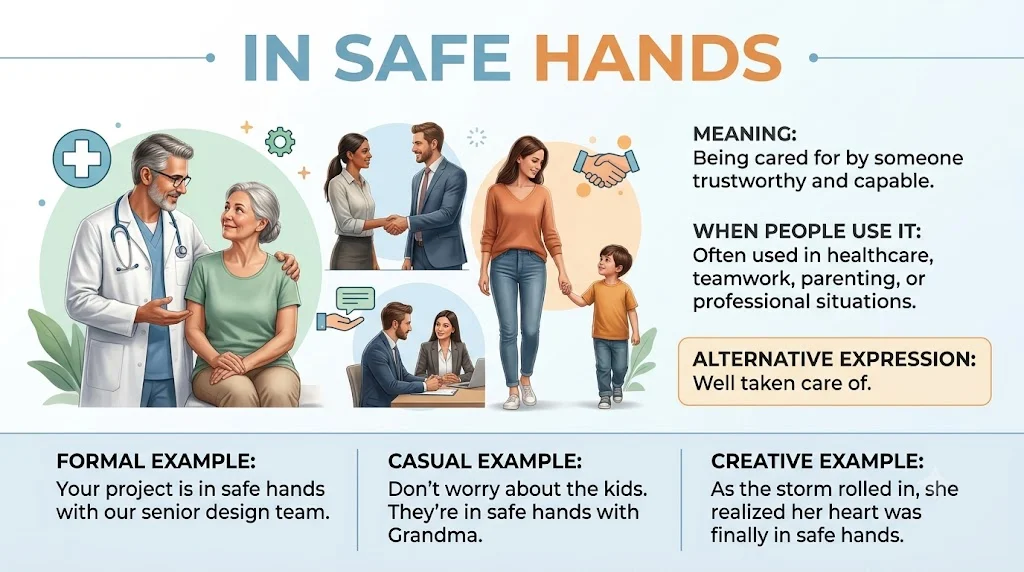
Meaning
Being cared for by someone trustworthy and capable.
When People Use It
Often used in healthcare, teamwork, parenting, or professional situations.
Alternative Expression
Well taken care of
Examples in Communication
Formal Example
Your project is in safe hands with our senior design team.
Casual Example
Don’t worry about the kids. They’re in safe hands with Grandma.
Creative Example
As the storm rolled in, she realized her heart was finally in safe hands.
Have Someone’s Back
Meaning
To support and protect someone no matter what.
When People Use It
Common in friendships, sports teams, workplaces, and family relationships.
Alternative Expression
Stand by someone
Examples in Communication
Formal Example
A strong leader always has their team’s back during difficult periods.
Casual Example
Relax, I’ve got your back.
Creative Example
Even when the whole room turned cold, she knew her brother had her back.
Usage Insight
This idiom is informal but extremely common in spoken English.
Through Thick and Thin
Meaning
Remaining loyal during both good and difficult times.
When People Use It
Used to describe lasting loyalty and emotional commitment.
Alternative Expression
No matter what
Examples in Communication
Formal Example
Their partnership survived through thick and thin over two decades.
Casual Example
Best friends stick together through thick and thin.
Creative Example
Like old trees surviving every season, they stood together through thick and thin.
Give Someone the Benefit of the Doubt

Meaning
To choose trust even when uncertainty exists.
When People Use It
Often used during misunderstandings or conflicts.
Alternative Expression
Assume good intentions
Examples in Communication
Formal Example
The committee gave him the benefit of the doubt during the investigation.
Casual Example
Maybe she forgot accidentally. Give her the benefit of the doubt.
Creative Example
Trust sometimes begins with the quiet decision to give someone the benefit of the doubt.
Keep One’s Word
Meaning
To do what was promised.
When People Use It
Common in business, leadership, and personal relationships.
Alternative Expression
Honor a promise
Examples in Communication
Formal Example
A respected leader always keeps their word.
Casual Example
Dad said he’d come, and he always keeps his word.
Creative Example
In a world full of excuses, she still kept her word like it mattered.
True Blue
Meaning
Completely loyal and dependable.
When People Use It
Usually used for deeply loyal friends or supporters.
Alternative Expression
Faithful and loyal
Examples in Communication
Formal Example
She remained a true blue supporter of the organization.
Casual Example
Jake’s true blue. He’ll never let you down.
Creative Example
Some friendships fade with time, but hers stayed true blue.
Stick by Someone
Meaning
To continue supporting someone during difficult times.
When People Use It
Often connected to emotional loyalty and relationships.
Alternative Expression
Remain loyal
Examples in Communication
Formal Example
Her colleagues stuck by her throughout the controversy.
Casual Example
Thanks for sticking by me when things got messy.
Creative Example
While others disappeared quietly, he stayed and stuck by her side.
Rock Solid
Meaning
Extremely dependable and trustworthy.
When People Use It
Used for relationships, plans, agreements, or personalities.
Alternative Expression
Strong and reliable
Examples in Communication
Formal Example
The company has built a rock solid reputation over the years.
Casual Example
Their friendship is rock solid.
Creative Example
Trust became the rock solid bridge between their broken past and hopeful future.
Trust Someone with Your Life
Meaning
To trust someone completely.
When People Use It
Used in emotional or serious contexts.
Alternative Expression
Trust completely
Examples in Communication
Formal Example
The rescue team trusted each other with their lives during the mission.
Casual Example
She’s my best friend. I trust her with my life.
Creative Example
Some people earn trust slowly until one day you’d trust them with your life.
A Man/Woman of Their Word
Meaning
Someone who always keeps promises.
When People Use It
Often used respectfully in personal or professional settings.
Alternative Expression
Reliable person
Examples in Communication
Formal Example
He is known as a man of his word in the business community.
Casual Example
Don’t worry — she’s a woman of her word.
Creative Example
His reputation wasn’t built on charm alone but on being a man of his word.
Put Faith in Someone
Meaning
To trust someone’s ability or character.
When People Use It
Common in emotional support and leadership situations.
Alternative Expression
Believe in someone
Examples in Communication
Formal Example
The organization put faith in young leaders.
Casual Example
Thanks for putting faith in me.
Creative Example
Sometimes a single person putting faith in you can change your entire future.
On the Level
Meaning
Honest and trustworthy.
When People Use It
Used when discussing sincerity or fairness.
Alternative Expression
Straightforward and honest
Examples in Communication
Formal Example
The negotiation process remained completely on the level.
Casual Example
I think he’s on the level.
Creative Example
Her calm eyes made it easy to believe she was on the level.
Handshake Agreement
Meaning
An agreement based on trust rather than written proof.
When People Use It
Common in business or old-fashioned trust-based situations.
Alternative Expression
Verbal agreement
Examples in Communication
Formal Example
The partnership began as a simple handshake agreement.
Casual Example
We didn’t sign anything — it was just a handshake agreement.
Creative Example
Their handshake agreement carried more honesty than some legal contracts.
Put Your Trust in Someone
Meaning
To rely emotionally or practically on someone.
When People Use It
Used in personal growth, relationships, and teamwork.
Alternative Expression
Depend on someone
Examples in Communication
Formal Example
Employees must feel safe putting their trust in leadership.
Casual Example
I put my trust in her decision.
Creative Example
Trust is risky because it asks you to place your heart in another person’s hands.
Straight as an Arrow
Meaning
Very honest and morally reliable.
When People Use It
Used to describe someone with strong integrity.
Alternative Expression
Completely honest
Examples in Communication
Formal Example
The investigator was known for being straight as an arrow.
Casual Example
You can trust him. He’s straight as an arrow.
Creative Example
In a complicated world, her honesty stayed straight as an arrow.
Built on Trust
Meaning
A relationship or system strengthened through reliability and honesty.
When People Use It
Often used in workplaces, friendships, and marriages.
Alternative Expression
Founded on honesty
Examples in Communication
Formal Example
Strong partnerships are built on trust and transparency.
Casual Example
Their friendship was built on trust.
Creative Example
Every meaningful relationship is quietly built on trust long before love appears.
A Shoulder to Lean On
Meaning
Someone dependable during emotional difficulty.
When People Use It
Used during stressful or emotional situations.
Alternative Expression
Reliable support
Examples in Communication
Formal Example
Great mentors provide a shoulder to lean on during career challenges.
Casual Example
Thanks for being a shoulder to lean on lately.
Creative Example
When life became unbearably heavy, she became the shoulder he leaned on most.
Bank On Someone
Meaning
To rely confidently on someone.
When People Use It
Used in teamwork, planning, and dependable relationships.
Alternative Expression
Count on someone
Examples in Communication
Formal Example
Clients can bank on our support team for timely assistance.
Casual Example
You can always bank on Mia to help.
Creative Example
In uncertain times, dependable people become the ones we bank on most.
Stand the Test of Time
Meaning
Remain trustworthy or valuable over a long period.
When People Use It
Often used for relationships, values, or reputations.
Alternative Expression
Remain strong over time
Examples in Communication
Formal Example
Their reputation has stood the test of time.
Casual Example
Real friendships stand the test of time.
Creative Example
Some trust grows quietly until it stands the test of time like ancient stone.
Practical Usage Guidance
How to Use Idioms Naturally
The best way to use idioms for trust is to match them to real emotional situations. Instead of forcing idioms into every sentence, use them when they genuinely add personality or clarity.
For example:
- In professional writing, phrases like “keep one’s word” or “built on trust” sound polished and natural.
- In casual conversation, “have your back” or “bank on someone” feels more relaxed and conversational.
- In storytelling or creative writing, trust idioms add emotional depth and realism.
Common Mistakes with Idioms
One common mistake is using idioms too literally. For example, “in safe hands” does not actually refer to physical hands. It symbolically describes safety and reliability.
Another mistake is mixing idioms awkwardly. Native speakers usually use idioms naturally and sparingly rather than stacking several together in one paragraph.
Idioms vs Literal Expressions
Literal language communicates facts directly.
- Literal: “She is reliable.”
- Idiomatic: “She’s rock solid.”
Idioms create stronger emotional color and make communication feel more human.
Tips for Sounding More Fluent
To sound natural:
- Listen to idioms in movies, interviews, and podcasts.
- Practice using one or two idioms daily.
- Write short journal entries using new expressions.
- Notice emotional tone before choosing an idiom.
Fluency comes less from memorizing vocabulary and more from understanding when expressions emotionally fit the moment.
How to Remember Idioms Easily
People remember idioms faster when they connect them to personal experiences.
For example:
- Think of a loyal friend when learning “through thick and thin.”
- Remember a dependable teacher for “in safe hands.”
Mental images and emotional associations make idioms much easier to retain.
FAQs
What are idioms for trust?
Idioms for trust are figurative expressions used to describe loyalty, honesty, reliability, and emotional confidence in relationships or communication.
Why are trust idioms important in English?
They make speech and writing sound more natural, expressive, and emotionally meaningful.
Are trust idioms formal or informal?
Some are formal, like “keep one’s word,” while others are casual, like “have someone’s back.”
Can idioms improve writing skills?
Yes. Idioms add personality, emotional depth, and conversational fluency to essays, storytelling, blogs, and dialogue.
What is the easiest way to learn idioms naturally?
Practice them in real conversations, read widely, and connect each idiom to a memorable situation or emotion.
Conclusion
Idioms for trust do more than decorate language. They help people express loyalty, honesty, reliability, and emotional connection in ways that feel vivid and human. A simple phrase like “have someone’s back” can communicate warmth and support far more naturally than a long explanation ever could.
Whether you’re improving spoken English, writing stories, preparing school assignments, or trying to sound more fluent in conversations, these expressions can make your communication feel richer and more authentic. The key is not memorizing dozens of idioms at once, but learning how real people naturally use them in everyday life.
Pay attention to emotional context, listen for these phrases in conversations and media, and practice them gradually in your own writing and speech. Over time, they’ll begin to feel less like vocabulary words and more like part of your natural voice.
Discover More Related Articles:
- Idioms for Scared | That Bring Fearful Moments to Life In 2026
- Idioms for Confusion | That Perfectly Express a “Lost in Thought” Mind In 2026