Quick Answer
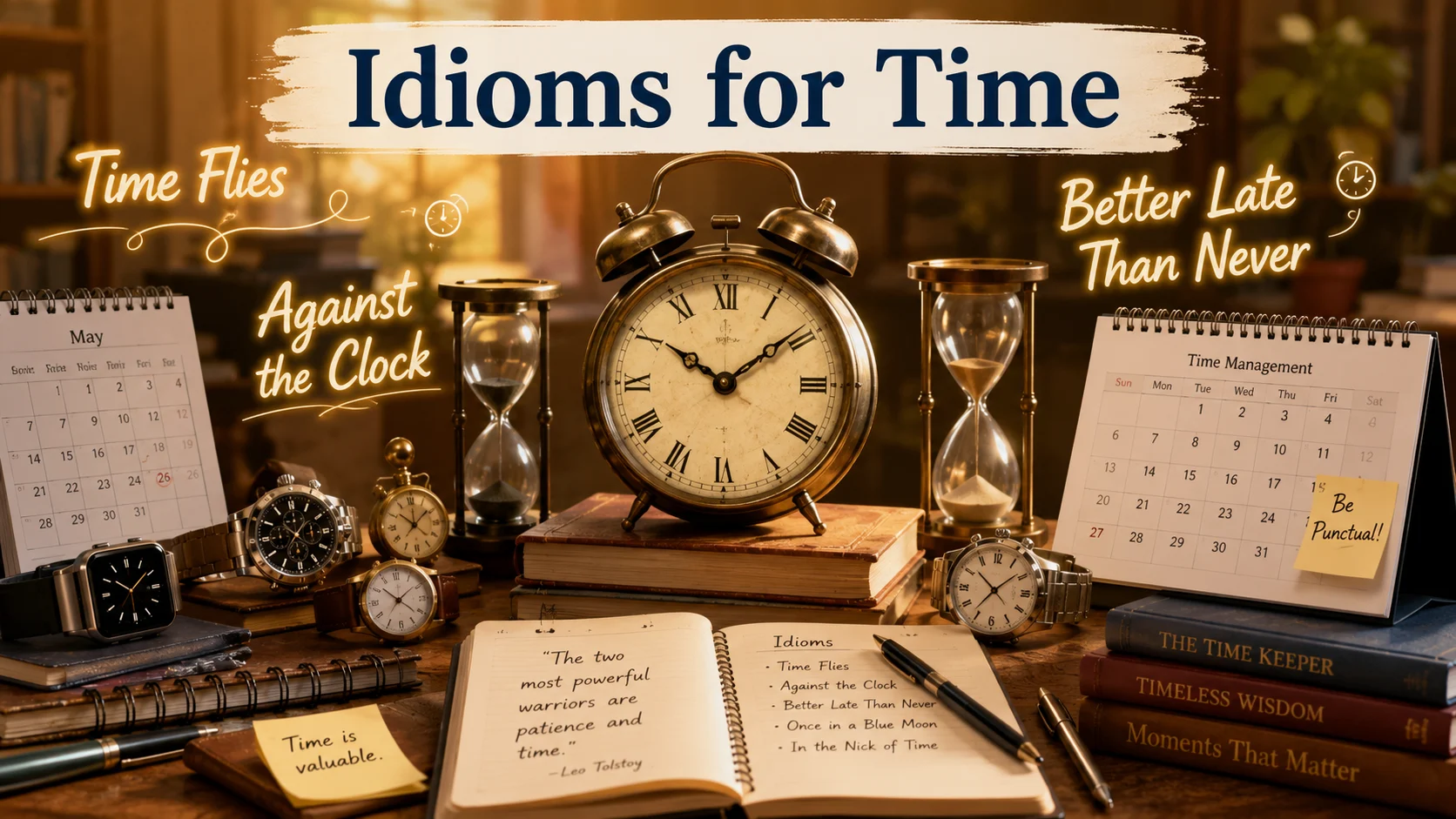
Time idioms are expressions that use the idea of time to describe situations, emotions, opportunities, delays, or urgency. Phrases such as “Time flies,” “Better late than never,” and “Against the clock” are widely used in everyday conversations, essays, storytelling, and workplace communication. Learning these expressions can make your English sound more natural and expressive.
Some conversations feel flat, while others seem vivid and memorable. A big reason for that difference is the use of expressions that paint a picture instead of simply stating facts. Idioms do exactly that.
When people talk about being against the clock or say that time flies, they are adding personality and emotion to their words. These expressions appear everywhere—from casual chats and social media captions to novels, essays, and workplace discussions.
Idioms for time are especially useful because time affects almost every part of life. We speak about deadlines, memories, opportunities, delays, and patience almost daily. Understanding these expressions helps students write more naturally, allows bloggers to create engaging content, and makes conversations sound more fluent.
Many learners discover that mastering a few time-related idioms can instantly make their English feel more confident and expressive.
Quick Summary Table
| Idiom | Meaning | Common Use |
|---|---|---|
| Time flies | Time passes quickly | Happy moments |
| Better late than never | Doing something late is better than not doing it | Encouragement |
| Around the clock | All day and night | Work and services |
| Against the clock | In a hurry | Deadlines |
| In the nick of time | Just before it is too late | Last-minute situations |
| Kill time | Spend time while waiting | Everyday conversation |
| Behind the times | Old-fashioned | Trends and technology |
| Ahead of one’s time | Innovative | Creativity |
| Third time’s the charm | Success after repeated attempts | Motivation |
| Time will tell | The future will reveal the answer | Uncertain situations |
| Beat the clock | Finish before time runs out | Competitions and work |
| Call it a day | Stop working | Daily life |
| Once in a blue moon | Very rarely | Conversation |
| Make up for lost time | Catch up after delay | Personal goals |
| On borrowed time | Near the end of something | Serious situations |
| Have the time of your life | Enjoy greatly | Memorable events |
| Bide your time | Wait patiently | Strategy |
| Buy time | Delay something temporarily | Problem-solving |
| Time is money | Time is valuable | Business and productivity |
| At the eleventh hour | At the last possible moment | Deadlines |
| Save time | Reduce unnecessary effort | Efficiency |
| Pass the time | Occupy yourself while waiting | Relaxation |
| A race against time | Urgent situation | Emergencies |
| For the time being | Temporarily | Plans and decisions |
| Big-time | On a large scale or successfully | Achievement |
Time Flies
Meaning
Time passes very quickly.
When People Use It
People often say this while reflecting on enjoyable experiences or important milestones.
Alternative Expression
“Where did the time go?”
Examples in Communication
Formal Example:
The semester seemed short because time flies when you are engaged in meaningful work.
Casual Example:
I can’t believe we’re graduating already. Time flies!
Creative Example:
As laughter filled the room, time flew away like a bird disappearing into the evening sky.
Better Late Than Never
Meaning
Doing something eventually is better than not doing it at all.
When People Use It
Used to encourage people who are starting something later than expected.
Alternative Expression
“It’s never too late.”
Examples
Formal Example:
She finally completed her degree, proving that better late than never.
Casual Example:
You made it to the party! Better late than never.
Creative Example:
The old dream arrived slowly, but it still knocked on the door.
Around the Clock
Meaning
Continuously throughout the day and night.
When People Use It
Used for hospitals, customer support, or busy projects.
Alternative Expression
“Twenty-four seven.”
Examples
Formal Example:
The emergency team worked around the clock to restore services.
Casual Example:
I’ve been studying around the clock for exams.
Creative Example:
The city lights stayed awake around the clock.
Against the Clock
Meaning
Working quickly because time is limited.
When People Use It
Deadlines, exams, projects, and competitions.
Alternative Expression
“In a hurry.”
Examples
Formal Example:
The researchers worked against the clock to complete the report.
Casual Example:
I’m against the clock, so I’ll call you later.
Creative Example:
The hands of the clock seemed to chase her every move.
In the Nick of Time
Meaning
Just before it becomes too late.
When People Use It
Unexpected rescues or last-minute success.
Alternative Expression
“Just in time.”
Examples
Formal Example:
The documents arrived in the nick of time.
Casual Example:
You reached the station in the nick of time.
Creative Example:
The rain started moments after they stepped inside.
Kill Time
Meaning
Spend time doing something while waiting.
When People Use It
Travel, waiting rooms, or free moments.
Alternative Expression
“Pass the time.”
Examples
Formal Example:
Passengers used books to kill time during the delay.
Casual Example:
Let’s watch videos to kill time.
Creative Example:
He wandered through old memories to kill time.
Behind the Times
Meaning
Old-fashioned or outdated.
When People Use It
Technology, fashion, or opinions.
Alternative Expression
“Out of date.”
Examples
Formal Example:
Some methods are considered behind the times.
Casual Example:
Dad still uses that old phone. He’s behind the times.
Creative Example:
His ideas belonged to yesterday’s world.
Ahead of One’s Time
Meaning
Innovative or more advanced than others.
When People Use It
Artists, inventors, and visionaries.
Alternative Expression
“Forward-thinking.”
Examples
Formal Example:
Many historians believe the scientist was ahead of his time.
Casual Example:
That movie was ahead of its time.
Creative Example:
Her imagination walked years ahead of everyone else.
Third Time’s the Charm
Meaning
Success often comes after repeated attempts.
When People Use It
Encouragement after failures.
Alternative Expression
“Try again.”
Examples
Formal Example:
After two unsuccessful interviews, the third time proved to be the charm.
Casual Example:
Failed twice? Don’t worry, third time’s the charm.
Creative Example:
Persistence finally opened the stubborn door.
Time Will Tell
Meaning
The future will reveal the answer.
When People Use It
Uncertain situations.
Alternative Expression
“We’ll see.”
Examples
Formal Example:
Time will tell whether the policy achieves its goals.
Casual Example:
Will they get married? Time will tell.
Creative Example:
Only tomorrow knows the answer.
Real-Life Scenarios Where Time Idioms Shine
Idioms become powerful only when they move from memory into real communication. Here are a few everyday situations where “idioms for time” naturally appear without sounding forced.
In workplaces, people often use phrases like “against the clock” during tight deadlines. It creates a shared understanding that everyone is in a hurry without needing long explanations. In classrooms, teachers might say “time flies” at the end of a term, instantly connecting with students’ shared experience.
In storytelling or blogging, expressions like “once in a blue moon” or “have the time of your life” add emotional depth. They don’t just describe events—they help readers feel them.
Even in casual chats, idioms like “kill time” or “call it a day” make conversations smoother and more natural. Instead of sounding mechanical, your English starts to feel lived-in and human.
Idioms in Writing: Making Your Language More Expressive
Writers often rely on idioms to add rhythm and personality to their sentences. Instead of repeatedly stating facts in plain language, idioms allow subtle emotional shading.
For example:
- Plain: She was very late.
- Expressive: She arrived at the eleventh hour.
The second version carries urgency and drama without adding extra words. That’s the beauty of idioms—they compress meaning while expanding emotion.
However, good writers don’t overload their content with idioms. The key is balance. One strong expression in the right place can elevate an entire paragraph.
Cultural Insight: Why Time Idioms Feel So Universal
Interestingly, time-related idioms exist in almost every language. Whether it’s English, Urdu, Arabic, or Chinese, people naturally connect time with life experience.
This is because time is something everyone feels but cannot control. That shared human experience makes idioms like “time will tell” or “for the time being” universally relatable.
Even if someone is learning English as a second language, these expressions often feel intuitive because the emotions behind them are already familiar.
Learning Strategy: Building Your Own Idiom Memory System
If you want to remember idioms more effectively, don’t treat them like vocabulary lists. Instead, try this simple method:
Think in situations, not words.
For example:
- Waiting for results → time will tell
- Last-minute exam prep → against the clock
- Relaxing on a holiday → have the time of your life
By linking idioms to real experiences, they naturally become part of your active speech.
Another helpful trick is to write short daily sentences using one idiom. Even a single line like “Today I’m working against the clock” helps reinforce memory.
Why Mastering Time Idioms Improves Communication Skills
Using idioms correctly signals more than vocabulary knowledge it shows cultural understanding and fluency.
When you say “call it a day” instead of “stop working,” your language becomes more natural and conversational. People also tend to respond more warmly to idiomatic speech because it feels less robotic and more human.
For students, bloggers, and professionals, this skill can make writing more engaging and spoken English more confident.
How to Use Idioms Naturally
Don’t force idioms into every sentence. Native speakers use them occasionally to add color and emotion.
Instead of saying:
“The meeting was completed quickly.”
You might write:
“We were working against the clock to finish the meeting preparations.”
That small change makes the sentence feel more vivid and natural.
Common Mistakes with Idioms
One mistake learners often make is interpreting idioms literally.
For example, “time flies” does not mean that time actually has wings.
Another mistake is using too many idioms in one paragraph. A few well-chosen expressions are far more effective than overloading your writing.
Idioms vs Literal Expressions
Literal language says exactly what it means.
Literal:
The project was completed before the deadline.
Idiomatic:
We beat the clock and finished ahead of schedule.
Idioms create stronger imagery and make communication more engaging.
Tips for Sounding More Fluent
- Learn idioms in context rather than memorizing lists.
- Read novels, blogs, and news articles to see them naturally.
- Use one or two idioms in conversations each week.
- Practice writing short stories using idiomatic expressions.
- Listen to movies and podcasts to understand tone and usage.
How to Remember Idioms Easily
Connect each idiom with a real-life experience.
If you remember rushing to finish homework, you’ll easily recall against the clock.
If you remember an unforgettable vacation, you’ll naturally remember having the time of your life.
Personal memories make expressions easier to retain.
FAQs
What are idioms for time?
Idioms for time are figurative expressions that describe speed, delays, opportunities, patience, and the passage of time.
Which time idiom is most commonly used?
“Time flies” is one of the most popular and widely recognized expressions.
Are time idioms formal or informal?
Most are informal, but many are acceptable in essays, articles, and professional communication when used naturally.
Why should language learners study idioms?
Idioms help speakers sound more fluent, expressive, and culturally aware.
Can I use idioms in creative writing?
Absolutely. Idioms add emotion, personality, and vivid imagery to stories and descriptions.
Conclusion
Language becomes more memorable when it goes beyond plain facts and captures experiences in colorful ways. That’s why idioms for time have remained popular for generations. They allow us to talk about urgency, patience, memories, and opportunities with expressions that feel lively and relatable.
Whether you’re preparing for school assignments, improving your spoken English, writing blog posts, or simply expanding your vocabulary, these idioms can enrich the way you communicate. The key is not to memorize hundreds of expressions at once, but to practice using a few naturally in everyday situations.
Over time, these phrases will become part of your writing and conversations without feeling forced. And perhaps that’s the most fitting lesson of all when you’re enjoying the process, time flies.
Discover More Related Articles:
- Idioms for Successful | That Inspire Greatness In 2026
- Idioms for Success | Expressions of Achievement In 2026