Quick Answer
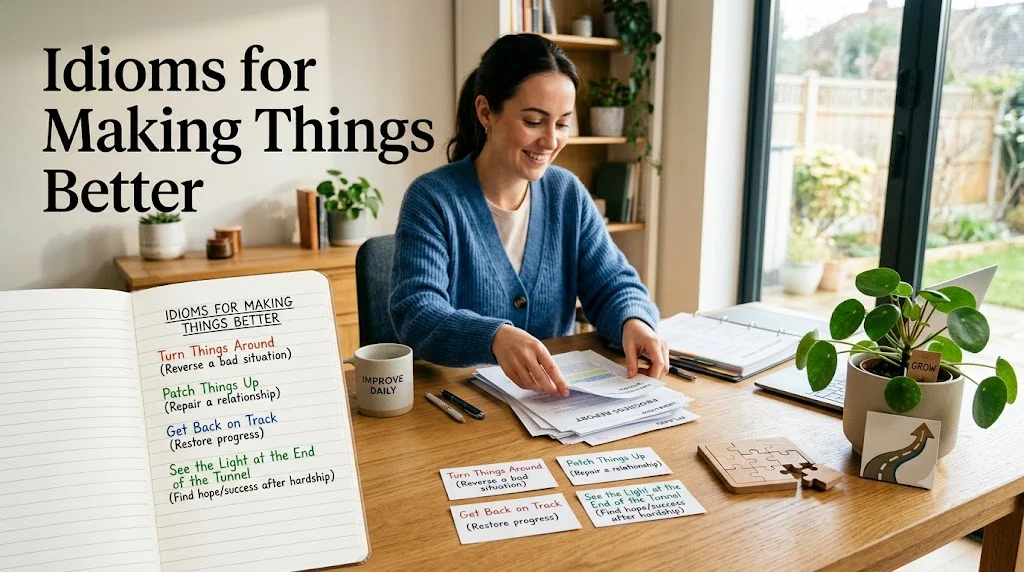
Idioms for making things better are expressions that describe improving a difficult situation, repairing a relationship, solving a problem, creating progress, or finding hope after a setback. Useful examples include smooth things over, patch things up, mend fences, turn things around, get back on track, iron out the wrinkles, turn over a new leaf, make the best of it, see the light at the end of the tunnel, and take a step in the right direction.
These expressions are especially useful when you want your English to sound more natural, expressive, and conversational. Instead of simply saying “The situation improved,” you might say, “We managed to turn things around.” That small change adds personality and emotional meaning to your communication.
A tense conversation becomes calmer. A struggling project finally starts moving. Two friends who stopped talking decide to clear the air. A disappointing week ends with one small piece of good news. English has plenty of colorful expressions for these moments, and idioms for making things better can help you describe them with far more feeling than ordinary vocabulary.
Compare “We solved the problem” with “We managed to turn things around.” Both communicate improvement, but the second expression suggests that the situation was heading in the wrong direction and then changed for the better.
That is the real strength of idioms. They do not merely communicate information; they add context, emotion, and personality.
Whether you are a student writing an essay, a language learner practicing conversation, a blogger searching for expressive vocabulary, or simply someone who wants to sound more natural in English, these expressions can give your language more color.
Below, you will find useful idioms for repairing problems, improving relationships, overcoming setbacks, restoring progress, and finding something positive in difficult circumstances.
Quick Summary of Table
| Idiom | Simple Meaning | Best Used For |
|---|---|---|
| Smooth things over | Reduce tension or conflict | Arguments and disagreements |
| Patch things up | Repair a relationship | Friends, couples, family |
| Mend fences | Repair a damaged relationship | Personal or professional relationships |
| Turn things around | Improve a bad situation | Problems, projects, circumstances |
| Get back on track | Return to progress | Plans, studies, projects |
| Iron out the wrinkles | Solve small problems | Plans, systems, projects |
| Turn over a new leaf | Start behaving differently | Personal change |
| Make the best of it | Deal positively with a bad situation | Disappointments |
| See the light at the end of the tunnel | See hope after difficulty | Long struggles |
| A step in the right direction | A positive improvement | Progress and decisions |
| Make lemonade out of lemons | Create something positive from difficulty | Setbacks |
| Every cloud has a silver lining | Find something positive in hardship | Disappointments |
| Clear the air | Resolve misunderstandings | Conversations |
| Nip it in the bud | Stop a problem early | Preventing bigger problems |
| Go the extra mile | Make an additional effort | Work, relationships, service |
| Get the ball rolling | Start making progress | Projects and plans |
| Pick up the pieces | Begin recovering after trouble | Losses and setbacks |
| Weather the storm | Survive a difficult period | Challenges and crises |
| Bounce back | Recover from difficulty | Failure and setbacks |
| Turn a corner | Begin moving toward improvement | Long-term problems |
| Brighten things up | Make something more cheerful | Mood and atmosphere |
| Put things right | Correct a problem | Mistakes and disagreements |
| Take the edge off | Make something less unpleasant | Stress, pain, tension |
| Put your best foot forward | Make a good impression | New situations |
| Leave things better than you found them | Improve something before leaving | Work, community, responsibilities |
Smooth Things Over
Meaning: To make a disagreement, conflict, or uncomfortable situation less tense.
When People Use It:
Smooth things over is useful when people have argued, misunderstood each other, or experienced an awkward moment. The goal is not necessarily to solve every underlying issue immediately. Instead, it means reducing tension and restoring a more peaceful atmosphere.
It is common in everyday conversation and also works well in workplace situations.
Alternative Expression: Ease tensions
Formal Example:
“The manager arranged a meeting to smooth things over after the misunderstanding between the two departments.”
Casual Example:
“I know you two had an argument, but maybe you can talk and smooth things over.”
Creative Example:
“Her thoughtful message helped smooth things over before a small disagreement became something much bigger.”
Usage Tip: This idiom is particularly useful when the emphasis is on reducing tension, rather than completely repairing a relationship.
Patch Things Up
Meaning: To repair a damaged relationship after an argument or disagreement.
This expression has a warm, informal quality. Imagine a tear in a piece of fabric being patched so it can be used again. When people patch things up, they repair their relationship after something has gone wrong.
It is especially natural when talking about friends, siblings, classmates, or people who have had a personal disagreement.
Alternative Expression: Make up
Formal Example:
“After several weeks of disagreement, the colleagues finally patched things up and resumed working together.”
Casual Example:
“They had a huge argument yesterday, but I think they’ll patch things up soon.”
Creative Example:
“Time did not erase the disagreement, but an honest conversation helped them patch things up.”
Usage Tip: Patch things up is generally conversational and informal. It sounds natural in speech but may be less suitable for highly formal academic writing.
Mend Fences
Meaning: To repair a damaged relationship or restore friendly relations.
This idiom comes from the image of repairing a broken fence between neighboring properties. Figuratively, the fence represents distance or disagreement between people.
Mend fences is especially useful when discussing diplomacy, workplaces, friendships, families, or communities.
Alternative Expression: Repair relations
Formal Example:
“The organization made several efforts to mend fences with local community leaders.”
Casual Example:
“She called her old friend because she wanted to mend fences.”
Creative Example:
“After years of silence, they finally began mending fences one conversation at a time.”
Usage Tip: This expression often carries a slightly more mature or diplomatic tone than patch things up.
Turn Things Around
Meaning: To change a bad or unsuccessful situation into a better one.
Few expressions capture improvement as strongly as turn things around. It suggests that something was moving in an undesirable direction but then changed course.
You can use it for businesses, schoolwork, personal goals, sports, projects, or difficult circumstances.
Alternative Expression: Turn the situation around
Formal Example:
“The new strategy helped the company turn things around after several difficult years.”
Casual Example:
“My grades were terrible at first, but I worked harder and turned things around.”
Creative Example:
“The project seemed destined to fail until one determined team member helped turn things around.”
Usage Tip: This is one of the most versatile idioms on the list. It works naturally in both conversation and writing.
Get Back on Track
Meaning: To return to the correct, successful, or intended course after experiencing problems.
Everyone gets off track sometimes. A student may fall behind, a project may lose momentum, or a team may become distracted. Get back on track describes the process of returning to progress.
Alternative Expression: Get back on course
Formal Example:
“The revised schedule should help the team get back on track and meet its goals.”
Casual Example:
“I missed a few study sessions, but I’m finally getting back on track.”
Creative Example:
“One quiet weekend was enough to help her get back on track and regain her confidence.”
Usage Tip: This idiom is especially effective when improvement involves recovering progress, rather than solving one isolated problem.
Iron Out the Wrinkles
Meaning: To solve small problems or difficulties in a plan, system, or process.
The phrase compares problems to wrinkles that need to be smoothed out. It usually suggests that the main idea is already working but a few details still need attention.
Alternative Expression: Work out the kinks
Formal Example:
“The team will use the first month to iron out the wrinkles in the new system.”
Casual Example:
“The plan looks good; we just need to iron out a few wrinkles.”
Creative Example:
“The first rehearsal was messy, but the actors gradually ironed out the wrinkles.”
Usage Tip: This is a great expression for workplace communication because it suggests manageable problems, not complete failure.
Turn Over a New Leaf
Meaning: To make a fresh start and change your behavior for the better.
This idiom is often used when someone decides to leave behind an unhelpful habit or pattern and begin differently.
Alternative Expression: Make a fresh start
Formal Example:
“The organization has turned over a new leaf by adopting more transparent practices.”
Casual Example:
“I’ve decided to turn over a new leaf and stop putting everything off.”
Creative Example:
“Monday felt like the first blank page in a new chapter; she was ready to turn over a new leaf.”
Usage Tip: This expression focuses more on personal change than on fixing an external problem.
Make the Best of It
Meaning: To deal positively with a difficult, disappointing, or less-than-ideal situation.
Sometimes making things better does not mean changing the circumstances. It means changing how you respond to them.
That is exactly what make the best of it expresses.
Alternative Expression: Make the most of the situation
Formal Example:
“Although the original plan was canceled, the students made the best of the available resources.”
Casual Example:
“We can’t change the weather, so let’s make the best of it.”
Creative Example:
“The trip did not go according to plan, but they made the best of it and created memories they never expected.”
Usage Tip: This idiom has an optimistic but realistic tone. It does not pretend that a bad situation is good; it suggests finding value within it.
See the Light at the End of the Tunnel
Meaning: To begin seeing hope or an end to a difficult period.
Imagine traveling through a long, dark tunnel and finally noticing light ahead. The idiom uses that image to describe the moment when a difficult situation starts to feel manageable.
Alternative Expression: See hope on the horizon
Formal Example:
“After months of restructuring, the organization is finally beginning to see the light at the end of the tunnel.”
Casual Example:
“Exams are almost over. I can finally see the light at the end of the tunnel!”
Creative Example:
“After months of uncertainty, one promising opportunity gave the family a glimpse of light at the end of the tunnel.”
Usage Tip: This idiom is particularly effective when describing long periods of difficulty.
A Step in the Right Direction
Meaning: An action or decision that represents positive progress.
Not every improvement solves a problem completely. Sometimes progress comes in small stages. Calling something a step in the right direction recognizes that improvement without exaggerating it.
Alternative Expression: A move in the right direction
Formal Example:
“The new policy is a step in the right direction toward improving workplace communication.”
Casual Example:
“It’s not perfect, but getting everyone to agree is a step in the right direction.”
Creative Example:
“The apology did not repair everything, but it was a step in the right direction.”
Usage Tip: This expression is excellent when you want to sound balanced and realistic.
Make Lemonade Out of Lemons
Meaning: To create something positive from a difficult or disappointing situation.
This expression comes from the familiar idea that if life gives you something unpleasant, you can still find a useful way to respond.
Alternative Expression: Make the best of a bad situation
Formal Example:
“The entrepreneur made lemonade out of lemons by turning the unexpected setback into an opportunity for innovation.”
Casual Example:
“Our picnic got canceled, so we made lemonade out of lemons and had a movie night instead.”
Creative Example:
“She lost the opportunity she wanted, but she made lemonade out of lemons and discovered a completely different path.”
Usage Tip: This idiom is colorful and conversational. It works especially well in storytelling and motivational writing.
Every Cloud Has a Silver Lining
Meaning: Even a difficult situation may contain something positive.
This is one of the most recognizable expressions for finding hope during hardship.
Alternative Expression: There is a bright side
Formal Example:
“Although the delay was frustrating, every cloud has a silver lining; the additional time allowed the researchers to improve their findings.”
Casual Example:
“I didn’t get the job, but I met some great people during the interview process. Every cloud has a silver lining.”
Creative Example:
“The setback felt disappointing at first, but every cloud had a silver lining she could not yet see.”
Usage Tip: Use this idiom when you want to highlight unexpected positives, not when you want to dismiss someone’s genuine disappointment.
Clear the Air
Meaning: To talk openly about a disagreement or misunderstanding so that tension can be reduced.
Sometimes things improve simply because people finally say what they actually mean.
Alternative Expression: Set the record straight
Formal Example:
“The director scheduled a meeting to clear the air and address concerns raised by employees.”
Casual Example:
“I think we should clear the air before this misunderstanding gets worse.”
Creative Example:
“One honest conversation cleared the air and gave both friends room to start again.”
Usage Tip: Clear the air is useful when communication itself is the solution.
Nip It in the Bud
Meaning: To stop a problem before it becomes larger or more serious.
This idiom is based on stopping a plant problem before it develops fully. In everyday language, it means dealing with trouble early.
Alternative Expression: Stop it before it gets worse
Formal Example:
“Early intervention can nip communication problems in the bud before they affect the entire team.”
Casual Example:
“We should nip this argument in the bud before everyone gets involved.”
Creative Example:
“She noticed the small misunderstanding and decided to nip it in the bud with a simple question.”
Usage Tip: This expression is especially useful when discussing prevention rather than recovery.
Go the Extra Mile
Meaning: To make more effort than is normally expected.
Making things better often requires someone to do a little more than the minimum. Go the extra mile captures that willingness.
Alternative Expression: Make an extra effort
Formal Example:
“The support team went the extra mile to ensure that the client’s concerns were addressed.”
Casual Example:
“She always goes the extra mile when a friend needs help.”
Creative Example:
“Sometimes making a difficult day better means going the extra mile with one thoughtful gesture.”
Usage Tip: This idiom is common in professional settings, but it also works naturally in personal conversations.
Get the Ball Rolling
Meaning: To start a process, activity, or project.
Improvement cannot happen if nothing begins. Get the ball rolling focuses on taking the first action.
Alternative Expression: Get things moving
Formal Example:
“The committee approved the proposal, allowing the project to get the ball rolling.”
Casual Example:
“Let’s get the ball rolling and figure out what needs to be done.”
Creative Example:
“One small decision was enough to get the ball rolling toward a much-needed change.”
Usage Tip: This expression is informal and energetic, making it particularly useful in conversation.
Pick Up the Pieces
Meaning: To begin recovering and rebuilding after a difficult experience.
This idiom suggests that something has been disrupted and people must gradually rebuild what they can.
Alternative Expression: Rebuild after a setback
Formal Example:
“Following the failed initiative, the organization began picking up the pieces and developing a new strategy.”
Casual Example:
“It took some time, but she’s finally picking up the pieces and moving forward.”
Creative Example:
“After the disappointment, he slowly picked up the pieces and began building something new.”
Usage Tip: The expression has a more emotional tone than many of the other idioms in this article.
Weather the Storm
Meaning: To survive or endure a difficult period.
A storm represents hardship, while surviving it represents resilience. Weather the storm is useful when a problem is temporary but challenging.
Alternative Expression: Ride out the storm
Formal Example:
“The company introduced temporary measures to help it weather the storm.”
Casual Example:
“Things are tough right now, but we’ll weather the storm.”
Creative Example:
“They stayed patient, worked together, and trusted that they could weather the storm.”
Usage Tip: This expression emphasizes endurance. It does not necessarily mean the problem has already been solved.
Bounce Back
Meaning: To recover quickly or successfully after a setback.
This is a lively, optimistic expression. It is often used for people, teams, businesses, or situations that recover after difficulty.
Alternative Expression: Recover
Formal Example:
“The organization demonstrated its ability to bounce back after a challenging year.”
Casual Example:
“She didn’t let the disappointing result stop her; she bounced back quickly.”
Creative Example:
“Some setbacks leave marks, but they do not always determine where the story ends. People can bounce back.”
Usage Tip: Bounce back is especially common in spoken English and modern informal writing.
Turn a Corner
Meaning: To reach a point where a difficult situation begins to improve.
This expression suggests that you have been traveling along a difficult road and have finally reached a bend where conditions ahead look better.
Alternative Expression: Begin to improve
Formal Example:
“After several months of decline, the organization appears to have turned a corner.”
Casual Example:
“I think things are finally turning a corner.”
Creative Example:
“The hardest part had not disappeared, but somehow the family could feel that they had turned a corner.”
Usage Tip: This idiom is excellent when improvement is gradual rather than immediate.
Brighten Things Up
Meaning: To make a situation, place, or mood more cheerful or pleasant.
Not every problem requires a serious solution. Sometimes making things better means creating a little joy.
Alternative Expression: Cheer things up
Formal Example:
“The redesigned workspace helped brighten things up and create a more welcoming environment.”
Casual Example:
“Let’s put on some music and brighten things up.”
Creative Example:
“Her unexpected joke brightened things up just when everyone needed a reason to smile.”
Usage Tip: This expression can refer to both physical surroundings and emotional atmosphere.
Put Things Right
Meaning: To correct a mistake, repair a problem, or restore a situation to a better condition.
This expression is especially useful when someone recognizes that something has gone wrong and wants to correct it.
Alternative Expression: Make things right
Formal Example:
“The company apologized and took immediate action to put things right.”
Casual Example:
“I know I made a mistake, and I want to put things right.”
Creative Example:
“An apology could not change the past, but it was a sincere attempt to put things right.”
Usage Tip: Put things right is common in British English, while make things right is also widely understood in American English.
Take the Edge Off
Meaning: To make something unpleasant, stressful, or difficult feel less intense.
You can use this expression for stress, tension, disappointment, or other uncomfortable feelings.
Alternative Expression: Ease the tension
Formal Example:
“A short break helped take the edge off the pressure surrounding the project.”
Casual Example:
“A little music might take the edge off after such a stressful day.”
Creative Example:
“Her reassuring words did not solve the problem, but they took the edge off the uncertainty.”
Usage Tip: This idiom means reduce the intensity, not completely remove the problem.
Put Your Best Foot Forward
Meaning: To make a strong effort to create a positive impression.
This expression is particularly useful when entering a new situation such as a school, workplace, interview, team, or social setting.
Alternative Expression: Make a good impression
Formal Example:
“New employees are encouraged to put their best foot forward during their first few weeks.”
Casual Example:
“I want to put my best foot forward on my first day.”
Creative Example:
“She could not control every uncertainty ahead, but she could put her best foot forward.”
Usage Tip: This idiom focuses on creating a positive beginning, rather than fixing something that has already gone wrong.
Leave Things Better Than You Found Them
Meaning: To improve something rather than simply using or benefiting from it.
This phrase is often associated with places and responsibilities, but it can also describe relationships, projects, communities, and opportunities.
Alternative Expression: Leave a positive impact
Formal Example:
“Effective leaders aim to leave things better than they found them by creating sustainable improvements.”
Casual Example:
“If you’re borrowing the room, try to leave things better than you found them.”
Creative Example:
“Perhaps the best measure of progress is simple: leave things better than you found them.”
Usage Tip: This is more of a common expression or guiding principle than a traditional fixed idiom, but it is highly useful when writing about positive change and responsibility.
How to Use Idioms Naturally
Knowing an idiom is only half the job. The more important skill is knowing when it sounds natural.
A common mistake among English learners is trying to insert several idioms into the same sentence or paragraph. Native speakers usually do not speak that way. One well-chosen expression can be more effective than five forced ones.
For example:
“After the disagreement, they cleared the air and patched things up.”
That sounds natural because the two expressions describe related stages of repairing a relationship.
But this would feel overloaded:
“They cleared the air, patched things up, turned things around, got back on track, weathered the storm, and saw the light at the end of the tunnel.”
Every expression may be correct individually, but putting them all together makes the sentence feel artificial.
Match the Idiom to the Situation
Use smooth things over when tension needs to be reduced.
Use patch things up when people are repairing a personal relationship.
Use iron out the wrinkles when a plan is basically good but has small problems.
Use turn things around when a situation has changed from bad to better.
Use get back on track when progress has been interrupted.
Use turn over a new leaf when someone is changing their own behavior.
The more precisely you match the expression to the situation, the more fluent your English will sound.
Common Mistakes with Idioms
One of the easiest ways to misuse idioms is to understand their individual words but miss their figurative meaning.
For example, “get the ball rolling” does not literally require a ball. It means to start something.
Another mistake is changing the wording too much. Idioms are often fixed or semi-fixed expressions, so changing their structure can make them sound unnatural.
For example:
Natural: “Let’s get the ball rolling.”
Awkward: “Let’s make the ball roll to begin the project.”
The second sentence communicates the general idea, but it loses the idiomatic expression.
Another important point is register. Patch things up and get the ball rolling are conversational. They may sound perfectly natural in an email to a colleague but could be less appropriate in highly formal academic writing.
Idioms vs. Literal Expressions
Idioms make language more expressive because their meaning goes beyond the individual words.
Consider:
Literal: “The situation improved.”
Idiomatic: “We turned things around.”
The literal version is clear and direct. The idiomatic version tells us something extra: the situation had been going poorly, but a significant change improved its direction.
Similarly:
Literal: “They resolved their disagreement.”
Idiomatic: “They cleared the air.”
The idiom gives the sentence a conversational quality and emphasizes open communication.
This does not mean idioms are always better. In technical instructions, legal documents, scientific writing, or situations where absolute precision matters, direct language is often preferable.
The real skill is knowing when expressive language adds value.
Tips for Sounding More Fluent
Learn Idioms in Groups
Instead of memorizing random expressions, organize them by purpose.
For repairing relationships, learn:
- Smooth things over
- Patch things up
- Mend fences
- Clear the air
- Put things right
For recovering from problems, learn:
- Bounce back
- Pick up the pieces
- Weather the storm
- Turn a corner
- Get back on track
For creating progress, learn:
- Get the ball rolling
- Go the extra mile
- Take a step in the right direction
- Iron out the wrinkles
- Turn things around
Grouped learning makes it easier to remember both meaning and context.
Learn the Emotion Behind the Idiom
Do not memorize only the dictionary definition.
Ask yourself what feeling the expression creates.
Bounce back sounds energetic and optimistic.
Pick up the pieces sounds more emotional and reflective.
Smooth things over sounds diplomatic.
Turn over a new leaf sounds hopeful and personal.
Understanding the emotional shade helps you choose the right expression when speaking or writing.
Notice Idioms in Real English
When reading articles, watching age-appropriate English-language programs, listening to conversations, or reading books, pay attention to expressions that appear repeatedly.
Do not immediately try to memorize every unfamiliar phrase. Instead, notice:
- Who uses it?
- Is the situation formal or casual?
- What happened before the expression?
- What feeling does it communicate?
- Could you replace it with ordinary language?
This kind of observation builds a much stronger understanding than memorizing lists alone.
Practice One Idiom in Three Sentences
Take one expression such as turn things around.
Write:
Personal: “I turned things around by changing my study routine.”
Work or school: “The new plan helped the team turn things around.”
Creative: “One brave decision turned things around when everyone had lost hope.”
Using an idiom in different contexts helps move it from passive vocabulary into active vocabulary.
How to Remember Idioms Easily
Images can make idioms much easier to remember.
Imagine an actual road with a difficult path. At a bend, the road suddenly becomes smoother. That picture can help you remember turn a corner.
Picture a ball beginning to roll across a field. That visual connection makes get the ball rolling easier to recall.
Imagine two people repairing a broken fence between their homes. That makes mend fences memorable.
You can also create tiny personal stories around idioms. For example:
“My project was falling behind. I changed my schedule, got back on track, and finally turned things around.”
A short story gives several expressions a meaningful context instead of leaving them as isolated vocabulary items.
Choosing the Right Idiom for the Situation
| Situation | Natural Idiom |
|---|---|
| Two people had an argument | Patch things up |
| A disagreement needs discussion | Clear the air |
| Tension needs reducing | Smooth things over |
| A project is failing but improves | Turn things around |
| A project has fallen behind | Get back on track |
| Small problems remain in a plan | Iron out the wrinkles |
| Someone wants to change their behavior | Turn over a new leaf |
| A disappointing situation cannot be changed | Make the best of it |
| A difficult period is almost over | See the light at the end of the tunnel |
| A person recovers after failure | Bounce back |
| A problem should be stopped early | Nip it in the bud |
| A team needs to begin | Get the ball rolling |
| Someone makes extra effort | Go the extra mile |
Why Idioms Make Communication More Powerful
Good communication is not only about choosing complicated words. Often, the strongest expression is the one that communicates an idea quickly and vividly.
If someone says, “The company experienced difficulties but eventually improved,” you understand the information.
If they say, “The company managed to turn things around,” you immediately picture a change in direction.
Likewise, saying “They resolved their disagreement” is perfectly correct. But “They cleared the air” adds the sense of an honest conversation that removed tension.
Idioms work because they compress experiences into familiar images.
A storm represents difficulty.
A corner represents a change in direction.
A ball rolling represents progress beginning.
A broken fence represents damaged relations.
A new leaf represents a fresh beginning.
Once you understand those images, idioms become much easier to remember and use.
Using Idioms in Essays and Academic Writing
Idioms can make essays more engaging, but they should be used selectively.
In a formal school assignment, it is usually better to use one appropriate idiom than to fill an entire paragraph with conversational expressions.
For example:
“The community’s response was a step in the right direction, although further improvements were still necessary.”
Here, the idiom fits because it communicates gradual progress while maintaining a reasonably formal tone.
In creative writing, however, you have more freedom:
“For the first time in months, she felt as though she could see the light at the end of the tunnel.”
The idiom adds emotional texture and helps the reader experience the character’s changing perspective.
The key is not simply knowing idioms. It is knowing how much figurative language your particular piece of writing needs.
Using Idioms in Workplace Communication
Idioms are common in professional English, especially in conversations, presentations, team meetings, and informal emails.
For example:
“We’re making progress, but we still need to iron out a few wrinkles.”
This sounds natural because it communicates that the main plan is working while acknowledging smaller issues.
Another example:
“Let’s get the ball rolling on the new project.”
This is friendly and energetic, although a more formal alternative might be:
“Let’s begin work on the new project.”
Both are correct. Your choice depends on the relationship, audience, and setting.
Using Idioms in Everyday Conversations
In everyday speech, idioms often make conversations shorter and more expressive.
Instead of:
“The situation was difficult, but it has started to improve.”
You might say:
“Things are finally turning a corner.”
Instead of:
“We discussed the misunderstanding and reduced the tension.”
You could say:
“We cleared the air.”
Instead of:
“She recovered successfully after the disappointing result.”
You could say:
“She bounced back.”
This is why learning idioms can make spoken English feel more natural. They give you ready-made expressions for situations that people encounter repeatedly.
FAQs
What is the best idiom for improving a bad situation?
Turn things around is one of the strongest choices because it specifically describes changing a negative situation into a better one.
What idiom means repairing a friendship after an argument?
Patch things up is a natural conversational expression for repairing a relationship after a disagreement. Mend fences is another good choice, especially when the situation has a more diplomatic tone.
What idiom means solving small problems in a plan?
Iron out the wrinkles means resolving minor difficulties or imperfections in something that is generally working.
What idiom means starting again with better behavior?
Turn over a new leaf means making a fresh start and changing one’s behavior or habits.
What idiom describes finding hope during a difficult time?
See the light at the end of the tunnel describes beginning to see hope or an end to a difficult period. Every cloud has a silver lining is useful when focusing on a positive aspect hidden within a difficult situation.
Conclusion
Making things better is rarely one dramatic moment. More often, it happens through small choices: an honest conversation, an extra effort, a fresh start, or the decision to keep moving after a setback.
That is why idioms for making things better are so useful. They give you expressive ways to describe progress, reconciliation, resilience, hope, and positive change.
When you learn expressions such as smooth things over, patch things up, turn things around, get back on track, clear the air, bounce back, and turn a corner, you are not simply adding vocabulary to a list. You are learning how English speakers describe real experiences.
The best approach is simple: learn an idiom, understand its emotional meaning, notice how people use it, and then practice it in your own sentences.
You do not need dozens of idioms in every conversation. One well-chosen expression, used naturally, can make your English clearer, warmer, and far more memorable.
Discover More Related Articles:
- Idioms for Loneliness | Expressions That Capture Solitude & Isolation In 2026
- Idioms for Patience | Timeless Expressions to Stay Calm In 2026