Quick Answer:
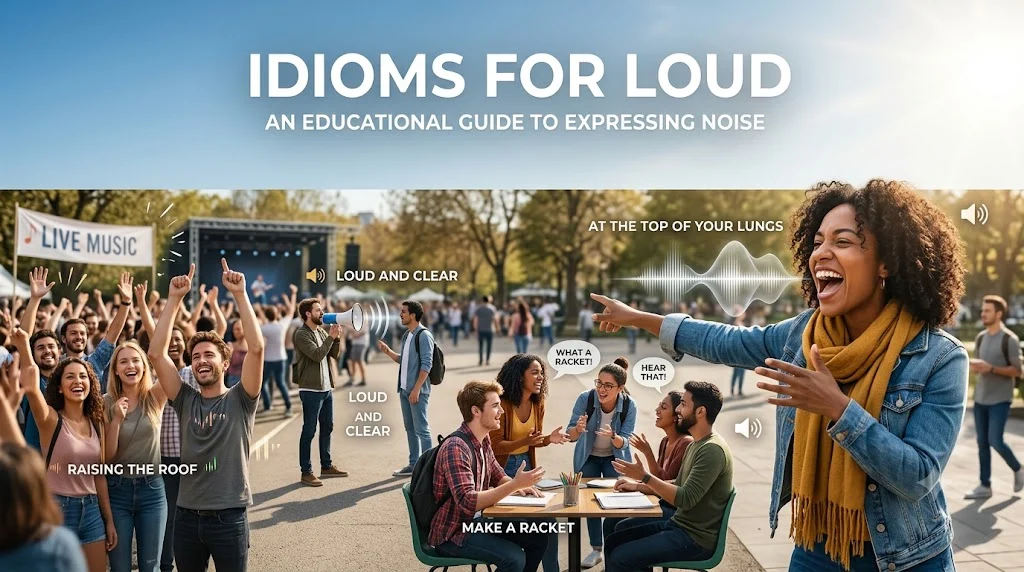
Idioms for loud are colorful expressions used to describe very strong sounds, raised voices, noisy environments, enthusiastic reactions, or someone speaking with unusual volume. Instead of simply saying “very loud,” expressions such as “at the top of your lungs,” “raise your voice,” “make a racket,” “raise the roof,” and “loud and clear” make communication more vivid.
Some expressions describe actual volume, while others use loudness figuratively to suggest excitement, anger, confidence, attention, or public expression.
Some moments are quiet enough to make you notice every little sound. Then there are moments when a room seems to explode with conversation, laughter, music, shouting, or excitement.
In ordinary English, we might simply say, “It was very loud.” That works, but it does not always capture the feeling. Was the noise exciting? Annoying? Joyful? Angry? Powerful? Was someone shouting across a crowded room, or was an entire audience cheering together?
This is where idioms for loud become useful.
Idiomatic expressions give ordinary descriptions more personality. They can help a student make an essay more vivid, allow a storyteller to create a stronger scene, or help a language learner sound more natural in conversation.
There is also an important distinction: not every expression connected with loudness describes volume literally. Some use the idea of sound to express confidence, publicity, anger, enthusiasm, or being noticed.
The expressions below explore those different shades of meaning so you can choose words that fit the situation rather than simply choosing the loudest phrase available.
Quick Summary of Idioms for Loud
| Idiom or Expression | Meaning | Tone | Best Used For |
|---|---|---|---|
| At the top of your lungs | Very loudly | Informal | Shouting, calling |
| Raise your voice | Speak louder | Neutral | Conversation |
| Make a racket | Make a lot of noise | Informal | Complaints, noisy places |
| Raise the roof | Make an extremely loud noise | Informal | Parties, celebrations |
| Loud and clear | Heard or understood clearly | Neutral | Communication |
| Make yourself heard | Speak loudly enough to be heard | Neutral | Meetings, crowds |
| Speak up | Talk louder | Neutral | Everyday conversation |
| At full volume | As loudly as possible | Informal | Music, speech |
| Give voice to | Express something openly | Formal | Writing, opinions |
| Sound off | Speak loudly or express opinions | Informal | Complaints, opinions |
| Bellow out | Shout in a deep, powerful voice | Informal | Storytelling, descriptions |
| Cry out | Shout suddenly | Neutral | Reactions, emergencies |
| Let out a yell | Suddenly shout | Informal | Excitement, surprise |
| Shout from the rooftops | Announce something openly | Figurative | News, excitement |
| Make a big noise | Attract considerable attention | Informal | Success, publicity |
| Blow the roof off | Create an extremely energetic response | Informal | Events, performances |
| Ring out | Sound loudly and clearly | Literary | Bells, voices, sounds |
| Roar with laughter | Laugh very loudly | Vivid | Stories, social scenes |
| Give someone an earful | Speak angrily at length | Informal | Arguments, complaints |
| Make a scene | Behave loudly or dramatically in public | Informal | Public disputes |
| Have the volume turned up | Be unusually energetic or intense | Figurative | People, writing, events |
| Speak at the top of your voice | Speak extremely loudly | Informal | Calling, crowds |
| Loud enough to wake the dead | Extremely loud | Humorous | Exaggeration |
| Strike up a clamor | Create loud public noise or protest | Literary/Formal | Crowds, protests |
| You could hear a pin drop | Extremely quiet | Contrast | Quiet moments |
At the Top of Your Lungs
Meaning:
To shout or speak extremely loudly.
When People Use It:
This expression is common when someone is calling, cheering, protesting, or shouting with great force. It is strongly informal and often creates a vivid mental picture.
Alternative Expression:
At the top of your voice.
Examples in Communication
Formal Example:
The witness called for assistance at the top of his lungs after noticing the disturbance.
Casual Example:
She was singing at the top of her lungs in the car.
Creative Example:
Across the empty field, his voice rose at the top of his lungs, carrying all the way to the distant trees.
Raise Your Voice
Meaning:
To speak louder, often because someone cannot hear you or because you are becoming angry or emphatic.
When People Use It:
This is one of the most flexible expressions on the list. It can describe simple communication or an emotional change in someone’s speech.
Alternative Expression:
Speak louder.
Examples in Communication
Formal Example:
The presenter raised her voice so that everyone in the back of the hall could hear.
Casual Example:
Could you raise your voice a little? I can’t hear you.
Creative Example:
He rarely raised his voice, which made everyone notice when he finally did.
Make a Racket
Meaning:
To make a lot of unpleasant or disruptive noise.
When People Use It:
This informal expression is particularly useful when the speaker finds the noise annoying.
Alternative Expression:
Make a terrible noise.
Examples in Communication
Formal Example:
The construction work made a racket throughout the morning.
Casual Example:
The kids are making a racket upstairs.
Creative Example:
Pots, pans, and wooden spoons joined together to make a racket worthy of a tiny marching band.
Raise the Roof
Meaning:
To make an extremely loud and energetic noise, especially by cheering, singing, or celebrating.
When People Use It:
It is usually associated with excitement rather than irritation. You might hear it when describing a concert, sports event, party, or celebration.
Alternative Expression:
Make an enormous noise.
Examples in Communication
Formal Example:
The supporters raised the roof when their team scored the winning goal.
Casual Example:
Let’s raise the roof tonight!
Creative Example:
When the singer appeared on stage, the crowd raised the roof.
Loud and Clear
Meaning:
Heard clearly and understood without confusion.
When People Use It:
This phrase is useful when checking communication, especially over phones, radios, online calls, or noisy environments. It can also mean that a message has been understood very clearly.
Alternative Expression:
Crystal clear.
Examples in Communication
Formal Example:
Your instructions were received loud and clear by the entire team.
Casual Example:
Yep, I hear you loud and clear.
Creative Example:
Her answer came through loud and clear: she was ready for whatever came next.
Make Yourself Heard
Meaning:
To speak loudly or clearly enough that people notice and listen to you.
When People Use It:
This expression works both literally and figuratively. A person in a crowded room may need to make themselves heard, while someone with an unpopular opinion may also need to make themselves heard.
Alternative Expression:
Get your voice across.
Examples in Communication
Formal Example:
Employees should feel confident enough to make themselves heard during important discussions.
Casual Example:
You have to make yourself heard over all this noise.
Creative Example:
In a room full of competing opinions, she found a calm way to make herself heard.
Speak Up
Meaning:
To speak more loudly or clearly.
When People Use It:
This is extremely common in everyday English. It is simple, natural, and useful for language learners.
Alternative Expression:
Talk louder.
Examples in Communication
Formal Example:
Could you please speak up so that the audience at the back can hear you?
Casual Example:
Speak up! I can barely hear you.
Creative Example:
He finally spoke up, and the room gradually fell silent.
At Full Volume
Meaning:
At the loudest possible or selected sound level.
When People Use It:
This phrase is particularly natural when discussing music, television, speakers, or energetic voices.
Alternative Expression:
At maximum volume.
Examples in Communication
Formal Example:
The announcement was played at full volume so that visitors throughout the building could hear it.
Casual Example:
Why is your music playing at full volume?
Creative Example:
The old radio came alive at full volume, filling the kitchen with music.
Give Voice to
Meaning:
To express thoughts, feelings, opinions, or concerns openly.
When People Use It:
Unlike many expressions on this list, this one is primarily figurative. It is especially useful in essays, journalism, speeches, and thoughtful writing.
Alternative Expression:
Express openly.
Examples in Communication
Formal Example:
The article gives voice to concerns that are often overlooked.
Casual Example:
She finally gave voice to what everyone had been thinking.
Creative Example:
His poem gave voice to a frustration he had struggled to explain in ordinary conversation.
Sound Off
Meaning:
To speak loudly, especially to express an opinion, complaint, or criticism.
When People Use It:
This is informal and can sometimes sound challenging or confrontational.
Alternative Expression:
Speak out.
Examples in Communication
Formal Example:
Residents were encouraged to sound off about problems affecting the neighborhood.
Casual Example:
If you’ve got something to say, sound off.
Creative Example:
The crowd sounded off with a mixture of cheers, complaints, and laughter.
Bellow Out
Meaning:
To shout or speak in a very loud, deep, powerful voice.
When People Use It:
“Bellow” creates a particularly strong image. It works well in storytelling and descriptive writing but can sound dramatic in everyday conversation.
Alternative Expression:
Boom out.
Examples in Communication
Formal Example:
The coach bellowed out instructions from the edge of the field.
Casual Example:
Dad bellowed out my name from downstairs.
Creative Example:
The captain bellowed out the command, and every sailor turned at once.
Cry Out
Meaning:
To shout suddenly, often because of surprise, fear, pain, excitement, or urgency.
When People Use It:
This expression focuses more on the suddenness or emotion of the sound than its sheer volume.
Alternative Expression:
Call out.
Examples in Communication
Formal Example:
The child cried out when she noticed that her backpack was missing.
Casual Example:
He cried out in surprise when everyone jumped out from behind the door.
Creative Example:
A voice cried out across the valley, breaking the stillness.
Let Out a Yell
Meaning:
To suddenly shout loudly.
When People Use It:
This informal expression is common in conversations and storytelling.
Alternative Expression:
Let out a shout.
Examples in Communication
Formal Example:
The player let out a yell of excitement after scoring.
Casual Example:
I let out a yell when the cold water hit me.
Creative Example:
She let out a yell that startled everyone around the campfire.
Shout from the Rooftops
Meaning:
To announce something openly and enthusiastically to everyone.
When People Use It:
This is usually figurative. It does not necessarily mean someone is literally shouting from a roof.
Alternative Expression:
Announce it to the world.
Examples in Communication
Formal Example:
The organization was eager to shout the achievement from the rooftops.
Casual Example:
I’d shout it from the rooftops if I could!
Creative Example:
After years of work, she wanted to shout her success from the rooftops.
Make a Big Noise
Meaning:
To attract a lot of attention or become highly noticeable.
When People Use It:
This expression can refer to literal noise, but it often has a figurative meaning related to success, publicity, or influence.
Alternative Expression:
Make an impact.
Examples in Communication
Formal Example:
The new company has made a big noise in the technology industry.
Casual Example:
That new band is making a big noise around town.
Creative Example:
The little café made a big noise despite opening on a quiet street.
Blow the Roof Off
Meaning:
To create an extremely energetic, exciting, or enthusiastic response.
When People Use It:
This informal expression is common when talking about concerts, performances, parties, or sporting events.
Alternative Expression:
Bring the house down.
Examples in Communication
Formal Example:
The performers blew the roof off the venue with their final number.
Casual Example:
That concert totally blew the roof off!
Creative Example:
One final chord sent the audience into a frenzy and seemed to blow the roof off the theater.
Ring Out
Meaning:
To produce a loud, clear, resonant sound that continues or carries through an area.
When People Use It:
This expression is especially effective in descriptive and literary writing. It can describe bells, voices, laughter, alarms, or other distinct sounds.
Alternative Expression:
Echo through.
Examples in Communication
Formal Example:
The church bells rang out across the town at noon.
Casual Example:
Her laugh rang out across the room.
Creative Example:
The final note rang out across the empty hall before silence returned.
Roar with Laughter
Meaning:
To laugh extremely loudly and enthusiastically.
When People Use It:
This vivid expression is useful when describing groups reacting strongly to something funny.
Alternative Expression:
Laugh loudly.
Examples in Communication
Formal Example:
The audience roared with laughter throughout the performance.
Casual Example:
We all roared with laughter when he told the story.
Creative Example:
The entire table roared with laughter, drowning out the music around them.
Give Someone an Earful
Meaning:
To speak angrily or critically to someone for a considerable amount of time.
When People Use It:
This is informal and usually implies an emotional, lengthy complaint or scolding. It is not simply about physical loudness.
Alternative Expression:
Tell someone off.
Examples in Communication
Formal Example:
The manager gave the supplier an earful after repeated delivery problems.
Casual Example:
Mom gave me an earful when I came home late.
Creative Example:
After discovering what had happened, the coach gave the team an earful.
Make a Scene
Meaning:
To behave loudly, dramatically, or disruptively in a public place.
When People Use It:
This expression is useful when loud behavior becomes socially noticeable or embarrassing.
Alternative Expression:
Cause a commotion.
Examples in Communication
Formal Example:
The customer was asked to leave after making a scene in the restaurant.
Casual Example:
Don’t make a scene here.
Creative Example:
One angry argument was enough to make a scene in the middle of the quiet café.
Have the Volume Turned Up
Meaning:
To be unusually energetic, intense, expressive, or noticeable.
When People Use It:
This is a modern figurative expression rather than a traditional fixed idiom. It works particularly well in informal writing and descriptions of personalities.
Alternative Expression:
Be larger than life.
Examples in Communication
Formal Example:
The speaker seemed to have the volume turned up throughout the entire presentation, keeping the audience engaged.
Casual Example:
She’s fun, but she definitely has the volume turned up!
Creative Example:
His personality seemed to have the volume turned up, filling every corner of the room.
Speak at the Top of Your Voice
Meaning:
To speak or shout as loudly as possible.
When People Use It:
This expression is especially useful when someone is trying to communicate across distance or over background noise.
Alternative Expression:
Shout as loudly as possible.
Examples in Communication
Formal Example:
The guide spoke at the top of her voice to direct the group through the crowded station.
Casual Example:
I was speaking at the top of my voice, but he still couldn’t hear me.
Creative Example:
They spoke at the top of their voices across the rushing river.
Loud Enough to Wake the Dead
Meaning:
Extremely loud.
When People Use It:
This humorous exaggeration is informal. It is useful when you want to emphasize just how excessive a noise seems.
Alternative Expression:
Deafeningly loud.
Examples in Communication
Formal Example:
The music was loud enough to wake the dead, making conversation nearly impossible.
Casual Example:
Your alarm is loud enough to wake the dead!
Creative Example:
Thunder rolled through the night, loud enough to wake the dead.
Strike Up a Clamor
Meaning:
To create or begin a loud, noisy expression of protest, excitement, or public reaction.
When People Use It:
This is more literary and formal than “make a racket.” It works particularly well in journalism, historical writing, and descriptive prose.
Alternative Expression:
Cause an uproar.
Examples in Communication
Formal Example:
The announcement struck up a clamor among residents who opposed the decision.
Casual Example:
The new rule caused a real clamor online.
Creative Example:
As soon as the decision was announced, a clamor rose from the crowd.
You Could Hear a Pin Drop
Meaning:
The environment is extremely quiet.
When People Use It:
This is technically an idiom about silence rather than loudness, but it is extremely useful when writing about sound because it creates a powerful contrast with noisy situations.
Alternative Expression:
Dead silent.
Examples in Communication
Formal Example:
When the results were announced, the auditorium became so quiet that you could hear a pin drop.
Casual Example:
Everyone went silent—you could hear a pin drop.
Creative Example:
The laughter disappeared, and suddenly you could hear a pin drop.
How to Choose the Right Idiom for Loudness
- Not every expression for loudness creates the same emotional effect.
- If you are describing simple volume, “raise your voice” or “speak up” may be enough.
- If the sound is annoying, “make a racket” is much more appropriate.
- If the atmosphere is celebratory, “raise the roof” or “blow the roof off” adds excitement.
- For dramatic storytelling, “bellow out,” “ring out,” and “at the top of your lungs” create stronger imagery.
For figurative communication, expressions such as “give voice to,” “make yourself heard,” and “shout from the rooftops” move beyond physical volume and describe the act of expressing something powerfully.
That distinction is what makes idioms useful. They do not merely tell readers that something is loud. They tell readers what kind of loudness they should imagine.
Formal vs Informal Idioms for Loud
Understanding register is important if you want your English to sound natural.
More neutral expressions:
- Raise your voice
- Speak up
- Loud and clear
- Make yourself heard
- Cry out
More informal expressions:
- Make a racket
- Raise the roof
- Sound off
- Let out a yell
- Give someone an earful
- Loud enough to wake the dead
For an academic essay, “make yourself heard” or “give voice to concerns” may work beautifully. In a casual text message, “speak up” is much more natural than “strike up a clamor.”
Idioms for Loud People
Sometimes the noise comes from a person’s personality rather than the environment.
If someone regularly talks at a high volume, you can say they “have the volume turned up” in a playful way. You might also say they “make themselves heard” when they confidently participate in a busy conversation.
However, be careful about using “loud” as a judgment about someone’s personality. A person who speaks loudly may simply be enthusiastic, confident, hard of hearing, accustomed to noisy environments, or naturally expressive.
For respectful communication, describing the behavior is often better than labeling the person.
Instead of:
“She’s a loud person.”
You could write:
“She tends to speak at a high volume.”
Or:
“She has an energetic, expressive way of speaking.”
The second approach gives readers more information without making the description unnecessarily negative.
Idioms for Loud Noises
When describing a loud noise, think about source, emotion, and effect.
A machine might make a racket.
A crowd might raise the roof.
A bell might ring out.
A singer might perform at the top of their lungs.
An audience might roar with laughter.
Thunder can be described as being loud enough to wake the dead.
This approach helps writers avoid repeating “loud” throughout a paragraph.
For example:
The concert was loud. The singer was loud. The crowd was loud. The drums were loud.
This communicates the basic idea, but it sounds flat.
A more expressive version might describe the singer performing at the top of her lungs while the crowd raised the roof and drums rang out across the venue.
The second version gives the reader a scene instead of a repeated adjective.
Idioms for Loud and Exciting Situations
Some loud environments are not unpleasant at all.
A packed stadium, wedding, concert, festival, or birthday party can be wonderfully noisy.
Expressions such as “raise the roof,” “blow the roof off,” and “roar with laughter” communicate excitement rather than irritation.
Compare these two sentences:
“The crowd was loud.”
“The crowd raised the roof.”
The first sentence gives information. The second gives atmosphere.
That is one of the main advantages of idioms in creative writing: they allow a short phrase to carry emotion, movement, and cultural meaning at the same time.
Idioms for Loud in Creative Writing
Writers should think of idioms as seasoning rather than the entire meal.
One strong expression can make a paragraph memorable. Five idioms packed into two sentences can make the writing feel unnatural.
For example, instead of writing:
The crowd raised the roof, roared with laughter, sounded off, made a racket, and shouted at the top of its lungs.
Choose the expression that best represents the scene:
The crowd raised the roof as the final performer stepped onto the stage.
The sentence is cleaner, and the image remains powerful.
Good creative writing does not prove that you know many idioms. It uses the right idiom at the right moment.
Idioms for Loud in Essays and Academic Writing
Idioms can be effective in essays, but they should be used carefully.
Academic writing generally favors precise language. Expressions such as “give voice to concerns” or “make oneself heard” can fit naturally in analytical writing.
For example:
The campaign gave voice to concerns that had previously received little public attention.
This sounds more polished than forcing a casual expression such as “raise the roof” into an academic paragraph.
When writing formally, always ask whether the idiom adds meaning or merely adds decoration.
If it adds clarity and emphasis, keep it.
If it makes the sentence sound conversational when the assignment requires a formal tone, replace it with a direct expression.
Common Mistakes When Using Idioms for Loud
Using an idiom literally when it is figurative
“Shout from the rooftops” usually means to announce something publicly, not literally stand on a roof and shout.
Choosing an expression that has the wrong emotional tone
“Make a racket” usually suggests annoying noise, while “raise the roof” often suggests enthusiastic celebration.
Overusing idioms
Too many idioms can make writing feel forced. One well-selected expression is often more effective than several weak ones.
Ignoring formality
“Give someone an earful” is natural in casual English but may sound too informal for a formal academic report.
Confusing loudness with confidence
“Make yourself heard” can mean becoming noticed or expressing an opinion. It does not always mean increasing physical volume.
Idioms vs Literal Expressions
Idioms are especially interesting because their meanings cannot always be understood word by word.
Consider “raise the roof.”
Literally, raising a roof would mean physically lifting part of a building. Idiomatically, it can mean making an extremely loud and energetic response.
Likewise, “at the top of your lungs” does not mean someone is physically standing on top of their lungs. It means speaking or shouting with maximum vocal effort.
Literal language tells the reader exactly what happened.
Figurative language often tells the reader how the moment felt.
That is why idioms are valuable for storytelling and conversation. They compress a larger idea into a familiar, memorable expression.
How to Sound More Fluent When Using Loudness Idioms
Fluent English is not about inserting an idiom into every sentence. Natural fluency comes from knowing when not to use one.
Listen for how native speakers use expressions in context. Notice whether an expression sounds playful, angry, formal, dramatic, or casual.
Then practice short sentences instead of memorizing isolated definitions.
For example:
- “Could you speak up?”
- “The crowd raised the roof.”
- “The children were making a racket.”
- “I hear you loud and clear.”
- “She finally made herself heard.”
These are easier to remember because they represent complete communication situations.
Another useful technique is to learn idioms in groups based on meaning. Keep expressions for noise, shouting, celebration, anger, and public expression together. This helps you select the right phrase more quickly when speaking or writing.
How to Remember Idioms for Loud
Try connecting each idiom with a mental picture.
Imagine a concert crowd literally trying to raise the roof.
Picture someone calling at the top of their lungs across a large field.
Imagine a bell ringing out across a quiet village.
Picture a noisy group making a racket in the next room.
The stranger or more memorable the mental image, the easier the expression can become to recall.
You can also create a personal sentence for every new idiom. A phrase becomes much easier to remember when it is connected to something familiar from your own life, schoolwork, conversations, or writing.
Why Idioms Make Communication More Powerful
Compare:
“The audience laughed very loudly.”
with:
“The audience roared with laughter.”
Both sentences communicate loud laughter, but the second has greater energy.
Now compare:
“She announced her achievement to everyone.”
with:
“She shouted it from the rooftops.”
The second version adds enthusiasm and emotional force.
Idioms are powerful because they combine meaning with imagery. They allow speakers and writers to communicate not only what happened, but also how it felt.
That is particularly valuable in storytelling, captions, speeches, personal essays, blog posts, and everyday conversations.
FAQs
What is a good idiom for someone speaking very loudly?
“At the top of your lungs,” “at the top of your voice,” and “bellow out” are useful expressions for someone speaking or shouting very loudly.
What is an idiom for making a lot of noise?
“Make a racket” is one of the most common informal expressions for making a lot of unpleasant or disruptive noise.
What is an idiom for a very loud celebration?
“Raise the roof” and “blow the roof off” are excellent informal expressions for an extremely energetic and noisy celebration.
What does “loud and clear” mean?
“Loud and clear” means that something has been heard clearly and understood without difficulty. It is especially common in communication involving phones, radios, or noisy surroundings.
Are idioms for loud suitable for formal writing?
Some are. Expressions such as “give voice to,” “make yourself heard,” and “loud and clear” can work in appropriate formal contexts, while expressions such as “make a racket” or “give someone an earful” are generally more conversational.
Conclusion
Loudness is more than a matter of volume. A sound can be joyful, irritating, powerful, emotional, dramatic, or impossible to ignore. That is why idioms for loud are so useful: they help us describe not only how loud something is, but also the feeling surrounding the sound.
Expressions such as “raise your voice,” “make a racket,” “at the top of your lungs,” “raise the roof,” “ring out,” and “make yourself heard” each bring a slightly different shade of meaning.
The best way to learn them is through context. Notice how people use them in conversations, stories, articles, films, speeches, and everyday situations. Then try using one naturally in your own sentence.
You do not need dozens of idioms to sound fluent. You need the right expression at the right moment. Once you understand that difference, your English can become more vivid, confident, and expressive without ever sounding forced.
Discover More Related Articles: