Quick Answer:
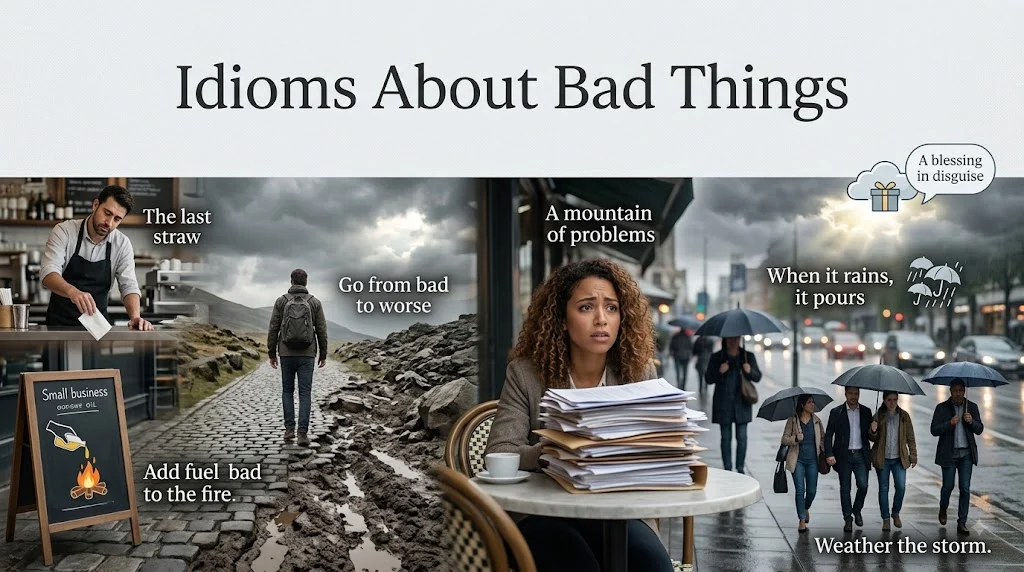
Idioms about bad things are expressions that describe trouble, failure, misfortune, difficult situations, negative events, or things going badly in a more vivid and memorable way. Instead of repeatedly saying that something is “bad” or “going wrong,” English speakers use expressions such as “a blessing in disguise,” “when it rains, it pours,” “go from bad to worse,” “a bitter pill to swallow,” and “the last straw.”
Bad things are part of every story.
A plan fails. A friendship becomes difficult. A project goes wrong at the worst possible moment. One small problem appears, then another follows, and suddenly you find yourself wondering how everything became so complicated.
In everyday English, we could simply say, “Things are going badly.” But English has a much more colorful way of describing difficult situations.
That is where idioms about bad things become useful.
Expressions such as “go from bad to worse,” “when it rains, it pours,” and “add fuel to the fire” give language emotional depth. They help us explain not only that something went wrong, but how badly it went wrong, why it feels difficult, or what happened next.
These idioms are valuable for students, writers, bloggers, and English learners because they make descriptions more natural without requiring complicated vocabulary.
The key, however, is choosing the right expression. A disappointing result is not necessarily “rock bottom,” and a temporary difficult period is not automatically a “catastrophe.”
The expressions below will help you recognize those differences and use them naturally.
Quick Summary of Idioms About Bad Things
| Idiom | Meaning | Tone | Best Used For |
|---|---|---|---|
| A blessing in disguise | Something bad that eventually has a good result | Positive | Unexpected outcomes |
| When it rains, it pours | Problems often arrive together | Informal | Multiple problems |
| Go from bad to worse | Become increasingly worse | Neutral | Worsening situations |
| A bitter pill to swallow | Something unpleasant to accept | Neutral | Disappointment |
| The last straw | Final problem that causes someone to react | Informal | Frustration |
| A tough break | An unfortunate situation | Informal | Bad luck |
| Down in the dumps | Feeling unhappy or discouraged | Informal | Emotions |
| In hot water | In trouble | Informal | Problems or mistakes |
| In deep trouble | Facing serious difficulties | Neutral | Serious problems |
| A nightmare | An extremely difficult experience | Informal | Difficult situations |
| A rough patch | A difficult period | Neutral | Temporary hardship |
| Hit rock bottom | Reach the lowest point | Neutral | Severe difficulties |
| Out of the frying pan into the fire | Escape one problem only to face another | Informal | New problems |
| Bite the bullet | Face something unpleasant bravely | Informal | Difficult decisions |
| Weather the storm | Survive a difficult period | Neutral | Hard times |
| Add fuel to the fire | Make a bad situation worse | Neutral | Conflict |
| Open a can of worms | Create many new problems | Informal | Complications |
| Dig yourself into a hole | Make your situation worse through your actions | Informal | Mistakes |
| A recipe for disaster | Something likely to cause trouble | Neutral | Risky situations |
| Go south | Go wrong or deteriorate | Informal | Plans or situations |
| Fall apart | Stop functioning or become disorganized | Neutral | Plans, relationships, situations |
| Come crashing down | Suddenly fail or collapse | Vivid | Plans, hopes, success |
| The writing is on the wall | Signs indicate something bad is coming | Neutral | Warnings |
| A catastrophe waiting to happen | Something likely to end badly | Informal | Dangerous situations |
| Have a lot on your plate | Have many difficult things to deal with | Neutral | Stressful circumstances |
A Blessing in Disguise
Meaning:
Something that initially seems bad but eventually produces a positive result.
When People Use It:
Use this expression when an unfortunate event unexpectedly leads to something beneficial. It is especially useful when looking back on a difficult experience.
Alternative Expression:
A hidden benefit.
Examples in Communication
Formal Example:
Losing the position turned out to be a blessing in disguise because it encouraged her to pursue a more suitable career.
Casual Example:
Missing that flight was a blessing in disguise. I met my future business partner at the airport instead.
Creative Example:
What felt like a closed door became a blessing in disguise, opening a path she had never considered.
When It Rains, It Pours
Meaning:
When one problem happens, several other problems often seem to happen at the same time.
When People Use It:
This is a common informal expression for a period when everything appears to go wrong at once.
Alternative Expression:
Things come all at once.
Examples in Communication
Formal Example:
The company experienced several unexpected difficulties in the same week; when it rains, it pours.
Casual Example:
First my phone broke, then I missed the bus. When it rains, it pours!
Creative Example:
The roof began leaking just as the electricity went out. When it rains, it pours.
Go From Bad to Worse
Meaning:
To become increasingly worse.
When People Use It:
This expression is useful when an already difficult situation develops into an even more serious one.
Alternative Expression:
Take a turn for the worse.
Examples in Communication
Formal Example:
The negotiations went from bad to worse after both sides rejected the revised proposal.
Casual Example:
I thought losing my wallet was bad, but then my car broke down. Things just went from bad to worse.
Creative Example:
One wrong decision sent the entire afternoon from bad to worse.
A Bitter Pill to Swallow
Meaning:
Something unpleasant or disappointing that someone must accept.
When People Use It:
Use this idiom when reality is difficult to accept, especially after disappointment or failure.
Alternative Expression:
A hard truth to accept.
Examples in Communication
Formal Example:
The defeat was a bitter pill to swallow after months of preparation.
Casual Example:
Losing the competition was a bitter pill to swallow.
Creative Example:
The truth arrived quietly, but it was still a bitter pill to swallow.
The Last Straw
Meaning:
The final problem in a series of problems that makes someone unable or unwilling to tolerate the situation anymore.
When People Use It:
This is usually used when someone has been patient for a while and one final event causes them to react.
Alternative Expression:
The final breaking point.
Examples in Communication
Formal Example:
The repeated delays were frustrating, but the missing documents were the last straw.
Casual Example:
He forgot my birthday again. That was the last straw.
Creative Example:
She had forgiven every mistake, but the final betrayal was the last straw.
A Tough Break
Meaning:
An unfortunate or disappointing event, often something that was beyond someone’s control.
When People Use It:
This informal expression is common when showing sympathy for someone experiencing bad luck.
Alternative Expression:
Bad luck.
Examples in Communication
Formal Example:
Missing the deadline because of the unexpected outage was certainly a tough break.
Casual Example:
You lost your ticket? That’s a tough break.
Creative Example:
It was a tough break, but he refused to let one setback define the entire journey.
Down in the Dumps
Meaning:
Feeling sad, discouraged, or unhappy.
When People Use It:
This is an informal expression about someone’s emotional state rather than a bad event itself.
Alternative Expression:
Feeling low.
Examples in Communication
Formal Example:
After the disappointing results, many team members were feeling down in the dumps.
Casual Example:
I’ve been a little down in the dumps lately.
Creative Example:
For a few days, the empty room seemed to match the way she felt—quiet and down in the dumps.
In Hot Water
Meaning:
To be in trouble or facing difficulties because of something that happened.
When People Use It:
This is informal and often suggests that someone has done something wrong or is facing consequences.
Alternative Expression:
In trouble.
Examples in Communication
Formal Example:
The employee found himself in hot water after failing to follow the required procedure.
Casual Example:
You’re going to be in hot water if you don’t finish that assignment.
Creative Example:
One careless decision left him in hot water with the entire team.
In Deep Trouble
Meaning:
To be facing serious problems or consequences.
When People Use It:
This is more direct than “in hot water” and can describe serious personal, professional, or practical difficulties.
Alternative Expression:
In serious difficulty.
Examples in Communication
Formal Example:
Without additional funding, the organization could be in deep trouble.
Casual Example:
If we miss this deadline, we’re in deep trouble.
Creative Example:
By the time they realized the mistake, they were already in deep trouble.
A Nightmare
Meaning:
An extremely unpleasant, difficult, or stressful experience.
When People Use It:
This is often used informally to describe frustrating experiences such as travel problems, complicated projects, technical issues, or difficult situations.
Alternative Expression:
A terrible experience.
Examples in Communication
Formal Example:
The delayed shipment created a logistical nightmare for the company.
Casual Example:
Moving house was an absolute nightmare.
Creative Example:
What should have been a peaceful journey turned into a nightmare of delays and confusion.
A Rough Patch
Meaning:
A difficult period in someone’s life, relationship, work, or circumstances.
When People Use It:
Unlike some stronger idioms, “a rough patch” usually suggests that the difficulty may eventually pass.
Alternative Expression:
A difficult period.
Examples in Communication
Formal Example:
The organization is currently going through a rough patch but remains committed to its long-term goals.
Casual Example:
We’ve been going through a rough patch lately.
Creative Example:
Their friendship survived the rough patch because neither person stopped trying.
Hit Rock Bottom
Meaning:
To reach the lowest or most difficult point of a situation.
When People Use It:
This is a strong expression and should not be used casually for minor inconveniences.
Alternative Expression:
Reach the lowest point.
Examples in Communication
Formal Example:
The business hit rock bottom before a new strategy helped it recover.
Casual Example:
After losing the project, he felt like he’d hit rock bottom.
Creative Example:
At what seemed like rock bottom, a small opportunity appeared.
Out of the Frying Pan Into the Fire
Meaning:
To escape one difficult situation only to enter another, often worse, one.
When People Use It:
Use this when someone’s attempt to solve a problem unexpectedly creates a new problem.
Alternative Expression:
From one problem into another.
Examples in Communication
Formal Example:
The company moved suppliers to solve its delivery issues but went out of the frying pan into the fire when costs increased dramatically.
Casual Example:
I left one bad job and ended up in an even worse one—out of the frying pan into the fire.
Creative Example:
They thought they had escaped the storm, only to sail straight into another. Out of the frying pan into the fire.
Bite the Bullet
Meaning:
To face something unpleasant or difficult with courage and determination.
When People Use It:
This expression does not mean that something bad has happened; rather, it describes the decision to confront an unpleasant situation.
Alternative Expression:
Face the music.
Examples in Communication
Formal Example:
The organization decided to bite the bullet and make the necessary changes.
Casual Example:
I don’t want to make the call, but I’ll bite the bullet and do it.
Creative Example:
There was no easy way forward, so she bit the bullet and faced the truth.
Weather the Storm
Meaning:
To survive or endure a difficult period.
When People Use It:
This expression often carries a sense of hope because it suggests that the difficult period can eventually pass.
Alternative Expression:
Get through a difficult time.
Examples in Communication
Formal Example:
The company introduced temporary measures to weather the storm.
Casual Example:
We’ll get through this. We just have to weather the storm.
Creative Example:
The family held together and weathered the storm one difficult day at a time.
Add Fuel to the Fire
Meaning:
To make an already bad or tense situation even worse.
When People Use It:
This is particularly useful when describing arguments, conflicts, rumors, or disagreements.
Alternative Expression:
Make matters worse.
Examples in Communication
Formal Example:
The inflammatory statement only added fuel to the fire during an already tense discussion.
Casual Example:
Don’t argue with him right now you’ll just add fuel to the fire.
Creative Example:
One careless rumor added fuel to the fire that had already begun spreading through the town.
Open a Can of Worms
Meaning:
To create a complicated situation involving many unexpected problems.
When People Use It:
This informal idiom is useful when solving one problem is likely to expose several others.
Alternative Expression:
Create a complicated situation.
Examples in Communication
Formal Example:
Changing the policy could open a can of worms by creating several unresolved legal questions.
Casual Example:
If we start talking about that old argument, we’ll open a can of worms.
Creative Example:
One innocent question opened a can of worms no one was prepared to deal with.
Dig Yourself Into a Hole
Meaning:
To make your situation worse through your own actions, words, or mistakes.
When People Use It:
This expression is especially common when someone keeps making excuses or poor decisions after an initial mistake.
Alternative Expression:
Make matters worse for yourself.
Examples in Communication
Formal Example:
The spokesperson dug himself into a hole by giving contradictory explanations.
Casual Example:
Stop talking—you’ll just dig yourself into a deeper hole.
Creative Example:
Every excuse was supposed to help, but each one only dug him deeper into the hole.
A Recipe for Disaster
Meaning:
A combination of circumstances that is very likely to produce a bad result.
When People Use It:
This expression is useful when warning that a plan, decision, or combination of factors is likely to end badly.
Alternative Expression:
A setup for failure.
Examples in Communication
Formal Example:
Ignoring safety procedures while rushing the project would be a recipe for disaster.
Casual Example:
Mixing those two plans without talking first is a recipe for disaster.
Creative Example:
Too much confidence, too little preparation, and a ticking clock—a perfect recipe for disaster.
Go South
Meaning:
To go wrong, deteriorate, or become unsuccessful.
When People Use It:
This informal expression is common in everyday conversation and business discussions.
Alternative Expression:
Go wrong.
Examples in Communication
Formal Example:
The negotiations began positively but went south after disagreements over costs.
Casual Example:
Everything was fine until the plan went south.
Creative Example:
The evening went south the moment the unexpected news arrived.
Fall Apart
Meaning:
To stop working properly, lose organization, or collapse emotionally or practically.
When People Use It:
This versatile expression can describe plans, relationships, systems, teams, or even a person’s emotional state.
Alternative Expression:
Break down.
Examples in Communication
Formal Example:
The original strategy began to fall apart when several assumptions proved incorrect.
Casual Example:
Our plans completely fell apart because of the weather.
Creative Example:
The carefully organized schedule began to fall apart one delay at a time.
Come Crashing Down
Meaning:
To fail or collapse suddenly and dramatically.
When People Use It:
This expression is useful when something that seemed strong or successful suddenly collapses.
Alternative Expression:
Collapse suddenly.
Examples in Communication
Formal Example:
The company’s rapid expansion came crashing down after several financial difficulties.
Casual Example:
All my plans came crashing down at once.
Creative Example:
Years of confidence came crashing down with a single unexpected announcement.
The Writing Is on the Wall
Meaning:
There are clear signs that something bad or unwanted is likely to happen.
When People Use It:
This expression is useful when a negative outcome has not happened yet, but the warning signs are obvious.
Alternative Expression:
The signs are clear.
Examples in Communication
Formal Example:
With declining sales and repeated budget cuts, the writing is on the wall for the struggling department.
Casual Example:
After three missed deadlines, the writing is on the wall.
Creative Example:
No one said the project was finished, but the writing was already on the wall.
A Catastrophe Waiting to Happen
Meaning:
A situation that appears very likely to result in serious problems.
When People Use It:
This expression is useful for warning about poor planning, risky decisions, or unstable circumstances.
Alternative Expression:
A disaster waiting to happen.
Examples in Communication
Formal Example:
Ignoring repeated safety concerns could create a catastrophe waiting to happen.
Casual Example:
That loose shelf is a disaster waiting to happen.
Creative Example:
The unstable structure stood silently, looking like a catastrophe waiting to happen.
Have a Lot on Your Plate
Meaning:
To have many responsibilities, problems, or tasks to deal with.
When People Use It:
This expression does not necessarily mean that something bad has happened, but it is useful when someone is overwhelmed by difficult responsibilities.
Alternative Expression:
Have a lot to deal with.
Examples in Communication
Formal Example:
The project manager already has a lot on her plate this quarter.
Casual Example:
I can’t take on another task right now. I’ve got a lot on my plate.
Creative Example:
He smiled as if everything were fine, even though he had more on his plate than anyone realized.
Idioms About Bad Things in Everyday Conversation
Not every difficult situation needs dramatic language.
If your friend misses a bus, saying “That’s a tough break” sounds sympathetic without exaggerating the problem.
If their own choices have made a situation worse, “You’re digging yourself into a hole” may describe what is happening.
The important skill is matching the strength of the idiom to the seriousness of the situation.
Calling a missed appointment “rock bottom” may sound dramatic. Calling a series of major setbacks “a rough patch” may sound too mild.
Good communication depends on that sense of proportion.
Idioms About Bad Things in Writing
Idioms can make writing more vivid, especially in personal essays, blog posts, stories, opinion pieces, and informal articles.
Consider this sentence:
The project had many problems.
It is clear, but fairly plain.
Now consider:
The project went from bad to worse when the original deadline was moved forward.
The second version immediately gives the reader a stronger sense of progression.
For creative writing, idioms can also help establish character.
A relaxed character might say:
“It’s been a rough patch, but we’ll get through it.”
A frustrated character might say:
“That’s the last straw.”
A reflective narrator might write:
“What looked like a disaster at first became a blessing in disguise.”
The expression becomes part of the voice, not simply an extra vocabulary item.
Idioms About Bad Things in School Essays
Students often want to use idioms to make essays more sophisticated. That can work, but moderation matters.
Expressions such as “a bitter pill to swallow,” “a blessing in disguise,” “weather the storm,” and “the writing is on the wall” can fit many analytical or reflective essays.
For example:
The initial failure was a bitter pill to swallow, but it encouraged the team to reconsider its approach.
This sounds natural because the idiom supports the idea.
Avoid inserting an idiom simply because you learned it recently. Academic writing benefits from precision, and some highly informal expressions may weaken an otherwise formal paragraph.
Idioms About Bad Things at Work
Workplaces generate plenty of difficult situations: missed deadlines, failed plans, unexpected changes, misunderstandings, and competing priorities.
Here are some useful choices:
“Go south” | when a plan or negotiation begins to fail.
“Open a can of worms” | when a decision creates unexpected complications.
“Add fuel to the fire” | when someone’s action makes a conflict worse.
“Have a lot on your plate” | when someone has too many responsibilities.
“Weather the storm” | when a team is trying to survive a difficult period.
These expressions can make workplace communication more conversational, although formal reports may benefit from direct language instead.
Common Mistakes With Idioms About Bad Things
Using the wrong level of seriousness
A small inconvenience does not necessarily require a dramatic idiom like “hit rock bottom.”
Confusing similar expressions
“Go from bad to worse” describes deterioration.
“Out of the frying pan into the fire” describes moving from one problem into another.
They are related, but not identical.
Using informal idioms in formal situations
Expressions such as “go south,” “in hot water,” and “make a scene” are often conversational.
Mixing idioms
Avoid creating unnatural combinations such as:
“The project went from bad to worse and we decided to bite the roof.”
Idioms should be used as complete expressions rather than mixed together.
Taking figurative language literally
“The writing is on the wall” does not mean that a physical message must be written somewhere. It means that the signs of an approaching outcome are becoming clear.
How to Use Idioms About Bad Things Naturally
The easiest way to use idioms naturally is to start with the situation rather than the phrase.
First ask:
What actually happened?
Then ask:
What feeling or idea do I want to communicate?
If several problems happened together, choose “when it rains, it pours.”
If a person is trying to survive a difficult period, choose “weather the storm.”
This approach prevents idioms from sounding memorized or forced.
How to Remember Idioms About Bad Things
Try organizing them by situation instead of memorizing them alphabetically.
For multiple problems:
- When it rains, it pours
- Out of the frying pan into the fire
- Open a can of worms
For difficult emotions:
- Down in the dumps
- A bitter pill to swallow
- Hit rock bottom
Grouping expressions this way gives your memory a useful structure.
How Idioms Make Descriptions of Bad Things More Powerful
The word “bad” is broad.
A bad experience could mean disappointing, frustrating, frightening, complicated, embarrassing, stressful, or disastrous.
Idioms allow you to be more precise.
Instead of:
The situation was bad.
You might say:
The situation went from bad to worse.
Or:
We were in hot water.
Each expression gives the reader a different picture.
That is the real value of idioms. They are not simply decorative alternatives to ordinary vocabulary. They help us communicate shades of meaning that a single adjective cannot fully capture.
FAQs
What is a common idiom for something going wrong?
“Go south” is a common informal expression meaning that a situation has gone wrong or begun to deteriorate. “Go from bad to worse” is another useful choice when the situation continues getting worse.
What idiom means many bad things happen at once?
“When it rains, it pours” describes a situation where several problems seem to happen together.
What is an idiom for a difficult situation?
“A rough patch,” “in hot water,” “in deep trouble,” and “a nightmare” can all describe difficult situations, depending on their seriousness and context.
What idiom means making a bad situation worse?
“Add fuel to the fire” means to make an already difficult or tense situation worse. “Dig yourself into a hole” is used when someone’s own actions make their situation worse.
What is a positive idiom about something bad?
“A blessing in disguise” describes something that initially appears negative but eventually produces a positive or beneficial result.
Conclusion
Bad experiences are unavoidable, but the way we describe them can make our communication much more precise and expressive. Idioms about bad things give us a richer vocabulary for discussing setbacks, disappointment, conflict, mistakes, difficult periods, and unexpected consequences.
You can use “when it rains, it pours” when problems arrive together, “go from bad to worse” when circumstances deteriorate, and “a bitter pill to swallow” when something difficult must be accepted. When a challenging period eventually leads somewhere positive, “a blessing in disguise” may tell the story perfectly.
The goal is not to fill every sentence with figurative language. Instead, learn to recognize the emotional difference between expressions and choose the one that genuinely fits.
Once you begin noticing these idioms in conversations, books, articles, and everyday writing, they become much easier to remember. With practice, they can help your English sound more natural, expressive, and confident.
Discover More Related Articles:
- Idioms for Marriage | Describe Love, Relationships & Commitment In 2026
- Idioms for Making Things Better | Improving Situations & Moving Forward In 2026