Quick Answer
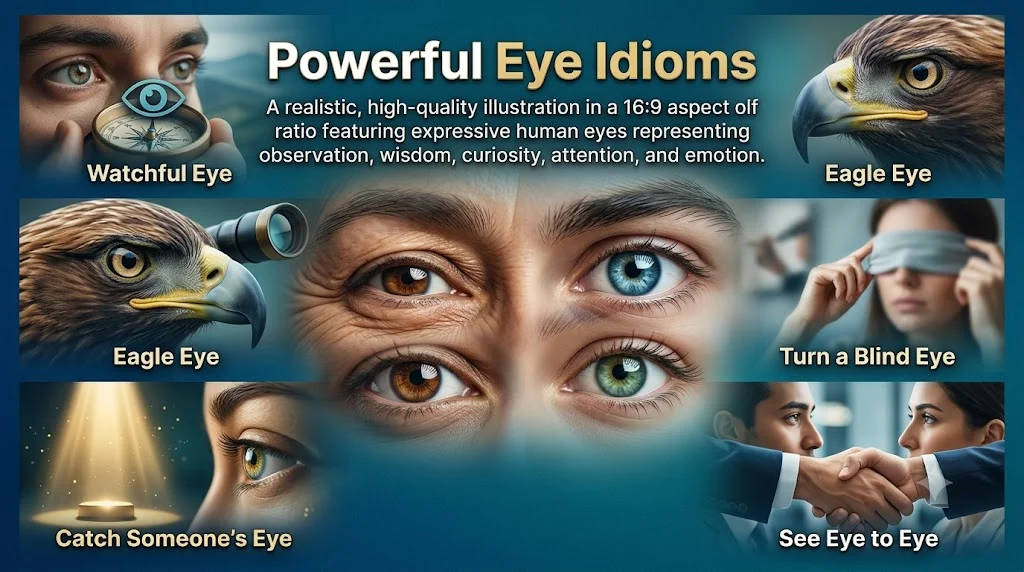
Eye idioms are figurative expressions that use the word “eye” to describe attention, awareness, emotions, honesty, curiosity, judgment, or observation rather than eyesight itself.
They make conversations, storytelling, and writing more expressive by helping you communicate ideas in a memorable and natural way. Common examples include keep an eye on, catch someone’s eye and see eye to eye.
Think about how often we communicate through our eyes without saying a single word. A glance can show confidence, curiosity, surprise, kindness, or even disappointment. It’s no surprise that English is filled with eye idioms that capture these everyday experiences in colorful and memorable ways.
Whether you’re writing an essay, creating engaging blog posts, preparing for an English exam, or simply trying to sound more natural in conversation, learning eye idioms can make a noticeable difference. They help transform ordinary sentences into vivid expressions that readers and listeners remember.
The beauty of eye idioms is that they aren’t limited to describing vision. They often express agreement, awareness, honesty, attention, emotions, and even hidden truths. Once you understand when and how to use them, your communication becomes richer and more authentic.
In this guide, you’ll discover some of the most powerful eye idioms, learn what they really mean, and explore practical examples you can confidently use in everyday conversations and writing.
Quick Summary
| Eye Idiom | Meaning | Best Used When |
|---|---|---|
| Keep an eye on | Watch or monitor something | Responsibility, safety |
| See eye to eye | Agree completely | Discussions, teamwork |
| Catch someone’s eye | Attract attention | Fashion, marketing, conversations |
| Ignore something intentionally | Social issues, workplace | |
| In the blink of an eye | Very quickly | Storytelling, daily conversation |
| More than meets the eye | More complex than it appears | Reviews, opinions |
| Eagle eye | Very observant person | Work, sports, school |
| Eye-opener | Something surprising | Learning experiences |
| Eyes bigger than your stomach | Taking more than you can eat | Food, humor |
| Have eyes in the back of your head | Notice everything | Parenting, teaching |
Keep an Eye On
Meaning
To watch, monitor, or take care of someone or something carefully.
When People Use It
People use this idiom when asking someone to supervise children, pets, belongings, projects, or important tasks.
Alternative Expression
- Watch over
Examples in Communication
Formal Example
Please keep an eye on the project timeline to ensure every deadline is met.
Casual Example
Can you keep an eye on my bag while I grab a coffee?
Creative Example
She kept an eye on the tiny seedling every morning, hoping today would be the day it bloomed.
Usage Tip
This is one of the most common and versatile eye idioms. It’s suitable in both professional and casual conversations.
See Eye to Eye
Meaning
To completely agree with someone.
When People Use It
This idiom is common during discussions, meetings, friendships, and family conversations.
Alternative Expression
- Be on the same page
Examples in Communication
Formal Example
Although they debated several ideas, the committee finally saw eye to eye on the proposal.
Casual Example
We don’t always see eye to eye, but we’re still good friends.
Creative Example
When they finally saw eye to eye, years of misunderstanding quietly faded away.
Usage Tip
Perfect for discussing teamwork, relationships, negotiations, and decision-making.
Catch Someone’s Eye
Meaning
To attract someone’s attention because something is interesting, beautiful, or unusual.
When People Use It
You’ll hear this idiom when talking about fashion, advertisements, artwork, or anything visually appealing.
Alternative Expression
- Grab someone’s attention
Examples in Communication
Formal Example
The colorful display immediately caught the visitors’ eyes.
Casual Example
That jacket really caught my eye.
Creative Example
A single golden leaf caught her eye as it danced through the autumn breeze.
Usage Tip
Excellent for descriptive writing because it creates vivid imagery without sounding forced.
In the Blink of an Eye
Meaning
Something happens extremely quickly.
When People Use It
Perfect for storytelling, sports, travel, unexpected events, or describing rapid change.
Alternative Expression
- In an instant
Examples in Communication
Formal Example
Technology continues to evolve in the blink of an eye.
Casual Example
The weekend disappeared in the blink of an eye.
Creative Example
The shooting star vanished in the blink of an eye, leaving only wonder behind.
Usage Tip
Use this idiom when you want to emphasize speed and suddenness.
More Than Meets the Eye
Meaning
A person or situation is more complicated or interesting than it first appears.
When People Use It
Frequently used in reviews, storytelling, interviews, and everyday conversations.
Alternative Expression
- Not as simple as it seems
Examples in Communication
Formal Example
The research findings reveal more than meets the eye.
Casual Example
Trust me, there’s more to this story than meets the eye.
Creative Example
The quiet old bookstore held more than meets the eye behind its dusty shelves.
Usage Tip
This idiom adds curiosity and encourages readers or listeners to think more deeply.
Eagle Eye
Meaning
Someone who notices even the smallest details.
When People Use It
Common in workplaces, classrooms, sports, photography, editing, and detective stories.
Alternative Expression
- Sharp observer
Examples in Communication
Formal Example
The editor’s eagle eye caught several mistakes before publication.
Casual Example
Wow, you have an eagle eye! I never noticed that.
Creative Example
With an eagle eye, she spotted hope hidden inside every challenge.
Usage Tip
This idiom creates a positive impression by highlighting attentiveness and precision.
Eye-Opener
Meaning
An experience or discovery that changes your understanding of something.
When People Use It
People use it after traveling, learning new information, attending workshops, or experiencing unexpected events.
Alternative Expression
- Wake-up call
Examples in Communication
Formal Example
The seminar was an eye-opener for many young entrepreneurs.
Casual Example
That documentary was a real eye-opener.
Creative Example
Watching strangers help one another became the greatest eye-opener of his journey.
Usage Tip
An eye-opener often describes positive learning experiences, though it can also refer to difficult realizations.
Apple of One’s Eye
Meaning
A person who is deeply loved, cherished, or valued above others.
When People Use It
This idiom is often used when talking about children, grandchildren, partners, pets, or someone who holds a special place in your heart.
Alternative Expression
- Treasure someone
- Beloved person
Examples in Communication
Formal Example
Her youngest daughter has always been the apple of her father’s eye.
Casual Example
Their little puppy is definitely the apple of the family’s eye.
Creative Example
From the day she was born, she became the apple of his eye and the brightest chapter of his life.
Usage Tip
This idiom carries a warm, affectionate tone and works beautifully in personal stories and descriptive writing.
Eyes Bigger Than Your Stomach
Meaning
To take more food than you can actually eat.
When People Use It
People usually use this expression at family dinners, parties, restaurants, or buffets.
Alternative Expression
- Bite off more than you can chew (used more generally for taking on too much)
Examples in Communication
Formal Example
Many guests discovered their eyes were bigger than their stomachs at the buffet.
Casual Example
I shouldn’t have filled my plate—my eyes were definitely bigger than my stomach!
Creative Example
The dessert table looked so inviting that everyone’s eyes became bigger than their stomachs.
Usage Tip
Although it refers to food, it’s often used humorously and adds personality to everyday conversations.
Have Eyes in the Back of Your Head
Meaning
To notice everything, even things happening behind you.
When People Use It
Commonly used when talking about parents, teachers, coaches, or managers who seem to know everything.
Alternative Expression
- Notice everything
Examples in Communication
Formal Example
Experienced supervisors often appear to have eyes in the back of their heads.
Casual Example
Mom must have eyes in the back of her head—she knew exactly what we were doing!
Creative Example
The wise librarian seemed to have eyes in the back of her head, quietly catching every whispered conversation.
Usage Tip
This idiom is almost always humorous and shouldn’t be taken literally.
Keep Your Eyes Peeled
Meaning
To watch carefully or stay alert.
When People Use It
Used while searching for someone, looking for opportunities, driving, traveling, or waiting for something important.
Alternative Expression
- Stay alert
- Watch closely
Examples in Communication
Formal Example
Please keep your eyes peeled for any unusual activity during the inspection.
Casual Example
Keep your eyes peeled—we might spot dolphins!
Creative Example
They kept their eyes peeled as the first rays of sunrise painted the mountains.
Usage Tip
This idiom is informal but extremely common in everyday English.
Cry Your Eyes Out
Meaning
To cry intensely for a long time.
When People Use It
Used after heartbreak, emotional movies, disappointing news, or deeply moving experiences.
Alternative Expression
- Sob uncontrollably
Examples in Communication
Formal Example
She admitted she cried her eyes out after hearing the unexpected news.
Casual Example
I cried my eyes out during the movie.
Creative Example
She cried her eyes out beneath the quiet stars until hope slowly returned with the morning light.
Usage Tip
This idiom emphasizes strong emotion and is common in both speech and creative writing.
Easy on the Eyes
Meaning
Pleasant or attractive to look at.
When People Use It
People use this idiom to describe attractive people, beautiful places, stylish designs, or elegant interiors.
Alternative Expression
- Visually appealing
- Attractive
Examples in Communication
Formal Example
The redesigned website is clean, modern, and easy on the eyes.
Casual Example
That new apartment is really easy on the eyes.
Creative Example
The peaceful lavender fields were wonderfully easy on the eyes after a long journey.
Usage Tip
Although often used for people, it’s equally suitable for objects, architecture, landscapes, and artwork.
Pull the Wool Over Someone’s Eyes
Meaning
To deceive or trick someone.
When People Use It
Used when discussing lies, scams, manipulation, or dishonest behavior.
Alternative Expression
- Fool someone
- Mislead someone
Examples in Communication
Formal Example
Consumers should be careful not to let dishonest advertisers pull the wool over their eyes.
Casual Example
Nice try, but you can’t pull the wool over my eyes.
Creative Example
The magician smiled confidently, knowing everyone believed he had pulled the wool over their eyes.
Usage Tip
This idiom often appears in conversations about trust and honesty.
Open Someone’s Eyes
Meaning
To help someone realize or understand something they hadn’t noticed before.
When People Use It
Used in education, friendships, life experiences, travel, and personal growth.
Alternative Expression
- Change someone’s perspective
- Make someone aware
Examples in Communication
Formal Example
The volunteer experience opened her eyes to the challenges many communities face.
Casual Example
That conversation really opened my eyes.
Creative Example
Travel opened his eyes to cultures he had only imagined through books.
Usage Tip
This idiom has a positive, thoughtful tone and is especially effective in essays, blogs, and inspirational writing.
Eye for an Eye
Meaning
The belief that a person who causes harm should receive the same harm in return.
When People Use It
This idiom appears in discussions about justice, revenge, ethics, history, and law.
Alternative Expression
- Equal revenge
- Tit for tat (though this often refers to responding in kind rather than exact punishment)
Examples in Communication
Formal Example
Modern legal systems generally reject the idea of an eye for an eye as a method of justice.
Casual Example
He believes in an eye for an eye, but I’d rather forgive and move on.
Creative Example
If every disagreement ended with an eye for an eye, peace would never have a chance to grow.
Usage Tip
Use this idiom thoughtfully, as it often introduces discussions about morality, conflict, or forgiveness.
Have an Eye for Something
Meaning
To naturally recognize or appreciate quality, beauty, talent, or detail.
When People Use It
Common when discussing fashion, photography, art, design, architecture, decorating, or talent.
Alternative Expression
- Be good at spotting
- Have a talent for
Examples in Communication
Formal Example
She has an excellent eye for interior design.
Casual Example
You’ve really got an eye for great clothes.
Creative Example
He had an eye for forgotten treasures hidden inside old antique shops.
Usage Tip
This idiom has a positive tone and highlights someone’s natural skill or refined taste.
Give Someone the Evil Eye
Meaning
To look at someone with anger, annoyance, or disapproval.
When People Use It
Often used humorously when someone receives an unfriendly or disapproving look.
Alternative Expression
- Give a dirty look
- Glare at someone
Examples in Communication
Formal Example
She gave him the evil eye after he interrupted the presentation.
Casual Example
Mom gave me the evil eye when I came home late.
Creative Example
Across the crowded room, one silent glance carried the evil eye more clearly than words ever could.
Usage Tip
This idiom is mostly informal and works well in storytelling and everyday conversations.
Eye Candy
Meaning
Someone or something that is attractive to look at but may not have much deeper importance.
When People Use It
Used when talking about fashion, movies, events, luxury items, or beautiful scenery.
Alternative Expression
- Visually attractive
- Nice to look at
Examples in Communication
Formal Example
The exhibition wasn’t just eye candy—it also shared meaningful historical stories.
Casual Example
That sports car is pure eye candy.
Creative Example
The festival overflowed with colorful lights that were nothing short of eye candy.
Usage Tip
Because this idiom focuses on appearance, be careful when using it to describe people in professional settings.
An Eye for Detail
Meaning
The ability to notice small details that others might miss.
When People Use It
Frequently used in job interviews, resumes, editing, engineering, healthcare, and creative professions.
Alternative Expression
- Detail-oriented
- Highly observant
Examples in Communication
Formal Example
Successful editors need an exceptional eye for detail.
Casual Example
You’ve got such an eye for detail—I would’ve never noticed that mistake.
Creative Example
Her eye for detail turned an ordinary painting into an unforgettable masterpiece.
Usage Tip
This idiom is excellent for professional communication because it highlights precision and reliability.
Here’s Looking at You
Meaning
A friendly or affectionate expression used when saying goodbye or offering a toast.
When People Use It
Common in classic films, celebrations, speeches, and nostalgic conversations.
Alternative Expression
- Cheers
- Best wishes
Examples in Communication
Formal Example
As the ceremony concluded, the host smiled and said, “Here’s looking at you and your bright future.”
Casual Example
Here’s looking at you, buddy!
Creative Example
Here’s looking at you—the dreamer who never stopped believing.
Usage Tip
Although less common today, it adds warmth and a touch of classic charm to writing.
All Eyes on
Meaning
Everyone is watching or paying attention to someone or something.
When People Use It
Often used in sports, entertainment, business launches, political events, and public speaking.
Alternative Expression
- Everyone is watching
- In the spotlight
Examples in Communication
Formal Example
All eyes were on the keynote speaker as the conference began.
Casual Example
All eyes were on Jake when he proposed.
Creative Example
As the curtains opened, all eyes turned toward the stage, waiting for magic to begin.
Usage Tip
This idiom creates excitement and is especially effective in storytelling and journalism.
Eyes Wide Open
Meaning
To fully understand the risks, challenges, or reality of a situation before making a decision.
When People Use It
Used when discussing careers, business, education, relationships, or major life decisions.
Alternative Expression
- Fully aware
- Know what you’re getting into
Examples in Communication
Formal Example
Investors should enter the market with their eyes wide open.
Casual Example
I accepted the job with my eyes wide open.
Creative Example
She stepped into the unknown with her eyes wide open, ready for whatever came next.
Usage Tip
This idiom conveys wisdom, preparation, and confidence. It’s useful in both formal writing and everyday speech.
How to Use Eye Idioms Naturally
Eye idioms become powerful when they fit the situation instead of being added just to sound impressive. Native speakers naturally use them while telling stories, describing emotions, giving advice, or sharing opinions.
Here are a few practical tips:
- Match the idiom to the context. For example, see eye to eye fits discussions about agreement, while keep an eye on is perfect for responsibility or supervision.
- Don’t overuse idioms. One or two well-placed expressions make your writing stronger than filling every paragraph with them.
- Think about your audience. Informal idioms like cry your eyes out work well in conversations and blogs, while an eye for detail is ideal for professional writing.
- Read novels, newspapers, and blogs to see how experienced writers naturally use idioms in context.
Common Mistakes with Eye Idioms
Many English learners know the meanings of idioms but accidentally misuse them. Avoid these common mistakes:
- Taking idioms literally. Remember that eye idioms usually describe ideas or emotions rather than eyesight.
- Mixing two idioms together. Learn each expression as a complete phrase.
- Using formal and informal idioms interchangeably. Consider the setting before choosing an idiom.
- Overusing idioms. Too many figurative expressions can make writing feel unnatural.
- Changing the wording. Most idioms have fixed forms, so avoid altering their structure.
Eye Idioms vs Literal Expressions
Literal expressions describe exactly what is happening.
Literal: Please watch the children while I answer the phone.
Idiom: Please keep an eye on the children while I answer the phone.
The second sentence sounds more natural and conversational because English speakers frequently use this idiom in everyday life.
Similarly:
- Literal: We agree.
- Idiom: We see eye to eye.
Using idioms appropriately adds personality, emotion, and fluency without making your message difficult to understand.
Easy Tips to Remember Eye Idioms
Learning idioms becomes easier when you connect them with real experiences.
- Visualize the meaning behind each idiom.
- Create your own example sentences.
- Practice using one new idiom each day.
- Read books, blogs, and news articles to see idioms in context.
- Watch English movies or TV shows and notice how native speakers use these expressions naturally.
- Keep a personal notebook of favorite idioms and review them regularly.
The more often you encounter an idiom in real conversations, the more naturally it becomes part of your vocabulary.
FAQs
What are eye idioms?
Eye idioms are figurative expressions that use the word eye to describe ideas such as attention, awareness, agreement, emotions, or observation rather than literal eyesight.
Why should I learn eye idioms?
Learning eye idioms improves your English fluency, enhances your writing, and helps you sound more natural in conversations.
Are eye idioms suitable for formal writing?
Some are. Idioms like an eye for detail and see eye to eye work well in professional settings, while others are better suited to casual conversations.
How can I remember idioms more easily?
Practice them in your own sentences, read authentic English content, and associate each idiom with a real-life situation or image.
Which eye idiom is the most commonly used?
Some of the most frequently used include keep an eye on, see eye to eye, catch someone’s eye and in the blink of an eye.
Conclusion
Eye idioms do much more than decorate your language they help you express ideas with clarity, personality, and emotional depth. Whether you’re trying to describe careful observation, strong agreement, hidden truths, or heartfelt emotions, these expressions make your communication more vivid and memorable.
As you’ve seen, Powerful Eye Idioms appear everywhere: in everyday conversations, books, movies, classrooms, workplaces, and even professional writing. Learning their meanings is only the first step. The real progress comes from using them naturally in your own speaking and writing.
Start by choosing two or three idioms that resonate with you and use them throughout the week. Over time, they’ll become a natural part of your vocabulary, helping you sound more fluent and confident.
Language is full of colorful expressions, and eye idioms offer a wonderful way to see English from a fresh perspective. Keep practicing, stay curious, and enjoy discovering the richness these timeless phrases bring to your communication.
Discover More Related Articles:
- Powerful Idioms for Anger | Express Your Frustration with Confidence & Clarity In 2026
- Powerful Idioms for Darkness | That Express Fear, Mystery & Sadness In 2026