Quick Answer:
Idioms for kids are fun expressions whose meanings are different from the literal meanings of the individual words. For example, “break the ice” does not mean breaking actual ice it means helping people feel more comfortable when they first meet.
Kids are naturally curious about words. They hear a funny expression in a story, notice that it does not seem to make literal sense, and immediately have a question: “What does that actually mean?”
That curiosity is exactly what makes idioms so much fun to learn.
An idiom is an expression that has a special meaning beyond the literal words. If someone says, “This homework is a piece of cake,” they are not talking about dessert. They mean the homework is easy.
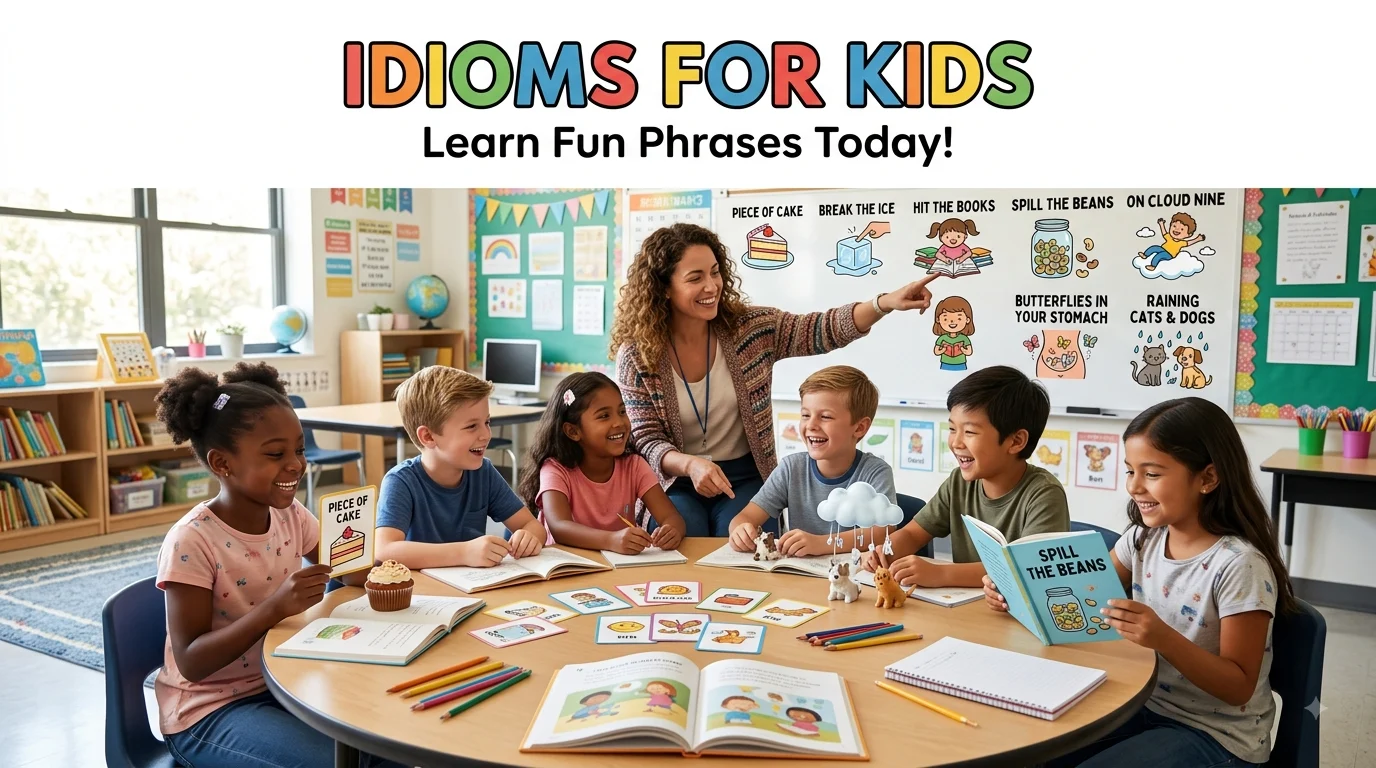
For children, idioms can turn vocabulary practice into something much more memorable. Instead of learning a plain definition, kids can connect a phrase with a funny picture, a short story, or a familiar situation. That makes new expressions easier to understand and remember.
This collection of idioms for kids focuses on expressions that are common, useful, and easy to explain. Each one includes a simple meaning and examples that children can recognize from school, family life, friendships, hobbies, and everyday adventures.
Quick Summary of Idioms for Kids
| Idiom | Simple Meaning | Best For |
|---|---|---|
| Piece of cake | Something very easy | School, conversation |
| Break the ice | Make people feel comfortable | Friends, introductions |
| Hit the books | Start studying | Schoolwork |
| Spill the beans | Reveal a secret | Casual conversation |
| A piece of advice | Helpful suggestion | Learning |
| Once in a blue moon | Very rarely | Everyday conversation |
| Under the weather | Feeling unwell | Daily life |
| On cloud nine | Extremely happy | Feelings |
| In hot water | In trouble | Stories, conversation |
| Hold your horses | Wait or slow down | Everyday speech |
| Cost an arm and a leg | Be very expensive | Shopping, stories |
| Let the cat out of the bag | Reveal a secret | Surprises |
| Raining cats and dogs | Raining very heavily | Weather |
| The ball is in your court | It is your turn to act | Decisions |
| Keep an eye on | Watch carefully | Home, school |
| Learn by heart | Memorize something | School |
| A breath of fresh air | Something pleasantly new | People, experiences |
| Go the extra mile | Make an extra effort | School, teamwork |
| Two heads are better than one | Working together helps | Group work |
| When pigs fly | Something unlikely to happen | Humor |
| Bite your tongue | Stop yourself from speaking | Conversation |
| Butterflies in your stomach | Feel nervous | Tests, performances |
| See eye to eye | Agree | Friendship, discussion |
| Practice makes perfect | Practice improves ability | Learning |
| Hang in there | Keep trying | Encouragement |
Piece of Cake
Meaning:
Something that is very easy to do.
When Kids Use It:
Children can use this friendly expression when talking about homework, games, chores, tests, or activities that seem easy.
Alternative Expression:
Easy as pie.
Examples in Communication
Formal Example:
The science activity was a piece of cake after we understood the instructions.
Casual Example:
That puzzle was a piece of cake!
Creative Example:
Mia looked at the giant stack of blocks and smiled. Building the tower was a piece of cake.
Break the Ice
Meaning:
To make people feel more comfortable when they meet for the first time.
When Kids Use It:
This is useful when a new student joins a class, children meet at camp, or a group starts an activity together.
Alternative Expression:
Start a friendly conversation.
Examples in Communication
Formal Example:
The teacher told a funny story to break the ice on the first day of class.
Casual Example:
I told a joke to break the ice.
Creative Example:
A silly guessing game helped break the ice, and soon everyone was laughing together.
Hit the Books
Meaning:
To begin studying.
When Kids Use It:
This popular informal expression works especially well when talking about homework, exams, quizzes, or school projects.
Alternative Expression:
Start studying.
Examples in Communication
Formal Example:
The students decided to hit the books before the science test.
Casual Example:
I need to hit the books tonight.
Creative Example:
With the big spelling test tomorrow, Leo knew it was time to hit the books.
Spill the Beans
Meaning:
To reveal a secret or tell information that was supposed to be kept private.
When Kids Use It:
This playful expression often appears when children are talking about surprises, birthday presents, or secret plans.
Alternative Expression:
Give away the secret.
Examples in Communication
Formal Example:
Tom accidentally spilled the beans about the surprise party.
Casual Example:
Come on, spill the beans! What’s the surprise?
Creative Example:
Ella tried to keep the secret, but her excited smile nearly spilled the beans.
A Piece of Advice
Meaning:
A helpful suggestion about what someone should do.
When Kids Use It:
This expression is useful when talking about school, friendship, sports, or learning new skills.
Alternative Expression:
A helpful tip.
Examples in Communication
Formal Example:
My teacher gave me a useful piece of advice before the presentation.
Casual Example:
Can I give you a piece of advice?
Creative Example:
Grandpa gave Sam one simple piece of advice: never stop asking questions.
Once in a Blue Moon
Meaning:
Something that happens very rarely.
When Kids Use It:
Children can use this fun expression when describing unusual events, such as eating a favorite treat or staying up late.
Alternative Expression:
Very rarely.
Examples in Communication
Formal Example:
We go to the amusement park once in a blue moon.
Casual Example:
I only eat that kind of candy once in a blue moon.
Creative Example:
Once in a blue moon, the whole family stayed awake to watch the stars.
Under the Weather
Meaning:
Feeling sick or unwell.
When Kids Use It:
This common expression is useful when talking about having a cold, feeling tired, or not feeling well.
Alternative Expression:
Feeling unwell.
Examples in Communication
Formal Example:
Emma stayed home because she was feeling under the weather.
Casual Example:
I’m a little under the weather today.
Creative Example:
The usually energetic puppy was under the weather and spent the morning resting.
On Cloud Nine
Meaning:
Feeling extremely happy.
When Kids Use It:
This cheerful expression works well when talking about winning something, receiving good news, celebrating, or enjoying a special moment.
Alternative Expression:
Overjoyed.
Examples in Communication
Formal Example:
The young athlete was on cloud nine after winning the school competition.
Casual Example:
I was on cloud nine when I got the good news!
Creative Example:
With her new bicycle waiting outside, Lily was on cloud nine.
In Hot Water
Meaning:
To be in trouble.
When Kids Use It:
This expression can describe situations involving forgotten homework, broken rules, or mistakes.
Alternative Expression:
In trouble.
Examples in Communication
Formal Example:
The student was in hot water after forgetting to complete the important assignment.
Casual Example:
I’m going to be in hot water if I don’t clean my room.
Creative Example:
When Jake realized he had lost the library book, he knew he was in hot water.
Hold Your Horses
Meaning:
Wait or slow down.
When Kids Use It:
This playful expression is useful when someone is rushing ahead or becoming too excited.
Alternative Expression:
Wait a moment.
Examples in Communication
Formal Example:
The teacher reminded the students to hold their horses before leaving the classroom.
Casual Example:
Hold your horses! I’m coming.
Creative Example:
“Hold your horses!” shouted Ben as his friends raced toward the playground.
Cost an Arm and a Leg
Meaning:
Something is extremely expensive.
When Kids Use It:
Children can encounter this expression when talking about toys, games, vacations, electronics, or other expensive things.
Alternative Expression:
Cost a fortune.
Examples in Communication
Formal Example:
The latest gaming system can cost an arm and a leg.
Casual Example:
That new bicycle costs an arm and a leg!
Creative Example:
The enormous treehouse looked amazing, but building it would cost an arm and a leg.
Let the Cat Out of the Bag
Meaning:
To accidentally reveal a secret.
When Kids Use It:
This expression is similar to “spill the beans” and works well when discussing surprises.
Alternative Expression:
Reveal the secret.
Examples in Communication
Formal Example:
Sarah let the cat out of the bag about the class celebration.
Casual Example:
Oops! I let the cat out of the bag.
Creative Example:
One excited whisper was all it took for Noah to let the cat out of the bag.
Raining Cats and Dogs
Meaning:
Raining very heavily.
When Kids Use It:
This colorful weather expression is easy for children to remember because the literal image is funny.
Alternative Expression:
Pouring with rain.
Examples in Communication
Formal Example:
It was raining cats and dogs, so the outdoor activity was canceled.
Casual Example:
We can’t go outside—it’s raining cats and dogs!
Creative Example:
Rain poured against the windows as if the sky had opened a giant tap.
The Ball Is in Your Court
Meaning:
It is now your turn to make a decision or take action.
When Kids Use It:
This expression is especially useful when talking about games, teamwork, projects, and decisions.
Alternative Expression:
It’s your turn.
Examples in Communication
Formal Example:
I’ve shared my idea, so the ball is now in your court.
Casual Example:
I invited you, so the ball is in your court!
Creative Example:
Maya had offered three choices. Now the ball was in Daniel’s court.
Keep an Eye On
Meaning:
To watch or monitor something carefully.
When Kids Use It:
Children hear this expression frequently at home, school, playgrounds, and during activities.
Alternative Expression:
Watch carefully.
Examples in Communication
Formal Example:
Please keep an eye on the younger students during the activity.
Casual Example:
Can you keep an eye on my backpack?
Creative Example:
Dad asked Ava to keep an eye on the cookies while he prepared the drinks.
Learn by Heart
Meaning:
To memorize something so well that you can say it without looking at it.
When Kids Use It:
This is particularly useful for schoolwork, poems, songs, multiplication facts, and presentations.
Alternative Expression:
Memorize.
Examples in Communication
Formal Example:
The students had to learn the short poem by heart.
Casual Example:
I know this song by heart.
Creative Example:
After practicing all week, Noah knew his lines by heart.
A Breath of Fresh Air
Meaning:
Someone or something that feels pleasantly new, refreshing, or different.
When Kids Use It:
This can describe a new friend, a fun idea, a different activity, or a change from a boring routine.
Alternative Expression:
Something refreshing and new.
Examples in Communication
Formal Example:
The new activity was a breath of fresh air for the students.
Casual Example:
Our new teacher is a breath of fresh air.
Creative Example:
After weeks of rainy afternoons, the sunny picnic was a breath of fresh air.
Go the Extra Mile
Meaning:
To make more effort than is expected.
When Kids Use It:
This is a great expression for school projects, helping friends, teamwork, sports, and acts of kindness.
Alternative Expression:
Make an extra effort.
Examples in Communication
Formal Example:
The student went the extra mile to make the project especially creative.
Casual Example:
Thanks for going the extra mile to help me.
Creative Example:
Liam went the extra mile and made colorful cards for every member of his team.
Two Heads Are Better Than One
Meaning:
Working together can make it easier to solve a problem.
When Kids Use It:
This is perfect for group projects, puzzles, homework, games, and teamwork.
Alternative Expression:
Working together is better.
Examples in Communication
Formal Example:
We decided to solve the problem together because two heads are better than one.
Casual Example:
Let’s work on it together. Two heads are better than one!
Creative Example:
Neither friend could solve the puzzle alone, but together they remembered that two heads are better than one.
When Pigs Fly
Meaning:
Something is very unlikely or probably will not happen.
When Kids Use It:
This humorous idiom is often used jokingly when someone makes an unlikely promise or prediction.
Alternative Expression:
Probably never.
Examples in Communication
Formal Example:
He joked that he would clean his room without being asked when pigs fly.
Casual Example:
He’ll wake up early without an alarm when pigs fly!
Creative Example:
“I’ll share my last cookie,” Mia joked. “When pigs fly!”
Bite Your Tongue
Meaning:
To stop yourself from saying something.
When Kids Use It:
This expression can be useful when someone is tempted to say something rude, unnecessary, or better left unsaid.
Alternative Expression:
Keep quiet.
Examples in Communication
Formal Example:
She wanted to complain, but she decided to bite her tongue.
Casual Example:
I almost told him, but I bit my tongue.
Creative Example:
Tom wanted to reveal the surprise, but he bit his tongue just in time.
Butterflies in Your Stomach
Meaning:
A nervous or excited feeling in your stomach.
When Kids Use It:
This is especially common when children are preparing for tests, performances, competitions, speeches, or new experiences.
Alternative Expression:
Feel nervous.
Examples in Communication
Formal Example:
The student had butterflies in her stomach before giving her presentation.
Casual Example:
I always get butterflies in my stomach before a game.
Creative Example:
As the curtain opened, tiny butterflies seemed to flutter inside Ben’s stomach.
See Eye to Eye
Meaning:
To agree with someone.
When Kids Use It:
This expression is useful when discussing different opinions between friends, classmates, teammates, or family members.
Alternative Expression:
Agree.
Examples in Communication
Formal Example:
The two students did not see eye to eye about how to complete the project.
Casual Example:
We don’t always see eye to eye, but we’re still friends.
Creative Example:
They disagreed about the game at first, but eventually they saw eye to eye.
Practice Makes Perfect
Meaning:
Practicing regularly helps you improve a skill.
When Kids Use It:
This is especially helpful for encouraging children who are learning sports, music, spelling, drawing, mathematics, or another skill.
Alternative Expression:
Practice helps you improve.
Examples in Communication
Formal Example:
The coach reminded the team that practice makes perfect.
Casual Example:
Keep practicing. Practice makes perfect!
Creative Example:
Ella missed several notes at first, but she kept practicing because she knew practice makes perfect.
Hang in There
Meaning:
Keep trying and do not give up.
When Kids Use It:
This encouraging expression is useful when a child is struggling with homework, learning a skill, losing a game, or facing a difficult task.
Alternative Expression:
Keep going.
Examples in Communication
Formal Example:
The teacher encouraged the student to hang in there and continue practicing.
Casual Example:
Hang in there! You’re almost finished.
Creative Example:
The mountain looked steep, but Dad smiled and said, “Hang in there. We’re almost at the top.”
Why Are Idioms Helpful for Kids?
Idioms introduce children to a different side of language.
When kids learn an expression such as “piece of cake,” they are not simply learning another way to say “easy.” They are also learning how English speakers communicate humor, emotion, exaggeration, and personality.
Idioms can help children:
- Understand stories more easily
- Improve reading comprehension
- Expand vocabulary
- Recognize figurative language
- Make conversations more natural
- Add personality to creative writing
- Understand jokes and expressions
- Become more confident English speakers
They can also encourage children to ask questions about language. That curiosity is valuable because language learning becomes much more effective when children are interested in why an expression means what it means.
How to Teach Idioms to Kids
The easiest way to teach an idiom is through a situation rather than a dictionary definition alone.
For example, instead of simply telling a child:
“Break the ice means to make people comfortable.”
Create a situation:
“A new student joins the class. Nobody knows what to say, so the teacher tells a funny joke. The joke helps everyone relax. The teacher has broken the ice.”
Now the child can connect the phrase with an actual event.
Pictures, short stories, cartoons, classroom games, and acting activities can make idioms even easier to remember.
Children also enjoy discovering the difference between the literal meaning and the real meaning. Asking, “Can you imagine what would happen if someone actually tried to spill the beans?” can turn vocabulary practice into a fun conversation.
How Kids Can Use Idioms Naturally
Children do not need to use idioms in every sentence.
The goal is to recognize them and understand when they fit.
For example, if a friend asks whether a simple homework assignment was difficult, saying:
“Nope, it was a piece of cake!”
sounds natural.
If someone is rushing:
“Hold your horses!”
can be playful.
If a child is nervous before a school performance:
“I have butterflies in my stomach.”
clearly communicates the feeling.
The best practice is to learn one idiom, understand its meaning, and then create several simple sentences with it.
Common Mistakes Kids Make With Idioms
Taking every idiom literally
A child learning “raining cats and dogs” might imagine animals falling from the sky. That is perfectly understandable when first learning idioms. Explain that the expression means heavy rain.
Using an idiom in the wrong situation
“Make a racket” usually describes noisy or disruptive behavior. It would not normally be the best phrase for a peaceful concert.
Using too many idioms together
A sentence filled with five different idioms can become confusing. Encourage children to use one expression where it adds meaning.
Forgetting the tone
Some idioms are playful, while others are more serious. “When pigs fly” is humorous, while “give voice to” is more appropriate for thoughtful or formal communication.
Memorizing without understanding
Simply memorizing definitions is less useful than understanding the situation behind each expression. Children should learn what an idiom means, when it is used, and how it sounds in a real sentence.
Fun Ways to Practice Idioms for Kids
Learning idioms does not have to feel like a vocabulary test.
Try an idiom drawing game. Give children an expression such as “butterflies in your stomach” and ask them to draw what the words literally suggest. Then discuss what the idiom actually means.
Another activity is an idiom guessing game. Describe a situation without giving the expression:
“Someone is very nervous before going on stage. What idiom could describe that feeling?”
The answer is “butterflies in your stomach.”
Children can also keep a small idiom notebook. For every new expression, they can write:
- The idiom
- Its simple meaning
- A funny picture
- Their own sentence
- A situation where they could use it
This turns passive vocabulary into language they can actually use.
Idioms for Kids in School Writing
Idioms can make children’s creative writing much more interesting when used carefully.
Instead of:
Sam was very nervous before the race.
A child might write:
Sam had butterflies in his stomach before the race.
Instead of:
The test was very easy.
They could write:
The test was a piece of cake.
Instead of:
The friends worked together to solve the puzzle.
They could write:
They remembered that two heads are better than one.
These expressions give simple sentences more personality while still keeping the language understandable.
Teachers can also use idioms to introduce the difference between literal language and figurative language, an important reading and writing skill.
Idioms for Kids in Everyday Conversation
Children hear idioms every day, sometimes without realizing it.
A parent might say:
“Hold your horses!”
A teacher might say:
“It’s time to hit the books.”
A friend might say:
“That game was a piece of cake.”
Someone might say:
“I’m feeling under the weather.”
Recognizing these expressions helps children understand conversations more quickly.
The next step is learning to use them naturally. A child who understands the expression “on cloud nine” can use it when describing an exciting achievement or wonderful day.
That is how vocabulary moves from something children recognize to something they can communicate.
Why Funny Idioms Are Easier to Remember
Many idioms are memorable because their literal meanings create funny mental pictures.
Imagine pigs flying through the sky.
Imagine someone actually trying to hold a horse still.
Imagine a person with butterflies fluttering around inside their stomach.
Imagine a teacher telling students to hit their books.
These unusual images make the expressions stick.
For children, humor is especially useful because it transforms abstract language into something visual and memorable. If an idiom makes a child laugh, there is a good chance they will remember it.
FAQs
What is an idiom in simple words for kids?
An idiom is a phrase that has a special meaning different from the literal meanings of its words. For example, “piece of cake” means something is easy, not that the activity is actually a cake.
What is an easy idiom for kids to learn?
“Piece of cake” is one of the easiest because children quickly understand that it means something is easy. “On cloud nine” and “break the ice” are also useful beginner-friendly idioms.
Why should kids learn idioms?
Idioms help children understand books, conversations, movies, stories, and classroom language. They also make speaking and writing more expressive.
How can kids remember idioms?
Kids can remember idioms by connecting them with pictures, funny stories, real-life situations, and their own sentences. Learning an idiom in context is usually more effective than memorizing a definition alone.
Can kids use idioms in school writing?
Yes. Idioms can make creative writing and personal narratives more expressive. However, children should consider the type of assignment because some formal school writing may require more direct language.
Conclusion
Learning idioms for kids is more than memorizing unusual phrases. It is an introduction to the playful, creative side of English.
Expressions such as “piece of cake,” “break the ice,” “hit the books,” “spill the beans,” “on cloud nine,” and “butterflies in your stomach” help children describe everyday experiences in more colorful ways. They also teach an important lesson: words do not always mean exactly what they appear to mean.
The best way for children to learn idioms is through stories, conversations, games, pictures, and real situations. Encourage kids to ask questions, imagine the literal meaning, discover the figurative meaning, and then create their own examples.
With regular practice, these expressions become easier to recognize and use. And once children start noticing idioms around them, ordinary conversations and stories can become a fascinating little language adventure.
Discover More Related Articles:
- Idioms for Mean | Expressions for Unkind, Cruel & Nasty Behavior In 2026
- Ear Idioms | Interesting Meanings Behind Common Phrases In 2026