Quick Answer
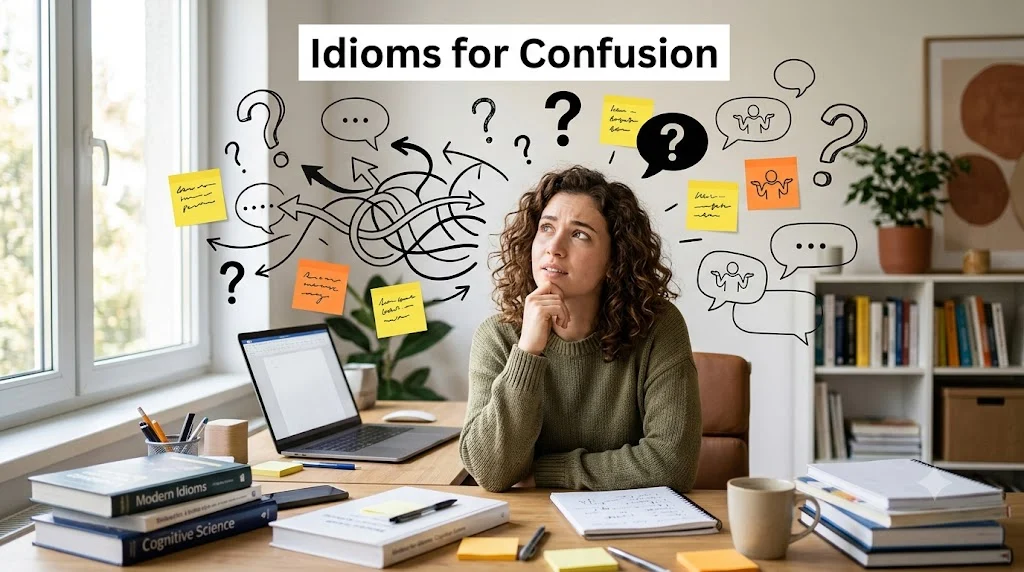
Idioms for confusion are figurative expressions that describe feeling uncertain, puzzled, overwhelmed, or unable to understand something clearly.
Common examples include at sea, in a fog, all mixed up, can’t make head or tail of it, and go around in circles. These idioms make conversations, essays, stories, and everyday English sound more natural and expressive.
Everyone feels confused sometimes. Maybe you’ve read an email three times and still weren’t sure what it meant. Perhaps a teacher explained a concept that seemed clear in class but disappeared from your memory later. Or maybe a conversation moved so quickly that you lost track of what everyone was talking about.
English has a surprisingly rich collection of idioms for these moments. Instead of simply saying I’m confused, native speakers often use vivid expressions such as I’m at sea or I can’t make head or tail of it. These phrases add color, emotion, and personality to both speech and writing.
For students, writers, bloggers, and language learners, understanding these idioms does more than expand vocabulary. It helps you recognize the tone behind a sentence, follow conversations more easily, and sound more natural when expressing uncertainty.
In this guide, you’ll learn 25 useful idioms for confusion, their meanings, when people actually use them, and realistic examples you can start using right away.
Quick Summary Table
| Idiom | Meaning |
|---|---|
| At sea | Completely confused |
| In a fog | Unable to think clearly |
| All mixed up | Mentally confused |
| Can’t make head or tail of it | Cannot understand something |
| Go around in circles | Make no progress in understanding |
| Draw a blank | Suddenly forget something |
| Miss the point | Fail to understand the main idea |
| Be in two minds | Feel undecided |
| Get the wrong end of the stick | Misunderstand someone |
| Be all over the place | Disorganized or mentally scattered |
At Sea
Meaning: Completely confused or uncertain.
When People Use It: Often used when someone feels lost in a new situation, task, or discussion.
Alternative Expression: Feeling lost
Examples in Communication
- Formal: After reading the revised policy, several employees were still at sea about the new procedures.
- Casual: I was completely at sea during that math lesson.
- Creative: The instructions were so complicated that she felt like a sailor drifting without a map.
In a Fog
Meaning: Unable to think clearly.
When People Use It: Common when tired, stressed, or overwhelmed.
Alternative Expression: Foggy-headed
Examples in Communication
- Formal: He admitted that he had been in a fog during the morning meeting.
- Casual: Sorry, I haven’t had coffee yet. I’m still in a fog.
- Creative: Her thoughts drifted through her mind like cars disappearing into morning mist.
All Mixed Up
Meaning: Mentally confused or unable to organize thoughts.
When People Use It: Often after receiving too much information.
Alternative Expression: Jumbled up
Examples in Communication
- Formal: The conflicting reports left the committee all mixed up.
- Casual: I get all mixed up when people explain directions too fast.
- Creative: Dates, names, and places swirled together until everything felt tangled.
Can’t Make Head or Tail of It
Meaning: Cannot understand something at all.
When People Use It: Useful for confusing documents, instructions, or explanations.
Alternative Expression: Can’t figure it out
Examples in Communication
- Formal: Several readers said they couldn’t make head or tail of the technical report.
- Casual: This recipe is so confusing. I can’t make head or tail of it.
- Creative: The note looked like a puzzle written in a language only its author understood.
Go Around in Circles
Meaning: Discuss or think about something repeatedly without reaching clarity.
When People Use It: Common in meetings, debates, and problem-solving.
Alternative Expression: Get nowhere
Examples in Communication
- Formal: The discussion went around in circles for nearly an hour.
- Casual: We’re just going around in circles. Let’s make a decision.
- Creative: Every answer led them back to the same unanswered question.
Draw a Blank
Meaning: Suddenly be unable to remember something.
When People Use It: Frequently used in exams, presentations, or conversations.
Alternative Expression: Forget completely
Examples in Communication
- Formal: During the presentation, she briefly drew a blank.
- Casual: I knew the answer yesterday, but now I’m drawing a blank.
- Creative: His mind opened like an empty notebook with no words on the page.
Miss the Point
Meaning: Fail to understand the main idea.
When People Use It: Useful when someone focuses on details instead of the central message.
Alternative Expression: Misunderstand the message
Examples in Communication
- Formal: The response missed the point of the original proposal.
- Casual: You’re missing the point. I’m talking about the deadline, not the design.
- Creative: He stared so hard at the branches that he forgot to notice the tree.
Be in Two Minds
Meaning: Feel uncertain between two choices.
When People Use It: Common in British English.
Alternative Expression: Be undecided
Examples in Communication
- Formal: The board was in two minds about expanding the project.
- Casual: I’m in two minds about taking that course.
- Creative: One part of her wanted to stay, while the other was already walking toward the door.
Get the Wrong End of the Stick
Meaning: Misunderstand what someone means.
When People Use It: Often used to gently correct a misunderstanding.
Alternative Expression: Take something the wrong way
Examples in Communication
- Formal: I think some readers got the wrong end of the stick regarding the announcement.
- Casual: Oh, you got the wrong end of the stick. I wasn’t criticizing you.
- Creative: The message arrived intact, but its meaning took a wrong turn along the way.
Be All Over the Place
Meaning: Mentally scattered or disorganized.
When People Use It: Common when someone is stressed or distracted.
Alternative Expression: Scattered
Examples in Communication
- Formal: Her notes were all over the place after the rushed meeting.
- Casual: Sorry, my thoughts are all over the place today.
- Creative: Ideas bounced around her mind like papers caught in the wind.
Be None the Wiser
Meaning: Still not understand after receiving an explanation.
When People Use It: Useful when an explanation fails to help.
Alternative Expression: Still confused
Examples in Communication
- Formal: After the briefing, many attendees were none the wiser.
- Casual: He explained it twice, and I’m still none the wiser.
- Creative: The answer added more words, but not more understanding.
Be Out of One’s Depth
Meaning: Face a situation that is too difficult to understand or handle.
When People Use It: Common in work, study, and technical discussions.
Alternative Expression: Overwhelmed
Examples in Communication
- Formal: New employees often feel out of their depth during the first week.
- Casual: I was out of my depth in that coding workshop.
- Creative: He stepped into a conversation that felt deeper than he could comfortably swim.
Scratch One’s Head
Meaning: Be puzzled or confused.
When People Use It: A very visual, informal expression.
Alternative Expression: Puzzle over something
Examples in Communication
- Formal: The unexpected results made researchers scratch their heads.
- Casual: This phone setting has me scratching my head.
- Creative: Everyone stared at the screen, silently scratching their heads in disbelief.
Lose the Thread
Meaning: Forget the main idea during a conversation or explanation.
When People Use It: Common during long discussions.
Alternative Expression: Lose track
Examples in Communication
- Formal: The speaker lost the thread halfway through the presentation.
- Casual: Wait, I lost the thread. What were we talking about?
- Creative: The story slipped from his hands like a piece of yarn unwinding across the floor.
Have One’s Wires Crossed
Meaning: Misunderstand each other.
When People Use It: Useful for communication mix-ups.
Alternative Expression: Miscommunicate
Examples in Communication
- Formal: It seems we had our wires crossed about the meeting time.
- Casual: Sorry, we got our wires crossed.
- Creative: Their messages traveled the same path but arrived carrying different meanings.
Be Up in the Air
Meaning: Remain uncertain or unresolved.
When People Use It: Common for plans, decisions, and future events.
Alternative Expression: Still undecided
Examples in Communication
- Formal: The final schedule is still up in the air.
- Casual: Our weekend plans are up in the air.
- Creative: The decision hovered above them like a paper airplane that refused to land.
Not Know Which Way to Turn
Meaning: Feel overwhelmed and unsure what to do next.
When People Use It: Often during stressful situations.
Alternative Expression: Feel lost
Examples in Communication
- Formal: After the sudden changes, many employees did not know which way to turn.
- Casual: I had so many assignments that I didn’t know which way to turn.
- Creative: Every path looked possible, which somehow made choosing one even harder.
Be at a Loss
Meaning: Not know what to say or do.
When People Use It: Useful in both formal and informal English.
Alternative Expression: Be unsure
Examples in Communication
- Formal: The manager was at a loss for an immediate explanation.
- Casual: I’m at a loss. What should we do?
- Creative: Words stood just out of reach while she searched for the right response.
See Through a Glass Darkly
Meaning: Understand something only partially or imperfectly.
When People Use It: More literary and formal.
Alternative Expression: See only part of the picture
Examples in Communication
- Formal: We currently see the situation through a glass darkly.
- Casual: I get the general idea, but I still see it through a glass darkly.
- Creative: The truth appeared like a reflection blurred by rain on a window.
Be in the Dark
Meaning: Lack important information.
When People Use It: Common in workplaces and group projects.
Alternative Expression: Be uninformed
Examples in Communication
- Formal: Several team members were still in the dark about the changes.
- Casual: Keep me updated. I don’t want to be in the dark.
- Creative: Everyone else seemed to have a flashlight except him.
Tie Oneself in Knots
Meaning: Become confused while explaining or thinking about something.
When People Use It: Often used humorously.
Alternative Expression: Get tangled up
Examples in Communication
- Formal: The witness tied himself in knots during the explanation.
- Casual: I always tie myself in knots when I try to explain that story.
- Creative: His sentences looped around each other until even he couldn’t find the beginning.
Be Puzzled
Meaning: Feel confused or uncertain.
When People Use It: A simple, widely accepted expression.
Alternative Expression: Be baffled
Examples in Communication
- Formal: Researchers were puzzled by the unexpected results.
- Casual: I’m puzzled by this message.
- Creative: The clue sat quietly on the page while everyone searched for its meaning.
Be Baffled
Meaning: Be completely unable to understand something.
When People Use It: Stronger than be puzzled.
Alternative Expression: Be bewildered
Examples in Communication
- Formal: Experts were baffled by the sudden change in data.
- Casual: I’m totally baffled by this app.
- Creative: The mystery stood in front of them like a locked door with no visible key.
Be Bewildered
Meaning: Feel deeply confused and uncertain.
When People Use It: Often used in emotional or dramatic situations.
Alternative Expression: Be utterly confused
Examples in Communication
- Formal: Visitors were bewildered by the sudden change of directions.
- Casual: I was bewildered when everyone started cheering.
- Creative: The room shifted from familiar to strange in a single unexpected moment.
Practical Usage Guidance
How to Use Idioms Naturally
The easiest mistake language learners make is using idioms in every sentence. Native speakers usually save them for moments when they want to add emotion, humor, or emphasis.
Instead of saying:
I was confused about the assignment.
You might say:
I was completely at sea about the assignment.
The second version feels more vivid and memorable.
Match the Idiom to the Situation
Professional settings
Best choices
- At a loss
- In the dark
- Have our wires crossed
Casual conversations
Best choices
- All mixed up
- Scratching my head
- Drawing a blank
Creative writing or storytelling
Best choices
- In a fog
- See through a glass darkly
- Not know which way to turn
Common Mistakes to Avoid
Mixing two idioms together
I was at sea in the dark about the report.
Choose one clear idiom instead.
Using very informal idioms in formal writing
For academic essays, at a loss sounds more polished than all over the place.
Using an idiom literally
When someone says I’m in a fog, they usually mean they are mentally unclear, not standing in actual fog.
A Simple Memory Trick
Group idioms by the feeling they describe.
Mild confusion
- Puzzled
- In two minds
Strong confusion
- Baffled
- At sea
Overwhelmed confusion
- Bewildered
- Out of one’s depth
Learning them in emotional groups makes them much easier to remember.
FAQs
What is the most common idiom for confusion?
At sea is one of the most common and widely understood idioms for confusion. It works in both spoken and written English.
Can I use these idioms in academic writing?
Some idioms, such as at a loss or in the dark, can work in less formal academic writing. Extremely casual idioms are usually better suited to conversations or creative writing.
What is the difference between baffled and puzzled?
Puzzled suggests mild confusion, while baffled implies a much stronger inability to understand something.
Are these idioms used by native English speakers?
Yes. Many of these expressions appear regularly in everyday conversations, workplace discussions, novels, films, and online communication.
How can I remember idioms more easily?
Connect each idiom to a real situation from your life. For example, remember draw a blank by thinking about a time you forgot an answer during a test.
Conclusion
Learning idioms for confusion is about more than memorizing colorful phrases. These expressions help you describe real human experiences: uncertainty, hesitation, misunderstanding, and those moments when your brain simply refuses to cooperate.
The most effective approach is to choose a few idioms that genuinely fit situations you encounter often. If you’re a student, draw a blank and lose the thread may become especially useful. If you write stories or blog posts, expressions such as in a fog or not know which way to turn can add emotion and realism to your writing.
Language becomes memorable when it feels connected to life. The next time you’re confused, try replacing the plain sentence I’m confused with one of these idioms. You’ll sound more natural, more expressive, and much closer to the way fluent English speakers communicate every day.
With practice, these idioms won’t feel like vocabulary items anymore. They’ll become part of your own voice.
Discover More Related Articles:
- Idioms for Thank You | For Friends, Family, Coworkers & Teachers In 2026
- Powerful Idioms for Silence | That Perfectly Describe Quiet Moments In 2026