Quick Answer
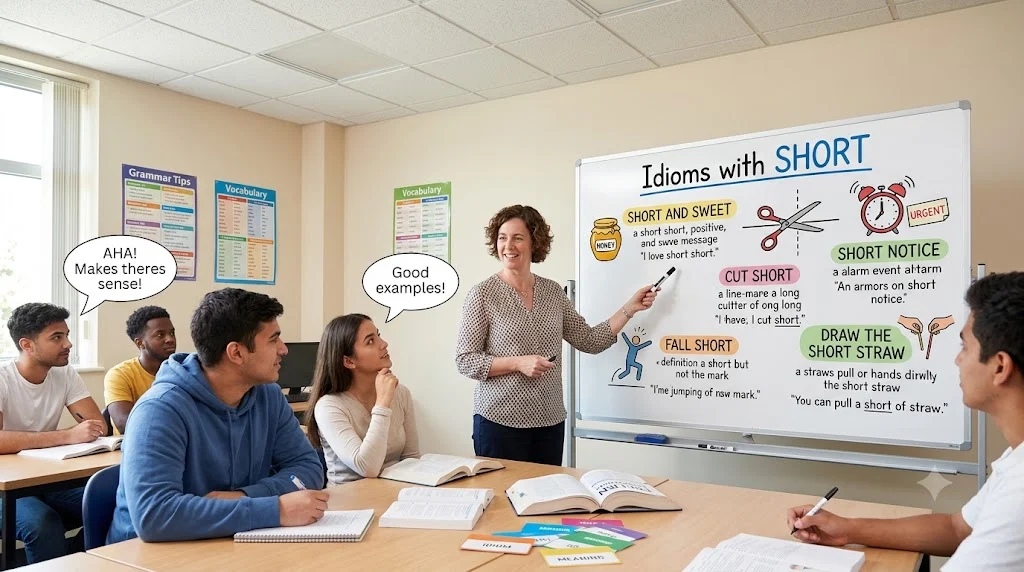
Looking for useful idioms for short? English offers many colorful expressions to describe something or someone that is short in height, brief in time, limited in distance, or lacking in quantity. Popular idioms like short and sweet, cut short, in short, short fuse, come up short, and draw the short straw are widely used in everyday conversations, storytelling, business writing, and academic English.
Sometimes a single idiom can paint a clearer picture than an entire paragraph. Instead of simply saying something is “short,” English speakers often rely on expressive phrases that describe shortness in creative ways. Whether they’re talking about a brief conversation, a nearby location, a quick temper, or even a person who wasn’t lucky enough to avoid an unpleasant task, idioms make communication richer and far more memorable.
If you’ve ever wondered why someone says a meeting was “short and sweet” or complains about receiving “short notice,” you’re not alone. These expressions appear everywhere—from everyday conversations and novels to workplace emails and classroom discussions. Learning them doesn’t just expand your vocabulary; it helps you sound more confident and understand native speakers more naturally.
In this guide, you’ll discover practical idioms for short, complete with meanings, real-life examples, and helpful usage tips. Whether you’re a student, writer, blogger, or English learner, these expressions will make your communication more fluent, engaging, and authentic.
Quick Summary
| Idiom | Best Used For | Tone | Common Situation |
|---|---|---|---|
| Short and sweet | Brief communication | Positive | Speeches, emails |
| Cut short | Ending something early | Neutral | Meetings, vacations |
| In short | Summarizing | Formal | Essays, presentations |
| Come up short | Failing to achieve | Neutral | Goals, competitions |
| Draw the short straw | Being unlucky | Informal | Group situations |
| Short fuse | Quick temper | Informal | Personality |
| Fall short | Not meeting expectations | Neutral | Performance |
| A stone’s throw | Short distance | Informal | Locations |
| Make short work of | Finish quickly | Neutral | Tasks |
| Short notice | Limited preparation time | Formal | Invitations, work |
Short and Sweet
Meaning
Something pleasantly brief while still being effective or meaningful.
When People Use It
People use this idiom when describing speeches, meetings, messages, presentations, or conversations that are concise but satisfying.
Alternative Expression
Brief but meaningful.
Examples in Communication
Formal Example
“The chairman kept his presentation short and sweet, allowing plenty of time for discussion.”
Casual Example
“I love your birthday messages—they’re always short and sweet.”
Creative Example
“Like the last rays of sunset, her goodbye was short and sweet but impossible to forget.”
Usage Tip
This idiom works well in both professional and casual settings and carries a positive tone.
Cut Short
Meaning
To stop or end something before it was supposed to finish.
When People Use It
Commonly used for trips, meetings, conversations, vacations, celebrations, or projects interrupted unexpectedly.
Alternative Expression
End early.
Examples in Communication
Formal Example
“The conference was cut short because of severe weather.”
Casual Example
“We had to cut our movie night short.”
Creative Example
“The laughter echoed through the room until a sudden phone call cut the evening short.”
Usage Tip
This idiom often suggests disappointment because something enjoyable or important ended unexpectedly.
In Short
Meaning
To summarize information briefly.
When People Use It
Useful in essays, presentations, articles, reports, and professional conversations.
Alternative Expression
To sum up.
Examples in Communication
Formal Example
“In short, the research confirms the effectiveness of the new strategy.”
Casual Example
“In short, we decided to stay home.”
Creative Example
“In short, every mistake became another stepping stone.”
Usage Tip
“In short” is one of the safest idioms to use in formal writing.
Come Up Short
Meaning
To fail to achieve an expected result.
When People Use It
Used when someone nearly succeeds but doesn’t quite reach the goal.
Alternative Expression
Fall behind.
Examples in Communication
Formal Example
“The proposal came up short during the final review.”
Casual Example
“I studied all week but still came up short on the test.”
Creative Example
“He chased the horizon for years, only to come up short by a single dream.”
Usage Tip
This idiom often expresses disappointment without sounding overly negative.
Draw the Short Straw
Meaning
To be the unlucky person chosen for an unpleasant responsibility.
When People Use It
Common in workplaces, classrooms, sports teams, or among friends.
Alternative Expression
Get the unlucky job.
Examples in Communication
Formal Example
“Unfortunately, I drew the short straw and worked the holiday shift.”
Casual Example
“You drew the short straw—you’re washing the dishes tonight.”
Creative Example
“Someone always draws the short straw when difficult decisions arrive.”
Usage Tip
Although informal, it’s one of the most recognizable idioms related to being unlucky.
Short Fuse
Meaning
Someone who becomes angry very quickly.
When People Use It
Describing personality, stressful situations, or emotional reactions.
Alternative Expression
Quick temper.
Examples in Communication
Formal Example
“A leader with a short fuse may struggle to motivate a team.”
Casual Example
“Don’t tease him today—he has a really short fuse.”
Creative Example
“His patience burned like a tiny match with a very short fuse.”
Usage Tip
Avoid using this idiom in professional feedback unless you’re speaking tactfully.
Fall Short
Meaning
To fail to meet expectations or requirements.
When People Use It
Frequently used in education, business, sports, and personal development.
Alternative Expression
Not measure up.
Examples in Communication
Formal Example
“Our results fell short of the projected targets.”
Casual Example
“My cooking fell short this time.”
Creative Example
“Even the brightest stars sometimes fall short of reaching every dream.”
Usage Tip
Unlike “come up short,” this idiom often focuses on standards or expectations rather than competition.
A Stone’s Throw
Meaning
A very short distance away.
When People Use It
Talking about nearby places, landmarks, homes, or businesses.
Alternative Expression
Just around the corner.
Examples in Communication
Formal Example
“The hotel is only a stone’s throw from the convention center.”
Casual Example
“The coffee shop is just a stone’s throw from my apartment.”
Creative Example
“Adventure waited only a stone’s throw beyond the old bridge.”
Usage Tip
Although it refers to distance rather than height or time, it’s one of the most common idioms expressing something short.
Make Short Work of
Meaning
To complete a task quickly and efficiently, often with very little effort.
When People Use It
This idiom is common when talking about difficult jobs, assignments, household chores, or competitions that were finished much faster than expected.
Alternative Expression
Finish in no time.
Examples in Communication
Formal Example
“Our software made short work of processing thousands of records.”
Casual Example
“We made short work of cleaning the garage.”
Creative Example
“The experienced climber made short work of the steep mountain trail while others were still catching their breath.”
Usage Tip
This idiom has a confident, positive tone and works well in both spoken and written English.
Short Notice
Meaning
Very little time to prepare before something happens.
When People Use It
People often use this expression for meetings, interviews, invitations, travel plans, or work requests.
Alternative Expression
Little advance warning.
Examples in Communication
Formal Example
“Thank you for attending the meeting on such short notice.”
Casual Example
“Sorry for the short notice, but can you come over tonight?”
Creative Example
“Life rarely sends invitations with plenty of time—it often arrives on short notice.”
Usage Tip
This is one of the most common workplace idioms and sounds perfectly natural in professional emails.
Run Short
Meaning
To have less of something than needed.
When People Use It
Used for money, supplies, food, time, patience, or resources.
Alternative Expression
Run out of.
Examples in Communication
Formal Example
“The project began to run short of funding during its final phase.”
Casual Example
“We’ve run short of milk.”
Creative Example
“As winter grew colder, the village began to run short of firewood.”
Usage Tip
You will often hear this idiom followed by of, as in run short of time or run short of ideas.
Stop Short
Meaning
To suddenly stop doing or saying something.
When People Use It
Used when someone changes their mind, hesitates, or unexpectedly pauses.
Alternative Expression
Pull back.
Examples in Communication
Formal Example
“The company stopped short of announcing the final decision.”
Casual Example
“I was about to tell her the secret, but I stopped short.”
Creative Example
“He stopped short at the old gate, remembering a promise he had almost forgotten.”
Usage Tip
This idiom often suggests caution, uncertainty, or reconsideration.
Short on Time
Meaning
Having very little time available.
When People Use It
Used in busy schedules, meetings, school, work, or daily life.
Alternative Expression
Pressed for time.
Examples in Communication
Formal Example
“As we’re short on time, let’s move directly to the final agenda item.”
Casual Example
“I’m short on time today.”
Creative Example
“The morning slipped away so quickly that everyone felt short on time before the day had truly begun.”
Usage Tip
This phrase is extremely common in everyday English and sounds natural in nearly every setting.
Short of Breath
Meaning
Having difficulty breathing.
When People Use It
Usually used when talking about health, exercise, or physical activity.
Alternative Expression
Out of breath.
Examples in Communication
Formal Example
“The patient reported feeling short of breath after climbing the stairs.”
Casual Example
“I’m short of breath after that run.”
Creative Example
“He stood at the hilltop, short of breath but smiling proudly.”
Usage Tip
This expression is common in medical conversations and should usually be understood literally.
A Short Leash
Meaning
To keep someone under close supervision or strict control.
When People Use It
Often used for employees, children, teenagers, or anyone being monitored carefully.
Alternative Expression
Keep a close eye on.
Examples in Communication
Formal Example
“New employees are often kept on a short leash until they gain experience.”
Casual Example
“My parents kept me on a short leash during high school.”
Creative Example
“The young prince lived on a short leash while dreaming of freedom beyond the castle walls.”
Usage Tip
This idiom can sometimes sound critical, so consider the context before using it.
Be Caught Short
Meaning
To be unexpectedly unprepared or without something needed.
When People Use It
Used for forgetting supplies, money, equipment, or preparation.
Alternative Expression
Be unprepared.
Examples in Communication
Formal Example
“The team was caught short when additional equipment was required.”
Casual Example
“I got caught short without my wallet.”
Creative Example
“Travelers who ignore the weather forecast are often caught short when the rain begins.”
Usage Tip
British English uses this idiom more frequently than American English.
Nothing Short of
Meaning
Used to emphasize that something is remarkable, extraordinary, or complete.
When People Use It
People use it to praise achievements, performances, courage, or dramatic events.
Alternative Expression
Absolutely.
Examples in Communication
Formal Example
“The team’s performance was nothing short of exceptional.”
Casual Example
“Your birthday cake was nothing short of amazing.”
Creative Example
“Watching the northern lights dance across the sky was nothing short of magical.”
Usage Tip
This idiom adds strong emphasis and works beautifully in storytelling and descriptive writing.
Sell Someone Short
Meaning
To underestimate someone’s ability or value.
When People Use It
Used in workplaces, schools, sports, friendships, and personal growth.
Alternative Expression
Underestimate someone.
Examples in Communication
Formal Example
“We shouldn’t sell the new employee short before seeing what she can accomplish.”
Casual Example
“Don’t sell yourself short—you can do this.”
Creative Example
“Every great inventor was once someone others sold short.”
Usage Tip
One of the most encouraging versions of this idiom is “Don’t sell yourself short,” often used to boost confidence.
A Short Memory
Meaning
To quickly forget events, promises, or past experiences.
When People Use It
Used in politics, friendships, sports, and everyday conversations.
Alternative Expression
Forget easily.
Examples in Communication
Formal Example
“Consumers often have a short memory when prices begin to fall.”
Casual Example
“You’ve got a short memory—I told you yesterday!”
Creative Example
“History reminds us that societies with a short memory often repeat old mistakes.”
Usage Tip
This idiom may sound humorous or slightly critical depending on the situation.
The Long and the Short of It
Meaning
The basic facts or the complete summary of a situation.
When People Use It
Perfect for concluding explanations or simplifying complicated stories.
Alternative Expression
The bottom line.
Examples in Communication
Formal Example
“The long and the short of it is that the proposal was approved.”
Casual Example
“The long and the short of it—we missed the bus.”
Creative Example
“The long and the short of it was simple: courage mattered more than luck.”
Usage Tip
This expression is excellent when you want to summarize a discussion in a friendly, natural way.
Be a Little Short
Meaning
To be slightly lacking in something such as money, patience, time, or resources.
When People Use It
This expression is commonly used in everyday conversations when someone doesn’t quite have enough of what they need.
Alternative Expression
Be a bit low on.
Examples in Communication
Formal Example
“Our department is a little short on staff this week.”
Casual Example
“I’m a little short on cash until payday.”
Creative Example
“The tiny bakery was short on ingredients but never short on kindness.”
Usage Tip
Although this expression is less figurative than some idioms, it’s a natural part of conversational English and often appears in daily speech.
Give Someone the Short End of the Stick
Meaning
To treat someone unfairly or give them a disadvantage.
When People Use It
Used when discussing unfair decisions, unequal treatment, or disappointing outcomes.
Alternative Expression
Treat unfairly.
Examples in Communication
Formal Example
“Many employees felt they received the short end of the stick during the restructuring.”
Casual Example
“I always get the short end of the stick when we split chores.”
Creative Example
“He accepted the short end of the stick with grace, believing better days would come.”
Usage Tip
This idiom expresses unfairness without sounding overly dramatic, making it useful in both conversations and storytelling.
Short-Changing Someone
Meaning
To give someone less than they deserve, whether it’s money, credit, respect, or opportunity.
When People Use It
People use this idiom when discussing fairness in work, relationships, business, or personal achievements.
Alternative Expression
Cheat someone.
Examples in Communication
Formal Example
“The report short-changed the contributions of several researchers.”
Casual Example
“Don’t short-change yourself by giving up too early.”
Creative Example
“Dreams are often short-changed only when we stop believing in them.”
Usage Tip
Besides money, this idiom is frequently used metaphorically to talk about confidence and personal growth.
In the Short Run
Meaning
Over a brief period of time.
When People Use It
Useful when comparing temporary results with long-term outcomes in business, education, health, or finance.
Alternative Expression
Temporarily.
Examples in Communication
Formal Example
“The investment may cost more in the short run but save money later.”
Casual Example
“It hurts in the short run, but it’ll be worth it.”
Creative Example
“The storm looked frightening in the short run, yet it left the forest stronger.”
Usage Tip
You’ll often hear this paired with “in the long run,” making it useful for comparisons.
At Short Range
Meaning
From a very close distance.
When People Use It
Common in descriptions involving photography, wildlife, sports, or storytelling.
Alternative Expression
Up close.
Examples in Communication
Formal Example
“The photographer captured the eagle at short range.”
Casual Example
“I’ve never seen a dolphin at such short range.”
Creative Example
“From short range, every wrinkle on the old map revealed another forgotten adventure.”
Usage Tip
This expression is more common in descriptive writing than casual conversation.
Practical Usage Guidance
How to Use Idioms Naturally
Learning idioms is one thing using them naturally is another. Rather than memorizing long lists, try noticing when native speakers use these expressions in conversations, books, movies, podcasts, and news articles. The more often you see an idiom in context, the easier it becomes to understand its tone and purpose.
Choose idioms that genuinely fit the situation. For example:
- Use “short and sweet” when complimenting a concise presentation or message.
- Say “short on time” when you’re busy.
- Use “draw the short straw” when talking about bad luck.
- Choose “nothing short of amazing” when giving sincere praise.
- Use “fall short” when discussing unmet expectations professionally.
Using just one well-placed idiom often sounds far more natural than trying to fit several into the same conversation.
Common Mistakes with Idioms
Many English learners make similar mistakes when first using idioms. Avoid these common pitfalls:
- Using an idiom literally instead of figuratively.
- Mixing two different idioms together.
- Choosing an informal idiom in a highly formal academic paper.
- Changing the wording of a well-known idiom.
- Overusing idioms in every sentence, making your writing sound forced.
When in doubt, keep your language simple and add idioms only where they naturally strengthen your message.
Idioms vs. Literal Expressions
Literal expressions state facts directly.
“The meeting lasted only ten minutes.”
An idiom adds personality and style.
“The meeting was short and sweet.”
Both are correct, but idioms often make writing more engaging, memorable, and expressive.
Tips for Sounding More Fluent
- Learn idioms by theme instead of memorizing random lists.
- Read novels, blogs, and quality articles regularly.
- Watch English interviews and everyday conversations.
- Practice writing one or two idioms in your daily journal.
- Listen to how native speakers naturally use these expressions.
- Focus on understanding the situation rather than translating word by word.
- Review idioms weekly to help them become part of your active vocabulary.
With consistent practice, these expressions will begin to feel natural instead of memorized.
FAQs
What are idioms for short?
Idioms for short are expressions that describe something brief, limited, nearby, lacking, or someone of short stature indirectly through figurative language. Examples include short and sweet, cut short, and short notice.
Which is the most common idiom for something brief?
Short and sweet is one of the most popular idioms. It describes something that is brief but enjoyable or effective.
Can I use these idioms in formal writing?
Yes. Expressions like in short, fall short, short notice, and in the short run are widely accepted in professional and academic writing, while others are better suited for informal conversations.
How can I remember idioms more easily?
The best method is to learn them through real-life examples, stories, conversations, and regular reading instead of memorizing isolated definitions.
Why should I learn idioms in English?
Idioms make your speaking and writing sound more natural, improve your understanding of native speakers, and help you express ideas with greater clarity and personality.
Conclusion
Mastering these idioms for short is about much more than expanding your vocabulary it’s about learning to communicate with confidence, precision, and personality. Whether you’re describing a brief conversation, a nearby location, limited time, or an unexpected disappointment, the right idiom can make your message more vivid and memorable.
Don’t feel pressured to memorize every expression at once. Start by choosing a few that match situations you encounter every day. Use them in conversations, emails, journal entries, classroom assignments, or even social media captions. As you hear and read them more often, they’ll become a natural part of your English.
Language grows through consistent practice, and idioms are one of the easiest ways to make your communication sound fluent and engaging. Keep exploring new expressions, pay attention to how they’re used in context, and enjoy the confidence that comes from expressing yourself with greater creativity and ease.
Discover More Related Articles:
- Idioms for Amazing | Opportunities & Good Fortune In 2026
- Powerful Idioms for Hate | Express Anger, Dislike & Resentment Naturally In 2026