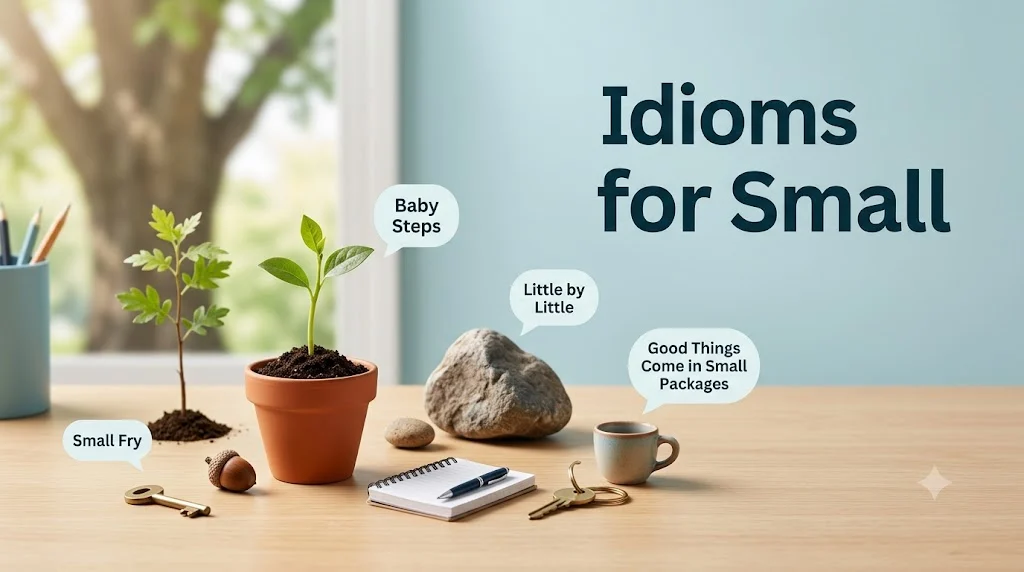
Quick Answer
If you’re looking for idioms for small, English offers plenty of colorful expressions to describe something tiny, limited, insignificant, or modest. Popular examples include small fry, drop in the bucket, little by little, a needle in a haystack, and the tip of the iceberg.
These idioms make your conversations, essays, and creative writing more expressive while helping you sound more fluent and natural.
Sometimes the smallest things carry the biggest meaning. Whether you’re describing a tiny achievement, a modest beginning, or something that seems almost insignificant, the right idiom can make your message far more vivid than ordinary words ever could.
English is filled with expressions that describe “small” in creative ways. Instead of repeatedly saying tiny, little, or small, native speakers often rely on idioms to paint a clearer picture. These expressions appear in everyday conversations, workplace discussions, school assignments, novels, blogs, and even news articles.
Learning idioms isn’t just about expanding your vocabulary—it helps you understand the culture behind the language and communicate with greater confidence. Once you recognize when and where these expressions fit naturally, your writing becomes more engaging, and your conversations sound smoother and more authentic.
In this guide, you’ll discover some of the most useful idioms for small, complete with meanings, natural examples, practical tips, and real-life situations where they shine.
Quick Summary
| Idiom | Meaning | Best Used For |
|---|---|---|
| Small Fry | An unimportant person or thing | People, business, competition |
| Drop in the Bucket | A very small amount | Money, time, effort |
| Little by Little | Gradually over time | Progress, learning |
| A Needle in a Haystack | Extremely hard to find | Searching, research |
| The Tip of the Iceberg | A small visible part of a larger issue | Problems, discoveries |
| In a Nutshell | In a few words | Summaries |
| Bite-Sized | Small and easy to understand | Learning, content |
| Pocket-Sized | Very compact | Objects, devices |
| Baby Steps | Small gradual progress | Goals, improvement |
| Few and Far Between | Rare or scarce | Opportunities, events |
Small Fry
Meaning
A person, group, or thing that is considered unimportant or insignificant compared to others.
When People Use It
People commonly use this idiom when comparing someone with more influential or powerful individuals.
Alternative Expression
- Minor player
Examples in Communication
Formal Example
Compared with international corporations, the local startup was considered small fry.
Casual Example
Don’t worry about those guys—they’re just small fry.
Creative Example
The young detective ignored the small fry, knowing the mastermind was still hiding in the shadows.
Usage Tip
This idiom is slightly informal and is often heard in business, politics, sports, and crime stories.
Drop in the Bucket
Meaning
A very small amount that makes little difference compared to what is actually needed.
When People Use It
Perfect for discussing money, donations, time, or effort that barely affects the overall situation.
Alternative Expression
- A drop in the ocean
Examples in Communication
Formal Example
The grant was appreciated, but it remained only a drop in the bucket compared to the project’s total budget.
Casual Example
Saving five dollars feels like a drop in the bucket when you’re buying a new laptop.
Creative Example
His single candle was a drop in the bucket against the endless darkness, yet it still inspired hope.
Usage Tip
This idiom emphasizes perspective rather than discouragement.
Little by Little
Meaning
Gradually over time through small, consistent efforts.
When People Use It
People often use this expression while talking about learning, personal growth, savings, fitness, or building habits.
Alternative Expression
- Step by step
Examples in Communication
Formal Example
The company expanded internationally little by little over the past decade.
Casual Example
Just keep practicing—you’ll improve little by little.
Creative Example
Little by little, the empty garden transformed into a colorful paradise filled with blooming flowers.
Usage Tip
Although it refers to small progress, it carries a positive and encouraging tone.
A Needle in a Haystack
Meaning
Something extremely difficult to find because it is hidden among many similar things.
When People Use It
Ideal for describing challenging searches, research, job hunting, or locating information.
Alternative Expression
- Hard to find
Examples in Communication
Formal Example
Finding the original document among thousands of files was like finding a needle in a haystack.
Casual Example
Trying to find my black sock was a needle in a haystack this morning.
Creative Example
Searching for hope in the abandoned city felt like chasing a needle in a haystack.
Usage Tip
This idiom creates a vivid mental image and is one of the most widely recognized English expressions.
The Tip of the Iceberg
Meaning
A small visible part that represents a much larger hidden situation.
When People Use It
Frequently used in journalism, business, education, and everyday conversations.
Alternative Expression
- Only the beginning
Examples in Communication
Formal Example
The audit revealed only the tip of the iceberg regarding financial irregularities.
Casual Example
You think that’s bad? That’s just the tip of the iceberg.
Creative Example
The mysterious diary was merely the tip of the iceberg in a family secret spanning generations.
Usage Tip
This idiom doesn’t describe physical size but rather how a small visible part hides something much larger.
In a Nutshell
Meaning
To explain something briefly using only the essential details.
When People Use It
Useful in presentations, blogs, meetings, essays, and conversations.
Alternative Expression
- In short
Examples in Communication
Formal Example
In a nutshell, the proposal aims to improve customer satisfaction.
Casual Example
Can you explain it in a nutshell?
Creative Example
The old traveler smiled and said, “In a nutshell, kindness always finds its way home.”
Usage Tip
This is one of the most useful idioms for writing concise summaries.
Bite-Sized
Meaning
Small enough to be easily understood, completed, or consumed.
When People Use It
Often used for lessons, articles, videos, training, or pieces of information.
Alternative Expression
- Easy to digest
Examples in Communication
Formal Example
The course is divided into bite-sized lessons for better learning.
Casual Example
I like watching bite-sized tutorials during lunch.
Creative Example
Her dreams arrived in bite-sized pieces, growing larger with every passing year.
Usage Tip
Modern educational platforms frequently use this expression because it suggests simplicity without reducing quality.
Pocket-Sized
Meaning
Something that is small enough to fit comfortably into a pocket or is exceptionally compact and easy to carry.
When People Use It
People use this expression when talking about portable gadgets, books, notebooks, tools, or travel accessories.
Alternative Expression
- Compact
Examples in Communication
Formal Example
The company introduced a pocket-sized emergency guide for travelers.
Casual Example
I always carry a pocket-sized notebook for quick ideas.
Creative Example
Inside his pocket-sized journal lived adventures far bigger than the world around him.
Usage Tip
Although it’s often used literally, pocket-sized can also describe something conveniently small or simplified.
Baby Steps
Meaning
Small, careful actions that gradually lead toward a larger goal.
When People Use It
This idiom is common when discussing self-improvement, learning a new skill, recovery, business growth, or personal development.
Alternative Expression
- One step at a time
Examples in Communication
Formal Example
The organization is making baby steps toward improving workplace diversity.
Casual Example
I’m learning Spanish with baby steps, and it’s getting easier every week.
Creative Example
Every sunrise marked another baby step toward the dream she refused to give up.
Usage Tip
This idiom carries an encouraging tone and reminds people that meaningful progress often starts small.
Few and Far Between
Meaning
Rare or uncommon; not happening very often.
When People Use It
Use this expression when talking about opportunities, exceptional people, memorable experiences, or valuable resources.
Alternative Expression
- Rare as hen’s teeth
Examples in Communication
Formal Example
Qualified applicants for the specialized position are few and far between.
Casual Example
Good comedy movies are few and far between these days.
Creative Example
Moments of complete silence were few and far between in the lively city.
Usage Tip
Although it doesn’t literally mean “small,” it effectively describes a small number of people or things.
Penny Ante
Meaning
Small, unimportant, or involving insignificant amounts of money or effort.
When People Use It
People often use this idiom to describe trivial disputes, low-value business deals, or minor problems.
Alternative Expression
- Petty
Examples in Communication
Formal Example
The company decided to focus on strategic investments instead of penny-ante projects.
Casual Example
I’m tired of these penny-ante arguments.
Creative Example
He left behind the penny-ante worries and chased the opportunities that truly mattered.
Usage Tip
Mostly heard in American English, this idiom is slightly informal.
A Little Goes a Long Way
Meaning
Even a small amount can produce significant results.
When People Use It
Common in discussions about kindness, money, food, effort, confidence, or encouragement.
Alternative Expression
- Small efforts matter
Examples in Communication
Formal Example
In customer service, a little goes a long way toward building trust.
Casual Example
Just smile—a little goes a long way.
Creative Example
One thoughtful word proved that a little goes a long way in healing a broken heart.
Usage Tip
This idiom has a positive, motivational tone and works well in speeches, blogs, and everyday conversations.
No Bigger Than a Minute
Meaning
Extremely small in size, especially when describing a child, animal, or object.
When People Use It
Usually used in friendly conversations or storytelling.
Alternative Expression
- Tiny
Examples in Communication
Formal Example
The rescued kitten was no bigger than a minute when it arrived at the shelter.
Casual Example
Look at that puppy—it’s no bigger than a minute!
Creative Example
The fairy appeared, no bigger than a minute, yet brave enough to face a giant.
Usage Tip
This idiom is informal and often adds warmth or affection to a description.
Mighty Oaks from Little Acorns Grow
Meaning
Great achievements often begin with small ideas or humble beginnings.
When People Use It
People use this proverb to encourage patience, persistence, and long-term growth.
Alternative Expression
- Every journey begins with a single step.
Examples in Communication
Formal Example
The entrepreneur reminded her team that mighty oaks from little acorns grow as the startup celebrated its first anniversary.
Casual Example
Don’t give up. Mighty oaks from little acorns grow.
Creative Example
The tiny seed rested quietly beneath the soil, proving that mighty oaks from little acorns grow.
Usage Tip
Although technically a proverb, it’s widely used like an idiom to inspire confidence and perseverance.
Pint-Sized
Meaning
Very small in size, often describing a child or someone physically small but energetic.
When People Use It
Common in sports, family conversations, and playful descriptions.
Alternative Expression
- Tiny but mighty
Examples in Communication
Formal Example
The pint-sized performer impressed the judges with remarkable confidence.
Casual Example
She’s pint-sized, but she can outrun everyone.
Creative Example
The pint-sized hero marched fearlessly into a world filled with giants.
Usage Tip
Usually affectionate and complimentary rather than critical.
Tiny but Mighty
Meaning
Someone or something may be small in size but possesses great strength, talent, or determination.
When People Use It
Often used for children, pets, small businesses, compact products, or inspiring individuals.
Alternative Expression
- Small but powerful
Examples in Communication
Formal Example
The startup proved that being tiny but mighty can be a competitive advantage.
Casual Example
This little speaker is tiny but mighty.
Creative Example
The hummingbird was tiny but mighty, crossing oceans with fearless determination.
Usage Tip
This modern expression is especially popular in motivational writing and social media.
Small but Significant
Meaning
Something that appears minor but has an important impact.
When People Use It
Useful when discussing improvements, thoughtful gestures, habits, or meaningful details.
Alternative Expression
- Small yet meaningful
Examples in Communication
Formal Example
The report highlighted several small but significant improvements in customer satisfaction.
Casual Example
It was a small but significant change that made my day better.
Creative Example
A single handwritten note became a small but significant reminder that kindness never goes unnoticed.
Usage Tip
This phrase is common in academic writing, business reports, and everyday communication because it emphasizes impact over size.
The Little Things Matter
Meaning
Small actions or details often have a greater impact than people realize.
When People Use It
This expression is commonly used when discussing relationships, customer service, personal growth, or everyday kindness.
Alternative Expression
- Every little bit helps
Examples in Communication
Formal Example
Excellent customer service often comes from remembering that the little things matter.
Casual Example
She always remembers birthdays because the little things matter.
Creative Example
The handwritten note reminded him that the little things matter more than expensive gifts ever could.
Usage Tip
Although this is a common phrase rather than a traditional idiom, native speakers use it frequently because it conveys warmth and sincerity.
Every Little Bit Helps
Meaning
Even a small contribution can make a positive difference.
When People Use It
People use this expression when encouraging teamwork, fundraising, volunteering, or saving money.
Alternative Expression
- A little goes a long way
Examples in Communication
Formal Example
Every donation supports the project because every little bit helps.
Casual Example
I only cleaned one room, but every little bit helps.
Creative Example
One smile couldn’t change the world overnight, yet every little bit helps build a kinder tomorrow.
Usage Tip
This expression creates a positive and encouraging tone, making it ideal for motivational writing.
Inch by Inch
Meaning
Making progress slowly through many small steps.
When People Use It
Ideal for discussing long-term goals, difficult projects, recovery, education, or career growth.
Alternative Expression
- Little by little
Examples in Communication
Formal Example
The research team completed the complex project inch by inch through careful planning.
Casual Example
I’m improving my cooking inch by inch.
Creative Example
The mountain seemed impossible until she climbed it inch by inch.
Usage Tip
This idiom emphasizes patience and persistence instead of speed.
Leave No Stone Unturned
Meaning
To search thoroughly, paying attention to every small detail.
When People Use It
Common in investigations, job hunting, academic research, business planning, and problem-solving.
Alternative Expression
- Search everywhere
Examples in Communication
Formal Example
The committee left no stone unturned while reviewing the evidence.
Casual Example
I left no stone unturned looking for my lost phone.
Creative Example
The explorer left no stone unturned, believing every clue could reveal another chapter of history.
Usage Tip
Although it isn’t directly about size, the idiom highlights the importance of even the smallest details.
Not by a Long Shot
Meaning
Not even close; far from enough.
When People Use It
People use this expression to emphasize that something falls well short of expectations.
Alternative Expression
- Not even close
Examples in Communication
Formal Example
The initial results were promising but not by a long shot sufficient for publication.
Casual Example
Am I finished? Not by a long shot!
Creative Example
He thought the puzzle was complete—but not by a long shot.
Usage Tip
This idiom is informal and works best in conversations or narrative writing.
A Grain of Sand
Meaning
A very small or seemingly insignificant part of something much larger.
When People Use It
Used when discussing vast collections, populations, ideas, or life’s bigger picture.
Alternative Expression
- Tiny part
Examples in Communication
Formal Example
Each individual opinion represents only a grain of sand in the overall survey.
Casual Example
My contribution is just a grain of sand, but I’m happy to help.
Creative Example
One dream may seem like a grain of sand, yet together dreams build entire deserts of possibility.
Usage Tip
This expression creates poetic imagery and is especially effective in essays and storytelling.
The Smaller, the Better
Meaning
Sometimes a smaller size, amount, or group is more practical or effective.
When People Use It
People often use this when talking about meetings, products, designs, or personal preferences.
Alternative Expression
- Less is more
Examples in Communication
Formal Example
For productive discussions, the smaller, the better often applies to meeting sizes.
Casual Example
I like backpacks—the smaller, the better.
Creative Example
Her tiny garden proved that the smaller, the better when every flower bloomed with care.
Usage Tip
This expression works well when emphasizing simplicity and efficiency.
Less Is More
Meaning
Simplicity often creates better results than adding unnecessary details.
When People Use It
Popular in writing, graphic design, architecture, fashion, presentations, and communication.
Alternative Expression
- Keep it simple
Examples in Communication
Formal Example
The editor removed unnecessary paragraphs because less is more.
Casual Example
I didn’t decorate much—less is more.
Creative Example
The empty canvas whispered that less is more, allowing every color to shine.
Usage Tip
This expression is extremely useful for writers and bloggers because clear communication often comes from simplicity.
Good Things Come in Small Packages
Meaning
Small people or things can possess exceptional value, talent, or quality.
When People Use It
This expression is often used to compliment someone’s abilities or praise compact products.
Alternative Expression
- Tiny but mighty
Examples in Communication
Formal Example
Despite its compact size, the device proves that good things come in small packages.
Casual Example
He’s short, but good things come in small packages!
Creative Example
The little bookstore reminded every visitor that good things come in small packages, offering endless adventures behind its modest door.
Usage Tip
This is one of the most beloved expressions related to “small” because it carries a positive and uplifting message.
How to Use Idioms Naturally
Learning idioms is only the first step. The real challenge is knowing when and how to use them so they sound natural rather than forced. Native English speakers choose idioms based on the situation, tone, and audience—not simply because they know them.
Here are a few practical tips:
- Use idioms where they fit the conversation instead of adding them to every sentence.
- Match the tone. Expressions like small fry and penny ante are informal, while in a nutshell works well in both professional and casual settings.
- Read books, blogs, and news articles to see idioms used in real contexts.
- Practice speaking them aloud so they become part of your everyday vocabulary.
- Use one or two idioms in essays or presentations to make your writing more engaging without overdoing it.
Natural communication is about balance. A well-placed idiom is memorable, while too many can make your writing feel unnatural.
Common Mistakes When Using Idioms
Many English learners know the meanings of idioms but still struggle to use them correctly. Avoid these common mistakes:
- Taking idioms literally instead of understanding their figurative meaning.
- Mixing two different idioms together.
- Using an informal idiom in a highly formal academic paper.
- Changing the wording of a fixed idiom.
- Using too many idioms in one paragraph.
A good rule is to learn the complete expression exactly as native speakers use it. This helps your English sound fluent and authentic.
Idioms vs. Literal Expressions
Literal language says exactly what it means.
The box is small.
An idiom expresses an idea creatively.
Good things come in small packages.
The first sentence describes physical size. The second suggests that something small can still be valuable or impressive.
Idioms make language more colorful, emotional, and memorable, which is why they appear so often in stories, speeches, conversations, and blogs.
Tips for Remembering Idioms Easily
Remembering idioms becomes much easier when you connect them to real-life experiences rather than trying to memorize long lists.
Here are a few effective strategies:
- Learn idioms by topic, such as small, success, family, or friendship.
- Write one new idiom in a sentence every day.
- Watch English movies or YouTube videos and notice how native speakers use idioms naturally.
- Keep a vocabulary notebook with meanings and your own examples.
- Review your favorite idioms weekly to strengthen long-term memory.
The more you encounter idioms in real situations, the more naturally they’ll become part of your vocabulary.
FAQs
What are idioms for small?
Idioms for small are figurative expressions used to describe something tiny, limited, gradual, or seemingly insignificant. Instead of simply saying “small,” these idioms add color and emotion to your communication. Examples include small fry, a drop in the bucket, and good things come in small packages.
Which idiom means a very small amount?
The most common idiom is a drop in the bucket (or a drop in the ocean in British English). It describes an amount that is too small to make a noticeable difference compared to the whole.
What is the best idiom for describing gradual progress?
Little by little, baby steps, and inch by inch are among the best idioms for expressing slow but steady progress. They’re frequently used in education, personal growth, fitness, and career development.
Can I use these idioms in formal writing?
Yes, but choose carefully. Idioms such as in a nutshell and the tip of the iceberg are widely accepted in professional and business writing. More informal expressions like small fry or penny ante are better suited to conversations, blogs, or creative writing.
How can I remember English idioms more easily?
The easiest way is to learn idioms by theme, create your own example sentences, read authentic English content, and use them in everyday conversations. Regular practice in real contexts helps you remember them naturally.
Conclusion
Mastering idioms for small is about much more than learning a list of clever expressions. These phrases help you communicate ideas with greater personality, clarity, and confidence. Whether you’re describing a tiny amount, celebrating small victories, or emphasizing that even modest beginnings can lead to remarkable outcomes, the right idiom can make your message more memorable.
As with any part of language learning, consistency matters more than speed. Start by choosing a few idioms that feel natural to you, use them in conversations, writing, or journal entries, and pay attention to how native speakers use them in books, podcasts, and everyday discussions. Over time, these expressions will become a natural part of your vocabulary.
Remember, fluent communication isn’t about using difficult words it’s about choosing the right words for the right moment. By practicing these idioms for small, you’ll not only enrich your English but also make your stories, essays, presentations, and conversations more engaging, expressive, and enjoyable. Every small step you take today brings you closer to becoming a more confident English communicator.
Discover More Related Articles:
- Powerful Idioms for Awesome| That Make English More Fun In 2026
- Idioms for Surprise| To Use in Speaking & Writing In 2026