Quick Answer
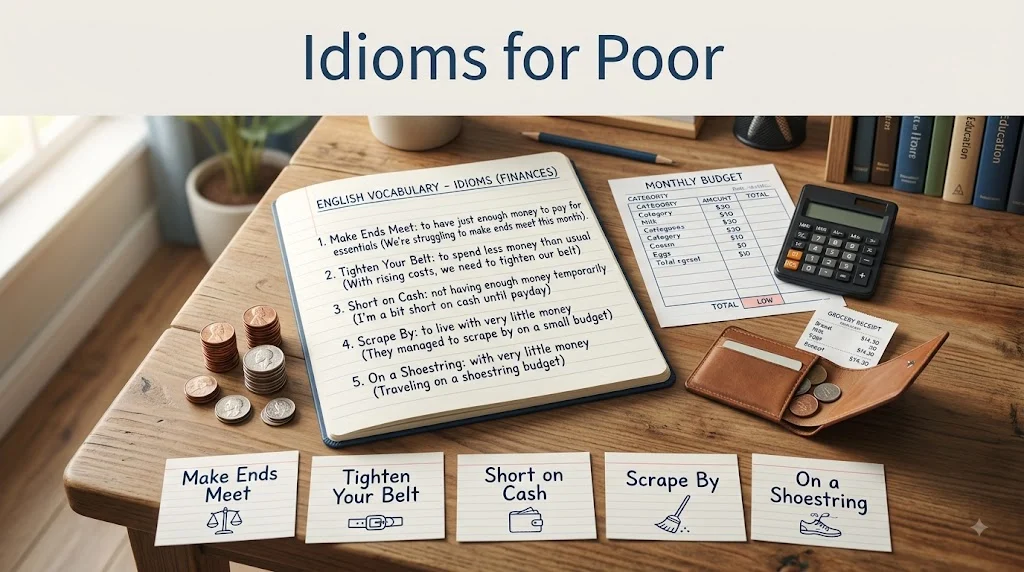
Idioms for poor are expressions used to describe having little money, lacking resources, living with financial difficulty, being short of something, or experiencing a situation where resources are limited. Useful expressions include short on cash, living from hand to mouth, make ends meet, in the red, tighten your belt, down on your luck, hard up, scrape by, on a shoestring, and money is tight.
Money can be an uncomfortable subject, but English has many ways to talk about financial difficulty without repeating the same words.
Instead of simply saying someone does not have much money, you might hear that they are short on cash, hard up, or down on their luck. Someone struggling to cover basic expenses may be described as trying to make ends meet, while a person carefully managing a limited budget might be tightening their belt.
These expressions are valuable because they communicate more than a basic definition. They can suggest whether a problem is temporary, serious, personal, or connected to a particular situation.
For students and English learners, learning these phrases can make conversations easier to understand and writing more expressive. For writers and bloggers, they provide alternatives to repetitive words such as poor, broke, struggling, or financially difficult.
At the same time, context matters. Financial hardship is a serious reality for many people, so idioms should be used with sensitivity. The goal is not simply to find colorful words for poverty, but to understand what each expression actually means and when it is appropriate.
Quick Summary of Idioms for Poor
| Idiom | Simple Meaning | Best Used For |
|---|---|---|
| Short on cash | Having little money available | Temporary money problems |
| Make ends meet | Have enough money for basic needs | Household finances |
| Tighten your belt | Spend less because money is limited | Budgeting |
| Living from hand to mouth | Having barely enough for basic needs | Serious financial hardship |
| Down on your luck | Experiencing a period of bad fortune | General hardship |
| Hard up | Having very little money | Casual conversation |
| Scrape by | Manage with barely enough | Financial difficulty |
| On a shoestring | With a very small budget | Projects, travel, living |
| Money is tight | Money is limited | Everyday financial situations |
| In the red | Owing money or operating at a loss | Personal/business finances |
| Broke | Having no money | Very casual speech |
| Flat broke | Having absolutely no money | Informal conversation |
| Paycheck to paycheck | Depending on each paycheck to cover expenses | Personal finances |
| Pinch pennies | Be extremely careful with spending | Saving money |
| Watch every penny | Monitor spending carefully | Budgeting |
| Count your pennies | Be careful about limited money | Informal situations |
| Cut corners | Save money by reducing costs, sometimes improperly | Projects/business |
| Live within your means | Spend no more than you can afford | Financial advice |
| Get by | Manage despite limited resources | Everyday hardship |
| Keep your head above water | Avoid being overwhelmed by difficulties | Financial or general problems |
| In a tight spot | In a difficult situation | Money and general problems |
| Robbing Peter to pay Paul | Paying one debt with another resource | Financial pressure |
| Beggars can’t be choosers | Limited choices must sometimes be accepted | Difficult circumstances |
| Cost an arm and a leg | Be extremely expensive | High prices |
| A shoestring budget | A very small amount of money | Events, projects, travel |
Short on Cash
Meaning: To have little money available, usually temporarily.
Short on cash is one of the most useful and natural expressions for everyday situations involving limited money. It does not necessarily mean someone is poor; a person can simply be waiting for payday or dealing with an unexpected expense.
Alternative Expression: Low on money
Formal Example:
“The organization was short on cash after several unexpected expenses.”
Casual Example:
“I’d love to come, but I’m a little short on cash this week.”
Creative Example:
“With only a few days left until payday, he was short on cash but determined to make the most of the week.”
Usage Tip: This expression is relatively mild and is often better than stronger expressions when describing a temporary situation.
Make Ends Meet
Meaning: To have enough money to pay for basic living expenses.
This is one of the most important idioms for discussing financial difficulty. Someone who is struggling to make ends meet may have income but finds it difficult to cover necessary expenses.
Alternative Expression: Manage financially
Formal Example:
“Many families work multiple jobs simply to make ends meet.”
Casual Example:
“It’s getting harder to make ends meet with prices going up.”
Creative Example:
“Every month became a careful puzzle as she tried to make ends meet without giving up the things that mattered most.”
Usage Tip: This expression focuses on managing necessary expenses rather than having absolutely no money.
Tighten Your Belt
Meaning: To spend less money because finances have become more difficult.
The image is of tightening a belt because there is less food or fewer resources available. Today, the expression usually means reducing unnecessary spending.
Alternative Expression: Cut back on spending
Formal Example:
“The organization had to tighten its belt after experiencing a significant decline in revenue.”
Casual Example:
“We’re tightening our belts this month and avoiding unnecessary purchases.”
Creative Example:
“When expenses started climbing, the family decided to tighten their belts and rethink their budget.”
Usage Tip: This idiom can describe individuals, families, businesses, or governments.
Living from Hand to Mouth
Meaning: Having barely enough money or resources to cover immediate basic needs.
This expression describes a much more difficult financial situation than simply being short on cash.
Alternative Expression: Barely getting by
Formal Example:
“The report examined households living from hand to mouth without reliable financial security.”
Casual Example:
“They were living from hand to mouth and had very little money left after paying for necessities.”
Creative Example:
“Each week brought another calculation as they lived from hand to mouth, never knowing whether the next expense could be covered.”
Usage Tip: Use this expression carefully because it suggests serious and ongoing financial hardship.
Down on Your Luck
Meaning: Experiencing a period of bad fortune, difficulty, or setbacks.
Being down on your luck does not necessarily mean someone is poor. It can describe someone whose financial, professional, or personal circumstances have recently become difficult.
Alternative Expression: Going through a rough patch
Formal Example:
“The community program was created to assist people who were temporarily down on their luck.”
Casual Example:
“He’s been down on his luck lately, so a little support would mean a lot.”
Creative Example:
“She was down on her luck, but she refused to believe that one difficult season would define her future.”
Usage Tip: This expression can sound more sympathetic than directly calling someone poor.
Hard Up
Meaning: Having very little money or experiencing financial difficulty.
Hard up is an informal expression commonly used in everyday English.
Alternative Expression: Short of money
Formal Example:
“The family was temporarily hard up after several unexpected expenses.”
Casual Example:
“I’m a bit hard up until I get paid.”
Creative Example:
“Though hard up for money, they found ways to enjoy an afternoon together without spending much.”
Usage Tip: This phrase is casual and should generally be avoided in highly formal writing.
Scrape By
Meaning: To manage to survive or succeed with very limited resources.
Someone who scrapes by has just enough to manage, but there is little room for comfort or extra expenses.
Alternative Expression: Get by
Formal Example:
“Some households are forced to scrape by despite working full time.”
Casual Example:
“I can scrape by until the end of the month.”
Creative Example:
“They were not living comfortably, but by planning carefully, they managed to scrape by.”
Usage Tip: Scrape by often emphasizes how difficult or marginal the situation is.
On a Shoestring
Meaning: Using a very small amount of money or working with a very limited budget.
Unlike many expressions in this article, on a shoestring is not necessarily about poverty. A person or organization can deliberately choose to operate on a small budget.
Alternative Expression: On a tiny budget
Formal Example:
“The community project was completed on a shoestring budget.”
Casual Example:
“We traveled around the country on a shoestring.”
Creative Example:
“With creativity and determination, the students organized the entire event on a shoestring.”
Usage Tip: This expression is especially useful for projects, trips, events, businesses, and creative work.
Money Is Tight
Meaning: There is not much money available.
This is a straightforward, common expression for financial pressure.
Alternative Expression: Finances are strained
Formal Example:
“With household budgets under pressure, money is tight for many families.”
Casual Example:
“Money is tight right now, so I’m staying home this weekend.”
Creative Example:
“Money was tight, but the family discovered that some of their happiest evenings cost almost nothing.”
Usage Tip: This is a relatively gentle expression and can describe temporary financial difficulty.
In the Red
Meaning: Owing money or operating at a financial loss.
The expression comes from accounting practices in which negative amounts were traditionally shown in red.
Alternative Expression: In debt
Formal Example:
“The company remained in the red for several quarters.”
Casual Example:
“My budget is in the red after all those unexpected expenses.”
Creative Example:
“By the end of the month, the household budget was firmly in the red.”
Usage Tip: In the red is especially common when discussing businesses, budgets, accounts, and financial results.
Broke
Meaning: Having little or no money.
Broke is extremely common in informal English. It usually describes a person’s current financial situation rather than their long-term economic circumstances.
Alternative Expression: Out of money
Formal Example:
“The student reported being temporarily without funds after an unexpected expense.”
Casual Example:
“I’m broke until payday.”
Creative Example:
“He was broke, but the empty wallet did not stop him from finding free ways to enjoy the afternoon.”
Usage Tip: Because broke is informal, choose a more precise expression in professional or academic contexts.
Flat Broke
Meaning: Having absolutely no money.
Flat broke is a stronger and more emphatic version of broke.
Alternative Expression: Completely out of money
Formal Example:
“The phrase is commonly used informally to describe someone with no available money.”
Casual Example:
“After paying for everything, I’m flat broke.”
Creative Example:
“By the final day of the trip, they were flat broke and relying entirely on the kindness of friends.”
Usage Tip: This is very informal and should generally be avoided in formal financial writing.
Paycheck to Paycheck
Meaning: Depending on each paycheck to cover regular expenses, with little or no money left over.
This phrase is common in discussions about household finances and financial pressure.
Alternative Expression: Living from one paycheck to the next
Formal Example:
“Many workers report living paycheck to paycheck because their regular expenses consume most of their income.”
Casual Example:
“I’ve been living paycheck to paycheck lately.”
Creative Example:
“Each payday brought temporary relief, followed quickly by another round of bills.”
Usage Tip: This phrase describes financial vulnerability rather than necessarily meaning someone has no income.
Pinch Pennies
Meaning: To be extremely careful about how money is spent.
Someone who pinches pennies tries to avoid unnecessary expenses and save wherever possible.
Alternative Expression: Be extremely frugal
Formal Example:
“The organization had to pinch pennies while operating with a reduced budget.”
Casual Example:
“We’re pinching pennies until things get easier.”
Creative Example:
“She learned to pinch pennies without letting careful budgeting take away all the joy from everyday life.”
Usage Tip: Depending on context, this can be neutral, positive, or slightly critical.
Watch Every Penny
Meaning: To monitor spending very carefully.
This expression emphasizes careful financial management.
Alternative Expression: Watch your spending
Formal Example:
“When resources are limited, families may need to watch every penny.”
Casual Example:
“I’m watching every penny this month.”
Creative Example:
“With a tight budget, every purchase required thought, and she learned to watch every penny.”
Usage Tip: This expression is useful when describing budgeting rather than poverty itself.
Count Your Pennies
Meaning: To be very careful with a limited amount of money.
The expression creates the image of someone carefully counting each small amount of money because every bit matters.
Alternative Expression: Count every cent
Formal Example:
“Small businesses often have to count their pennies during uncertain economic periods.”
Casual Example:
“I’m counting my pennies until the next paycheck.”
Creative Example:
“They counted their pennies carefully and discovered that small savings could add up over time.”
Usage Tip: It is generally informal and can describe careful budgeting.
Cut Corners
Meaning: To save time or money by taking shortcuts, sometimes at the expense of quality.
This idiom is important because it does not simply mean spending less. It often implies that the method used to save money or effort may create problems.
Alternative Expression: Take shortcuts
Formal Example:
“The contractor was criticized for cutting corners to reduce costs.”
Casual Example:
“Saving money is fine, but don’t cut corners on important things.”
Creative Example:
“They wanted to keep costs low without cutting corners on the quality of the work.”
Usage Tip: This expression can have a negative meaning, especially when cutting corners compromises safety, quality, honesty, or standards.
Live Within Your Means
Meaning: To spend no more money than you can reasonably afford.
This is more of a common financial expression than a traditional colorful idiom, but it is extremely useful when discussing money.
Alternative Expression: Spend within your budget
Formal Example:
“Learning to live within your means can help create greater long-term financial stability.”
Casual Example:
“I’m trying to live within my means instead of buying things I don’t need.”
Creative Example:
“She realized that living within her means gave her more freedom than constantly chasing things she could not afford.”
Usage Tip: This expression is useful in financial advice, essays, blogs, and everyday conversations.
Get By
Meaning: To manage to live or function despite having limited money, resources, or support.
Get by is broad and can refer to many kinds of difficulty, not just finances.
Alternative Expression: Manage
Formal Example:
“Some households rely on careful budgeting to get by during periods of financial uncertainty.”
Casual Example:
“We don’t have much, but we get by.”
Creative Example:
“They learned to get by with less and discovered how resourceful they could become.”
Usage Tip: This expression often sounds less dramatic than scrape by.
Keep Your Head Above Water
Meaning: To avoid being overwhelmed by serious difficulties.
Although the expression can refer to many challenges, it is frequently used for financial problems.
Alternative Expression: Stay afloat
Formal Example:
“The business introduced new measures to keep its head above water during the difficult period.”
Casual Example:
“I’m working extra hours just to keep my head above water.”
Creative Example:
“Bills kept arriving, but careful planning helped the family keep its head above water.”
Usage Tip: This idiom emphasizes avoiding collapse, rather than becoming wealthy or comfortable.
In a Tight Spot
Meaning: To be in a difficult or troublesome situation.
The problem can be financial, personal, professional, or practical.
Alternative Expression: In a difficult situation
Formal Example:
“The emergency fund proved valuable when the household found itself in a tight spot.”
Casual Example:
“I’m in a tight spot until I get paid.”
Creative Example:
“They were in a tight spot, but an unexpected opportunity gave them a way forward.”
Usage Tip: This is a versatile expression that does not necessarily imply poverty.
Robbing Peter to Pay Paul
Meaning: To take money or resources from one obligation in order to pay another.
This expression describes a situation where solving one financial problem creates another.
Alternative Expression: Shift one debt to cover another
Formal Example:
“Using one outstanding obligation to cover another can amount to robbing Peter to pay Paul.”
Casual Example:
“I’m just robbing Peter to pay Paul at this point.”
Creative Example:
“Each payment solved one problem while creating another, leaving him feeling as though he were constantly robbing Peter to pay Paul.”
Usage Tip: This is an idiomatic and informal way of describing a cycle of financial pressure.
Beggars Can’t Be Choosers
Meaning: When you have very limited choices, you may have to accept what is available rather than demand exactly what you want.
This expression is traditionally used when someone has little bargaining power.
Alternative Expression: Take what you can get
Formal Example:
“When resources are extremely limited, people may have fewer alternatives available to them.”
Casual Example:
“It’s not exactly what I wanted, but beggars can’t be choosers.”
Creative Example:
“The room was smaller than expected, but beggars couldn’t be choosers when every other option was unavailable.”
Usage Tip: This expression can sound blunt or insensitive when applied to people experiencing poverty. Use it carefully and consider your audience.
Cost an Arm and a Leg
Meaning: To be extremely expensive.
This expression does not mean someone is poor. Instead, it describes something that costs a great deal of money and may therefore create financial pressure.
Alternative Expression: Cost a fortune
Formal Example:
“The repairs would cost an arm and a leg, making replacement a more practical option.”
Casual Example:
“That new phone costs an arm and a leg!”
Creative Example:
“The tiny apartment had a beautiful view, but the rent cost an arm and a leg.”
Usage Tip: This is a very common informal expression for high prices.
A Shoestring Budget
Meaning: A very small or limited budget.
This expression is particularly useful when someone needs to accomplish something without much money.
Alternative Expression: Limited budget
Formal Example:
“The community group organized the event on a shoestring budget.”
Casual Example:
“We’re planning the whole trip on a shoestring budget.”
Creative Example:
“With a shoestring budget and plenty of imagination, the students transformed an ordinary room into a memorable event space.”
Usage Tip: A shoestring budget does not automatically mean poverty. It can simply mean that a particular project has limited funding.
How to Use Idioms About Poverty and Financial Difficulty Naturally
The most important lesson with these expressions is context.
Not every idiom means the same level of financial difficulty.
For example:
“I’m short on cash this week.”
This usually suggests a temporary problem.
Compare that with:
“They’re living from hand to mouth.”
That suggests a much more serious and ongoing lack of resources.
Similarly:
“We’re tightening our belts.”
This suggests deliberate spending cuts.
But:
“We’re struggling to make ends meet.”
This emphasizes difficulty covering necessary expenses.
Using the right expression helps your reader or listener understand the seriousness of the situation without unnecessary explanation.
Common Mistakes with Idioms for Poor
One frequent mistake is using poor, broke, and financially struggling as though they always mean the same thing.
They do not.
A person can be broke today and financially comfortable next month.
A family struggling to make ends meet may have regular income but face high essential expenses.
Someone down on their luck may be experiencing a temporary period of setbacks.
A business in the red is operating at a financial loss, but that does not describe a person’s personal economic status.
Another important mistake is using these expressions carelessly to describe real people. Financial hardship can involve circumstances far beyond an individual’s control. In professional, academic, or sensitive contexts, precise and respectful language is usually preferable.
Idioms vs Literal Expressions
Idioms can make financial writing more vivid, but literal language is sometimes clearer.
Compare:
Literal:
“The family has difficulty covering its monthly expenses.”
Idiomatic:
“The family is struggling to make ends meet.”
The first sounds more formal and precise. The second sounds more conversational and emotionally immediate.
Another example:
Literal:
“The business is losing money.”
Idiomatic:
“The business is in the red.”
Both are useful, but the idiomatic version is more compact and conversational.
Strong writers know when to use each style.
Tips for Sounding More Fluent
Learn Idioms by Financial Situation
Group expressions according to what they actually describe.
Temporary lack of money:
- Short on cash
- Money is tight
- Hard up
- Broke
Longer-term financial pressure:
- Make ends meet
- Living from hand to mouth
- Paycheck to paycheck
- Scrape by
Careful spending:
- Tighten your belt
- Pinch pennies
- Watch every penny
- Live within your means
Financial trouble:
- In the red
- Keep your head above water
- In a tight spot
- Robbing Peter to pay Paul
This approach makes it much easier to select the correct phrase.
Pay Attention to Tone
Short on cash sounds relatively mild.
Flat broke is stronger and very informal.
Living from hand to mouth suggests serious hardship.
Down on your luck can sound sympathetic.
Beggars can’t be choosers can sound blunt.
Knowing these emotional differences is just as important as knowing dictionary meanings.
Use One Strong Expression Instead of Several
Avoid stacking idioms unnecessarily.
For example:
“Money was tight, so they tightened their belts and watched every penny.”
This works because the expressions reinforce one another naturally.
But:
“They were broke, hard up, short on cash, scraping by, living paycheck to paycheck, and in a tight spot.”
This sounds repetitive because all the phrases communicate similar ideas.
Choose the expression that most accurately fits the situation.
Using Financial Idioms in Essays
Idioms can make an essay more engaging, but formal assignments usually require careful selection.
For example:
“Many households struggle to make ends meet when essential living costs increase.”
This sounds natural while remaining relatively formal.
Another possibility is:
“When resources are limited, families may need to tighten their belts and prioritize essential expenses.”
The key is to use idioms as supporting language rather than allowing them to replace precise explanations.
In academic writing, phrases such as make ends meet, live within your means, and financially strained may be more appropriate than very casual expressions such as flat broke.
Using Idioms in Everyday Conversation
Informal conversations often use these expressions naturally.
Instead of:
“I currently have very little money.”
You might say:
“I’m short on cash.”
Instead of:
“We need to reduce our spending.”
You could say:
“We need to tighten our belts.”
Instead of:
“I have no money until my next paycheck.”
You might say:
“I’m broke until payday.”
These expressions make spoken English feel more natural because they are the kinds of compact phrases people use to communicate familiar situations.
Using Idioms in Creative Writing
Financial idioms can also help writers show a character’s circumstances without explaining everything directly.
For example:
“By the third week of the month, money was tight.”
This immediately creates a sense of pressure.
Or:
“They were scraping by, but they still found reasons to laugh.”
This communicates both financial difficulty and emotional resilience.
Or:
“After months of struggling to make ends meet, the new job finally gave them some breathing room.”
The idiom helps the reader understand the situation while keeping the prose flowing naturally.
How to Remember Idioms Easily
Visual images make these expressions easier to recall.
Imagine a person literally tightening a belt to remember tighten your belt.
Picture two ends of a rope being pulled together to remember make ends meet.
Imagine a person standing just above water to remember keep your head above water.
Picture a tiny budget represented by a single shoe string to remember on a shoestring.
Imagine a bank account showing negative numbers in red for in the red.
You can also create short personal sentences:
“Money is tight this month, so I’m tightening my belt.”
“I’m short on cash, but I’ll make ends meet.”
“The project has a shoestring budget.”
Context turns vocabulary into something memorable.
Choosing the Right Idiom for the Situation
| Situation | Natural Idiom |
|---|---|
| You have little money temporarily | Short on cash |
| You struggle to pay basic expenses | Make ends meet |
| You need to spend less | Tighten your belt |
| You have almost nothing for necessities | Living from hand to mouth |
| You are experiencing general bad luck | Down on your luck |
| You have very little money | Hard up |
| You barely manage financially | Scrape by |
| You have a very small project budget | On a shoestring |
| You have limited money available | Money is tight |
| You owe money or are losing money | In the red |
| You have no money right now | Broke / flat broke |
| Most income goes immediately to expenses | Paycheck to paycheck |
| You are extremely careful with spending | Pinch pennies |
| You monitor every expense | Watch every penny |
| You take shortcuts to save money | Cut corners |
| You avoid spending beyond your income | Live within your means |
| You are managing despite difficulty | Get by |
| You are close to being overwhelmed | Keep your head above water |
| You are facing a difficult situation | In a tight spot |
| One financial problem is used to solve another | Robbing Peter to pay Paul |
| Something is extremely expensive | Cost an arm and a leg |
FAQs
What is a common idiom for having little money?
Short on cash is one of the most natural expressions for having little money available, especially when the situation is temporary.
What idiom means struggling to pay basic expenses?
Make ends meet means having enough money to cover necessary living expenses, often with difficulty.
What does “tighten your belt” mean?
It means to reduce spending because money or resources are limited.
What is the difference between “broke” and “down on your luck”?
Broke specifically refers to having little or no money. Down on your luck is broader and describes a period of bad fortune or difficulty that may include financial problems.
What idiom means having a very small budget?
On a shoestring or on a shoestring budget means working with very limited financial resources.
Conclusion
English has many expressive ways to describe financial difficulty, but choosing the right expression requires more than memorizing definitions.
Short on cash can describe a temporary shortage. Make ends meet focuses on covering essential expenses. Tighten your belt suggests cutting spending, while scrape by emphasizes managing with very little. Expressions such as down on your luck add a sense of temporary hardship, while in the red is especially useful when discussing debt or financial losses.
Learning these idioms for poor can make your English more natural and flexible in conversations, essays, stories, and everyday writing. Just remember that financial hardship is a sensitive subject, so precision and empathy matter.
The best language is not necessarily the most colorful language. It is the language that communicates exactly what you mean, with the right tone for the person and situation. Once you understand that distinction, these idioms become much more than vocabulary they become practical tools for communicating real-life experiences.
Discover More Related Articles:
- Idiom Definition for Kids | A Fun Way to Learn English In 2026
- Idioms for Good Luck | Success, Achievement & New Beginnings In 2026