Quick Answer
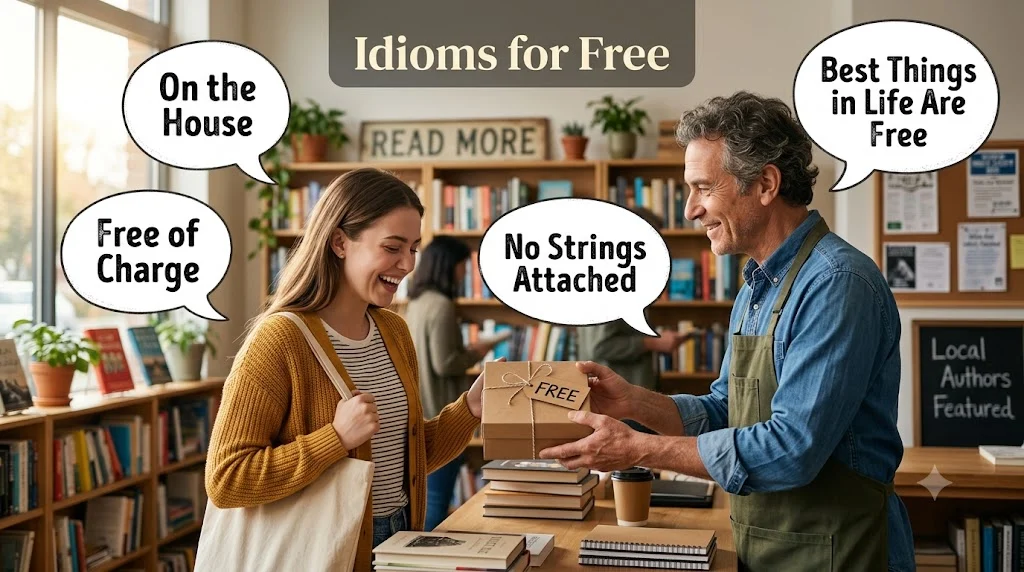
When people search for idioms for free, they usually want expressions that describe getting something without paying, receiving an extra benefit, having complete freedom, or doing something without restrictions. Popular examples include “free of charge,” “on the house,” “for nothing,” “gratis,” “throw in,” “there’s no such thing as a free lunch,” and “at no cost.” These idioms and expressions make conversations, essays, and storytelling sound more natural and expressive.
Everyone enjoys getting something for free, but English speakers rarely describe those moments with plain words alone. Instead, they rely on colorful idioms and everyday expressions that make conversations feel more natural and memorable. Whether someone is celebrating a complimentary dessert at a restaurant, describing an unexpected bonus at work, or reminding a friend that every opportunity has a hidden cost, idioms add personality to the message.
Learning idioms for free isn’t just about expanding vocabulary. It’s about understanding how native speakers communicate in everyday life, business conversations, storytelling, social media posts, and even academic writing. The right expression can instantly make your English sound more confident, fluent, and engaging.
In my experience, learners remember idioms best when they connect them to real-life situations rather than memorizing long lists. Throughout this guide, you’ll discover practical meanings, natural examples, helpful alternatives, and usage tips that make each idiom easier to understand and use correctly. By the end, you’ll have a collection of expressions that fit comfortably into everyday communication.
Quick Summary
| Topic | Details |
|---|---|
| Primary Topic | Idioms for Free |
| Best For | English learners, writers, students, bloggers |
| Number of Idioms | 25 |
| Main Themes | No cost, generosity, freedom, bonus offers, opportunities |
| Formal & Informal Mix | Yes |
| Includes Examples | Formal, Casual & Creative |
| Learning Outcome | Speak and write more naturally using English idioms |
| Reading Time | About 15–18 minutes |
🌟 Free of Charge
Meaning
Something is provided without requiring payment.
When People Use It
Used in both formal and everyday situations when a service or product costs nothing.
Alternative Expression
At no cost
Examples in Communication
Formal Example
The company repaired the device free of charge because it was still under warranty.
Casual Example
They fixed my bike free of charge.
Creative Example
The kindness arrived free of charge, yet it was worth more than money.
Usage Tip
One of the safest expressions for business emails and professional writing.
🌟 On the House
Meaning
A restaurant, café, or business gives something to customers without charging them.
When People Use It
Restaurants, hotels, cafés, and customer appreciation situations.
Alternative Expression
Complimentary
Examples
Formal
The dessert was offered on the house after the delay.
Casual
Your coffee is on the house today.
Creative
The café served smiles—and cheesecake—on the house.
Usage Tip
Mostly informal but extremely common.
🌟 For Nothing
Meaning
Received without paying.
When People Use It
Everyday conversation.
Alternative Expression
Without charge
Examples
Formal
Participants received educational materials for nothing.
Casual
I got the tickets for nothing!
Creative
Sometimes the best memories come for nothing.
🌟 At No Cost
Meaning
Entirely free.
When People Use It
Advertisements, business writing, websites.
Alternative Expression
Free of charge
Examples
Formal
Training is available at no cost.
Casual
The app is available at no cost.
Creative
A little encouragement often comes at no cost.
🌟 Throw In
Meaning
To include something extra for free.
When People Use It
Shopping and negotiations.
Alternative Expression
Include as a bonus
Examples
Formal
The retailer agreed to throw in a protective case.
Casual
They threw in free headphones.
Creative
Life sometimes throws in unexpected blessings.
🌟 Complimentary
Meaning
Given as a courtesy.
When People Use It
Hotels, airlines, events, businesses.
Alternative Expression
On the house
Examples
Formal
Guests received complimentary breakfast.
Casual
The drinks were complimentary.
Creative
Her encouragement felt like a complimentary gift to everyone’s confidence.
🌟 Gratis
Meaning
Completely free.
When People Use It
Formal writing and advertisements.
Alternative Expression
Free of charge
Examples
Formal: Admission is gratis today.
Casual: They gave it away gratis.
Creative: Some lessons arrive gratis through experience.
🌟 Open-Handed
Meaning
A person who is generous and willing to give freely without expecting anything in return.
When People Use It
Used when describing someone’s kindness, generosity, or willingness to help others. It can refer to sharing money, time, support, or opportunities.
Alternative Expression
Generous by nature
Examples in Communication
Formal Example
The organization is known for its open-handed support of local communities.
Casual Example
My uncle is very open-handed and always helps people who need it.
Creative Example
Her open-handed kindness turned ordinary moments into unforgettable memories.
Usage Tip
This expression is often used to describe a person’s character rather than a single action.
🌟 Share the Wealth
Meaning
To distribute benefits, opportunities, or resources among others.
When People Use It
Common in conversations about success, rewards, money, or opportunities.
Alternative Expression
Spread the benefits
Examples in Communication
Formal Example
Successful companies should share the wealth by investing in their employees.
Casual Example
You won all those snacks—share the wealth!
Creative Example
True success shines brighter when you share the wealth with others.
🌟 The Best Things in Life Are Free
Meaning
The most valuable things, such as love, friendship, happiness, and memories, do not require money.
When People Use It
Used when talking about emotional value instead of financial value.
Alternative Expression
Money can’t buy happiness
Examples in Communication
Formal Example
Many studies suggest that meaningful relationships prove that the best things in life are free.
Casual Example
A walk with good friends reminds me that the best things in life are free.
Creative Example
The sunset, the laughter, and the quiet moments proved that the best things in life are free.
Usage Tip
This phrase works especially well in speeches, essays, and inspirational writing.
🌟 Freedom Isn’t Free
Meaning
Important freedoms usually require effort, responsibility, or sacrifice.
When People Use It
Often used in discussions about independence, responsibility, society, and personal growth.
Alternative Expression
Great things require effort
Examples in Communication
Formal Example
History reminds us that freedom isn’t free and often requires dedication and courage.
Casual Example
Building the life you want takes work—freedom isn’t free.
Creative Example
The open road looked peaceful, but every step toward freedom carried a price.
🌟 Give Someone a Free Pass
Meaning
To allow someone to avoid responsibility, criticism, or consequences.
When People Use It
Used in social situations, workplaces, and discussions about fairness.
Alternative Expression
Let someone off the hook
Examples in Communication
Formal Example
The manager decided not to give employees a free pass for repeated mistakes.
Casual Example
I’m giving you a free pass this time, but don’t repeat it.
Creative Example
Life may offer second chances, but it rarely gives a free pass forever.
🌟 Without Paying a Dime
Meaning
To get something without spending any money.
When People Use It
Common in casual conversations.
Alternative Expression
Without spending a penny
Examples in Communication
Formal Example
Visitors can explore the museum without paying a dime during the special event.
Casual Example
I downloaded the guide without paying a dime.
Creative Example
She discovered a world of knowledge without paying a dime.
🌟 Pick Up the Tab
Meaning
To pay the bill for someone else.
When People Use It
Usually used in restaurants, meetings, and social situations.
Alternative Expression
Cover the cost
Examples in Communication
Formal Example
The company agreed to pick up the tab for the business dinner.
Casual Example
Don’t worry, I’ll pick up the tab tonight.
Creative Example
A true friend sometimes picks up the tab—not just for dinner, but for difficult moments.
🌟 Foot the Bill
Meaning
To pay for something, especially a large expense.
When People Use It
Used in business, family, and financial discussions.
Alternative Expression
Pay the expenses
Examples in Communication
Formal Example
The organization will foot the bill for employee training.
Casual Example
Who is going to foot the bill for this repair?
Creative Example
Dreams may be free, but someone often has to foot the bill for turning them into reality.
🌟 Go the Extra Mile (Related to Generosity)
Meaning
To make extra effort beyond what is expected.
When People Use It
Used when someone provides additional help or service.
Alternative Expression
Go above and beyond
Examples in Communication
Formal Example
The company went the extra mile by offering free support after purchase.
Casual Example
She always goes the extra mile to help her friends.
Creative Example
Kindness often begins when someone chooses to go the extra mile.
🌟 No Charge
Meaning
Something is provided without payment.
When People Use It
Common in customer service, advertisements, and daily conversation.
Alternative Expression
Free of charge
Examples in Communication
Formal Example
Customers receive installation services at no charge.
Casual Example
They fixed my phone at no charge.
Creative Example
The advice came at no charge, but its value was priceless.
🌟 Complimentary Gift
Meaning
Something given as a free extra or token of appreciation.
When People Use It
Hotels, businesses, events, and customer experiences.
Alternative Expression
Free bonus
Examples in Communication
Formal Example
Guests received a complimentary gift upon arrival.
Casual Example
They gave us a complimentary gift with our order.
Creative Example
A small complimentary gift became a lasting reminder of kindness.
🌟 A Little Something Extra
Meaning
An additional benefit or gift included freely.
When People Use It
Friendly conversations and customer experiences.
Alternative Expression
Added bonus
Examples in Communication
Formal Example
The package includes a little something extra for loyal customers.
Casual Example
They added a little something extra with my purchase.
Creative Example
Sometimes life surprises us with a little something extra when we least expect it.
🌟 Worth Every Penny
Meaning
Something is valuable enough to justify its cost.
When People Use It
Used when discussing quality, experiences, or investments.
Alternative Expression
Excellent value
Examples in Communication
Formal Example
The training program was worth every penny because it improved employee skills.
Casual Example
That vacation was worth every penny.
Creative Example
Some memories are worth every penny because their value lasts forever.
How to Use Idioms Naturally
The secret to sounding fluent isn’t using dozens of idioms in every conversation. Instead, choose one that fits the situation naturally. Business writing often benefits from expressions like free of charge or at no cost, while casual conversations feel more authentic with phrases such as on the house or throw in.
Reading novels, watching interviews, listening to podcasts, and noticing how native speakers use these expressions will help you recognize when each idiom sounds appropriate. Practice by writing short diary entries, social media captions, or conversations using one idiom at a time.
Remember that idioms should support your message rather than overwhelm it. A well-placed expression sounds confident; too many in one paragraph can feel forced.
Common Mistakes with Idioms
- Mixing literal and figurative meanings.
- Using formal idioms in casual conversations—or vice versa.
- Translating idioms directly from your native language.
- Changing the wording of fixed expressions.
- Using an idiom without understanding its emotional tone.
Idioms vs Literal Expressions
Literal expressions simply describe facts:
- The meal was free.
Idioms make language richer:
- The meal was on the house.
Literal language communicates information clearly, while idioms often add personality, emotion, and cultural flavor.
Tips for Sounding More Fluent
- Learn idioms in context rather than isolation.
- Watch how native speakers use them.
- Practice speaking aloud.
- Keep a notebook of favorite idioms.
- Use one or two naturally instead of forcing several into every conversation.
How to Remember Idioms Easily
Associate each idiom with a real-life memory or visual image. For example, imagine a waiter smiling while saying, “Dessert is on the house.” Visual connections make expressions much easier to remember than memorizing definitions alone.
Another helpful strategy is grouping idioms by theme. Keep expressions about generosity, freedom, money, success, or emotions together so your brain forms meaningful connections instead of isolated facts.
FAQs
What is the most common idiom for getting something free?
“On the house” is one of the most common informal idioms, especially in restaurants and cafés.
Is “free of charge” an idiom?
It’s considered a common fixed expression rather than a traditional idiom, but it functions similarly in everyday English.
Can I use these idioms in formal writing?
Yes. Expressions like “free of charge,” “at no cost,” and “complimentary” work well in professional writing.
What’s the difference between “gratis” and “free of charge”?
Both mean something costs nothing, but “gratis” sounds more formal and is less common in everyday conversation.
How can I remember English idioms faster?
Practice them in real conversations, write your own example sentences, and connect each idiom with a memorable situation or image.
Conclusion
Language becomes more memorable when it paints a picture, and that’s exactly what idioms do. Learning these idioms for free gives you more than just new vocabulary it helps you communicate with greater confidence, warmth, and precision. Whether you’re writing an essay, chatting with friends, creating blog content, or improving your spoken English, the right idiom can make your message feel more natural and engaging.
Don’t try to memorize every expression at once. Instead, choose a few that match your everyday conversations and start using them consistently. Over time, they’ll become a natural part of your vocabulary. As you encounter these idioms in books, films, podcasts, and conversations, you’ll begin to recognize the subtle ways they add color and personality to English.
The more you practice using idioms in real contexts, the more fluent and expressive your communication will become and that’s a skill that never goes out of style.
Discover More Related Articles:
- Funny Idioms | That Will Make Your English More Colorful & Entertaining In 2026
- Powerful Idioms for Friendship | That Show Trust, Loyalty & Strong Bonds In 2026