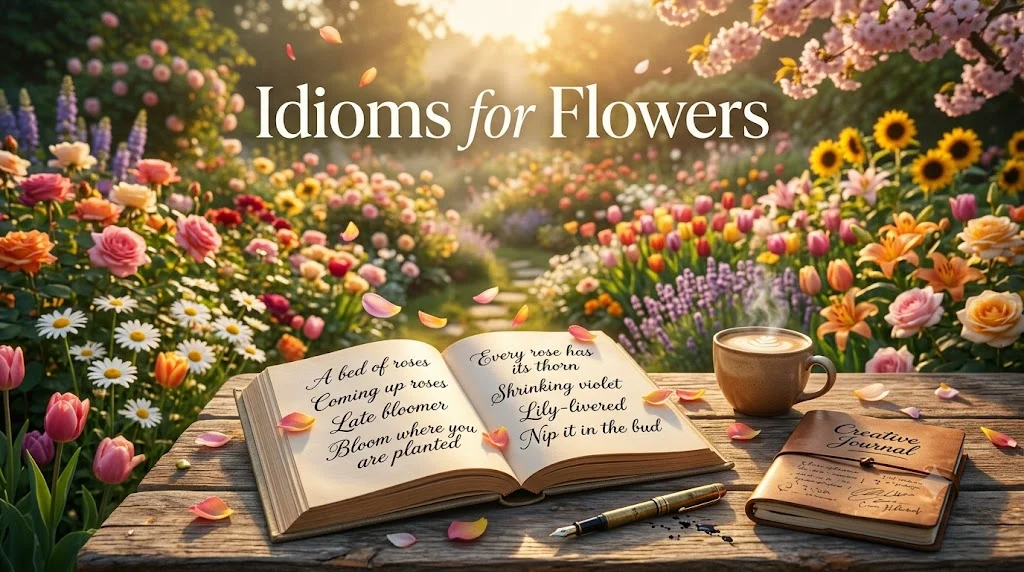
Quick Answer
Flower idioms use flowers and gardens as symbols to express emotions, personality, beauty, growth, success, love, hope, and even challenges. Expressions like come up roses, push up daisies, a late bloomer, and bed of roses help make conversations and writing more vivid, memorable, and emotionally engaging. Learning these idioms allows you to sound more natural while adding color and creativity to your English.
Flowers have inspired language for centuries. They symbolize love, hope, beauty, resilience, fresh beginnings, and even life’s temporary nature. It’s no surprise that many English idioms borrow the imagery of flowers to express ideas that ordinary words sometimes struggle to capture.
Whether you’re writing a story, preparing an essay, chatting with friends, or simply trying to sound more fluent in English, flower idioms can make your language feel richer and more expressive. Instead of saying someone became successful later in life, you can simply call them a late bloomer. Rather than saying a problem should be solved immediately, you might advise someone to nip it in the bud.
These expressions aren’t just decorative they reflect everyday communication. You’ll hear them in books, speeches, workplace conversations, movies, and social media. Once you understand the meanings behind these floral expressions, you’ll begin noticing them almost everywhere.
In this guide, you’ll discover some of the most useful idioms for flowers, learn when people naturally use them, and see practical examples that help you use each one with confidence.
Quick Summary
| Idiom | Meaning | Best Used For |
|---|---|---|
| Come up roses | End successfully | Success, positive outcomes |
| Bed of roses | Easy or comfortable life | Challenges and expectations |
| Push up daisies | To be dead | Literature, humor, storytelling |
| Late bloomer | Someone who succeeds later | Personal growth |
| Fresh as a daisy | Looking energetic | Compliments |
| Nip in the bud | Stop early | Problem solving |
| Gather rosebuds | Enjoy the present | Motivation |
| Bloom where you’re planted | Make the best of your situation | Inspiration |
| Every rose has its thorn | Good things have drawbacks | Relationships |
| In full bloom | At peak beauty or success | Nature, careers, confidence |
🌹 Come Up Roses
Meaning
To end successfully or turn out much better than expected.
When People Use It
People use this idiom when a difficult situation eventually has a happy or successful ending.
Alternative Expression
- Everything worked out.
- Turn out well.
Examples in Communication
Formal Example
Despite several obstacles, the project ultimately came up roses.
Casual Example
I thought the interview went badly, but it came up roses!
Creative Example
After months of uncertainty, her dreams finally came up roses like a garden after spring rain.
Usage Tip: This is a positive idiom that’s common in both everyday conversations and professional writing.
🌼 Bed of Roses
Meaning
A life or situation that is easy, comfortable, or free from difficulties.
When People Use It
Usually used in negative sentences to remind someone that success requires effort.
Alternative Expression
- Easy life
- Smooth sailing
Examples in Communication
Formal Example
Starting a new business is rarely a bed of roses.
Casual Example
College isn’t exactly a bed of roses.
Creative Example
Behind every beautiful garden lies hard work—it was never a bed of roses.
Usage Tip: Often appears with the phrase “not a bed of roses.”
🌸 Late Bloomer
Meaning
Someone who develops skills, confidence, or success later than others.
When People Use It
To encourage people who improve later in life or achieve success at their own pace.
Alternative Expression
- Slow starter
- Develops over time
Examples in Communication
Formal Example
She was considered a late bloomer but eventually became an outstanding researcher.
Casual Example
Don’t worry—you might just be a late bloomer.
Creative Example
Like a flower waiting for the perfect season, he proved that late bloomers often bloom the brightest.
Usage Tip: One of the most encouraging flower idioms. It creates an optimistic and supportive tone.
🌻 Fresh as a Daisy
Meaning
Feeling or looking energetic, healthy, and refreshed.
When People Use It
After a good night’s sleep, vacation, or relaxing break.
Alternative Expression
- Full of energy
- Well-rested
Examples in Communication
Formal Example
She arrived at the meeting looking fresh as a daisy.
Casual Example
I slept ten hours—I feel fresh as a daisy!
Creative Example
The morning breeze greeted him as he stepped outside, fresh as a daisy and ready for adventure.
Usage Tip: This idiom works naturally in compliments and everyday conversation.
🌷 Nip It in the Bud
Meaning
To stop a problem before it becomes bigger.
When People Use It
Common in workplaces, parenting, schools, and leadership situations.
Alternative Expression
- Stop it early
- Prevent it from growing
Examples in Communication
Formal Example
Management decided to nip the issue in the bud before it affected the entire team.
Casual Example
Let’s nip this argument in the bud.
Creative Example
Like removing a damaged bud before it spreads through the garden, she solved the misunderstanding immediately.
Usage Tip: One of the most frequently used flower idioms in professional communication.
🌺 Gather Rosebuds While You May
Meaning
Enjoy opportunities while they last because time moves quickly.
When People Use It
To encourage people to appreciate the present and seize opportunities.
Alternative Expression
- Seize the day
- Make the most of today
Examples in Communication
Formal Example
The speaker encouraged graduates to gather rosebuds while they may by embracing every opportunity.
Casual Example
We’re only young once—let’s gather rosebuds while we may.
Creative Example
She danced beneath the sunset, determined to gather every rosebud life offered.
Usage Tip: This classic literary idiom creates a thoughtful and inspirational tone.
🌹 Every Rose Has Its Thorn
Meaning
Every good thing has some disadvantages or imperfections.
When People Use It
To remind someone that nothing is completely perfect.
Alternative Expression
- Nothing is perfect.
- Every advantage has a downside.
Examples in Communication
Formal Example
While remote work offers flexibility, every rose has its thorn.
Casual Example
The new phone is awesome, but every rose has its thorn.
Creative Example
Even the most beautiful garden hides a few sharp surprises—every rose has its thorn.
Usage Tip: Excellent for balanced discussions, reviews, and personal advice.
🌼 Bloom Where You’re Planted
Meaning
Make the best of your current situation instead of waiting for perfect circumstances.
When People Use It
Popular in motivational writing, education, career advice, and personal development.
Alternative Expression
- Make the best of it.
- Thrive where you are.
Examples in Communication
Formal Example
Employees are encouraged to bloom where they’re planted while developing new skills.
Casual Example
Maybe this town isn’t perfect, but I’m learning to bloom where I’m planted.
Creative Example
She transformed an ordinary corner into a beautiful garden because she believed in blooming where she was planted.
Usage Tip: This expression is especially popular in inspirational blogs, speeches, and self-improvement content.
🌺 In Full Bloom
Meaning
At the peak of beauty, health, confidence, or success.
When People Use It
People use this idiom to describe someone or something that has reached its best stage, whether it’s a person, career, relationship, or garden.
Alternative Expression
- At your best
- In your prime
Examples in Communication
Formal Example
The company’s creativity was in full bloom after the new leadership team arrived.
Casual Example
Your confidence is really in full bloom these days.
Creative Example
The village came alive in spring, with every tree and every dream in full bloom.
Usage Tip: This idiom creates a positive, uplifting tone and works beautifully in descriptive writing.
🌹 Bloom of Youth
Meaning
The period when someone is young, energetic, and full of potential.
When People Use It
Often used in literature, speeches, or reflective conversations about growing up.
Alternative Expression
- Prime of youth
- Young and vibrant
Examples in Communication
Formal Example
Many great artists discovered their passion during the bloom of youth.
Casual Example
Enjoy the bloom of your youth while you can.
Creative Example
She chased every sunrise during the bloom of her youth, believing every day held a new adventure.
Usage Tip: This phrase has a slightly literary feel, making it ideal for essays and storytelling.
🌼 Push Up Daisies
Meaning
A humorous or indirect way to say someone has died.
When People Use It
Mostly found in novels, movies, mystery stories, or dark humor. It is not appropriate for serious conversations about loss.
Alternative Expression
- Pass away
- Gone to rest
Examples in Communication
Formal Example
The detective believed the missing treasure had been buried long before its owner was pushing up daisies.
Casual Example
If I keep forgetting my umbrella, I’ll be pushing up daisies before summer ends! (jokingly)
Creative Example
Legends say the old pirate was pushing up daisies long before anyone found his hidden map.
Usage Tip: Use this idiom carefully. It is informal and can sound insensitive in real-life discussions about grief.
🌷 A Rose by Any Other Name
Meaning
The name of something doesn’t change its true nature or value.
When People Use It
When discussing branding, identity, reputation, or labels.
Alternative Expression
- It’s still the same thing.
- Names don’t change reality.
Examples in Communication
Formal Example
A rose by any other name would still provide the same quality of service.
Casual Example
Call it brunch or lunch—a rose by any other name!
Creative Example
She smiled, knowing kindness remained kindness—a rose by any other name.
Usage Tip: Originating from Shakespeare, this idiom adds elegance to discussions about identity and perception.
🌻 Stop and Smell the Roses
Meaning
Slow down and appreciate life’s simple pleasures.
When People Use It
Common in conversations about work-life balance, mindfulness, and happiness.
Alternative Expression
- Slow down
- Enjoy the moment
Examples in Communication
Formal Example
Employees were encouraged to stop and smell the roses to avoid burnout.
Casual Example
You’ve been working nonstop—go stop and smell the roses.
Creative Example
She paused beneath the blooming trees, remembering that life becomes richer when you stop and smell the roses.
Usage Tip: This is one of the most popular inspirational flower idioms in everyday English.
🌸 A Thorn in Someone’s Side
Meaning
A person or problem that constantly causes annoyance or difficulty.
When People Use It
In workplaces, friendships, politics, or family situations.
Alternative Expression
- Constant irritation
- Ongoing problem
Examples in Communication
Formal Example
The unresolved technical issue became a thorn in the company’s side.
Casual Example
My old laptop has become a thorn in my side.
Creative Example
Like a hidden thorn beneath beautiful petals, the tiny mistake kept causing trouble.
Usage Tip: Although it mentions a thorn rather than a flower, the imagery comes from roses and fits naturally among flower-related idioms.
🌹 Rose-Colored Glasses
Meaning
Seeing everything too positively while ignoring problems.
When People Use It
When someone is overly optimistic or unrealistic.
Alternative Expression
- Unrealistically optimistic
- Looking on the bright side too much
Examples in Communication
Formal Example
Investors should avoid viewing the market through rose-colored glasses.
Casual Example
You’re wearing rose-colored glasses if you think this project has no risks.
Creative Example
She admired the world through rose-colored glasses until experience taught her to notice the shadows too.
Usage Tip: This idiom is especially useful in discussions about decision-making and expectations.
🌺 A Blooming Success
Meaning
Something that becomes extremely successful or develops remarkably well.
When People Use It
To describe successful projects, businesses, events, or personal achievements.
Alternative Expression
- Huge success
- Flourishing achievement
Examples in Communication
Formal Example
The charity event was a blooming success, exceeding every fundraising goal.
Casual Example
Your new café is a blooming success!
Creative Example
From a tiny seed of hope grew a blooming success that inspired the whole community.
Usage Tip: This expression is more conversational than traditional but fits naturally in modern English.
🌼 Like a Wildflower
Meaning
Someone who grows freely, independently, and naturally despite difficult circumstances.
When People Use It
Often used in motivational writing and personal reflections.
Alternative Expression
- Free spirit
- Naturally resilient
Examples in Communication
Formal Example
She adapted to every challenge like a wildflower thriving in unexpected places.
Casual Example
My sister has always been like a wildflower.
Creative Example
She bloomed like a wildflower, untouched by doubt and strengthened by every storm.
Usage Tip: This expression creates vivid imagery and works beautifully in creative writing.
🌷 Flower of the Family
Meaning
The person considered the pride or finest member of a family or group.
When People Use It
To praise someone’s achievements, kindness, or character.
Alternative Expression
- Pride of the family
- Family’s brightest star
Examples in Communication
Formal Example
She became the flower of the family through her dedication to education.
Casual Example
Everyone says Grandma is the flower of our family.
Creative Example
Among many beautiful blossoms, she remained the flower of the family, admired for her generous heart.
Usage Tip: This expression has a poetic quality and is more common in literary or heartfelt contexts.
🌼 How to Use Flower Idioms Naturally
Learning the meanings of flower idioms is only the first step. The real skill comes from using them naturally in conversation, writing, and storytelling. Rather than forcing an idiom into every sentence, think of it as a finishing touch that adds personality and imagery to your words.
Here are a few practical ways to make flower idioms part of your everyday English.
Use Them Where They Fit the Emotion
Flower idioms often carry emotional meaning. Match the expression to the situation instead of using it randomly.
For example:
- If someone’s career improves after years of effort, late bloomer feels natural.
- When a small disagreement starts growing, nip it in the bud is the perfect choice.
- If someone needs a reminder to enjoy life, stop and smell the roses communicates that idea beautifully.
Mix Idioms with Plain Language
Good communicators don’t fill every sentence with idioms. Instead, they balance figurative language with clear, direct wording.
Natural:
After months of hard work, everything finally came up roses.
Less Natural:
Everything came up roses because I stopped to smell the roses while blooming where I was planted.
Too many idioms together can sound confusing or unnatural.
Think About Your Audience
Some flower idioms work almost everywhere.
Examples include:
- Late bloomer
- Fresh as a daisy
- Stop and smell the roses
- Nip it in the bud
Others, such as push up daisies, are more informal and are better suited to fiction or humorous conversations.
Use Idioms to Strengthen Writing
Flower idioms can make:
- Essays more engaging
- Blog posts more relatable
- Stories more vivid
- Speeches more memorable
- Social media captions more expressive
Used thoughtfully, they add color without making your writing feel exaggerated.
🌷 Common Mistakes When Using Flower Idioms
Even advanced English learners occasionally misuse idioms. Avoid these common errors.
Using an Idiom Literally
Remember that idioms are figurative.
For example:
Incorrect
The meeting room had roses, so it came up roses.
Correct
Although the project faced delays, it eventually came up roses.
Using the Wrong Situation
Not every flower idiom fits every context.
For example:
Late bloomer describes gradual personal development—not a flower opening late in the day.
Understanding the intended meaning helps you sound much more natural.
Overusing Idioms
A few well-placed idioms make writing memorable.
Too many can distract readers and reduce clarity.
Aim for balance.
Ignoring Tone
Some idioms sound friendly and encouraging.
Others, like push up daisies, can feel insensitive in serious conversations.
Always consider the emotional context before using an idiom.
🌹 Idioms vs. Literal Flower Expressions
One of the easiest ways to improve your English is learning the difference between figurative and literal language.
| Flower Idiom | Figurative Meaning | Literal Meaning |
|---|---|---|
| Come up roses | End successfully | Roses growing |
| Fresh as a daisy | Full of energy | A fresh flower |
| Bed of roses | Easy life | A bed covered with roses |
| Stop and smell the roses | Enjoy life | Smell actual roses |
| Nip it in the bud | Stop early | Remove a flower bud |
When you recognize the figurative meaning, you’ll understand books, movies, podcasts, and conversations much more easily.
🌸 Tips to Remember Flower Idioms Easily
Memorizing idioms becomes much easier when you connect them with images and real-life experiences.
Picture the Scene
Visualize someone stopping to smell beautiful roses in a peaceful garden.
You’ll naturally remember that it means slow down and enjoy life.
Learn Through Stories
Instead of memorizing definitions, create short stories using each idiom.
Stories help your brain remember meaning far better than isolated vocabulary lists.
Practice Speaking
Challenge yourself to use one new flower idiom every day.
For example:
- during class discussions
- while chatting with friends
- in journal writing
- on social media
- in emails
Small daily practice leads to lasting confidence.
Group Similar Idioms Together
Organizing idioms by theme helps reinforce meaning.
Success
- Come up roses
- In full bloom
- A blooming success
Growth
- Late bloomer
- Bloom where you’re planted
Life Lessons
- Stop and smell the roses
- Gather rosebuds while you may
Read Authentic English
You’ll notice flower idioms naturally in:
- Novels
- Newspapers
- Podcasts
- TED Talks
- TV shows
- Blogs
- Speeches
Seeing idioms in context is one of the fastest ways to make them part of your vocabulary.
🌻 FAQs
What are flower idioms?
Flower idioms are figurative expressions that use flowers, blossoms, or gardens to represent ideas such as beauty, growth, success, love, hope, or life’s challenges.
Which flower idiom is used most often?
Some of the most commonly used flower idioms include stop and smell the roses, late bloomer, nip it in the bud, fresh as a daisy, and come up roses.
Are flower idioms suitable for formal writing?
Yes. Many flower idioms work well in essays, presentations, speeches, and articles when they fit the context naturally. However, avoid using too many in a single piece of formal writing.
How can I remember flower idioms more easily?
The best approach is to learn each idiom with a real-life example, visualize its meaning, and use it in everyday conversations or writing. Regular practice makes the expressions feel natural.
Why should English learners study flower idioms?
Flower idioms help learners understand native speakers, improve reading comprehension, enrich vocabulary, and make both speaking and writing sound more fluent, expressive, and engaging.
🌺 Conclusion
Flowers have long symbolized beauty, hope, resilience, and new beginnings, so it’s no surprise that they also bloom throughout the English language. By learning these idioms for flowers, you’re doing more than expanding your vocabulary you’re gaining expressive tools that make conversations, stories, essays, and everyday communication feel more natural and memorable.
The best way to master these expressions is through regular practice. Try using one or two flower idioms in a conversation, journal entry, or social media post each week. Over time, they’ll become a natural part of your English, helping you communicate with greater confidence and creativity.
Whether you’re a student preparing assignments, a writer looking for vivid language, a blogger crafting engaging content, or simply someone who enjoys learning English, flower idioms can add warmth, personality, and color to your words. Keep exploring new expressions, pay attention to how native speakers use them, and let your language skills bloom one beautiful idiom at a time. 🌸
Discover More Related Articles:
- Funny Idioms | That Will Make Your English More Colorful & Entertaining In 2026
- Powerful Idioms for Friendship | That Show Trust, Loyalty & Strong Bonds In 2026