Quick Answer
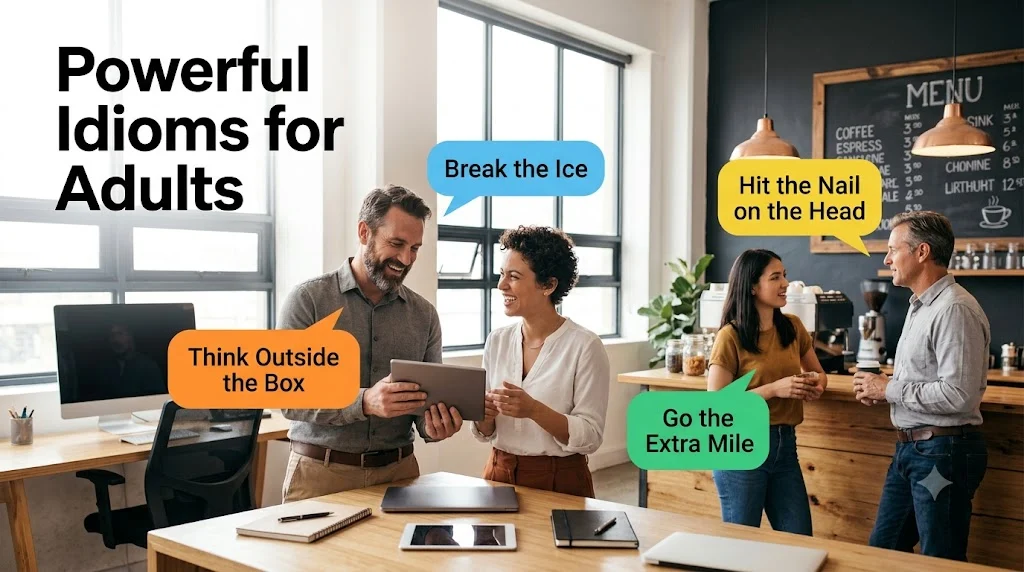
Powerful idioms for adults are expressive phrases that help communicate ideas, emotions, and experiences in a memorable way. They make conversations more engaging, improve professional communication, enrich writing, and help speakers sound more fluent. Popular examples include break the ice, think outside the box, bite the bullet, go the extra mile, and hit the nail on the head.
Think about the last conversation that truly caught your attention. Chances are, it wasn’t filled with complicated vocabulary—it was filled with expressions that painted vivid pictures. That’s exactly what idioms do.
As adults, we communicate in countless situations every day. Whether you’re leading a meeting, writing an email, preparing a presentation, chatting with friends, or telling a story, the right idiom can make your words more memorable and emotionally engaging.
Powerful idioms are more than colorful phrases. They reflect experience, confidence, and cultural understanding. They help simplify complex emotions, describe difficult situations, and express opinions with style.
Learning these expressions also improves reading comprehension because idioms frequently appear in books, news articles, movies, podcasts, and everyday conversations. Once you understand how they’re used naturally, you’ll begin recognizing them everywhere.
In this guide, you’ll discover some of the most useful powerful idioms for adults, understand what they really mean, learn when to use them, and see realistic examples that fit both professional and personal conversations.
Quick Summary
| Topic | Details |
|---|---|
| Primary Topic | Powerful Idioms for Adults |
| Best For | Students, professionals, writers, bloggers, and English learners |
| Number of Idioms | 25 |
| Skill Level | Beginner to Advanced |
| Main Benefit | Improve speaking, writing, and everyday communication |
| Common Usage | Workplace, conversations, storytelling, presentations, essays |
| Formality | Mix of formal and informal idioms |
| Reading Time | About 15–18 minutes |
Break the Ice
Meaning
To start a conversation in a way that makes people feel more comfortable.
When People Use It
This idiom is common during first meetings, networking events, classrooms, interviews, or social gatherings where people may feel nervous.
Alternative Expression
Get the conversation started
Examples in Communication
Formal Example
“The team-building activity helped break the ice before our project discussion.”
Casual Example
“I told a funny story just to break the ice.”
Creative Example
“One smile broke the ice faster than a hundred rehearsed introductions.”
Usage Tip
Suitable for both professional and informal situations.
Hit the Nail on the Head
Meaning
To describe something exactly right.
When People Use It
When someone’s explanation, opinion, or observation is perfectly accurate.
Alternative Expression
Be exactly right
Examples in Communication
Formal Example
“Your analysis hit the nail on the head regarding customer expectations.”
Casual Example
“You totally hit the nail on the head!”
Creative Example
“Her single sentence hit the nail on the head and ended the debate.”
Usage Tip
Excellent for meetings, essays, discussions, and presentations.
Think Outside the Box
Meaning
To find creative or unusual solutions.
When People Use It
Common in workplaces, business discussions, education, and brainstorming sessions.
Alternative Expression
Be creative
Examples in Communication
Formal Example
“Our company encourages employees to think outside the box.”
Casual Example
“We need a different plan. Let’s think outside the box.”
Creative Example
“The greatest ideas often begin when someone refuses to stay inside the box.”
Usage Tip
Frequently used in leadership and innovation contexts.
Bite the Bullet
Meaning
To do something difficult or unpleasant because it must be done.
When People Use It
When facing unavoidable responsibilities or challenging decisions.
Alternative Expression
Face the challenge
Examples in Communication
Formal Example
“The organization decided to bite the bullet and invest in new technology.”
Casual Example
“I finally bit the bullet and cleaned my entire garage.”
Creative Example
“Sometimes courage begins with simply biting the bullet.”
Usage Tip
Adds emotional strength when discussing determination.
Go the Extra Mile
Meaning
To put in more effort than expected.
When People Use It
Workplaces, customer service, education, teamwork, and personal relationships.
Alternative Expression
Give your best
Examples in Communication
Formal Example
“Our support team always goes the extra mile for clients.”
Casual Example
“She always goes the extra mile to help her friends.”
Creative Example
“Success often belongs to those willing to walk the extra mile.”
Usage Tip
Creates a positive and professional tone.
Burn the Midnight Oil
Meaning
To work or study late into the night.
When People Use It
During deadlines, exams, projects, or important work.
Alternative Expression
Stay up working
Examples in Communication
Formal Example
“The researchers burned the midnight oil to finish the report.”
Casual Example
“I’ve been burning the midnight oil all week.”
Creative Example
“The quiet night witnessed dreams built under the glow of a desk lamp.”
Usage Tip
Ideal for academic and professional writing.
Keep Your Chin Up
Meaning
Stay positive despite difficulties.
When People Use It
When encouraging someone during stressful or emotional situations.
Alternative Expression
Stay strong
Examples in Communication
Formal Example
“I encouraged the team to keep their chins up despite the setbacks.”
Casual Example
“Keep your chin up. Things will get better.”
Creative Example
“Even during storms, she kept her chin up and kept moving forward.”
Usage Tip
Creates a warm, supportive emotional tone.
On the Same Page
Meaning
To understand and agree with one another.
When People Use It
Meetings, teamwork, family planning, and collaborative projects.
Alternative Expression
Agree completely
Examples in Communication
Formal Example
“Before launching the campaign, we made sure everyone was on the same page.”
Casual Example
“I think we’re finally on the same page.”
Creative Example
“Great teamwork begins when everyone reads from the same page.”
Usage Tip
One of the most commonly used workplace idioms.
Pull Your Weight
Meaning
To do your fair share of work or responsibility.
When People Use It
Group projects, workplaces, sports teams, or family responsibilities.
Alternative Expression
Do your part
Examples in Communication
Formal Example
“Every department must pull its weight to achieve our annual goals.”
Casual Example
“Come on, everyone needs to pull their weight.”
Creative Example
“A strong team grows when every member carries their share.”
Usage Tip
Useful when discussing teamwork, accountability, and collaboration.
A Blessing in Disguise
Meaning
Something that seems unfortunate at first but eventually leads to a positive outcome.
When People Use It
Adults often use this idiom after overcoming setbacks such as losing a job, ending a relationship, or facing an unexpected life change that later proves beneficial.
Alternative Expression
A hidden advantage
Examples in Communication
Formal Example
“The delayed project turned out to be a blessing in disguise because it gave us time to improve the design.”
Casual Example
“Missing that flight was a blessing in disguise.”
Creative Example
“Sometimes life’s closed doors quietly lead us toward better ones.”
Usage Tip
This idiom creates an optimistic tone and works well in motivational writing and personal stories.
Raise the Bar
Meaning
To set higher standards or expectations.
When People Use It
Common in workplaces, education, sports, and personal development conversations.
Alternative Expression
Set a higher standard
Examples in Communication
Formal Example
“The new policy has raised the bar for customer service.”
Casual Example
“You’ve really raised the bar with this project.”
Creative Example
“Every achievement raises the bar for the dreams that follow.”
Usage Tip
A professional expression that inspires improvement and excellence.
Cut to the Chase
Meaning
To get directly to the main point without unnecessary details.
When People Use It
During meetings, presentations, interviews, or everyday conversations when time is limited.
Alternative Expression
Get to the point
Examples in Communication
Formal Example
“Let’s cut to the chase and discuss the final proposal.”
Casual Example
“Just cut to the chase—what happened?”
Creative Example
“The shortest path to understanding is often cutting to the chase.”
Usage Tip
This idiom is slightly informal but widely accepted in business conversations.
Actions Speak Louder Than Words
Meaning
What people do is more important than what they say.
When People Use It
When discussing trust, leadership, promises, or personal integrity.
Alternative Expression
Practice what you preach
Examples in Communication
Formal Example
“Effective leaders understand that actions speak louder than words.”
Casual Example
“Don’t tell me you’ll help—show me. Actions speak louder than words.”
Creative Example
“Promises fade, but meaningful actions leave lasting memories.”
Usage Tip
An excellent idiom for essays, speeches, and motivational writing.
The Ball Is in Your Court
Meaning
It is now your turn to make a decision or take action.
When People Use It
Negotiations, teamwork, career decisions, and personal discussions.
Alternative Expression
It’s your move
Examples in Communication
Formal Example
“We’ve submitted our proposal. The ball is now in your court.”
Casual Example
“I’ve done everything I can. The ball’s in your court now.”
Creative Example
“Opportunity knocked, placed the ball in her court, and waited.”
Usage Tip
Very common in professional emails and business communication.
Learn the Ropes
Meaning
To understand how something works through experience.
When People Use It
Starting a new job, learning a skill, joining a team, or adapting to a new environment.
Alternative Expression
Learn the basics
Examples in Communication
Formal Example
“It took several weeks for the new employee to learn the ropes.”
Casual Example
“I’m still learning the ropes around here.”
Creative Example
“Every expert once spent time learning the ropes.”
Usage Tip
Perfect for workplace communication and career advice.
Keep Your Eyes on the Prize
Meaning
Stay focused on your goal despite distractions.
When People Use It
Career growth, education, fitness, entrepreneurship, or long-term personal goals.
Alternative Expression
Stay focused
Examples in Communication
Formal Example
“Our team kept its eyes on the prize throughout the challenging project.”
Casual Example
“Ignore the distractions and keep your eyes on the prize.”
Creative Example
“The finish line belongs to those who never stop looking toward it.”
Usage Tip
A motivating idiom that encourages perseverance.
Call It a Day
Meaning
To stop working because the task is finished or you’ve done enough for the day.
When People Use It
After work, studying, household tasks, or long meetings.
Alternative Expression
Finish for today
Examples in Communication
Formal Example
“After completing the report, we decided to call it a day.”
Casual Example
“I’m exhausted. Let’s call it a day.”
Creative Example
“Knowing when to stop is part of working wisely.”
Usage Tip
A friendly and commonly used expression in everyday English.
Get the Ball Rolling
Meaning
To start something or begin a process.
When People Use It
Launching projects, organizing events, or beginning discussions.
Alternative Expression
Get started
Examples in Communication
Formal Example
“Let’s get the ball rolling on the marketing campaign.”
Casual Example
“Who’s going to get the ball rolling?”
Creative Example
“Every great success begins when someone gets the ball rolling.”
Usage Tip
Ideal for teamwork, planning, and leadership conversations.
Read Between the Lines
Meaning
To understand the hidden or implied meaning rather than only the literal words.
When People Use It
Professional communication, literature, negotiations, relationships, and everyday conversations.
Alternative Expression
Understand the hidden message
Examples in Communication
Formal Example
“If you read between the lines, you’ll notice the client has concerns.”
Casual Example
“I could read between the lines and knew she wasn’t happy.”
Creative Example
“The most meaningful conversations are often written between the lines.”
Usage Tip
Useful in analytical writing, critical thinking, and communication skills.
Keep the Ball Rolling
Meaning
To continue making progress without stopping.
When People Use It
Long-term projects, teamwork, business growth, or maintaining motivation.
Alternative Expression
Maintain the momentum
Examples in Communication
Formal Example
“Let’s keep the ball rolling until the project is complete.”
Casual Example
“We’ve made a great start—let’s keep the ball rolling.”
Creative Example
“Momentum grows when determination refuses to slow down.”
Usage Tip
This idiom creates an energetic and positive tone, making it suitable for workplace discussions and motivational writing.
Every Cloud Has a Silver Lining
Meaning
Every difficult situation has something positive hidden within it.
When People Use It
People use this idiom to encourage optimism during challenging times such as career setbacks, personal struggles, or unexpected life changes.
Alternative Expression
Look on the bright side
Examples in Communication
Formal Example
“Although the project was delayed, every cloud has a silver lining because we improved the final product.”
Casual Example
“I didn’t get the job, but every cloud has a silver lining.”
Creative Example
“Even the darkest skies sometimes hide the brightest sunrise.”
Usage Tip
This idiom is encouraging and works well in speeches, blogs, and supportive conversations.
A Piece of the Puzzle
Meaning
An important part that helps complete the whole picture.
When People Use It
During problem-solving, investigations, planning, or discussions that involve gathering information.
Alternative Expression
An important clue
Examples in Communication
Formal Example
“The customer feedback was a valuable piece of the puzzle.”
Casual Example
“I finally found another piece of the puzzle.”
Creative Example
“Success is built one small piece of the puzzle at a time.”
Usage Tip
A useful idiom in business, education, and storytelling.
Keep Your Feet on the Ground
Meaning
To stay practical, humble, and realistic.
When People Use It
When advising someone not to become overconfident after success.
Alternative Expression
Stay humble
Examples in Communication
Formal Example
“Despite his promotion, he kept his feet firmly on the ground.”
Casual Example
“Don’t let the praise change you. Keep your feet on the ground.”
Creative Example
“The tallest trees remain rooted to the earth.”
Usage Tip
Creates a respectful and mature tone.
Put Your Best Foot Forward
Meaning
To make the best possible impression.
When People Use It
Job interviews, presentations, networking events, first meetings, and important opportunities.
Alternative Expression
Do your best
Examples in Communication
Formal Example
“Candidates should put their best foot forward during interviews.”
Casual Example
“I really want to put my best foot forward today.”
Creative Example
“Every new beginning deserves your strongest first step.”
Usage Tip
Perfect for career advice, education, and self-improvement content.
Weather the Storm
Meaning
To survive or overcome a difficult period.
When People Use It
Business challenges, family issues, financial struggles, or emotional hardships.
Alternative Expression
Get through difficult times
Examples in Communication
Formal Example
“Our company weathered the storm through careful planning.”
Casual Example
“We’ll weather the storm together.”
Creative Example
“The strongest ships aren’t built for calm seas.”
Usage Tip
Adds emotional depth when discussing resilience.
In the Driver’s Seat
Meaning
To be in control of a situation or decision.
When People Use It
Leadership, business, personal goals, and decision-making.
Alternative Expression
Be in control
Examples in Communication
Formal Example
“After the promotion, she was finally in the driver’s seat.”
Casual Example
“You’re in the driver’s seat now.”
Creative Example
“Confidence grows when you take hold of the steering wheel.”
Usage Tip
Suitable for leadership, motivation, and workplace communication.
Practical Ways to Use Idioms Naturally
Learning idioms is only the beginning. The real skill comes from using them naturally instead of forcing them into every conversation. Native speakers usually choose idioms when they fit the situation, not simply because they know them.
Here are a few practical habits that can help:
- Use one or two idioms in a conversation instead of several at once.
- Match the idiom to the situation and emotional tone.
- Listen to podcasts, interviews, and movies to hear how native speakers naturally use idioms.
- Practice by writing short journal entries or social media captions using one new idiom each day.
- Read blogs, novels, and newspapers to see idioms in authentic contexts.
With regular practice, these expressions will become a natural part of your vocabulary rather than phrases you have to memorize.
Common Mistakes When Using Idioms
Even advanced English learners sometimes misuse idioms. Avoid these common mistakes:
- Using an idiom literally instead of figuratively.
- Mixing two different idioms together.
- Changing important words within an idiom.
- Using highly informal idioms in formal business writing.
- Overusing idioms, which can make writing sound unnatural.
When you’re unsure, choose a familiar idiom that fits the context instead of trying to sound overly sophisticated.
Idioms vs. Literal Expressions
Literal expressions mean exactly what the words say.
For example:
- “She opened the door.”
This sentence describes a real action.
Idioms, however, have figurative meanings.
For example:
- “She opened the door to new opportunities.”
Here, no physical door is involved. The phrase symbolizes creating new possibilities.
Understanding this difference makes reading, writing, and conversation much easier.
Tips for Sounding More Fluent
Fluent speakers don’t use difficult words all the time—they choose natural expressions.
To improve your fluency:
- Learn idioms in groups based on themes like work, success, friendship, and life.
- Practice speaking aloud.
- Notice how native speakers use tone and timing.
- Use idioms in emails, essays, presentations, and conversations.
- Review your favorite expressions regularly.
Confidence grows through consistent use rather than memorizing long lists.
How to Remember Idioms Easily
Idioms are easier to remember when connected to stories or experiences.
Try these methods:
- Create a sentence using the idiom.
- Imagine a visual scene representing its figurative meaning.
- Group similar idioms together.
- Keep an idiom notebook.
- Review a few expressions every week.
- Use flashcards or language-learning apps.
- Practice with a friend or language partner.
The more often you use an idiom, the more naturally it becomes part of your everyday English.
FAQs
What are powerful idioms for adults?
Powerful idioms for adults are commonly used figurative expressions that make communication more expressive, engaging, and memorable. They are especially useful in workplaces, social conversations, presentations, and writing.
Can idioms be used in professional communication?
Yes. Many idioms, such as on the same page, go the extra mile, and hit the nail on the head, are widely accepted in professional settings. However, it’s best to avoid overly informal idioms in formal documents.
How can I learn idioms faster?
Practice using one or two idioms each day in conversations, journal entries, or emails. Reading books, watching English movies, and listening to podcasts also help reinforce their natural usage.
Are idioms suitable for academic writing?
Some idioms can enhance essays or creative writing, but formal academic papers generally require more literal language. Always consider your audience and purpose before using idiomatic expressions.
Why do native English speakers use idioms so often?
Idioms make conversations more colorful, relatable, and efficient. They often express complex ideas or emotions in just a few words, making communication feel more natural and engaging.
Conclusion
Mastering powerful idioms for adults is about much more than expanding your vocabulary. These expressions help you communicate with confidence, add personality to your writing, and connect with people in a more natural and meaningful way. Whether you’re preparing for a job interview, writing an article, giving a presentation, or simply chatting with friends, the right idiom can make your message clearer and more memorable.
Rather than trying to memorize dozens of phrases at once, focus on learning a few that match your daily conversations. Use them in real situations, notice how others use them, and gradually make them part of your own communication style. Over time, you’ll find that idioms not only improve your English fluency but also make your speaking and writing more engaging, expressive, and enjoyable. Keep practicing, stay curious, and let these timeless expressions bring new energy to the way you communicate.
Discover More Related Articles:
- Powerful Idioms About Bad | That Will Make You Sound Fluent In 2026
- Powerful Ocean Idioms | That Add Color to Your Conversations In 2026