Quick Answer
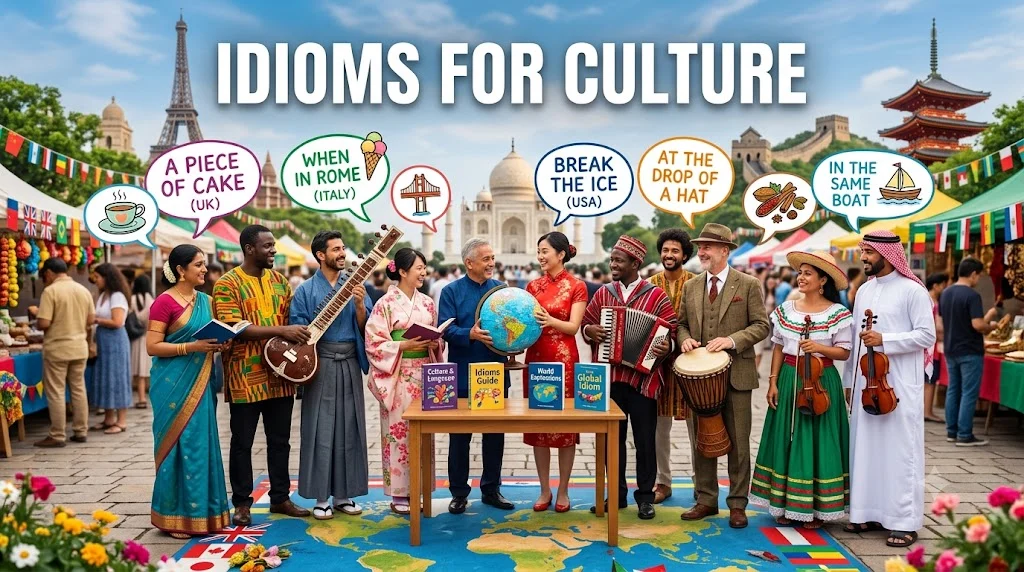
Culture shapes how people think, communicate, celebrate, and connect with others. While there are very few idioms that literally contain the word culture, many English idioms beautifully express ideas related to traditions, customs, heritage, diversity, social values, and community.
Learning these idioms helps you sound more natural in conversations, write with greater creativity, and better understand how English speakers describe cultural experiences and human connections.
Culture is much more than food, clothing, festivals, or language it reflects the stories, traditions, beliefs, and values that shape how people live and connect with one another. Whether you’re writing an essay, sharing a travel experience, speaking in class, or having a conversation with friends, using idioms can make your English sound more vivid, expressive, and natural.
Many learners search for idioms for culture because they want to describe traditions, family values, diversity, heritage, or social customs without sounding repetitive. Idioms offer exactly that. They add personality to your language while helping you communicate ideas in a memorable way.
In everyday English, these expressions often appear in conversations, books, speeches, workplaces, and even news articles. Knowing when and how to use them gives you confidence and helps your writing feel more engaging.
In this guide, you’ll discover carefully selected culture-related idioms, practical meanings, realistic examples, and helpful tips so you can use them naturally in both spoken and written English.
Quick Summary
| Topic | Details |
|---|---|
| Primary Keyword | Idioms for Culture |
| Best For | Students, writers, bloggers, language learners, ESL learners |
| Number of Idioms | 22 Practical Culture-Related Idioms |
| Difficulty Level | Beginner to Advanced |
| Common Uses | Conversations, essays, storytelling, presentations, blogs |
| Formality | Mix of formal and informal expressions |
| Main Themes | Heritage, traditions, diversity, identity, community, values |
| Learning Tip | Practice using one idiom each day in real conversations or writing |
🌍 Melting Pot
Meaning
A place where people from many different cultures, backgrounds, or traditions live together and influence one another.
When People Use It
People commonly use this idiom when talking about multicultural cities, countries, schools, or workplaces.
Alternative Expression
Cultural mosaic
Examples in Communication
Formal Example
The city has become a melting pot of languages, traditions, and artistic influences.
Casual Example
Our neighborhood is a real melting pot you can try food from all over the world.
Creative Example
Every street corner felt like a melting pot where countless stories met and grew together.
Usage Tip: This idiom is widely accepted in both formal writing and everyday conversation.
🎭 A Taste of Something
Meaning
To experience a small part of a culture, tradition, or lifestyle.
When People Use It
Use this expression when describing travel, festivals, cultural events, or trying new traditions.
Alternative Expression
Get a glimpse of
Examples in Communication
Formal Example
The exhibition gave visitors a taste of Japanese culture.
Casual Example
The festival gave me a taste of Mexican traditions.
Creative Example
One evening at the village celebration offered a taste of centuries of history.
Usage Tip: Excellent for travel blogs, essays, and cultural reviews.
🌎 Walk in Someone’s Shoes
Meaning
To understand another person’s experiences, feelings, or cultural background.
When People Use It
This idiom is useful when discussing empathy, diversity, and understanding different perspectives.
Alternative Expression
See things from another perspective
Examples in Communication
Formal Example
We should walk in others’ shoes before making judgments about their customs.
Casual Example
Try walking in her shoes before criticizing her traditions.
Creative Example
Traveling taught me to walk in someone else’s shoes long before I learned their language.
Usage Tip: Creates a respectful and thoughtful tone in discussions about cultural differences.
🌏 Break the Ice
Meaning
To make people feel comfortable when meeting for the first time.
When People Use It
Often used during multicultural events, international meetings, classrooms, or social gatherings.
Alternative Expression
Start the conversation
Examples in Communication
Formal Example
The cultural activity helped break the ice among international students.
Casual Example
Games always help break the ice at family gatherings.
Creative Example
A shared smile broke the ice faster than words ever could.
Usage Tip: Works well in both professional and informal settings.
🧩 Fit In
Meaning
To become accepted within a group or community.
When People Use It
People use this expression when adapting to a new culture, school, workplace, or country.
Alternative Expression
Feel accepted
Examples in Communication
Formal Example
Learning local customs helped her fit in quickly.
Casual Example
It took me a few weeks to fit in at my new school.
Creative Example
Like a missing puzzle piece, he slowly found where he could fit in.
Usage Tip: Common in conversations about moving abroad or joining new communities.
🤝 Meet Someone Halfway
Meaning
To compromise and respect each other’s beliefs, customs, or opinions.
When People Use It
Useful in multicultural workplaces, families, and friendships.
Alternative Expression
Reach a compromise
Examples in Communication
Formal Example
Successful international partnerships require both sides to meet each other halfway.
Casual Example
We met halfway and celebrated both traditions.
Creative Example
Respect begins where people are willing to meet halfway.
Usage Tip: This idiom promotes cooperation and mutual understanding.
🌱 Put Down Roots
Meaning
To settle somewhere and become part of a community or culture.
When People Use It
Often used when discussing immigration, family history, or long-term residence.
Alternative Expression
Settle down
Examples in Communication
Formal Example
Their family put down roots after arriving decades ago.
Casual Example
We love this town and want to put down roots here.
Creative Example
Like an old tree, the family put down roots that stretched across generations.
Usage Tip: Frequently appears in storytelling and personal narratives.
🌈 Open Someone’s Eyes
Meaning
To help someone understand new ideas, cultures, or perspectives.
When People Use It
Common after travel, education, or meaningful conversations.
Alternative Expression
Broaden someone’s perspective
Examples in Communication
Formal Example
Studying abroad opened her eyes to different cultural traditions.
Casual Example
That trip really opened my eyes.
Creative Example
Every conversation became another window that opened his eyes to the world.
Usage Tip: Ideal for reflective writing and travel experiences.
❤️ Common Ground
Meaning
Shared beliefs, interests, values, or experiences between different people or cultures.
When People Use It
Useful when discussing diversity, teamwork, diplomacy, or friendships.
Alternative Expression
Shared understanding
Examples in Communication
Formal Example
Despite cultural differences, the delegates found common ground.
Casual Example
We come from different places but found common ground through music.
Creative Example
Culture may color our stories differently, but kindness remains common ground.
Usage Tip: This idiom is especially effective in essays about inclusion, cooperation, and cultural appreciation.
🌍 Cross That Bridge When You Come to It
Meaning
Deal with cultural challenges or unfamiliar situations only when they actually happen instead of worrying in advance.
When People Use It
This idiom is common when someone is moving to a new country, starting a new job abroad, or adapting to an unfamiliar culture.
Alternative Expression
Take it one step at a time
Examples in Communication
Formal Example
We will cross that bridge when we come to it during the international expansion.
Casual Example
Don’t stress about culture shock we’ll cross that bridge when we come to it.
Creative Example
Every journey has unknown bridges; confidence helps you cross each one.
Usage Tip: Best for conversations about uncertainty and adapting to change.
🌎 Learn the Ropes
Meaning
To become familiar with the customs, rules, or traditions of a place or community.
When People Use It
Often used when someone joins a new workplace, school, or cultural environment.
Alternative Expression
Get the hang of it
Examples in Communication
Formal Example
New employees need time to learn the ropes of the company’s culture.
Casual Example
Give me a few weeks to learn the ropes around here.
Creative Example
Every tradition has invisible ropes that newcomers slowly learn to follow.
Usage Tip: Suitable for both professional and everyday English.
🧭 When in Rome, Do as the Romans Do
Meaning
Adapt to the customs and traditions of the place you are visiting.
When People Use It
Perfect when discussing travel, studying abroad, or respecting local traditions.
Alternative Expression
Respect local customs
Examples in Communication
Formal Example
Travelers should remember that when in Rome, do as the Romans do.
Casual Example
We wore traditional clothes because, you know, when in Rome!
Creative Example
Every destination teaches a new lesson to those willing to live like the locals.
Usage Tip: One of the most famous idioms for discussing cultural respect.
🎨 Paint with a Broad Brush
Meaning
To make unfair generalizations about an entire group or culture.
When People Use It
Useful when discussing stereotypes or cultural misunderstandings.
Alternative Expression
Generalize
Examples in Communication
Formal Example
We should avoid painting every culture with a broad brush.
Casual Example
Don’t paint everyone with the same brush.
Creative Example
Cultures are colorful mosaics, not pictures painted with one brush.
Usage Tip: Excellent for essays about diversity and inclusion.
🤲 Extend an Olive Branch
Meaning
To offer peace, friendship, or goodwill.
When People Use It
Often used in international relations, communities, workplaces, and family relationships.
Alternative Expression
Make peace
Examples in Communication
Formal Example
The organization extended an olive branch to strengthen cultural cooperation.
Casual Example
She extended an olive branch after the disagreement.
Creative Example
Sometimes one kind gesture becomes the first page of a new cultural friendship.
Usage Tip: Creates a respectful and diplomatic tone.
🌺 Keep an Open Mind
Meaning
Be willing to accept or understand different cultures and ideas.
When People Use It
Frequently used when traveling, learning languages, or meeting people from different backgrounds.
Alternative Expression
Be open-minded
Examples in Communication
Formal Example
Students should keep an open mind when studying world cultures.
Casual Example
Just keep an open mind you might love the experience.
Creative Example
An open mind becomes a passport that never expires.
Usage Tip: One of the most practical expressions for intercultural communication.
🌟 See Eye to Eye
Meaning
To agree or share similar opinions despite different backgrounds.
When People Use It
Useful in workplaces, friendships, negotiations, and multicultural teams.
Alternative Expression
Agree
Examples in Communication
Formal Example
Although they came from different cultures, they saw eye to eye on the project’s goals.
Casual Example
We don’t always see eye to eye, but we respect each other.
Creative Example
Different journeys can still lead people to see eye to eye.
Usage Tip: Works well in both formal and informal communication.
🏡 Home Away from Home
Meaning
A place where you feel comfortable even though it isn’t your hometown.
When People Use It
Common among travelers, immigrants, international students, and expatriates.
Alternative Expression
Feel at home
Examples in Communication
Formal Example
The international center became a home away from home for exchange students.
Casual Example
This café feels like my home away from home.
Creative Example
Sometimes kindness turns a foreign place into a home away from home.
Usage Tip: Adds warmth to storytelling and travel writing.
🌿 Pass Down
Meaning
To transfer traditions, customs, stories, or values from one generation to another.
When People Use It
Frequently used when discussing family heritage and cultural identity.
Alternative Expression
Hand down
Examples in Communication
Formal Example
Traditional songs have been passed down for centuries.
Casual Example
My grandmother passed down these family recipes.
Creative Example
Every generation quietly passes down pieces of its heart.
Usage Tip: Ideal for writing about heritage and family traditions.
🎉 Carry On a Tradition
Meaning
To continue practicing a cultural custom or family tradition.
When People Use It
Used during festivals, holidays, ceremonies, and family gatherings.
Alternative Expression
Keep the tradition alive
Examples in Communication
Formal Example
The community continues to carry on its cultural traditions.
Casual Example
We still carry on this holiday tradition every year.
Creative Example
Every celebration carried the voices of generations before us.
Usage Tip: Perfect for cultural essays and family stories.
🌺 Rich Tapestry
Meaning
A beautiful mixture of different cultures, traditions, and experiences.
When People Use It
Often used when describing multicultural societies and diverse communities.
Alternative Expression
Cultural mosaic
Examples in Communication
Formal Example
The nation is a rich tapestry of languages and traditions.
Casual Example
Our school is a rich tapestry of cultures.
Creative Example
Every family story became another colorful thread in humanity’s rich tapestry.
Usage Tip: This idiom creates vivid imagery and works especially well in descriptive writing.
🌍 Bridge the Gap
Meaning
To reduce differences or improve understanding between people, cultures, or communities.
When People Use It
Common in education, diplomacy, teamwork, and community discussions.
Alternative Expression
Build understanding
Examples in Communication
Formal Example
Cultural exchange programs help bridge the gap between nations.
Casual Example
Music can bridge the gap between people who don’t speak the same language.
Creative Example
A single conversation can become the bridge that connects two different worlds.
Usage Tip: A powerful idiom for discussions about diversity, inclusion, and communication.
How to Use Idioms for Culture Naturally
Learning idioms is only the first step. The real skill comes from knowing when and how to use them. Native English speakers don’t force idioms into every sentence. Instead, they use them to make conversations, stories, and writing feel more vivid and relatable.
Here are a few practical ways to use culture-related idioms naturally.
🌍 Match the Idiom to the Situation
Choose an idiom that genuinely fits the context.
✔️ Talking about diversity? Use melting pot or rich tapestry.
✔️ Discussing empathy? Try walk in someone’s shoes.
✔️ Writing about traditions? Pass down and carry on a tradition are excellent choices.
Using the right idiom at the right moment makes your English sound fluent rather than memorized.
💬 Don’t Overuse Idioms
A common mistake among learners is adding an idiom to every paragraph or sentence.
Instead, use one or two meaningful idioms where they naturally strengthen your message.
For example:
The festival brought together people from many backgrounds, creating a true melting pot of cultures.
This sounds much smoother than filling one paragraph with several idioms.
✍️ Use Idioms in Different Types of Writing
Culture-related idioms work well in:
- Essays
- Travel blogs
- Personal stories
- Speeches
- Presentations
- Social media captions
- Cultural event reviews
- School assignments
When used thoughtfully, they add personality without making your writing difficult to understand.
🎯 Consider Your Audience
Some idioms are informal, while others work perfectly in academic or professional writing.
| Formal Writing | Informal Conversation |
|---|---|
| Common ground | Break the ice |
| Extend an olive branch | Fit in |
| Bridge the gap | Learn the ropes |
| Walk in someone’s shoes | Home away from home |
Understanding the setting helps you choose the most natural expression.
Common Mistakes with Culture Idioms
Even advanced English learners occasionally misuse idioms. Here are some mistakes worth avoiding.
❌ Using Idioms Literally
Remember that idioms usually have figurative meanings.
For example:
Incorrect
The city is literally melting.
Correct
The city is a melting pot of cultures.
❌ Mixing Two Different Idioms
Avoid combining unrelated expressions.
Incorrect:
We should break the bridge and meet halfway.
Correct:
We should meet halfway.
OR
We should bridge the gap.
❌ Ignoring the Context
Not every idiom fits every situation.
For example, break the ice works well when people first meet, but not when discussing family traditions.
Always think about the message before choosing an idiom.
❌ Overusing Popular Idioms
Repeating the same expression throughout an article or speech makes your writing feel repetitive.
Instead, vary your language with expressions like:
- Rich tapestry
- Common ground
- Keep an open mind
- Pass down
- Home away from home
Idioms vs. Literal Expressions
Understanding the difference helps you avoid confusion.
| Idiom | Literal Meaning | Figurative Meaning |
|---|---|---|
| Melting pot | A pot used for melting | A society with many cultures |
| Walk in someone’s shoes | Wear another person’s shoes | Understand another person’s experience |
| Break the ice | Break frozen water | Start a friendly conversation |
| Bridge the gap | Build a bridge | Reduce differences |
| Home away from home | Another house | A place where you feel comfortable |
Whenever an expression doesn’t make sense word for word, it’s often being used idiomatically.
Tips for Sounding More Fluent
Improving fluency isn’t about memorizing hundreds of idioms. It’s about using a few naturally and confidently.
Here are some habits that work well:
- Read English articles, novels, and magazines regularly.
- Watch interviews, documentaries, and travel shows.
- Listen carefully to how native speakers use idioms.
- Write short journal entries using one new idiom each day.
- Practice speaking with friends or language partners.
- Learn the story behind an idiom whenever possible.
- Focus on understanding the meaning instead of translating word for word.
Over time, these expressions will become part of your everyday vocabulary.
How to Remember Idioms Easily
Many learners forget idioms because they memorize lists instead of using them.
Try these techniques instead:
📖 Learn Through Stories
Create a short story around each idiom.
Stories make expressions much easier to remember.
🎨 Visualize the Meaning
Imagine a colorful melting pot filled with different traditions instead of food.
Mental images create stronger memories.
🗣 Practice in Real Conversations
Challenge yourself to use one culture idiom during conversations each week.
Real-life practice builds confidence much faster than passive reading.
📝 Keep an Idiom Journal
Write:
- The idiom
- Its meaning
- One personal sentence
- One example you heard or read
Reviewing your notes regularly reinforces long-term memory.
FAQs
What are idioms for culture?
Idioms for culture are figurative expressions that describe traditions, diversity, heritage, customs, identity, and relationships between different communities. They make communication more natural and expressive.
Why should I learn culture-related idioms?
They improve your speaking and writing by helping you express ideas about society, traditions, travel, and human connections more vividly and naturally.
Can I use these idioms in academic writing?
Yes. Many expressions such as common ground, bridge the gap, extend an olive branch, and walk in someone’s shoes are appropriate for essays, reports, and presentations when used in the right context.
Which culture idiom is the most commonly used?
Some of the most widely recognized include melting pot, when in Rome, do as the Romans do, break the ice, fit in, and keep an open mind.
How can I remember idioms more effectively?
Practice them in conversations, read authentic English content, create memorable examples, and review them regularly instead of simply memorizing definitions.
Conclusion
Culture is one of the richest topics in language because it reflects the traditions, experiences, and values that shape people around the world. Learning these idioms for culture allows you to describe those ideas with greater depth, personality, and confidence.
Rather than memorizing every expression at once, focus on understanding the situations where each idiom feels natural. Use them in conversations, essays, travel stories, classroom discussions, or everyday writing. As you encounter them in books, movies, podcasts, and real-life interactions, they’ll become a natural part of your vocabulary.
Language learning is more than mastering grammar it’s about connecting with people and understanding different perspectives. These idioms help you do exactly that. Keep practicing, stay curious about other cultures, and don’t be afraid to experiment with new expressions. Over time, you’ll find that your English sounds more fluent, engaging, and authentic.
Discover More Related Articles:
- Powerful Idioms for Sadness | Heartfelt Expressions That Give Emotions a Voice In 2026
- Powerful Idioms for Journey | Describe Life, Travel & New Beginnings In 2026