
Quick Answer
Idioms about fake friends are expressions used to describe dishonest, unreliable, or insincere people who pretend to be supportive but often act out of selfish motives. Popular examples include “a wolf in sheep’s clothing,” “stab someone in the back,” and “fair-weather friend.”
Friendship can be one of life’s greatest blessings, but not every smiling face represents genuine loyalty. Most people eventually encounter someone who seems supportive on the surface yet proves unreliable, dishonest, or self-serving when challenges arise.
That experience has inspired countless expressions in English. Idioms about fake friends help us describe betrayal, hidden motives, and insincere relationships in a vivid and memorable way. They are commonly used in everyday conversations, storytelling, social media posts, and even professional discussions.
Learning these expressions can improve your vocabulary while helping you communicate emotions and experiences more naturally. Whether you’re writing creatively, preparing for school assignments, or simply expanding your spoken English, these idioms add depth and personality to your language.
Let’s explore some of the most useful idioms about fake friends and discover how people use them in real-life situations.
Quick Summary Table
| Idiom | Meaning | Common Use |
|---|---|---|
| Fair-weather friend | A friend who disappears during difficult times | Relationships |
| Wolf in sheep’s clothing | Someone who hides bad intentions | Trust issues |
| Stab someone in the back | Betray someone secretly | Broken friendships |
| Two-faced | Pretending to be friendly while acting differently | Social situations |
| Snake in the grass | A deceitful person | Warning about people |
| Turncoat | Someone who changes loyalties | Betrayal |
| False friend | Someone who pretends to care | Relationships |
| Have an ulterior motive | Hidden selfish intentions | Trust and suspicion |
| Throw someone under the bus | Sacrifice someone for personal gain | Workplace and friendships |
| Play both sides | Support opposing groups for personal benefit | Social conflicts |
| Smile to your face, stab you in the back | Pretend friendship hiding betrayal | Personal experiences |
| Bad apple | A harmful or dishonest person | Groups and teams |
| A Judas | A traitor or betrayer | Serious betrayal |
| Poisoned chalice | Something appearing good but causing harm | Manipulation |
| Silver tongue | Using charm to deceive | Persuasive personalities |
| Wear a mask | Hide one’s true personality | Social interactions |
| Crocodile tears | Fake emotions | Manipulative behavior |
| Double-cross | Betray or deceive someone | Friendships and business |
| Have a hidden agenda | Secret intentions | Suspicion |
| Lead someone on | Mislead someone intentionally | Relationships |
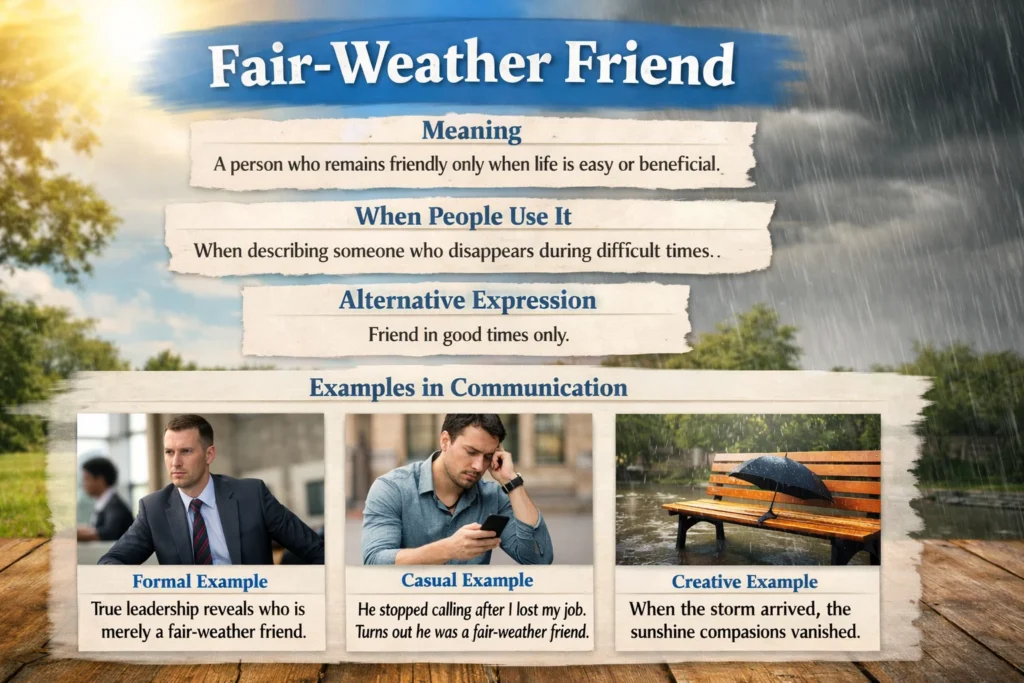
Fair-Weather Friend
Meaning
A person who remains friendly only when life is easy or beneficial.
When People Use It
When describing someone who disappears during difficult times.
Alternative Expression
Friend in good times only.
Examples in Communication
Formal Example
True leadership reveals who is merely a fair-weather friend.
Casual Example
He stopped calling after I lost my job. Turns out he was a fair-weather friend.
Creative Example
When the storm arrived, the sunshine companions vanished.
Wolf in Sheep’s Clothing
Meaning
Someone who appears kind but secretly has harmful intentions.
When People Use It
When warning others about deceptive people.
Alternative Expression
Hidden enemy.
Examples in Communication
Formal Example
The company learned that its trusted partner was a wolf in sheep’s clothing.
Casual Example
Be careful around him; he’s a wolf in sheep’s clothing.
Creative Example
Behind the gentle smile hid sharp intentions.
Stab Someone in the Back
Meaning
To betray someone secretly.
When People Use It
After experiencing betrayal from a friend or colleague.
Alternative Expression
Betray someone.
Examples in Communication
Formal Example
Several employees felt they had been stabbed in the back by the decision.
Casual Example
I trusted her, and she stabbed me in the back.
Creative Example
The deepest wounds came from those standing closest.
Two-Faced

Meaning
Pretending to be friendly while speaking or acting differently behind someone’s back.
When People Use It
When describing hypocrisy and dishonesty.
Alternative Expression
Double-faced.
Examples in Communication
Formal Example
Leaders should avoid appearing two-faced in their communication.
Casual Example
She’s nice in person but talks badly about everyone. She’s so two-faced.
Creative Example
One smile for the crowd, another story in the shadows.
Snake in the Grass
Meaning
A deceitful and untrustworthy person.
When People Use It
To warn others about hidden betrayal.
Alternative Expression
Backstabber.
Examples in Communication
Formal Example
The investigation exposed a snake in the grass within the organization.
Casual Example
I didn’t know he was such a snake in the grass.
Creative Example
Danger often hides beneath calm surroundings.
Throw Someone Under the Bus
Meaning
To sacrifice someone else to protect yourself.
When People Use It
In workplace conflicts or damaged friendships.
Alternative Expression
Blame someone unfairly.
Examples in Communication
Formal Example
Good leaders never throw their teams under the bus.
Casual Example
He threw me under the bus when things went wrong.
Creative Example
To save himself, he offered another person as the shield.
Play Both Sides
Meaning
To support opposing groups for personal advantage.
When People Use It
During conflicts and disagreements.
Alternative Expression
Sit on the fence.
Examples in Communication
Formal Example
Negotiators cannot effectively play both sides indefinitely.
Casual Example
Stop playing both sides and choose where you stand.
Creative Example
He danced between camps, hoping everyone would trust him.
Crocodile Tears
Meaning
Insincere sadness or fake sympathy.
When People Use It
When someone appears emotional without genuine feelings.
Alternative Expression
Fake sympathy.
Examples in Communication
Formal Example
Observers viewed the apology as little more than crocodile tears.
Casual Example
Don’t believe her tears. They’re crocodile tears.
Creative Example
The tears sparkled, but the heart remained untouched.
Double-Cross
Meaning
To deceive or betray someone unexpectedly.
When People Use It
In friendships, business, and conflicts.
Alternative Expression
Betray.
Examples in Communication
Formal Example
The agreement collapsed after one side attempted to double-cross the other.
Casual Example
I can’t believe he double-crossed me.
Creative Example
Trust shattered with one unexpected move.
Have a Hidden Agenda
Meaning
To have secret motives.
When People Use It
When questioning someone’s intentions.
Alternative Expression
Have ulterior motives.
Examples in Communication
Formal Example
The proposal appeared helpful, but many suspected a hidden agenda.
Casual Example
I feel like she has a hidden agenda.
Creative Example
Beneath every generous offer lay another purpose.
Lead Someone On
Meaning
To intentionally mislead someone.
When People Use It
When discussing manipulation or false promises.
Alternative Expression
Mislead someone.
Examples in Communication
Formal Example
Organizations should avoid leading customers on with unrealistic expectations.
Casual Example
He led everyone on and never intended to help.
Creative Example
Promises became lanterns that illuminated nothing.
How Idioms About Fake Friends Improve Communication
Idioms about fake friends are not just expressive phrases—they help you communicate emotional experiences that are often difficult to explain directly. When someone says “he stabbed me in the back,” it instantly communicates betrayal, pain, and surprise in a way that a plain sentence like “he betrayed me” cannot fully capture.
In writing, these idioms add emotional depth and storytelling power. In speaking, they make your language sound more natural and fluent, especially in casual conversations or personal storytelling. However, the key is balance. Overusing strong betrayal idioms can make communication sound overly dramatic, so choosing the right moment is important.
Real-Life Situations Where These Idioms Are Used
You’ll often hear these expressions in:
- Workplace discussions about trust or teamwork
- Friend group conversations after misunderstandings
- Social media posts about betrayal or disappointment
- Personal storytelling or emotional experiences
- Creative writing like stories, poems, and blogs
For example, after a group project fails, someone might say “someone really threw me under the bus,” while in a friendship breakup, “she was a fair-weather friend” fits naturally.
Emotional Tone Behind Fake Friend Idioms
These idioms usually carry strong emotional weight. Words like “snake in the grass” or “wolf in sheep’s clothing” are not neutral—they express caution, hurt, and awareness. That’s why they are powerful in storytelling but should be used thoughtfully in real-life conversations.
They can also reflect growth. Saying “I’ve learned who my fair-weather friends are” shows maturity and emotional understanding rather than just anger.
Common Mistakes Learners Make
Many English learners enjoy idioms, but there are a few common mistakes:
- Using idioms without understanding emotional intensity
- Mixing literal meaning with figurative meaning
- Using too many idioms in one sentence or paragraph
- Applying harsh idioms to small misunderstandings
- Translating idioms directly from native language expressions
A good rule is: if the situation is simple, keep the language simple. If the emotion is strong, an idiom can enhance it.
Idioms vs Simple Expressions
Understanding when to use idioms versus plain language is important.
Simple Expression:
He didn’t support me when I needed help.
Idiomatic Expression:
He turned out to be a fair-weather friend.
Both are correct, but the second version feels more expressive and emotionally layered.
Idioms are best used when you want your message to feel memorable, not just informative.
Tips to Use Fake Friend Idioms Naturally
- Start with 5–6 idioms instead of memorizing too many at once
- Use them in short personal stories before formal writing
- Watch how native speakers use them in movies or interviews
- Match the idiom with the emotional tone of the situation
- Avoid forcing idioms into sentences where they don’t fit naturally
Over time, these expressions will become part of your natural speaking style.
Practical Usage Guidance
How to Use Idioms Naturally
Idioms about fake friends often carry strong emotional tones. They work best when discussing trust, betrayal, disappointment, and personal experiences. Avoid using them excessively in formal reports, but they fit naturally in storytelling, essays, blogs, and conversations.
Common Mistakes with Idioms
- Taking the expressions literally.
- Using several betrayal idioms in the same sentence.
- Applying harsh idioms to minor disagreements.
- Ignoring the emotional weight some expressions carry.
Idioms vs Literal Expressions
Literal: He betrayed me.
Idiomatic: He stabbed me in the back.
The idiomatic version creates a stronger emotional image and feels more expressive.
Tips for Sounding More Fluent
- Learn idioms through stories and conversations.
- Pay attention to tone and context.
- Use one or two expressions naturally instead of forcing many into your speech.
- Practice by writing short scenarios.
How to Remember Idioms Easily
Connect each idiom with a memorable image. For example, imagining a wolf wearing sheep’s clothing makes the expression much easier to recall.
FAQs
What are idioms about fake friends?
They are expressions that describe betrayal, dishonesty, hidden motives, and insincere relationships.
What is the most common idiom for fake friends?
“Fair-weather friend” is one of the most widely used expressions.
Can these idioms be used in essays?
Yes. Many of them work well in essays, stories, and reflective writing when used appropriately.
Are these idioms formal or informal?
Most are conversational, though several also appear in professional and literary writing.
How can I remember these expressions better?
Practice them in real situations and connect them with vivid mental images.
Conclusion
Learning idioms about fake friends can enrich your vocabulary and help you express complicated emotions with greater clarity. These expressions capture experiences of trust, disappointment, and personal growth in ways that literal language often cannot.
Whether you’re improving your spoken English, writing stories, or expanding your understanding of figurative language, these idioms offer valuable insight into how people communicate relationships and emotions. Use them thoughtfully, pay attention to context, and allow them to become a natural part of your vocabulary.
Over time, you’ll find that understanding these colorful expressions not only improves your language skills but also makes your communication more vivid, relatable, and memorable.
Discover More Related Articles:
- Idioms for Sweet | That Make Language Tastier In 2026
- Idioms for Cake | Sweet Expressions That Make Language Tastier In 2026