Quick Answer
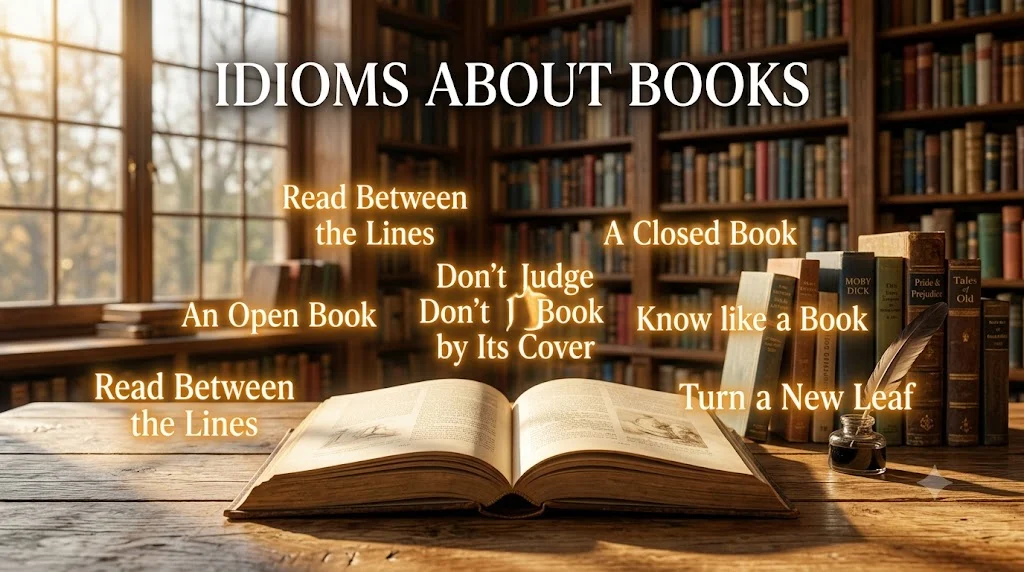
Idioms about books are expressions that use book-related imagery to describe people, situations, knowledge, judgment, learning, or life experiences. Common examples include “Don’t judge a book by its cover,” “An open book,” and “Read between the lines.” These idioms make conversations, essays, stories, and everyday communication more vivid and expressive.
Books have always been more than collections of pages. They symbolize knowledge, stories, wisdom, learning, and even human behavior. Because books play such an important role in our lives, it’s no surprise that English contains many colorful idioms inspired by them.
Whether you’re writing an essay, preparing for an exam, improving your English fluency, or simply looking to enrich your vocabulary, learning idioms about books can help you communicate with greater confidence and creativity. These expressions often say much more than their literal words suggest.
In everyday conversations, workplaces, classrooms, and creative writing, book-related idioms frequently appear because they convey ideas quickly and memorably. Understanding them not only improves comprehension but also helps your own speech and writing sound more natural.
Let’s explore some of the most useful idioms about books, what they mean, when people use them, and how you can incorporate them naturally into your communication.
Quick Summary Table
| Idiom | Meaning | Common Use |
|---|---|---|
| Don’t Judge a Book by Its Cover | Don’t form opinions based on appearance | Giving advice |
| An Open Book | Easy to understand and honest | Describing people |
| Read Between the Lines | Find hidden meaning | Communication |
| By the Book | Following rules exactly | Workplace situations |
| Take a Leaf Out of Someone’s Book | Copy a good example | Personal improvement |
| Bookworm | Someone who loves reading | Personality description |
| In Someone’s Good Books | Favored by someone | Relationships |
| In Someone’s Bad Books | Disliked by someone | Social situations |
| Cook the Books | Falsify records | Business discussions |
| A Closed Book | Difficult to understand | Learning challenges |
| Every Trick in the Book | All possible methods | Problem-solving |
| Throw the Book at Someone | Punish severely | Legal discussions |
| Read Someone Like a Book | Understand someone easily | Relationships |
| Balance the Books | Settle finances | Business and finance |
| A Sealed Book | Completely mysterious | Unknown situations |
Don’t Judge a Book by Its Cover
Meaning
Appearances can be misleading, so avoid making quick judgments.
When People Use It
When advising someone not to form opinions based solely on looks or first impressions.
Alternative Expression
Appearances can be deceiving.
Examples in Communication
Formal Example: Employers should not judge a book by its cover when evaluating applicants.
Casual Example: I thought he was unfriendly at first, but don’t judge a book by its cover.
Creative Example: The old café looked forgotten outside, yet inside it was filled with warmth and laughter.
An Open Book
Meaning
Someone who is honest, transparent, and easy to understand.
When People Use It
To describe a person who hides very little about their thoughts or feelings.
Alternative Expression
Easy to read.
Examples in Communication
Formal Example: The manager has always been an open book with her team.
Casual Example: Ask her anything—she’s an open book.
Creative Example: His smile revealed every emotion before he even spoke.
Read Between the Lines
Meaning
Understand an implied or hidden message.
When People Use It
During conversations, emails, stories, or negotiations.
Alternative Expression
Pick up on hidden meaning.
Examples in Communication
Formal Example: Readers must read between the lines to understand the author’s true intention.
Casual Example: I think she’s upset if you read between the lines.
Creative Example: The letter never mentioned goodbye, but every sentence whispered it.
By the Book
Meaning
Following rules exactly.
When People Use It
In workplaces, schools, or situations involving procedures.
Alternative Expression
Following the rules.
Examples in Communication
Formal Example: The investigation was conducted strictly by the book.
Casual Example: My teacher does everything by the book.
Creative Example: Every step of the project moved with careful precision.
Take a Leaf Out of Someone’s Book
Meaning
Copy someone’s positive behavior or habits.
When People Use It
When recommending a good example to follow.
Alternative Expression
Follow someone’s example.
Examples in Communication
Formal Example: New employees could take a leaf out of her book.
Casual Example: You should take a leaf out of your brother’s book and study regularly.
Creative Example: His discipline became a map others wanted to follow.
Bookworm
Meaning
Someone who loves reading.
When People Use It
To describe avid readers.
Alternative Expression
Avid reader.
Examples in Communication
Formal Example: She has been a bookworm since childhood.
Casual Example: My sister is such a bookworm.
Creative Example: Every free moment found her lost among fictional worlds.
In Someone’s Good Books
Meaning
To be favored or appreciated.
When People Use It
At work, school, or within relationships.
Alternative Expression
In someone’s favor.
Examples in Communication
Formal Example: Completing the project early put him in the director’s good books.
Casual Example: Bringing coffee definitely got me into her good books.
Creative Example: One thoughtful gesture changed the atmosphere entirely.
In Someone’s Bad Books
Meaning
To be disliked or viewed negatively.
When People Use It
After making a mistake or causing disappointment.
Alternative Expression
Out of favor.
Examples in Communication
Formal Example: Missing several deadlines placed him in management’s bad books.
Casual Example: I’m in my mom’s bad books for forgetting her birthday.
Creative Example: One careless decision cast a long shadow.
Cook the Books
Meaning
To falsify financial records.
When People Use It
Business, accounting, and legal discussions.
Alternative Expression
Manipulate records.
Examples in Communication
Formal Example: The company was accused of cooking the books.
Casual Example: They got caught cooking the books.
Creative Example: The numbers looked perfect until the truth emerged.
A Closed Book
Meaning
Something difficult to understand.
When People Use It
Regarding subjects, people, or concepts.
Alternative Expression
A mystery.
Examples in Communication
Formal Example: Quantum physics remains a closed book to many students.
Casual Example: Math is a closed book to me.
Creative Example: The topic seemed wrapped in fog and unanswered questions.
Every Trick in the Book
Meaning
Every possible method or strategy.
When People Use It
Discussing effort, competition, or problem-solving.
Alternative Expression
Try everything possible.
Examples in Communication
Formal Example: The team used every trick in the book to complete the project.
Casual Example: I’ve tried every trick in the book.
Creative Example: Every door was tested before finding the right key.
Throw the Book at Someone
Meaning
Punish someone as severely as possible.
When People Use It
Legal or disciplinary contexts.
Alternative Expression
Impose the maximum penalty.
Examples in Communication
Formal Example: Prosecutors requested that the court throw the book at the offender.
Casual Example: My parents threw the book at me after I broke the rules.
Creative Example: Consequences arrived all at once.
Read Someone Like a Book
Meaning
Understand someone’s thoughts or emotions easily.
When People Use It
In relationships and social situations.
Alternative Expression
See right through someone.
Examples in Communication
Formal Example: Experienced negotiators can often read people like a book.
Casual Example: Mom can read me like a book.
Creative Example: One glance revealed the entire story.
Balance the Books
Meaning
Ensure financial records are correct.
When People Use It
Business and accounting.
Alternative Expression
Settle the accounts.
Examples in Communication
Formal Example: The finance team balanced the books before the audit.
Casual Example: We need to balance the books this weekend.
Creative Example: Every number finally found its proper place.
A Sealed Book
Meaning
Something completely unknown or mysterious.
When People Use It
When discussing unfamiliar topics.
Alternative Expression
Complete mystery.
Examples in Communication
Formal Example: Ancient symbols remained a sealed book to researchers.
Casual Example: Coding is a sealed book to me.
Creative Example: The answers stayed hidden behind invisible pages.
Write the Book on Something
Meaning
To know a great deal about a subject.
When People Use It
To praise expertise.
Alternative Expression
Be an expert.
Examples in Communication
Formal Example: She could write the book on customer service.
Casual Example: My grandfather could write the book on gardening.
Creative Example: Years of experience turned knowledge into wisdom.
Bring Someone to Book
Meaning
Hold someone accountable.
When People Use It
In legal, workplace, or disciplinary situations.
Alternative Expression
Call to account.
Examples in Communication
Formal Example: Authorities promised to bring those responsible to book.
Casual Example: It’s time to bring him to book for his actions.
Creative Example: Accountability finally caught up with the truth.
One for the Books
Meaning
An unusual or memorable event.
When People Use It
After surprising experiences.
Alternative Expression
Unforgettable moment.
Examples in Communication
Formal Example: The comeback victory was one for the books.
Casual Example: That party was definitely one for the books.
Creative Example: The night became a story worth retelling.
Book Smart
Meaning
Knowledgeable through study rather than experience.
When People Use It
Discussing education and learning styles.
Alternative Expression
Academically knowledgeable.
Examples in Communication
Formal Example: He is exceptionally book smart.
Casual Example: She’s book smart but lacks practical experience.
Creative Example: Her answers came quickly from years of study.
Hit the Books
Meaning
Study hard.
When People Use It
School, college, and exam preparation.
Alternative Expression
Study intensively.
Examples in Communication
Formal Example: Students should hit the books before final examinations.
Casual Example: I need to hit the books tonight.
Creative Example: The quiet evening became a marathon of learning.
Practical Usage Guidance
How to Use Idioms Naturally
The best way to use idioms is to match them with appropriate situations. For example, “Hit the books” works well in casual conversations, while “By the book” can fit both professional and everyday settings.
Avoid forcing idioms into every sentence. A few well-placed expressions are often more effective than many.
Common Mistakes with Idioms
Many learners understand the meaning but use the wrong context. For instance, “Cook the books” carries a negative meaning and should only be used when discussing dishonesty.
Another common mistake is taking idioms literally. Remember that figurative language often communicates ideas rather than actual actions.
Idioms vs Literal Expressions
Literal language explains exactly what happened.
Example:
“I studied all night.”
Idiom:
“I hit the books all night.”
The second version sounds more natural and expressive.
Tips for Sounding More Fluent
- Learn idioms in context rather than memorizing lists.
- Notice how native speakers use them.
- Practice using one new idiom daily.
- Include idioms in stories, essays, and conversations.
- Read books, blogs, and articles that feature natural dialogue.
How to Remember Idioms Easily
Connect each idiom with a mental image. Visualizing a person literally reading between lines or hitting books makes expressions easier to recall.
Creating your own examples also helps transfer idioms from memory into active use.
FAQs
What are idioms about books?
They are figurative expressions that use books, reading, or writing to communicate ideas about people, learning, behavior, and life situations.
Why should I learn book-related idioms?
They improve communication, make writing more engaging, and help you understand native English speakers more easily.
Are book idioms common in everyday English?
Yes. Expressions like “Read between the lines” and “Don’t judge a book by its cover” are used regularly in conversations and writing.
Can I use these idioms in academic writing?
Some idioms work well in essays and articles, while highly informal ones may be better suited to conversations.
What is the easiest way to master idioms?
Practice them in real sentences, conversations, and short writing exercises rather than memorizing definitions alone.
Conclusion
Learning idioms about books is one of the most enjoyable ways to strengthen your English vocabulary and communication skills. These expressions add personality, color, and depth to everyday language while helping you convey ideas more effectively.
Whether you’re a student preparing assignments, a writer crafting engaging content, a blogger seeking more expressive language, or simply someone who loves learning English, book-related idioms can become valuable tools in your communication toolbox.
The key is to focus on understanding context rather than memorizing definitions. When you encounter these expressions in conversations, articles, novels, or workplace discussions, pay attention to how they are used naturally.
With regular practice, you’ll find yourself using idioms about books confidently and appropriately, making your speech and writing more fluent, memorable, and engaging. Keep reading, keep learning, and let these timeless expressions become part of your everyday language.
Discover More Related Articles:
- Idioms About Songs | Musical Expressions That Add Rhythm to Your English In 2026
- Idioms About Age | Timeless Expressions That Add Wisdom to Your English In 2026