Quick Answer
Idioms for the moon are figurative expressions that use the moon to represent emotions, dreams, rarity, romance, ambition, mystery, or imagination. Rather than referring to the moon literally, these expressions communicate ideas in a vivid and memorable way.
You’ll often encounter moon idioms in conversations, literature, songs, storytelling, motivational writing, and everyday communication. Learning them can help you sound more fluent while adding beauty and depth to your language.
The moon has fascinated people for thousands of years. It lights the night sky, inspires poetry, guides stories, and symbolizes everything from romance to ambition. It’s no surprise that English contains many beautiful idioms inspired by the moon.
These expressions often capture emotions that ordinary words struggle to express. Whether you’re describing great happiness, an impossible dream, a rare event, or a deep connection, moon idioms offer colorful alternatives that make communication more engaging.
Writers love them because they create imagery. Speakers use them because they make conversations feel more natural and expressive. Language learners appreciate them because they reveal how native speakers think and communicate beyond literal meanings.
In this guide, you’ll discover some of the most useful idioms for the moon, complete with meanings, contexts, alternatives, and practical examples. By the end, you’ll have a collection of celestial expressions ready to brighten your writing and conversations.
Quick Summary
| Idiom | Meaning | Common Tone |
|---|---|---|
| Over the moon | Extremely happy | Positive |
| Promise the moon | Promise something impossible | Cautious |
| Ask for the moon | Request something unrealistic | Conversational |
| Once in a blue moon | Very rarely | Everyday speech |
| Moon over someone | Admire someone romantically | Informal |
| Reach for the moon | Aim very high | Inspirational |
| Shoot for the moon | Pursue ambitious goals | Motivational |
| Bark at the moon | Complain without effect | Humorous |
| Moonstruck | Deeply fascinated or enchanted | Romantic |
| The moon is made of green cheese | Believe something foolish | Playful |
| Many moons ago | A long time ago | Storytelling |
| Full moon madness | Strange behavior linked to excitement | Informal |
| Moonlight and roses | Romantic idealism | Poetic |
| Chasing the moon | Pursuing an impossible dream | Reflective |
| Under the same moon | Sharing a connection despite distance | Emotional |
Over the Moon
Meaning
Extremely happy or delighted.
When People Use It
Used when someone experiences great joy, excitement, or satisfaction.
Alternative Expression
On cloud nine
Examples in Communication
Formal Example:
The research team was over the moon after receiving the prestigious award.
Casual Example:
I’m over the moon about my exam results!
Creative Example:
She was over the moon as the final star appeared above the horizon.
Promise the Moon
Meaning
To promise something impossible or unrealistic.
When People Use It
Used when discussing exaggerated promises.
Alternative Expression
Promise the world
Examples in Communication
Formal Example:
Successful leaders avoid promising the moon to their employees.
Casual Example:
He promised me the moon but barely returned my calls.
Creative Example:
The merchant promised the moon, but delivered only shadows.
Ask for the Moon
Meaning
To demand something unreasonable or impossible.
When People Use It
Used when expectations are excessively high.
Alternative Expression
Expect too much
Examples in Communication
Formal Example:
The client was not asking for the moon, merely timely service.
Casual Example:
I’m not asking for the moon; I just need some help.
Creative Example:
She wasn’t asking for the moon, only a little kindness.
Once in a Blue Moon
Meaning
Very rarely.
When People Use It
Commonly used when something happens infrequently.
Alternative Expression
Rarely
Examples in Communication
Formal Example:
Such market opportunities arise once in a blue moon.
Casual Example:
I eat fast food once in a blue moon.
Creative Example:
A flower bloomed there once in a blue moon.
Moon Over Someone
Meaning
To be deeply infatuated with someone.
When People Use It
Used when someone openly admires another person.
Alternative Expression
Head over heels
Examples in Communication
Formal Example:
His admiration for her was obvious to everyone.
Casual Example:
He’s been mooning over her for months.
Creative Example:
He spent every evening mooning over her beneath the silver sky.
Reach for the Moon
Meaning
To set very ambitious goals.
When People Use It
Used in motivational and inspirational contexts.
Alternative Expression
Aim high
Examples in Communication
Formal Example:
Students should be encouraged to reach for the moon.
Casual Example:
Don’t be afraid to reach for the moon.
Creative Example:
She reached for the moon and discovered her own stars.
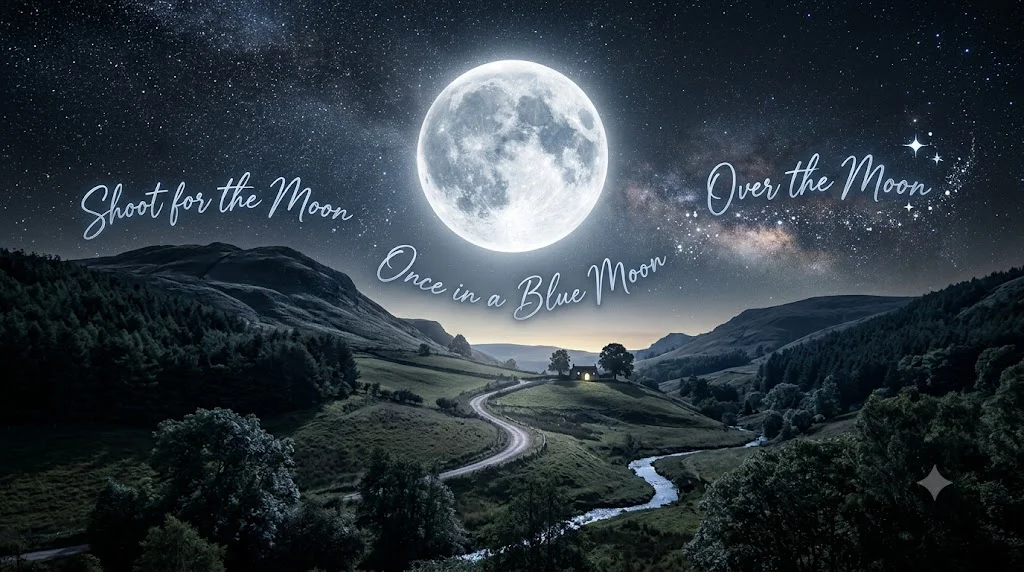
Shoot for the Moon
Meaning
To pursue a challenging dream or objective.
When People Use It
Common in personal growth and success discussions.
Alternative Expression
Dream big
Examples in Communication
Formal Example:
Entrepreneurs often succeed because they shoot for the moon.
Casual Example:
Why not shoot for the moon?
Creative Example:
The inventor shot for the moon and changed the future.
Bark at the Moon
Meaning
To complain or protest without achieving results.
When People Use It
Used when efforts are ineffective.
Alternative Expression
Waste your breath
Examples in Communication
Formal Example:
Complaining without action is merely barking at the moon.
Casual Example:
You’re barking at the moon if you think they’ll change overnight.
Creative Example:
The lonely wolf barked at the moon, unheard by anyone.
Moonstruck
Meaning
Deeply enchanted, fascinated, or romantically captivated.
When People Use It
Often used in romantic or artistic contexts.
Alternative Expression
Spellbound
Examples in Communication
Formal Example:
The audience appeared moonstruck by the performance.
Casual Example:
He looked completely moonstruck.
Creative Example:
Moonstruck and speechless, she watched the silver waves.
Many Moons Ago
Meaning
A very long time ago.
When People Use It
Common in storytelling and nostalgic conversations.
Alternative Expression
Long ago
Examples in Communication
Formal Example:
The tradition began many moons ago.
Casual Example:
I met him many moons ago.
Creative Example:
Many moons ago, the village stood beside a shining lake.
Full Moon Madness
Meaning
Unusually energetic, strange, or chaotic behavior.
When People Use It
Used humorously to explain unusual events.
Alternative Expression
Acting strangely
Examples in Communication
Formal Example:
The office jokingly blamed the confusion on full moon madness.
Casual Example:
Everyone’s acting weird today—must be full moon madness.
Creative Example:
The town danced through the night in a burst of full moon madness.
Moonlight and Roses
Meaning
An idealized view of romance or life.
When People Use It
Used when discussing unrealistic romantic expectations.
Alternative Expression
Fairy-tale thinking
Examples in Communication
Formal Example:
Relationships require effort, not merely moonlight and roses.
Casual Example:
Life isn’t always moonlight and roses.
Creative Example:
She dreamed of moonlight and roses but discovered real love instead.
Chasing the Moon
Meaning
Pursuing an impossible dream.
When People Use It
Used when goals are unlikely to be achieved.
Alternative Expression
Chasing a fantasy
Examples in Communication
Formal Example:
Without a practical strategy, the project was simply chasing the moon.
Casual Example:
You might be chasing the moon with that idea.
Creative Example:
He spent years chasing the moon across distant horizons.
Under the Same Moon
Meaning
Sharing a connection despite being far apart.
When People Use It
Common in emotional, family, and long-distance contexts.
Alternative Expression
Connected across distance
Examples in Communication
Formal Example:
The poem reminds readers that loved ones remain under the same moon.
Casual Example:
We’re far apart, but we’re under the same moon.
Creative Example:
Though oceans separated them, they still lived under the same moon.
How to Use Idioms Naturally
Moon idioms often carry emotional or poetic meanings. They work especially well in storytelling, blogs, speeches, creative writing, and conversations.
Try matching the idiom to the emotion:
- Happiness → Over the moon
- Ambition → Shoot for the moon
- Rarity → Once in a blue moon
- Romance → Moonstruck
- Nostalgia → Many moons ago
Using the right emotional context makes these expressions feel natural and memorable.
Common Mistakes with Moon Idioms
Using Them Literally
Moon idioms are figurative, not astronomical descriptions.
Ignoring Context
Some moon expressions sound poetic, while others sound casual.
Overusing Them
A few well-chosen idioms create impact. Too many can feel forced.
Mixing Idioms Incorrectly
Learn complete expressions rather than combining parts of different idioms.
To the Moon
Meaning
To rise dramatically, especially in success, popularity, or value.
When People Use It
Often used when discussing achievements, business growth, investments, or exciting progress.
Alternative Expression
Skyrocket
Examples in Communication
Formal Example:
The company’s revenue went to the moon after the product launch.
Casual Example:
This new game is going to the moon!
Creative Example:
Her dreams finally went to the moon after years of determination.
Moon Away
Meaning
To spend time daydreaming or thinking romantically.
When People Use It
Used when someone seems distracted by pleasant thoughts.
Alternative Expression
Daydream
Examples in Communication
Formal Example:
The manager noticed several employees mooning away during the lengthy presentation.
Casual Example:
Stop mooning away and finish your homework.
Creative Example:
She sat by the river, mooning away beneath the twilight sky.
Moon Child
Meaning
Someone who is dreamy, imaginative, sensitive, or deeply connected to emotions.
When People Use It
Popular in creative, artistic, and poetic contexts.
Alternative Expression
Dreamer
Examples in Communication
Formal Example:
Her artistic style reflects the spirit of a true moon child.
Casual Example:
You’ve always been a moon child at heart.
Creative Example:
The moon child wandered through silver forests collecting stories from the stars.
Follow the Moon
Meaning
To follow your intuition, dreams, or inner guidance.
When People Use It
Used in inspirational and reflective conversations.
Alternative Expression
Follow your heart
Examples in Communication
Formal Example:
Sometimes innovation begins when people choose to follow the moon rather than the crowd.
Casual Example:
Just follow the moon and trust yourself.
Creative Example:
He followed the moon through the darkness until dawn appeared.
Dance in the Moonlight
Meaning
To enjoy life freely and joyfully.
When People Use It
Used to describe carefree happiness and celebration.
Alternative Expression
Live in the moment
Examples in Communication
Formal Example:
The festival encouraged participants to dance in the moonlight and celebrate culture.
Casual Example:
Let’s forget our worries and dance in the moonlight.
Creative Example:
The villagers danced in the moonlight while music echoed across the valley.
The Moon on a Stick
Meaning
Something desirable but nearly impossible to obtain.
When People Use It
Common in British English when discussing unrealistic expectations.
Alternative Expression
An impossible dream
Examples in Communication
Formal Example:
The client wanted the moon on a stick within a limited budget.
Casual Example:
You can’t expect the moon on a stick every time.
Creative Example:
He searched the world for the moon on a stick and discovered contentment instead.
Why Moon Idioms Are So Powerful
Moon idioms remain popular because they connect language with imagination. Unlike ordinary expressions, they create vivid mental pictures that people remember.
The moon symbolizes:
- Hope
- Mystery
- Romance
- Ambition
- Distance
- Wonder
- Reflection
When speakers use moon idioms, they often communicate emotions and ideas more effectively than literal language can.
For writers, these expressions add atmosphere. For students, they improve vocabulary. For language learners, they provide insight into how native speakers naturally express thoughts and feelings.
Moon Idioms in Everyday Communication
Here are a few natural situations where moon idioms frequently appear:
| Situation | Useful Moon Idiom |
|---|---|
| Getting great news | Over the moon |
| Talking about a rare event | Once in a blue moon |
| Encouraging ambition | Shoot for the moon |
| Discussing unrealistic expectations | Ask for the moon |
| Remembering the past | Many moons ago |
| Romantic conversations | Moonstruck |
| Long-distance relationships | Under the same moon |
| Talking about dreams | Reach for the moon |
Using the right idiom in the right situation can instantly make your English sound more natural and expressive.
Bonus Moon Quotes and Expressions
While not traditional idioms, these moon-inspired expressions often appear in literature and conversation:
- Aim for the moon.
- Every moon has its dark side.
- Follow the moon and find your path.
- Beneath the same moon, we’re never truly apart.
- Let your dreams shine brighter than the moon.
These phrases can add elegance and emotional depth to writing, speeches, and social media content.
Tips for Remembering Moon Idioms
- Visualize the moon-related image.
- Connect each idiom with an emotion.
- Use them in journal entries and stories.
- Practice them in conversations.
- Read novels and poems that feature moon imagery.
The stronger the image, the easier the idiom becomes to remember.
FAQs
What are idioms for the moon?
They are figurative expressions that use the moon to represent emotions, rarity, dreams, ambition, romance, or imagination.
What is the most common moon idiom?
“Over the moon” is one of the most frequently used moon idioms in modern English.
What does “once in a blue moon” mean?
It means something happens very rarely.
Can moon idioms be used in formal writing?
Some can, especially in speeches, articles, and creative writing, though many are best suited for conversational contexts.
Why are moon idioms popular?
The moon has long been associated with mystery, beauty, romance, and dreams, making it a powerful source of figurative language.
Conclusion
Moon-inspired expressions add beauty, emotion, and imagination to communication. Whether you’re over the moon with excitement, recalling something from many moons ago, or encouraging someone to shoot for the moon, these idioms help transform ordinary language into something more memorable.
Learning idioms for the moon isn’t just about expanding vocabulary. It’s about understanding how English speakers express feelings, dreams, relationships, and experiences through vivid imagery. The more naturally you use these expressions, the more engaging your speech and writing will become.
Start by choosing a few favorites and practicing them in conversations, journal entries, or creative projects. Before long, these celestial phrases will become a natural part of your language toolkit, helping your communication shine as brightly as the moon itself.
Discover More Related Articles:
- Idioms About the Sky | Expressions That Soar Above the Rest In 2026
- Idioms About Storms | Expressions for Life’s Turbulent Moments In 2026