Quick Answer
Idioms about winter are figurative expressions inspired by cold weather, snow, ice, and the winter season. They are often used to describe challenges, emotions, relationships, difficult situations, or periods of inactivity. Learning these winter-themed idioms can make your conversations, writing, and storytelling more vivid and engaging.
Winter has always inspired colorful language. Long before weather forecasts and social media updates existed, people used winter imagery to describe real-life experiences. Ice, snow, frost, and freezing temperatures became powerful symbols for everything from difficult relationships to personal challenges and even moments of courage.
That’s why idioms about winter remain common in modern English. They appear in conversations, novels, business discussions, news articles, and everyday storytelling. Even when winter weather isn’t involved, these expressions help people communicate emotions and situations more effectively.
For language learners, winter idioms offer a practical way to sound more natural and understand native speakers more easily. For writers and bloggers, they add atmosphere, emotion, and memorable imagery to content.
In this guide, you’ll discover useful winter idioms, understand what they really mean, and learn how to use them naturally in both speaking and writing.
Quick Summary Table
| Idiom | Simple Meaning | Common Usage |
|---|---|---|
| Break the ice | Start a conversation | Social situations |
| Snowed under | Extremely busy | Work and studies |
| Left out in the cold | Excluded or ignored | Relationships |
| Cold shoulder | Deliberately ignoring someone | Social interactions |
| In cold blood | Without emotion | Serious situations |
| Snowball effect | Small issue grows bigger | Business and life |
| Put something on ice | Delay something | Projects and plans |
| Walking on thin ice | Taking risks | Decisions |
| Ice in your veins | Calm under pressure | Sports and leadership |
| Freeze someone out | Exclude someone | Social groups |
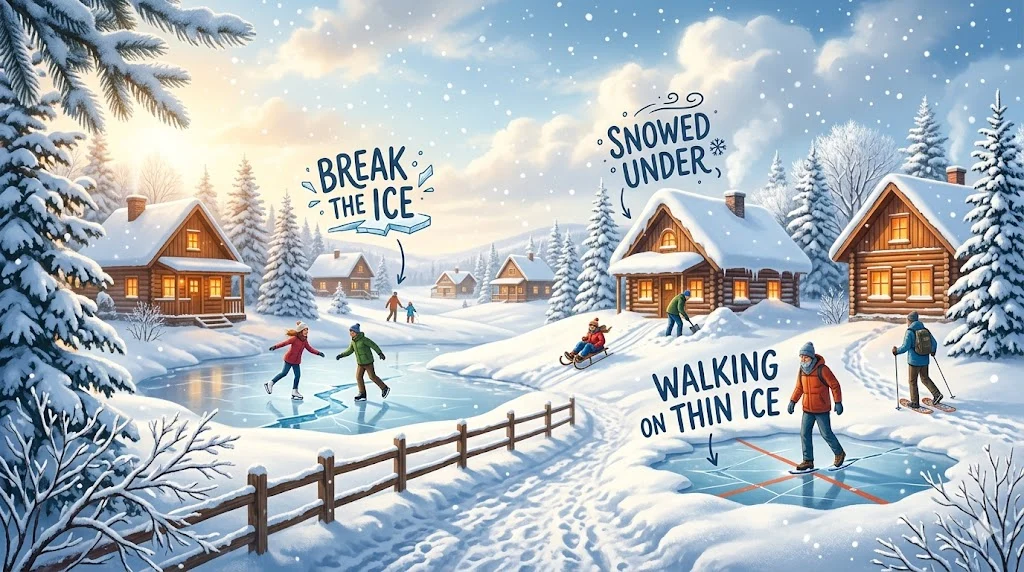
Break the Ice
Meaning
To start a conversation or reduce tension in a social situation.
When People Use It
Used when strangers meet or when a group feels awkward.
Alternative Expression
Get the conversation started
Examples in Communication
Formal Example
The manager organized a short activity to break the ice before the meeting.
Casual Example
I told a funny joke to break the ice.
Creative Example
Her cheerful smile broke the ice faster than the warm coffee in her hands.
Usage Insight
This is one of the most common idioms in English and is useful in both professional and casual settings.
Snowed Under
Meaning
Extremely busy with work or responsibilities.
When People Use It
Often used during busy periods at work or school.
Alternative Expression
Overloaded with work
Examples in Communication
Formal Example
The accounting department is snowed under during tax season.
Casual Example
Sorry I didn’t reply earlier. I’ve been snowed under all week.
Creative Example
Assignments piled up like snowdrifts, leaving her completely snowed under.
Left Out in the Cold
Meaning
Ignored, excluded, or neglected.
When People Use It
Used when someone feels left behind or not included.
Alternative Expression
Shut out
Examples in Communication
Formal Example
Several employees felt left out in the cold during the decision-making process.
Casual Example
I felt left out in the cold when everyone made plans without me.
Creative Example
Watching from the doorway, he felt left out in the cold despite standing among friends.
Give Someone the Cold Shoulder
Meaning
To deliberately ignore or avoid someone.
When People Use It
Common in social conflicts or misunderstandings.
Alternative Expression
Ignore someone
Examples in Communication
Formal Example
The client felt the company was giving them the cold shoulder.
Casual Example
Why is she giving me the cold shoulder today?
Creative Example
His messages remained unanswered, a digital version of the cold shoulder.
In Cold Blood
Meaning
Done without emotion, sympathy, or compassion.
When People Use It
Often used when discussing serious actions.
Alternative Expression
Without remorse
Examples in Communication
Formal Example
The crime was committed in cold blood.
Casual Example
He canceled our plans in cold blood without even apologizing.
Creative Example
The decision was made in cold blood, unaffected by emotions or memories.
Snowball Effect
Meaning
A situation that starts small and becomes larger over time.
When People Use It
Used in business, education, and personal growth discussions.
Alternative Expression
Chain reaction
Examples in Communication
Formal Example
The marketing campaign created a positive snowball effect.
Casual Example
One missed class turned into a snowball effect of falling behind.
Creative Example
Like a tiny snowball rolling downhill, the idea grew beyond anyone’s expectations.
Put Something on Ice
Meaning
To postpone or delay something temporarily.
When People Use It
Used when plans or projects are paused.
Alternative Expression
Put on hold
Examples in Communication
Formal Example
The company put the expansion plans on ice.
Casual Example
Let’s put that discussion on ice until tomorrow.
Creative Example
The dream wasn’t abandoned—it was simply placed on ice for a better season.
Walking on Thin Ice
Meaning
Taking risks or entering a dangerous situation.
When People Use It
Used when actions may lead to trouble.
Alternative Expression
Taking a risk
Examples in Communication
Formal Example
The company is walking on thin ice with its latest policy.
Casual Example
You’re walking on thin ice if you keep arriving late.
Creative Example
Every word felt like a careful step across thin ice above uncertain waters.
Ice in Your Veins
Meaning
Remaining calm under pressure.
When People Use It
Commonly used in sports, leadership, and crisis situations.
Alternative Expression
Cool under pressure
Examples in Communication
Formal Example
The surgeon showed ice in her veins during the emergency.
Casual Example
You must have ice in your veins to stay that calm.
Creative Example
While chaos swirled around him, he stood with ice in his veins and clarity in his mind.
Freeze Someone Out
Meaning
To intentionally exclude someone.
When People Use It
Used in social or professional environments.
Alternative Expression
Push aside
Examples in Communication
Formal Example
The committee was accused of freezing out younger members.
Casual Example
They completely froze me out of the group chat.
Creative Example
The silence at the table seemed designed to freeze him out.
Dead of Winter
Meaning
The coldest and deepest part of winter.
When People Use It
Used literally and figuratively for difficult periods.
Alternative Expression
Middle of winter
Examples in Communication
Formal Example
Construction continued even during the dead of winter.
Casual Example
I hate driving in the dead of winter.
Creative Example
Hope arrived like sunlight in the dead of winter.
Cold Comfort
Meaning
Little consolation during a difficult situation.
When People Use It
Used when positive news doesn’t improve circumstances much.
Alternative Expression
Small consolation
Examples in Communication
Formal Example
Receiving an apology was cold comfort after the loss.
Casual Example
That’s cold comfort now that the opportunity is gone.
Creative Example
The promise of tomorrow felt like cold comfort on such a difficult night.
Chill to the Bone
Meaning
To feel extremely cold or deeply frightened.
When People Use It
Used for physical coldness or emotional impact.
Alternative Expression
Deeply affected
Examples in Communication
Formal Example
The harsh weather chilled workers to the bone.
Casual Example
That horror movie chilled me to the bone.
Creative Example
The lonely wind carried a story that chilled everyone to the bone.
Practical Ways to Use Winter Idioms Naturally
Match the Situation
Many winter idioms are not actually about weather. Focus on their figurative meaning rather than the season itself.
Use Them in Storytelling
Winter idioms create vivid imagery and work especially well in narratives, blogs, and personal essays.
Learn Emotional Context
Some expressions sound negative, such as “cold shoulder” or “left out in the cold,” while others are neutral or positive like “break the ice.”
Practice with Real-Life Examples
Use idioms when talking about school, work, friendships, goals, or personal experiences.
Common Mistakes with Winter Idioms
Taking Them Literally
Many learners assume winter idioms refer only to weather. Most have broader figurative meanings.
Using the Wrong Tone
Expressions like “in cold blood” are serious and should not be used casually.
Mixing Similar Idioms
“Walking on thin ice” and “breaking the ice” involve ice imagery but have completely different meanings.
Overusing Idioms
Using too many idioms in one paragraph can make writing sound unnatural.
How to Remember Winter Idioms Easily
Visualize the Winter Image
Imagine snow, ice, frost, or freezing temperatures connected to the idiom’s meaning.
Learn Through Stories
Stories help create memorable connections between expressions and situations.
Group Similar Idioms
Study winter idioms together to reinforce vocabulary naturally.
Practice in Daily Writing
Use one winter idiom each day in a journal, social media caption, or conversation.
Bundle Up
Meaning
To dress warmly for cold weather.
When People Use It
Used when advising someone to wear extra clothing during winter conditions.
Alternative Expression
Dress warmly
Examples in Communication
Formal Example
Employees were advised to bundle up before traveling to the outdoor event.
Casual Example
It’s freezing outside. Don’t forget to bundle up.
Creative Example
She bundled up in layers of wool and stepped into the snowy morning like an explorer entering a winter wonderland.
Usage Insight
Although this phrase relates directly to winter weather, it is frequently used in everyday conversation during colder months.
Break Out in a Cold Sweat
Meaning
To suddenly feel nervous, anxious, or frightened.
When People Use It
Used when describing stress, fear, or intense worry.
Alternative Expression
Become extremely nervous
Examples in Communication
Formal Example
The thought of missing the deadline made him break out in a cold sweat.
Casual Example
I broke out in a cold sweat when I realized I had forgotten my phone.
Creative Example
The unexpected phone call made her break out in a cold sweat before she even answered.
Snow Job
Meaning
An attempt to persuade or deceive someone using exaggerated claims.
When People Use It
Often used when discussing marketing, sales tactics, or misleading explanations.
Alternative Expression
Smooth talk
Examples in Communication
Formal Example
The committee refused to accept the company’s snow job regarding the issue.
Casual Example
Don’t believe that snow job—he’s exaggerating everything.
Creative Example
His speech sparkled like fresh snow, but underneath it was little more than a clever snow job.
Cold Day in July
Meaning
Something very unlikely to happen.
When People Use It
Used when expressing doubt about an event occurring.
Alternative Expression
Not likely
Examples in Communication
Formal Example
It will be a cold day in July before that policy is approved.
Casual Example
It’ll be a cold day in July before my brother cleans his room.
Creative Example
The promise sounded as believable as a cold day in July.
Throw Cold Water On
Meaning
To discourage enthusiasm or excitement.
When People Use It
Used when someone’s negative comments reduce excitement about an idea.
Alternative Expression
Discourage
Examples in Communication
Formal Example
Management threw cold water on the proposal due to budget concerns.
Casual Example
Don’t throw cold water on my plans before I’ve even started.
Creative Example
Her excitement dimmed when criticism was poured over her idea like cold water.
Snowed In
Meaning
Unable to leave a place because of heavy snow.
When People Use It
Can be used literally or figuratively to describe being stuck somewhere.
Alternative Expression
Trapped indoors
Examples in Communication
Formal Example
Residents were snowed in for several days after the storm.
Casual Example
We were snowed in all weekend and watched movies.
Creative Example
Snowed in by winter’s silence, the family rediscovered the joy of long conversations.
Cold as Ice
Meaning
Emotionally distant or unfriendly.
When People Use It
Used when describing someone’s behavior or attitude.
Alternative Expression
Emotionally detached
Examples in Communication
Formal Example
His response seemed cold as ice despite the circumstances.
Casual Example
She was cold as ice after our argument.
Creative Example
Her words were cold as ice, leaving the room strangely silent.
Winter of Discontent
Meaning
A period of unhappiness, difficulty, or dissatisfaction.
When People Use It
Used to describe challenging phases in life, organizations, or society.
Alternative Expression
Difficult period
Examples in Communication
Formal Example
The company experienced a winter of discontent following major restructuring.
Casual Example
Last year felt like a winter of discontent for our whole family.
Creative Example
Every challenge seemed to arrive at once, creating a personal winter of discontent.
Out in the Cold
Meaning
Excluded from a group, opportunity, or activity.
When People Use It
Used when someone feels ignored or overlooked.
Alternative Expression
Left behind
Examples in Communication
Formal Example
Several stakeholders felt out in the cold during negotiations.
Casual Example
I hate feeling out in the cold when everyone else knows what’s happening.
Creative Example
The invitation never came, leaving him standing emotionally out in the cold.
Freeze Up
Meaning
To become unable to act, think, or speak because of fear or pressure.
When People Use It
Common in presentations, interviews, and performances.
Alternative Expression
Panic
Examples in Communication
Formal Example
Some candidates freeze up during interviews.
Casual Example
I always freeze up when speaking in front of large crowds.
Creative Example
The spotlight appeared, and suddenly every prepared word froze up inside her mind.
Why Winter Idioms Make Writing More Powerful
Winter imagery naturally creates strong emotional reactions. Snow can symbolize isolation or beauty. Ice can represent danger, calmness, or emotional distance. Frost can suggest hardship, while a warm fire often symbolizes hope and comfort.
Because of these rich associations, winter idioms help writers communicate complex emotions in just a few words.
For example:
- “Walking on thin ice” instantly suggests risk.
- “Left out in the cold” immediately conveys exclusion.
- “Snowed under” quickly communicates overwhelm.
This combination of emotion and imagery is what makes idioms so effective in storytelling, blogging, essays, and everyday communication.
FAQs
What are winter idioms?
Winter idioms are figurative expressions inspired by snow, ice, frost, and cold weather that describe situations, emotions, or experiences.
Why are winter idioms popular in English?
Winter imagery creates strong visual associations, making these expressions memorable and effective.
Can winter idioms be used year-round?
Yes. Most winter idioms have figurative meanings and can be used in any season.
What is the most common winter idiom?
Break the ice” is one of the most widely used winter-related idioms in English.
How can I learn winter idioms faster?
Read, listen, and practice them in real conversations and writing contexts while focusing on their figurative meanings.
Conclusion
Idioms about winter do much more than describe cold weather. They help express emotions, relationships, challenges, risks, and personal experiences in ways that feel vivid and memorable. Whether you’re trying to break the ice in a conversation, explain a snowball effect, or describe someone being left out in the cold, these expressions add depth and personality to your communication.
The best way to master winter idioms is through consistent exposure and practice. Read them in books, notice them in conversations, and start using them naturally in your own writing and speech.
Over time, these expressions will become part of your active vocabulary, helping you communicate with greater confidence, fluency, and creativity.
Discover More Related Articles: