
Quick Answer
“Idioms for Yourself” refers to idiomatic expressions that describe self-identity, self-awareness, self-expression, or being true to oneself. These idioms help people talk about their personality, feelings, and personal growth in a colorful and natural way.
Learning idioms doesn’t just help you sound more fluent—it also gives you new ways to express personal growth, confidence, independence, and self-awareness. Some of the most meaningful expressions in English revolve around the idea of “yourself.”
Whether you’re writing an essay, having a heartfelt conversation, or creating a blog post, these idioms can make your language feel richer and more natural. Native speakers often use expressions like “be yourself” or “stand on your own two feet” because they communicate emotions and experiences in ways that simple words sometimes cannot.
Many of these phrases appear in everyday conversations, motivational speeches, workplace discussions, and personal storytelling. Understanding them can help students, writers, and English learners express thoughts with greater confidence and authenticity.
Below, you’ll discover practical idioms for yourself, complete with meanings, natural examples, and helpful usage tips that make them easier to remember and use naturally.
Quick Summary
| Idiom | Meaning | Common Tone |
|---|---|---|
| Be yourself | Act naturally and authentically | Encouraging |
| Find yourself | Discover your identity or purpose | Reflective |
| Know yourself | Understand your strengths and weaknesses | Thoughtful |
| Come into your own | Become confident and successful | Positive |
| Stand on your own two feet | Be independent | Practical |
| Stay true to yourself | Remain faithful to your values | Inspirational |
| Pull yourself together | Regain control of emotions | Supportive |
| Get a grip on yourself | Calm down and regain control | Informal |
| Think for yourself | Form your own opinions | Encouraging |
| Keep to yourself | Prefer privacy or solitude | Neutral |
| Look after yourself | Take care of your health and well-being | Caring |
| Make something of yourself | Become successful through effort | Motivational |
| Talk to yourself | Speak aloud to oneself | Everyday speech |
| Bring out the best in yourself | Develop your full potential | Positive |
| Believe in yourself | Have confidence in your abilities | Inspirational |
Idioms for Yourself
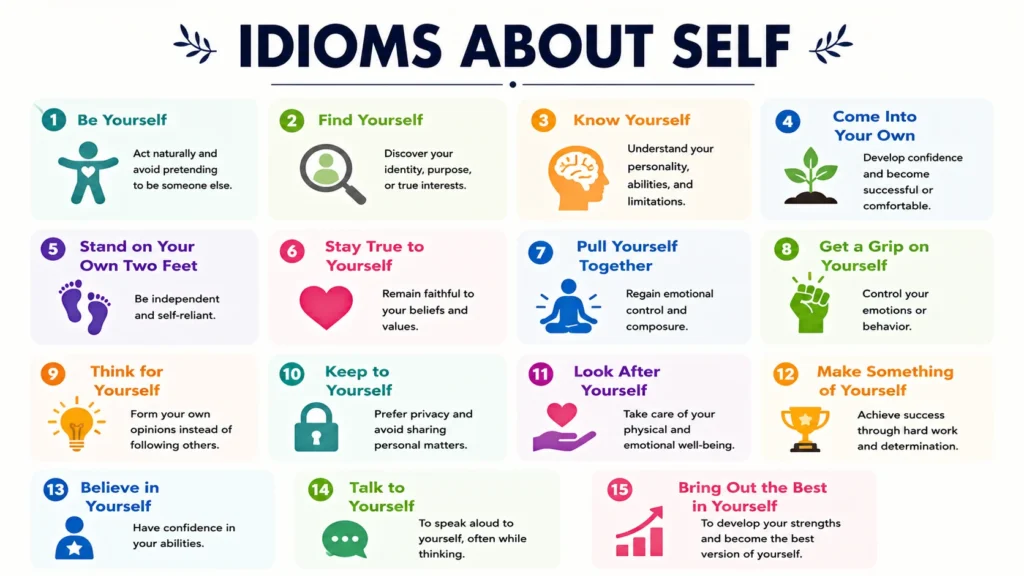
Be Yourself
Meaning
Act naturally and avoid pretending to be someone else.
When People Use It
Often used to encourage confidence and authenticity.
Alternative Expression
Stay true to yourself.
Examples in Communication
Formal Example:
The speaker encouraged students to be themselves and pursue their passions.
Casual Example:
Don’t worry about impressing everyone—just be yourself.
Creative Example:
Among all the noise and expectations, she learned the beauty of being herself.
Find Yourself
Meaning
Discover your identity, purpose, or true interests.
When People Use It
Common during periods of self-discovery or major life changes.
Alternative Expression
Discover who you are.
Examples in Communication
Formal Example:
Traveling abroad helped him find himself and clarify his career goals.
Casual Example:
She took a break from work to find herself.
Creative Example:
Lost among unfamiliar streets, he unexpectedly found himself.
Know Yourself
Meaning
Understand your personality, abilities, and limitations.
When People Use It
Used in discussions about personal development and decision-making.
Alternative Expression
Understand yourself.
Examples in Communication
Formal Example:
Good leaders know themselves and recognize their weaknesses.
Casual Example:
You know yourself better than anyone else.
Creative Example:
The journey began when she decided to truly know herself.
Come Into Your Own
Meaning
Develop confidence and become successful or comfortable with your abilities.
When People Use It
Common when someone matures or gains confidence.
Alternative Expression
Grow into yourself.
Examples in Communication
Formal Example:
The young writer came into her own after publishing several articles.
Casual Example:
You’ve really come into your own this year.
Creative Example:
Like a flower in spring, she finally came into her own.
Stand on Your Own Two Feet
Meaning
Be independent and self-reliant.
When People Use It
Used when discussing maturity, responsibility, and independence.
Alternative Expression
Be self-sufficient.
Examples in Communication
Formal Example:
Graduates should learn to stand on their own two feet.
Casual Example:
He wants to stand on his own two feet and move out.
Creative Example:
After years of struggle, she proudly stood on her own two feet.
Stay True to Yourself
Meaning
Remain faithful to your beliefs and values.
When People Use It
Used when encouraging authenticity and integrity.
Alternative Expression
Be yourself.
Examples in Communication
Formal Example:
Successful leaders stay true to themselves despite pressure.
Casual Example:
Always stay true to yourself.
Creative Example:
Through every storm, she stayed true to herself.
Pull Yourself Together
Meaning
Regain emotional control and composure.
When People Use It
Common during stressful or emotional situations.
Alternative Expression
Calm yourself down.
Examples in Communication
Formal Example:
He took a moment to pull himself together before speaking.
Casual Example:
Take a deep breath and pull yourself together.
Creative Example:
After the unexpected news, she slowly pulled herself together.
Get a Grip on Yourself
Meaning
Control your emotions or behavior.
When People Use It
Used when someone is overreacting.
Alternative Expression
Calm down.
Examples in Communication
Formal Example:
He reminded himself to get a grip before the presentation.
Casual Example:
Come on, get a grip on yourself.
Creative Example:
Standing in the rain, he whispered, “Get a grip on yourself.”
Think for Yourself
Meaning
Form your own opinions instead of blindly following others.
When People Use It
Used to encourage independence and critical thinking.
Alternative Expression
Use your own judgment.
Examples in Communication
Formal Example:
Education teaches people to think for themselves.
Casual Example:
Don’t just follow trends—think for yourself.
Creative Example:
She learned to think for herself and embrace her own voice.
Keep to Yourself
Meaning
Prefer privacy and avoid sharing personal matters.
When People Use It
Common when describing reserved personalities.
Alternative Expression
Stay private.
Examples in Communication
Formal Example:
He tends to keep to himself during social gatherings.
Casual Example:
She’s friendly but mostly keeps to herself.
Creative Example:
Like a quiet river, he preferred to keep to himself.
Look After Yourself
Meaning
Take care of your physical and emotional well-being.
When People Use It
Used affectionately among friends and family.
Alternative Expression
Take care of yourself.
Examples in Communication
Formal Example:
Doctors advised patients to look after themselves during recovery.
Casual Example:
Travel safely and look after yourself.
Creative Example:
No matter where life takes you, remember to look after yourself.
Make Something of Yourself
Meaning
Achieve success through hard work and determination.
When People Use It
Often used to motivate someone.
Alternative Expression
Build a successful life.
Examples in Communication
Formal Example:
She worked tirelessly to make something of herself.
Casual Example:
I know you’ll make something of yourself.
Creative Example:
Against all odds, he made something remarkable of himself.
Believe in Yourself
Meaning
Have confidence in your abilities.
When People Use It
Common in motivational contexts.
Alternative Expression
Trust yourself.
Examples in Communication
Formal Example:
Students should believe in themselves and pursue their goals.
Casual Example:
Believe in yourself—you’ve got this.
Creative Example:
When no one else believed, she chose to believe in herself.
Talk to Yourself
Meaning
To speak aloud to yourself, often while thinking, practicing, or solving a problem.
When People Use It
People use this expression in everyday situations when describing someone who verbalizes their thoughts.
Alternative Expression
Think out loud.
Examples in Communication
Formal Example:
Researchers noted that some individuals talk to themselves while concentrating on complex tasks.
Casual Example:
Don’t mind me. I always talk to myself when I’m cooking.
Creative Example:
Alone in the library, she talked to herself as though the books were listening.
Bring Out the Best in Yourself
Meaning
To develop your strengths and become the best version of yourself.
When People Use It
Often used in motivational conversations, self-improvement, and personal development.
Alternative Expression
Reach your full potential.
Examples in Communication
Formal Example:
Regular practice can bring out the best in yourself and improve your abilities.
Casual Example:
Surround yourself with people who bring out the best in you.
Creative Example:
Every challenge became an opportunity to bring out the best in herself.
Be Hard on Yourself
Meaning
To judge yourself too strictly or expect perfection.
When People Use It
Common when comforting someone who is overly critical of themselves.
Alternative Expression
Be too self-critical.
Examples in Communication
Formal Example:
Experts advise people not to be excessively hard on themselves after making mistakes.
Casual Example:
Stop being so hard on yourself. Everyone makes mistakes.
Creative Example:
He carried the weight of perfection because he was always hard on himself.
Get Ahead of Yourself
Meaning
To become overly excited and act before thinking carefully.
When People Use It
Used when someone makes plans too quickly or assumes success too early.
Alternative Expression
Rush things.
Examples in Communication
Formal Example:
The manager warned the team not to get ahead of themselves before reviewing the results.
Casual Example:
Let’s not get ahead of ourselves. We haven’t even started yet.
Creative Example:
Dreams raced ahead, but reality reminded her not to get ahead of herself.
Be Full of Yourself
Meaning
To think too highly of yourself and act arrogant.
When People Use It
Usually used in a negative sense when describing someone who appears overly confident.
Alternative Expression
Be conceited.
Examples in Communication
Formal Example:
Some employees felt the executive had become too full of himself.
Casual Example:
Ever since he won the award, he’s been full of himself.
Creative Example:
Fame had turned the once humble artist into someone full of himself.
Put Yourself in Someone Else’s Shoes
Meaning
To imagine how another person feels or experiences a situation.
When People Use It
Used to encourage empathy and understanding.
Alternative Expression
See things from another perspective.
Examples in Communication
Formal Example:
Effective leaders put themselves in their employees’ shoes before making decisions.
Casual Example:
Try putting yourself in her shoes before judging her.
Creative Example:
For a moment, he stepped into another person’s world by putting himself in their shoes.
Keep Yourself Busy
Meaning
To stay occupied with activities and avoid boredom.
When People Use It
Common during vacations, retirement, or difficult periods.
Alternative Expression
Stay occupied.
Examples in Communication
Formal Example:
Volunteering helped her keep herself busy after retirement.
Casual Example:
I’ve been keeping myself busy with books and movies.
Creative Example:
Rainy afternoons became easier when she kept herself busy with painting.
Take Pride in Yourself
Meaning
To appreciate your accomplishments and personal qualities.
When People Use It
Used when encouraging self-confidence and self-respect.
Alternative Expression
Be proud of yourself.
Examples in Communication
Formal Example:
Students should take pride in themselves and celebrate their achievements.
Casual Example:
You worked hard for this. Be proud of yourself.
Creative Example:
At the end of the journey, she finally learned to take pride in herself.
Stay to Yourself
Meaning
To avoid social interactions and spend time alone.
When People Use It
Often used to describe quiet or reserved individuals.
Alternative Expression
Keep to yourself.
Examples in Communication
Formal Example:
He preferred to stay to himself during company events.
Casual Example:
She usually stays to herself and enjoys reading.
Creative Example:
Like the moon hidden behind clouds, he quietly stayed to himself.
Come to Yourself
Meaning
To regain consciousness, awareness, or emotional control.
When People Use It
Used after periods of confusion, shock, or emotional distress.
Alternative Expression
Recover your senses.
Examples in Communication
Formal Example:
After a few moments, she came to herself and continued the meeting.
Casual Example:
It took me a while to come to myself after hearing the news.
Creative Example:
As the fog lifted, he slowly came to himself and understood what had happened.
Practical Usage Guidance
How to Use Idioms Naturally
Idioms involving “yourself” often appear in conversations about growth, confidence, independence, and emotional well-being. They are especially useful in personal essays, motivational writing, speeches, and everyday conversations.
For example, saying “stand on your own two feet” sounds much more vivid than simply saying “be independent.”
Common Mistakes with Idioms
Taking Them Literally
Expressions like “pull yourself together” are figurative and do not refer to physical actions.
Using Them in the Wrong Context
Some idioms, such as “get a grip on yourself,” may sound harsh if used in sensitive situations.
Overusing Idioms
Using too many idioms in one paragraph can make writing feel unnatural. A few carefully chosen expressions usually work best.
Tips for Sounding More Fluent
- Learn idioms through stories and conversations.
- Pay attention to movies, podcasts, and books.
- Practice using one or two expressions daily.
- Focus on context rather than memorization.
- Write journal entries using newly learned idioms.
FAQs
What are idioms for yourself?
Idioms for yourself are expressions related to identity, confidence, independence, self-awareness, and personal growth.
Are these idioms common in everyday English?
Yes. Many of them are widely used in conversations, motivational speeches, and writing.
Can students use these idioms in essays?
Yes, especially in personal narratives and creative writing, though very informal idioms may not suit academic essays.
Which idiom encourages confidence the most?
“Believe in yourself” and “be yourself” are among the most encouraging and widely used expressions.
How can I remember these idioms easily?
Try using them in conversations, journaling, or storytelling. Real-life practice makes them easier to remember.
Conclusion
Idioms for yourself offer much more than colorful language. They reflect ideas about confidence, independence, authenticity, and personal growth. Expressions such as “be yourself,” “think for yourself,” and “stand on your own two feet” have become powerful ways to communicate experiences that many people share.
Whether you’re improving your spoken English, writing creatively, or simply expanding your vocabulary, these idioms can help your language sound more natural and expressive. The key is to learn them gradually and use them in meaningful situations.
Over time, these phrases become more than vocabulary they become tools for telling stories, sharing emotions, and expressing who you truly are. After all, one of the most valuable pieces of advice in any language is simple: be yourself.
Discover More Related Articles:
- Idioms for Funny | That Will Make You Smile Instantly In 2026
- Idioms for Weird | That Add Personality to Your English In 2026