Quick Answer
Idioms for stupid are figurative expressions used to describe someone who is acting foolishly, lacking common sense, making poor decisions, or behaving in a silly or unintelligent way. These expressions do not usually mean that a person is permanently unintelligent. Instead, they often refer to a specific mistake, moment of confusion, or careless behavior.
Everyone occasionally encounters situations where they need to describe foolish decisions, absent-minded behavior, or a lack of common sense. While the word “stupid” is straightforward, English offers a surprising number of colorful expressions that sound more natural, humorous, and memorable.
That’s where idioms for stupid come in. These phrases appear frequently in movies, novels, everyday conversations, and even workplace discussions when people want to express criticism in a softer or more playful way.
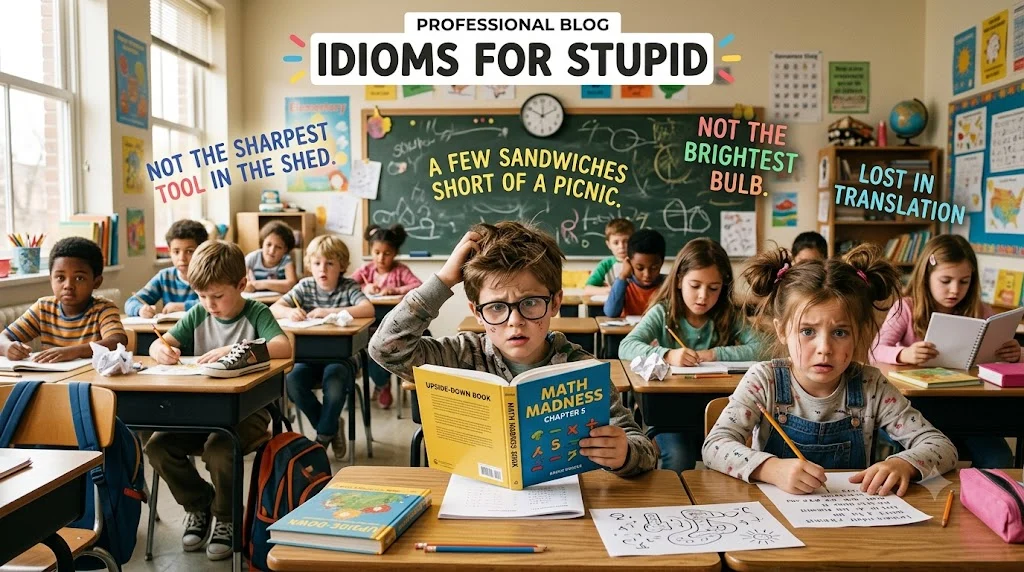
Rather than bluntly calling someone stupid, native speakers often say things like “He’s not the sharpest tool in the shed” or “She’s a few sandwiches short of a picnic.” These expressions add personality and humor while making communication more engaging.
For students, writers, bloggers, and English learners, understanding these idioms can improve conversational skills and make creative writing sound more authentic. Learning the context behind these expressions is just as important as memorizing their meanings.
Below are some of the most useful and widely recognized idioms for stupid, complete with meanings and realistic examples.
Quick Summary
| Idiom | Meaning | Common Tone |
|---|---|---|
| Not the sharpest tool in the shed | Not very intelligent | Humorous |
| A few sandwiches short of a picnic | Slightly foolish or odd | Playful |
| Thick as two short planks | Very unintelligent | Informal |
| Not playing with a full deck | Lacking common sense | Casual |
| Slow on the uptake | Slow to understand things | Neutral |
| Not the brightest bulb | Not particularly smart | Humorous |
| Thick-headed | Stubborn or slow-thinking | Informal |
| Dumb as a post | Extremely foolish | Casual |
| Have rocks in one’s head | Making poor decisions | Conversational |
| One brick short of a load | Slightly foolish | Playful |
| The lights are on, but nobody’s home | Appearing absent-minded | Humorous |
| Birdbrained | Silly and forgetful | Informal |
| Not firing on all cylinders | Not thinking clearly | Neutral |
| As dumb as a box of rocks | Extremely unintelligent | Casual |
| A few fries short of a Happy Meal | Not acting sensibly | Humorous |
Not the Sharpest Tool in the Shed
Meaning
Someone who lacks intelligence or common sense.
When People Use It
Usually said humorously rather than harshly.
Alternative Expression
Not the brightest bulb.
Examples in Communication
Formal Example:
His poor planning suggested he was not the sharpest tool in the shed.
Casual Example:
Anyone who forgets their passport twice isn’t exactly the sharpest tool in the shed.
Creative Example:
The pirate captain wasn’t the sharpest tool in the shed, but luck always favored him.
A Few Sandwiches Short of a Picnic
Meaning
Slightly foolish or eccentric.
When People Use It
Used in lighthearted conversations.
Alternative Expression
A few fries short of a Happy Meal.
Examples in Communication
Formal Example:
His unusual decisions made some colleagues think he was a few sandwiches short of a picnic.
Casual Example:
My cousin talks to his plants. He’s a few sandwiches short of a picnic.
Creative Example:
The old inventor was a few sandwiches short of a picnic, yet his ideas changed the world.
Thick as Two Short Planks
Meaning
Very unintelligent.
When People Use It
Common in British English and usually humorous.
Alternative Expression
Thick-headed.
Examples in Communication
Formal Example:
The critic jokingly described the character as thick as two short planks.
Casual Example:
He keeps pushing the wrong button. He’s thick as two short planks.
Creative Example:
The giant warrior was thick as two short planks but possessed a kind heart.
Not Playing with a Full Deck
Meaning
Lacking common sense or good judgment.
When People Use It
Often used humorously.
Alternative Expression
The lights are on, but nobody’s home.
Examples in Communication
Formal Example:
His behavior led observers to believe he was not playing with a full deck.
Casual Example:
Anyone who jumps into freezing water for fun isn’t playing with a full deck.
Creative Example:
The mysterious traveler seemed not to be playing with a full deck, but everyone enjoyed his stories.
Slow on the Uptake
Meaning
Slow to understand or learn something.
When People Use It
Suitable for both casual and professional situations.
Alternative Expression
Slow to catch on.
Examples in Communication
Formal Example:
Although he was slow on the uptake, persistence helped him master the skill.
Casual Example:
Sorry, I’m a little slow on the uptake today.
Creative Example:
The young wizard was slow on the uptake, but determination became his greatest strength.
Not the Brightest Bulb
Meaning
Not especially intelligent.
When People Use It
Used humorously among friends and family.
Alternative Expression
Not the sharpest tool in the shed.
Examples in Communication
Formal Example:
His repeated mistakes suggested he wasn’t the brightest bulb.
Casual Example:
He’s nice, but he’s not the brightest bulb.
Creative Example:
The cheerful knight wasn’t the brightest bulb in the castle, yet his bravery inspired everyone.
Thick-Headed
Meaning
Slow to understand or stubborn.
When People Use It
When someone refuses to listen to reason.
Alternative Expression
Hardheaded.
Examples in Communication
Formal Example:
His thick-headed approach caused unnecessary delays.
Casual Example:
Stop being so thick-headed and read the instructions.
Creative Example:
The thick-headed dragon ignored every warning until it was too late.
Dumb as a Post
Meaning
Extremely foolish or unintelligent.
When People Use It
Mostly in casual speech.
Alternative Expression
As dumb as a box of rocks.
Examples in Communication
Formal Example:
The author portrayed the villain as dumb as a post.
Casual Example:
I felt dumb as a post after locking myself out of the house.
Creative Example:
The scarecrow appeared dumb as a post, but secretly understood everything.
Have Rocks in One’s Head
Meaning
To make foolish choices.
When People Use It
When someone’s decisions seem unreasonable.
Alternative Expression
Out of one’s mind.
Examples in Communication
Formal Example:
The coach wondered if the player had rocks in his head after ignoring instructions.
Casual Example:
You climbed that fence? Have you got rocks in your head?
Creative Example:
Anyone who challenged the storm had rocks in their head.
One Brick Short of a Load
Meaning
Slightly foolish or lacking common sense.
When People Use It
Often in humorous situations.
Alternative Expression
Not playing with a full deck.
Examples in Communication
Formal Example:
The character was portrayed as one brick short of a load.
Casual Example:
He’s one brick short of a load if he thinks that’s a good idea.
Creative Example:
The king’s advisor was one brick short of a load, which made the royal meetings entertaining.
The Lights Are On, but Nobody’s Home
Meaning
Someone appears mentally absent or not paying attention.
When People Use It
Often used jokingly.
Alternative Expression
Not all there.
Examples in Communication
Formal Example:
During the interview, he seemed distracted, almost as if the lights were on but nobody was home.
Casual Example:
I tried talking to him, but the lights were on and nobody was home.
Creative Example:
She stared at the stars with the look of someone whose lights were on but nobody was home.
Birdbrained
Meaning
Forgetful, silly, or lacking good judgment.
When People Use It
Usually in playful conversations.
Alternative Expression
Scatterbrained.
Examples in Communication
Formal Example:
The novel describes the character as birdbrained but lovable.
Casual Example:
I’m so birdbrained today—I forgot my keys again.
Creative Example:
The birdbrained explorer always got lost but somehow discovered hidden treasures.
Not Firing on All Cylinders
Meaning
Not thinking clearly or performing at full mental ability.
When People Use It
When someone is tired or distracted.
Alternative Expression
Off one’s game.
Examples in Communication
Formal Example:
After working all night, he was clearly not firing on all cylinders.
Casual Example:
Sorry, I’m not firing on all cylinders this morning.
Creative Example:
Without sleep, the detective wasn’t firing on all cylinders.
As Dumb as a Box of Rocks
Meaning
Very unintelligent.
When People Use It
Mostly in humorous conversations.
Alternative Expression
Dumb as a post.
Examples in Communication
Formal Example:
The comedy portrayed the side character as dumb as a box of rocks.
Casual Example:
I felt as dumb as a box of rocks after missing that easy question.
Creative Example:
The giant troll was as dumb as a box of rocks but had a generous heart.
A Few Fries Short of a Happy Meal
Meaning
Acting foolishly or lacking common sense.
When People Use It
Playful and humorous settings.
Alternative Expression
A few sandwiches short of a picnic.
Examples in Communication
Formal Example:
The satirical article described the politician as a few fries short of a Happy Meal.
Casual Example:
He’s a few fries short of a Happy Meal if he thinks that will work.
Creative Example:
The mischievous wizard was a few fries short of a Happy Meal, which made his magic unpredictable.
Not Exactly a Genius
Meaning
Someone who lacks intelligence or frequently makes poor decisions.
When People Use It
Used sarcastically or humorously when someone’s actions seem obviously foolish.
Alternative Expression
Not the brightest bulb.
Examples in Communication
Formal Example:
His repeated errors suggested he was not exactly a genius.
Casual Example:
He tried charging his phone in the microwave. He’s not exactly a genius.
Creative Example:
The pirate wasn’t exactly a genius, but somehow treasure always found him.
Scatterbrained
Meaning
Forgetful, disorganized, or unable to concentrate.
When People Use It
Commonly used in everyday conversations and usually sounds less harsh than “stupid.”
Alternative Expression
Birdbrained.
Examples in Communication
Formal Example:
Despite being talented, she could sometimes appear scatterbrained under pressure.
Casual Example:
I’m so scatterbrained today. I left my wallet at home again.
Creative Example:
The scatterbrained inventor misplaced his blueprints but accidentally discovered something remarkable.
A Bit Thick
Meaning
Slow to understand or lacking common sense.
When People Use It
Popular in British English and often used humorously.
Alternative Expression
Thick as two short planks.
Examples in Communication
Formal Example:
The character is portrayed as a bit thick but incredibly loyal.
Casual Example:
I must be a bit thick—I still don’t understand this puzzle.
Creative Example:
Though the knight was a bit thick, his courage was legendary.
Soft in the Head
Meaning
Not thinking clearly or behaving foolishly.
When People Use It
Mostly in informal or old-fashioned speech.
Alternative Expression
Not all there.
Examples in Communication
Formal Example:
The villagers assumed the eccentric traveler was soft in the head.
Casual Example:
Are you soft in the head? Why would you jump into freezing water?
Creative Example:
People thought the old poet was soft in the head, but his verses touched generations.
Empty-Headed
Meaning
Lacking intelligence or good judgment.
When People Use It
Used to describe someone who appears thoughtless or careless.
Alternative Expression
Airheaded.
Examples in Communication
Formal Example:
The novel presents the character as empty-headed but charming.
Casual Example:
That was an empty-headed thing to do.
Creative Example:
The prince looked empty-headed, yet hidden wisdom lay beneath his cheerful smile.
Airheaded
Meaning
Forgetful, silly, or absent-minded.
When People Use It
Often used lightly among friends.
Alternative Expression
Scatterbrained.
Examples in Communication
Formal Example:
Her airheaded personality often caused amusing misunderstandings.
Casual Example:
Sorry, I’m being airheaded today.
Creative Example:
The airheaded actress constantly misplaced her script but always remembered her lines.
Dense
Meaning
Slow to understand something.
When People Use It
Used when someone misses obvious facts or explanations.
Alternative Expression
Slow on the uptake.
Examples in Communication
Formal Example:
The instructor patiently explained the topic to students who were struggling and feeling dense.
Casual Example:
Wow, I’m dense today. I just realized what you meant.
Creative Example:
The detective felt unusually dense after overlooking the simplest clue.
Have More Money Than Sense
Meaning
To spend money foolishly or make unwise financial decisions.
When People Use It
Often used humorously when someone wastes money.
Alternative Expression
Throw money around.
Examples in Communication
Formal Example:
Critics argued the company had more money than sense when funding unnecessary projects.
Casual Example:
Anyone buying that expensive gadget has more money than sense.
Creative Example:
The young king had more money than sense, and his palace overflowed with strange inventions.
Practical Usage Guidance
How to Use Idioms Naturally
Most idioms for stupid are informal and are best suited for storytelling, humorous conversations, and creative writing. They are less appropriate in professional or sensitive situations because they can sound insulting.
Idioms Versus Literal Language
Idioms create colorful images and emotional tones that ordinary words often lack. Saying someone is “not the brightest bulb” sounds softer and more humorous than directly calling them stupid.
Tips for Sounding More Fluent
- Listen to movies and TV shows to hear these expressions naturally.
- Use idioms sparingly instead of forcing them into every sentence.
- Pay attention to tone and audience.
- Remember that humor often softens these expressions.
- Learn related idioms together to build stronger vocabulary.
Common Mistakes
- Using humorous idioms in formal reports.
- Interpreting idioms literally.
- Overusing expressions in a single conversation.
- Forgetting that some idioms can sound rude depending on context.
FAQs
What are idioms for stupid?
Idioms for stupid are figurative expressions used to describe foolishness, poor judgment, or a lack of intelligence in a colorful way.
Are these idioms offensive?
Some can sound harsh, while others are playful and humorous. Tone and context matter greatly.
Can I use these idioms in essays?
They are better suited for creative writing and informal essays than academic or professional writing.
Which idiom is the most common?
“Not the sharpest tool in the shed” is one of the most widely used expressions in everyday English.
How can I remember these idioms?
Reading stories, watching movies, and practicing them in conversation helps them become easier to remember.
Conclusion
Learning idioms for stupid can make your English sound more natural, expressive, and engaging. These phrases add humor, personality, and vivid imagery that ordinary vocabulary often cannot provide.
Whether you’re writing stories, improving your conversational English, or expanding your vocabulary, understanding these idioms will help you communicate with greater confidence and creativity.
The key is to use them thoughtfully. Since many expressions are informal and sometimes teasing, paying attention to context and tone will help you avoid misunderstandings.
Over time, these colorful phrases become part of your natural vocabulary, allowing your speech and writing to feel richer, more authentic, and much more memorable.
Discover More Related Articles: